

In CoC THA, ceramic wear particles may not be entirely biologically inert and could trigger adverse local tissue reactions.
Sunil D Magadum, Department of Orthopaedics, MIOT International Hospital, Chennai, Tamil Nadu, 600089, India. E-mail: drsunil1304@gmail.com
Introduction: Adverse local tissue reactions (ALTRs) is a known complication post total hip arthroplasty (THA). ALTR is usually associated with cobalt chromium alloy joints with incidence rate of 36–61%. It has also been documented in mixed bearings such as metal on polyethylene. Although uncommon, pseudotumor formation has been reported in ceramic on ceramic (CoC) THA, suggesting that the ceramic debris is not entirely inert.
Case Report: This case study relates the history of a 56-year-old man with ankylosing spondylitis who underwent bilateral THA using a CoC articulations. Initially asymptomatic for 4 years, he developed pain, swelling around the right hip, and his imaging showed extensive osteolysis with pseudotumor formation. His fine-needle aspiration cytology report was inconclusive, so he underwent stage 1 procedure that is removal of prosthesis and biopsy. His histopathology report confirmed pseudotumor formation with presence of fibrin, proliferating fibroblasts, hemosiderin-laden macrophages and lymphocytes. Since the patient was not keen on second stage revision arthroplasty, he was mobilized with heel and sole raise and walking aid.
Conclusion: Pseudotumor formation occurred without any damage to ceramic head and liner, without any malposition of components, with no impingement between components and normal metal ion levels in our case. This case report further strengthen existing literature about pseudotumor formation in CoC articulation. Further studies needed to know exact tribology and individual immune response for ceramic wear debris.
Keywords: Adverse local tissue reaction, pseudotumor, ceramic on ceramic total hip arthroplasty.

Total hip arthroplasty (THA) is the most successful surgery for various hip pathologies; however, it is not without complications. Adverse local tissue reaction (ALTR) is commonly associated with complications of cobalt chromium alloy articulations (Metal-on-metal [MoM]); however, it is also seen in mixed articulations such as Metal on Polyethylene (MoP). Its prevalence is estimated to be 36–61% in MoM articulations [1,2]. It has a multifactorial etiology and is usually due to an inflammatory response with the prevalence of lymphocytes and inflammatory exudate. Inflammatory exudate is seen when the cause of the lesion is attributed to particulate debris or necrosis, and lymphocyte exudate is seen if it is related to metal and/or corrosion debris [3]. It is a granulomatous or cystic lesion which produces soft-tissue mass causing pain and discomfort around the hip, osteolysis, and bone erosion around the prosthesis, leading to instability and failure of THA [4]. All pseudotumors may not need immediate surgical attention; however, we need to closely monitor these patients for the development of symptoms and their radiological progression. Ceramic-on-ceramic (CoC) bearing surfaces are seen as an alternative to the above bearings since ceramic is inert, biocompatible, and has a low volumetric wear with excellent lubrication and superior scratch resistance [5]. However, CoC THA has a unique possibility of head or liner fracture, which has now greatly reduced with the availability of the newer generation of ceramics. It may produce squeaking sometimes when the components are malpositioned [6]. Although there are some reports about pseudotumor formations in Ceramic on Polyethylene (CoP) however only a few cases have been reported to date for CoC articulation producing pseudotumor formation in the literature, which suggests ceramic wear debris is not entirely inert and may lead to ALTRs [7]. In some of the case reports, they have found specific reasons for pseudotumor formation such as breakage of ceramic liner or head, malposition of component, and impingement between components as a reason for pseudotumor formation. However, very few reports are there where pseudotumor has formed without any head fracture or damage to the liner. We present a similar case of pseudotumor formation in CoC articulation.
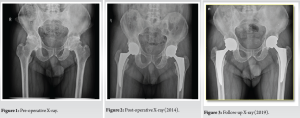
A 56-year-old man who is a known case of ankylosing spondylitis underwent bilateral THA (Fig. 1) for secondary osteoarthritis of both hips in the same sitting in our Hospital, Chennai, Tamil Nadu, India, in 2014. The patient had other comorbidities such as hypertension, hypothyroidism, cholelithiasis, and gastroesophageal reflux disease. Since the patient was young and active, uncemented THA with CoC bearing surface was used. The implant used where a pinnacle titanium shell size 54 with 36 × 54 mm ceramic liner, 36 + 8.5 biolox delta ceramic head (Johnson and Johnson DePuy). On the femoral side, size 4-high off-set titanium trilock femoral stem, which is proximally coated. The inclination of the acetabular cup was 40°, anteversion of the acetabular cup was 22° and stem anteversion was 10° (Fig. 2). The patient was immediately mobilized post-surgery. The patient was on regular follow-up for the initial 4 years up to 2019, his X-ray taken during the 2019 follow-up showed no signs of stem subsidence or lysis and loosening implants (Fig. 3).
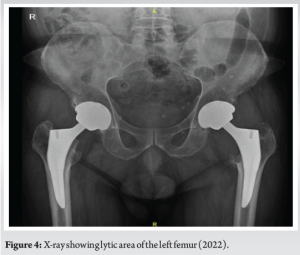
He presented to us in November 2022 with pain in the left hip of 2 months duration without any history of fall. His pain was dull, aching in character, radiating from the left groin to the left thigh. The pain aggravated with weight bearing. His pelvis with both hip X-rays revealed a large amount of periacetabular osteolysis with osteolysis seen around the greater and lesser trochanteric area with complete resorption of calcar (Fig. 4). He had normal erythrocyte sedimentation rate, C-reactive protein, procalcitonin, and metal ion levels (cobalt, chromium). His computed tomography (CT) scan report showed osteolysis around the roof and posterior wall of the acetabulum with peri-implant osteolysis. There was partial resorption of the greater and lesser trochanters and intertrochanteric region with associated large peri-implant soft tissue mass of size 13 × 6 cm (Fig. 5). His positron emission tomography-CT shows low metabolic activity around the peri-implant soft-tissue mass, suggestive of a benign tumor with no metastasis. The case was discussed in the hospital tumor board meeting and planned for ultrasound (USG)-guided fine needle aspiration cytology (FNAC) from soft-tissue mass. FNAC report was suggestive of a blood clot with blood-derived leukocytes, and no atypical cells were seen. Since FNAC was inconclusive patient was planned for a staged procedure, i.e., stage 1- excision of soft tissue mass along with explantation of the prosthesis, and stage 2- revision THA. The patient deferred surgery for 2 weeks, and he reported back to us with increased intensity of pain; hence, the patient was planned for staged surgery.
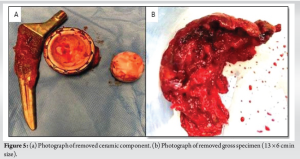
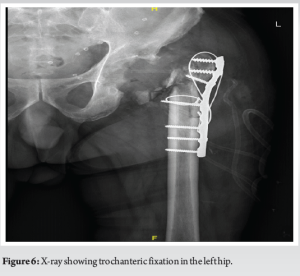
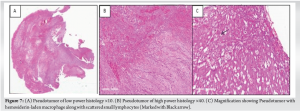
Stage 1 surgery was done via a posterior approach through the previous scar. Intraoperatively, after opening the fascia lata, we noticed a large soft tissue mass around the trochanter and acetabular region which was dark reddish brown in color. There was severe osteolysis around the acetabulum and trochanteric region. After the excision of the soft tissue mass, the material was sent for histopathology and culture (Fig. 5b). The acetabular component was completely loose, so it was removed along with the ceramic liner (Fig. 5a). There was no damage seen on the ceramic femoral head and acetabular liner. The trunnion of the femoral stem was normal. Since the femoral stem was well integrated, extended trochanteric osteotomy was done to remove the femoral stem. Extended trochanteric osteotomy was closed with encircling wiring and plating (Fig. 6). His histopathology reports showed fibrin, proliferating fibroblasts, hemosiderin-laden macrophages, lymphocytes, and chronic granulation tissue findings suggestive of pseudotumor formation. There was no evidence of malignancy (Fig. 7).
His culture report shows no growth of any organism. Postoperatively, the patient developed a serous collection around the hip for which he underwent USG aspiration. Since there was no evidence of malignancy and infection, the patient was advised for the reconstruction of the acetabulum and revision of the total hip replacement; however, the patient was not willing for surgery. Hence, the patient was started on rehabilitation using heal and sole raise and crutch support. The subsequent follow-up could not be conducted as the patient was lost to follow-up. The removed implant was not sent for any further study due to a lack of facilities.
The presence of ALTR and Pseudotumor formation is well documented with MoM articulations and is less common in mixed-bearing surfaces such as MoP and CoP [7,8]. The exact cause of pseudotumor formation is not well understood, and their histological appearances vary widely. It is probably due to the delayed type hypersensitive reaction triggered because of the release of metal ions particles secondary to wear, corrosion between non-articulating components or a combination of both [3,8,9]. These metal ion, in turn, causes mitochondrial damage and lead to hypoxic-like conditions in the cells, triggering the synthesis and secretion of cytokines, leading to inflammation in the periprosthetic tissue [10,11]. These pseudotumor causes pain and swelling around the hip and lead to osteolysis and bone resorption around THR prosthesis if left untreated, leading to failure of THA. CoC articulations were considered safe and inert however, fracture of the ceramic femoral head or liner, especially with first-generation ceramic, squeaking, and third-body wear, remains always a concern. With the availability of fourth-generation ceramics, the fracture rate has decreased to 0.0010% [12]; however, squeaking remains a persistent issue. Pseudotumor formations in CoC THA are due to ceramic fracture or wear, producing ceramic debris leading to a pro-inflammatory response predominantly dominated by macrophages [13]. Since the production of ceramic debris is significantly very less compared to other articulations, the inflammatory response is also less, and ALTR manifestation is also less. Campbell et al. first described the case report on the occurrence of pseudotumor in CoC THA without any damage to the ceramic components (both femoral head and liner) in their case report and were not able to conclude the cause of pseudotumor formation [14]. Tsunehito et al. reported a case of ALTR due to metal ion release secondary to femoral neck impingement. In his case report, he found excessive acetabulum and femoral anteversion causing the femoral neck impingement on the cup, leading to metal ion release and inflammatory reaction, causing pseudotumor formation even in CoC THA [15]. Dan Xing reported a unique case of MoP bearings in a revision THA for ceramic head breakage, leading to severe wear and increased release of metal ions, causing multiple pseudotumor. He concluded that if breakage happens in CoC THA, it should be revised to CoC or CoP bearing surface with complete synovectomy and debridement and should not be revised to MoP [16] as the small amount of remaining ceramic debris with the highest hardness can have an adverse effect after revision THA with metal components. Marcomini et al. published a case report on pseudotumor formation in CoC THA, where they could not find any particular reason for pseudotumor formation. Also there was a concomitant fungal infection with candida parapsilosis for which the patient was treated with antifungal treatment and revision THR. They were unable to find any association between these complications [17]. Daniel Piper et al. published a case of pseudotumor formation in CoC THA without evidence of infection or metallosis. They also noticed minimal damage to the ceramic head and acetabular liner and were not able to conclude the reason for pseudotumor formation [18]. In our case, the components were not malpositioned (combined anteversion 32° and inclination of cup 40°), no impingements between components were seen intraoperatively, and there was no visible damage to the ceramic femoral head, and liner was seen. There was no visible wear seen in the trunnion of the femoral stem. Hence, the reason for pseudotumor formation was not known; however, on the other hand, the detailed microscopic analysis and wear analysis of the implant post-explantation could have thrown some more light to find the reason for the microscopic wear pattern. We assume the pseudotumor formation was in response to the wear debris from CoC articulation. There are MHRA guidelines for management of MoM hips [19]. We need further research on CoC wear patterns and debris formation to have similar guidelines, which will be helpful for all the surgeons.
We present a case of symptomatic pseudotumor formation in a patient of CoC hip-bearing surface in the absence of any metal debris and normal chromium and cobalt levels. Even though CoC THA is considered the best in terms of its longevity and wear resistance, we still need to know the exact tribology and individual immune response for ceramic wear debris to have proper guidelines for the management of CoC THA. This report further strengthens the existing case reports that ceramic debris is not entirely inert.
CoC THA also needs close follow-up for pseudotumor formation, as the ceramic debris is not entirely inert.
References
- 1.Harris WH, Schiller AL, Scholler JM, Freiberg RA, Scott R. Extensive localized bone resorption in the femur following total hip replacement. J Bone Joint Surg Am 1976;58:612-8. [Google Scholar | PubMed]
- 2.Jacobs JJ, Urban RM, Hallab NJ, Skipor AK, Fischer A, Wimmer MA. Metal-on-metal bearing surfaces. J Am Acad Orthop Surg 2009;17:69-76. [Google Scholar | PubMed]
- 3.Cooper HJ, Urban RM, Wixson RL, Meneghini RM, Jacobs JJ. Adverse local tissue reaction arising from corrosion at the femoral neck-body junction in a dual-taper stem with a cobalt-chromium modular neck. J Bone Joint Surg Am 2013;95:865-72. [Google Scholar | PubMed]
- 4.Hauptfleisch J, Pandit H, Grammatopoulos G, Gill HS, Murray DW, Ostlere S. A MRI classification of periprosthetic soft tissue masses (pseudotumours) associated with metal-on-metal resurfacing hip arthroplasty. Skeletal Radiol 2012;41:149-55. [Google Scholar | PubMed]
- 5.Sentuerk U, von Roth P, Perka C. Ceramic on ceramic arthroplasty of the hip. Bone Joint J 2016;98-B(Supple A):14-7. [Google Scholar | PubMed]
- 6.Logroscino G, Saracco M, Maccauro G, Urbani A, Ciavardelli D, Consalvo A, et al. Ceramic-on-metal coupling in THA: Long term clinical and radiographic outcomes using two different short stems. BMC Musculoskelet Disord 2021;22(Suppl 2):1065. [Google Scholar | PubMed]
- 7.Pandit H, Glyn-Jones S, McLardy-Smith P, Gundle R, Whitwell D, Gibbons CL, et al. Pseudotumours associated with metal-on-metal hip resurfacings. J Bone Joint Surg Br 2008;90:847-51. [Google Scholar | PubMed]
- 8.McGrory BJ, MacKenzie J, Babikian G. A high prevalence of corrosion at the head-neck taper with contemporary Zimmer non-cemented femoral hip components. J Arthroplasty 2015;30:1265-8. [Google Scholar | PubMed]
- 9.Kwon YM, Ostlere SJ, McLardy-Smith P, Athanasou NA, Gill HS, Murray DW. “Asymptomatic” pseudotumors after metal-on-metal hip resurfacing arthroplasty: Prevalence and metal ion study. J Arthroplasty 2011;26:511-8. [Google Scholar | PubMed]
- 10.Movassaghi K, Patel A, Miller I, Levine BR. An atypical adverse local tissue reaction after ceramic-on-ceramic primary total hip arthroplasty. Arthroplast Today 2022;14:71-5. [Google Scholar | PubMed]
- 11.Nyga A, Hart A, Tetley TD. Importance of the HIF pathway in cobalt nanoparticle-induced cytotoxicity and inflammation in human macrophages. Nanotoxicology 2015;9:905-17. [Google Scholar | PubMed]
- 12.Lee GC, Kim RH. Incidence of modern alumina ceramic and alumina matrix composite femoral head failures in nearly 6 million hip implants. J Arthroplasty 2017;32:546-51. [Google Scholar | PubMed]
- 13.Mochida Y, Boehler M, Salzer M, Bauer TW. Debris from failed ceramic-on-ceramic and ceramic-on-polyethylene hip prostheses. Clin Orthop Relat Res 2001;389:113-25. [Google Scholar | PubMed]
- 14.14. Campbell J, Rajaee S, Brien E, Paiement GD. Inflammatory pseudotumor after ceramic-on-ceramic total hip arthroplasty. Arthroplast Today 2017;3:83-7. [Google Scholar | PubMed]
- 15.Ishida T, Tateiwa T, Takahashi Y, Masaoka T, Shishido T, Yamamoto K. Do polyethylene wear particles affect the development of pseudotumor in total hip arthroplasty? A minimum 15-year follow-up. J Orthop Surg Res 2023;18:147. [Google Scholar | PubMed]
- 16.Xing D, Yang C, Li R, Hou Y, Kou B, Li H, et al. Severe Wear and multiple Pseudotumor formation due to revision for ceramic head breakage after ceramic-on-ceramic Total hip arthroplasty: A case report. BMC Musculoskelet Disord 2019;20:332. [Google Scholar | PubMed]
- 17.Marcomini MP, Iqbal J, Bennett D. Rare pseudotumor in ceramic-on-ceramic total hip replacement with concomitant fungal periprosthetic joint infection: A case report. Am J Case Rep 2023;24:e941164. [Google Scholar | PubMed]
- 18.Piper D, Saloway JA, Jeys L, Hussain S. Pseudotumor in ceramic-on-ceramic total hip arthroplasty: A case report. Cureus 2024;16:e71518. [Google Scholar | PubMed]
- 19.Available from: https://www.gov.uk/drug-device-alerts/all-metal-on-metal-mom-hip-replacements-updated-advice-for-follow-up-of-patients, 29 June 2017. [Google Scholar | PubMed]






Related Articles in Journal of Orthopaedic Case Reports
 August 1, 2025 Progressive Loosening in Metal-on-Metal Total Hip Arthroplasty after Fifteen Years of Effective Function: Two Case Reports
 January 1, 2025 Metallosis, Trunnionosis, and Head-stem Dissociation of the Exeter v40 Stem in a Metal-on-Metal Hip: A Unique Case
 September 1, 2024 Metallosis Following Non-Metal-on-Metal Hip Arthroplasty: A Case Report and Review
 February 10, 2024 Pseudotumor – Cysticercosis of the Flexor Digitorum Profundus Mimicking Volkmanns Contracture