

Congenital absence of bilateral patella is a rare entity and incidental finding in an active serving asymptomatic military personal.
Dr. Mohammed Alshahrani, Department of Orthopedic Surgery, Armed Forces Hospital, Southern Region, Khamis Mushait, Saudi Arabia. E-mail: alshahrani9533@gmail.com
Introduction: Congenital absence of the patella refers to a condition where an individual is born without the patella. It may be bilateral or unilateral. It is an extremely rare condition and when present, mostly occurs as part of syndromes, such as the Nail-patella syndrome, small patella syndrome, trisomy 8 mosaicism, and Meier–Gorlin syndrome.
Case Report: We are presenting 35-years-old free medically, active soldier referred to the orthopedic clinic from family medicine after noticing abnormal incidental findings on X-rays. On inquiring him, he doesn’t recall any problem during his childhood and performing his military duties. On clinical examination of the patient, he had characteristic features of patellar absence with prominent femoral condyles and a hollow sulcus.
Conclusion: Isolated congenital bilateral patellar absence I asymptomatic serving military soldier has not been described in the English literature before and is exceedingly rare.
Keywords: Congenital absence of patella, bilateral, knee pain, conservative treatment, case report.

Congenital absence of the patella refers to a condition where an individual is born without the patella [1]. It may be bilateral or unilateral [2,3]. It is an extremely rare condition and when present mostly occurs as part of syndromes, such as the Nail-patella syndrome [4,5], small patella syndrome, trisomy 8 mosaicism, and Meier–Gorlin syndrome [6,7]. Limited data are available on congenital absence of the patella [8-10], Individual case reports highlight the rarity of the condition [11-13]. No data on incidence and prevalence is available due to the small number of cases except where the patella was absent as part of a syndrome [14-16].
We are presenting 35-years-old free medically, active soldier referred to the orthopedic clinic from family medicine after noticing abnormal incidental findings on X-rays (Fig. 1-4).
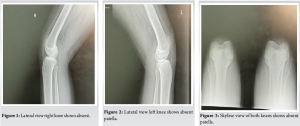
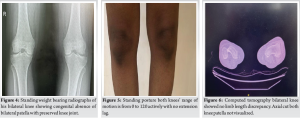
On inquiring him, he doesn’t recall any problem during his childhood and performing his military duties. On clinical examination of the patient, he had characteristic features of patellar absence with prominent femoral condyles and hollow sulcus as per computed tomography (CT) both knees (Fig. 5,6).
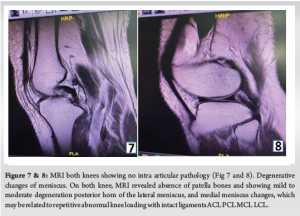
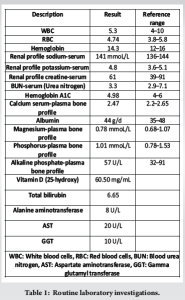
He has good quadriceps and hamstring power 5/5. No other abnormalities were detected in his upper and lower limbs. Potential biomechanical adaptations that help to maintain normal gait and joint kinematics in this patient with congenital absence of the patella, specifically mechanisms that prevent knee hyperextension. This may include strengthening or altered recruitment of surrounding musculature (e.g., hamstrings, hip flexors, gastrocnemius), and modified joint alignment or ligament tensioning within normal compare to other studies. Both static postures and dynamic loading scenarios, for example, walking and stair climbing, have been stable movements, which are normally enhance quadriceps efficiency by increasing the moment arm and increased hamstring stress due to compensatory function in absence of the patella (Fig. 5). His blood parameters of liver function test, renal function test, and bone profile and labs are all normal (Table 1). Patient’s hip joints demonstrated a normal range of movement and his ankle joints were also normal. The rest of her musculoskeletal exam was also normal. His cardiovascular, neurological, and abdominal examinations were all normal (Fig. 5). CT chest, abdomen, and pelvis showed no osseous or visceral abnormal. (Fig. 7 & 8).
Congenital absence of bilateral patella occurring in isolation is rare and is usually associated with syndromes. It is even rarer to occur in an asymptomatic active soldier. The most common syndrome associated is Nail Patella syndrome. Other rare syndrome includes Meier–Gorlin syndrome, RAPADILINO syndrome, and Genitopatellar syndrome.
Isolated congenital bilateral patellar absence I asymptomatic serving military soldier has not been described in the English literature before and is exceedingly rare.
Congenital absence of bilateral patella occurring in isolation is rare and is usually associated with syndromes. It is even rarer to occur in an asymptomatic active soldier.
References
- 1. Frantz CH, O’Rahilly R. Congenital skeletal limb deficiencies. J Bone Joint Surg Am 1961;43:1202. [Google Scholar] [PubMed]
- 2. Komistek RD, Allain J, Anderson DT, Dennis DA, Goutallier D. In vivo kinematics for subjects with and without an anterior cruciate ligament. Clin Orthop Relat Res 2002;404:315-25. [Google Scholar] [PubMed]
- 3. Jerome JT, Varghese M, Sankaran B, Thomas S. Bilateral congenital absence of patella. Indian J Orthop 2008;42:228-30. [Google Scholar] [PubMed]
- 4. Bennett WM, Musgrave JE, Campbell RA, Elliot D, Cox R, Brooks RE, et al. The nephropathy of the nail-patella syndrome. Clinicopathologic analysis of 11 kindred. Am J Med 1973;54:304-19. [Google Scholar] [PubMed]
- 5. Beaty JH, Crenshaw AH. Congenital anomalies of lower extremity. In: Campbell’s Operative Orthopedics. Vol. 4. Missouri: Mosby; 1987. p. 2668-9. [Google Scholar] [PubMed]
- 6. Kääriänen H, Ryoppy S, Norio R. RAPADILINO syndrome with radial and patellar plasia/hypoplasia as main manifestations. Am J Med Genet 1989;33:346-51. [Google Scholar] [PubMed]
- 7. Azouz EM, Kozlowski K. Small patella syndrome: A bone dysplasia to recognize and differentiate from the nail-patella syndrome. Pediatr Radiol 1997;27:432-5. [Google Scholar] [PubMed]
- 8. Beals RK. Hypochondroplasia. A report of five kindreds. J Bone Joint Surg Am 1969;51:728-36. [Google Scholar] [PubMed]
- 9. Letts M. Hereditary onycho-osteodysplasia (nail-patella syndrome). A three-generation familial study. Orthop Rev 1991;20:267-72. [Google Scholar] [PubMed]
- 10. Bongers EM, Huysmans FT, Levtchenko E, de Rooy JW, Blickman JG, Admiraal RJ, et al. Genotype-phenotype studies in nail-patella syndrome show that LMX1B mutation location is involved in the risk of developing nephropathy. Eur J Hum Genet 2005;13:935-46. [Google Scholar] [PubMed]
- 11. Lifchez CA, Rhead WJ, Leuthner SR, Lubinsky MS. Genitopatellar syndrome: Expanding the phenotype. Am J Med Genet A 2003;122A:80-3. [Google Scholar] [PubMed]
- 12. Sweeney E, Hoover-Fong JE, McIntosh I. Nail-patella syndrome. In: Pagon RA, Bird TD, Dolan CR, Stephens K, Adam MP, editors. Gene Reviews™. Seattle, WA: University of Washington, Seattle; 1993-2003. [Google Scholar] [PubMed]
- 13. Scott JE, Taor WS. The “small patella” syndrome. J Bone Joint Surg Br 1979;61-B:172-5. [Google Scholar] [PubMed]
- 14. Guidera KJ, Satterwhite Y, Ogden JA, Pugh L, Ganey T. Nail patella syndrome: A review of 44 orthopaedic patients. J Pediatr Orthop 1991;11:737-42. [Google Scholar] [PubMed]
- 15. Trinn C, Szöke B, Magyarlaki T, Turi S, Ormos J, Nagy J. Nail-patella syndrome: Clinico-pathological characteristics. Orv Hetil 1996;137:2253-56. [Google Scholar] [PubMed]
- 16. Farley FA, Lichter PR, Downs CA, McIntosh I, Vollrath D, Richards JE. An orthopaedic scoring system for nail-patella syndrome and application to a kindred with variable expressivity and glaucoma. J Pediatr Orthop 1999;19:624-31. [Google Scholar] [PubMed]



Related Articles in Journal of Orthopaedic Case Reports
 June 1, 2025 A Rare Case of Bilateral Congenital Radial Head Dislocation: A Case Report
 March 1, 2026 Salvage of a Broken Magnetic Tibia Nail with Plate Fixation Without Nail Removal: A Case Report
 March 1, 2026 Clavicle Fracture Non-Union in a 3-Year-Old Child: A Case Report and Literature Review
 March 1, 2026 Single Peg Patellar Component Fracture in Total Knee Replacement: A Case Report