

In complex hip trauma with neglected posterior dislocation and acetabular fracture, especially in patients with altered biomechanics such as prior patellectomy, total hip arthroplasty with acetabular cage reconstruction provides a reliable solution for joint stability and functional restoration. Meticulous pre-operative planning and individualized surgical strategy are essential for optimal outcomes.
Dr. S Krishna Kumar, Department of Orthopaedics, Teerthanker Mahaveer Medical College and Research Centre, Moradabad, Uttar Pradesh, India. E-mail: drkkasik08091995@gmail.com
Abstract
Introduction: Neglected complex posterior hip dislocations with associated acetabular fractures are rare but challenging injuries. When compounded by biomechanical alterations such as a prior patellectomy, surgical planning becomes more complicated. Total hip arthroplasty (THA) with acetabular cage reconstruction is a viable salvage option to restore hip stability and function in such scenarios.
Case Report: We report a case of a 42-year-old male with a chronic posterior dislocation of the right hip and a comminuted posterior wall and column acetabular fracture, presenting 2 months post-injury. The patient had previously undergone a right-sided patellectomy. Surgical intervention included THA with acetabular cage reconstruction due to segmental bone loss. At 6-month follow-up, the patient achieved pain-free ambulation, a stable prosthesis, and satisfactory functional outcomes.
Conclusion: This case highlights the successful use of acetabular cage-assisted THA in a patient with both complex hip trauma and altered knee biomechanics. Early intervention, comprehensive surgical planning, and the use of modern implants are key in managing such rare and challenging presentations.
Keywords: Posterior hip dislocation, acetabular fracture, total hip arthroplasty, acetabular cage, patellectomy, biomechanics.

Posterior dislocations of the hip are orthopedic emergencies often resulting from high-energy trauma. When associated with acetabular fractures and neglected for a prolonged period, they become surgically demanding due to soft-tissue contractures, cartilage damage, and joint incongruity [1,2]. Total hip arthroplasty (THA) is a well-established solution in chronic or irreducible dislocations, especially when osteonecrosis or secondary arthritis has developed [3]. However, the challenge intensifies in patients with prior surgeries that alter biomechanics, such as patellectomy. The patella plays a crucial role in knee extensor efficiency, and its absence may affect gait, limb alignment, and rehabilitation potential after THA [4]. In cases with acetabular bone loss, reconstruction cages provide structural support, restoring load-bearing capacity and joint congruency [5-7]. We present a rare case of neglected posterior dislocation with acetabular fracture in a patient with prior patellectomy, managed with THA and acetabular cage application.
A 42-year-old male presented to our trauma unit 2 months following a fall from height, complaining of persistent right hip pain, inability to bear weight, and limb shortening. The patient initially received conservative treatment at a peripheral center without imaging.
Past medical history
Ten years prior, the patient underwent right-sided patellectomy following a comminuted open patellar fracture. No other comorbidities were present.
Examination
Physical examination revealed a shortening of 4 cm, an internally rotated right lower limb, and reduced hip range of motion. Quadriceps strength was diminished due to previous patellectomy, though the knee joint remained stable.
Radiology
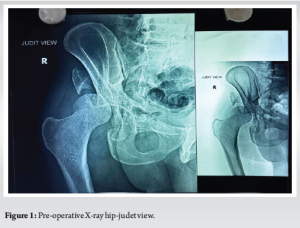
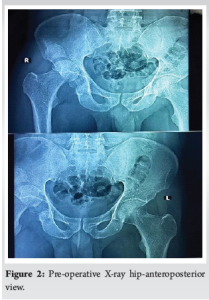
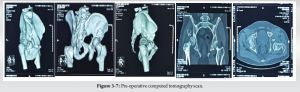
X-rays and computed tomography (CT) scan confirmed a neglected posterior dislocation of the right hip with a comminuted fracture of the acetabulum involving the posterior wall and column (Fig. 1-7). The femoral head showed early degenerative changes.
Surgical management
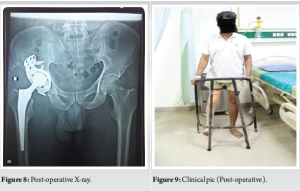
A posterior approach was used. Intraoperative findings included severe acetabular comminution and segmental bone loss. A reinforcement cage with a cemented acetabular cup was implanted. An uncemented femoral stem was inserted with attention to restoring limb length and offset. Stability was confirmed intraoperatively. Post-operative X-ray was done (Fig. 8).
Post-operative care
The patient followed a structured rehabilitation protocol with gradual weight-bearing. At 6 months, he was ambulatory without support, pain-free, and had satisfactory hip range of motion.
Neglected posterior dislocations with acetabular fractures are rare due to the disabling nature of the injury, but can occur in under-resourced settings or when initial treatment is inadequate [2,8]. In chronic cases, the femoral head may develop osteonecrosis or cartilage damage, making arthroplasty a preferred solution [3]. The use of acetabular cages is well supported in revision settings and complex primary THA, particularly when there is segmental or cavitary bone loss [5,6,9]. These constructs allow restoration of the center of rotation, limb length, and long-term implant stability. The presence of prior patellectomy introduces unique biomechanical considerations. The loss of the patella diminishes the quadriceps lever arm, increasing rehabilitation challenges and potentially influencing lower limb alignment [4,10]. Despite these concerns, this patient achieved excellent outcomes, demonstrating the feasibility of THA even in the presence of altered biomechanics. This report describes a single patient and, as such, findings cannot be generalized. Anatomical and biomechanical variations may yield different outcomes in similar clinical scenarios. The 6-month follow-up period provides only preliminary insight into long-term durability, implant survival, and patient function. Longer-term evaluation is needed. No objective gait or biomechanical analysis was conducted to assess compensatory mechanisms post-patellectomy, which may influence hip loading patterns. Comparative analysis with other treatment options – like conservative therapy, delayed fixation, or custom 3D-printed implants – was not performed. This limits the assessment of relative efficacy. The imaging presented did not include advanced modalities such as CT-based 3D reconstruction for pre-operative planning or post-operative implant integration analysis. Standardized functional scoring tools, such as the Harris Hip Score or Western Ontario and McMaster Universities Osteoarthritis Index, were not utilized to objectively measure clinical outcomes. While previous patellectomy was acknowledged, its specific long-term effects on hip joint biomechanics and compensatory gait adaptations were not comprehensively explored. (Fig. 9).
This case illustrates that THA with cage reconstruction is a reliable option for managing neglected posterior hip dislocation with acetabular fracture, even in the presence of biomechanical compromise due to prior patellectomy. Early diagnosis, individualized planning, and careful surgical execution are critical to achieving favorable outcomes in such complex cases.
Acetabular cage-assisted THA offers a viable solution in complex hip trauma with previous biomechanical alterations, such as patellectomy, provided comprehensive planning and follow-up are implemented.
References
- 1.Epstein HC. Posterior fracture-dislocations of the hip; Long-term follow-up. J Bone Joint Surg Am 1974;56:1103-27. [Google Scholar | PubMed]
- 2.Meena S, Sharma P, Gangary SK, Singh G. Delayed presentation of traumatic hip dislocation: A systematic review. J Clin Orthop Trauma 2015;6:281-6. [Google Scholar | PubMed]
- 3.Mears DC, Velyvis JH. Primary total hip arthroplasty after acetabular fracture. Instr Course Lect 2001;50:335-54. [Google Scholar | PubMed]
- 4.Yang IH, Lee JS. Long-term results of total knee arthroplasty after patellectomy. Knee Surg Relat Res 2014;26:97-102. [Google Scholar | PubMed]
- 5.Sporer SM, Paprosky WG. Acetabular reconstruction with cages in revision total hip arthroplasty. Clin Orthop Relat Res 2004;429:202-7. [Google Scholar | PubMed]
- 6.Berry DJ, Müller ME. Revision arthroplasty using the Müller acetabular reinforcement ring. Orthop Clin North Am 1998;29:221-9. [Google Scholar | PubMed]
- 7.Raut VV, Siney PD, Wroblewski BM. The Burch-Schneider cage for acetabular defects in revision hip arthroplasty: A 10-15-year follow-up study. J Bone Joint Surg Br 1999;81:351-5. [Google Scholar | PubMed]
- 8.Sahin V, Karakaş ES, Aksu S, Atlihan D, Turk CY, Halici M. Traumatic dislocation and fracture-dislocation of the hip: A long-term follow-up study. J Trauma 2003;54:520-9. [Google Scholar | PubMed]
- 9.Garbuz DS, Morsi E, Gross AE. Acetabular revision using allograft bone and cages. Orthop Clin North Am 1998;29:327-36. [Google Scholar | PubMed]
- 10.Merchant TC, Arendt EA. Functional outcomes of patellectomy: A critical review. Clin Orthop Relat Res 2001;389:15-24. [Google Scholar | PubMed]



Related Articles in Journal of Orthopaedic Case Reports
 October 1, 2026 Posterior Acetabular Reconstruction Can Sometimes Lead To Retroverted Cup Placement In Complex Total Hip Arthroplasty
 February 1, 2026 Arthroscopic-Assisted Removal of Incarcerated Fragment following Manual Reduction of Posterior Hip Dislocation in Acute Polytrauma Patient: A Case Report
 December 1, 2025 Total Hip Arthroplasty for Neglected Hip Dislocation – Surgical Technique and Results
 October 1, 2026 Late Diagnosis of Femoral Shaft Perforation During Total Hip Arthroplasty: Case Report