

Suzuki frame fixation provides a minimally invasive, joint-sparing solution for complex intra-articular phalangeal fractures, enabling early mobilization with satisfactory short- and long-term functional outcomes when combined with structured rehabilitation and standardized evaluation.
Dr. Bibin Thankanadar Amaravathy, Department of Orthopaedics, Sree Balaji Medical College and Hospital, CLC Works Road, Shankar Nagar, Chromepet, Chennai – 600044, Tamil Nadu, India. E-mail: bibinta1629@gmail.com
Abstract
Introduction: Injuries involving the base of the middle phalanx with intra-articular extension and dorsal subluxation are challenging to manage, particularly when joint congruity and motion preservation are critical. This case report demonstrates the use of the Suzuki frame for dynamic external fixation in such a scenario and discusses broader clinical considerations.
Case Report: A 37-year-old male sustained an intra-articular middle phalanx base fracture with dorsal subluxation of the left index finger during a cricket injury. Examination showed swelling, tenderness, and a flexion deformity. Radiographs confirmed a comminuted volar lip fracture. Under fluoroscopic guidance, a Suzuki frame was applied using three K-wires and rubber band traction. Advanced imaging was not deemed necessary for acute management. Early active motion was initiated post-operatively, followed by a structured hand therapy protocol. At 6 months, radiological union, >90% range of motion, minimal pain, and return to function were achieved.
Conclusion: The Suzuki frame offers a motion-preserving and cost-effective technique for complex phalangeal injuries. Standardized functional outcome measures, complication tracking, and long-term follow-up are essential to support its broader adoption.
Keywords: Suzuki frame, phalanx fracture, dynamic external fixation, dorsal subluxation, hand trauma, functional outcome, rehabilitation protocol.

Fractures involving the base of the middle phalanx with proximal interphalangeal (PIP) joint subluxation represent complex intra-articular injuries that, if improperly managed, can lead to stiffness, joint incongruity, and functional impairment. These injuries typically involve the volar lip of the middle phalanx, resulting in dorsal subluxation due to extensor pull and loss of volar buttress [1]. Conventional treatments, including K-wire fixation, volar plate open reduction and internal fixation (ORIF), and static external fixators, are associated with varying degrees of post-operative stiffness and prolonged immobilization [2]. The Suzuki frame, described in 1994, uses dynamic distraction through skeletal fixation to maintain alignment while allowing early joint motion [3]. Although promising, there is a lack of high-quality comparative data against established methods. This report presents a case treated with the Suzuki frame and highlights technical considerations, rehabilitation, and the need for standardized evaluation.
A 37-year-old right-handed male presented with pain, swelling, and deformity of the left index finger after a cricket injury. Physical examination showed diffuse swelling, flexion deformity at the PIP joint, and tenderness (Fig. 1). No neurovascular deficits were identified.
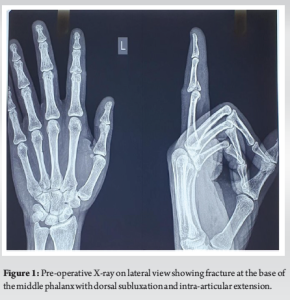
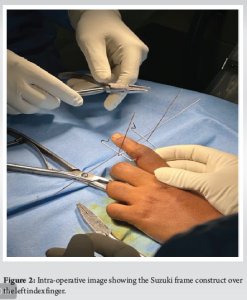
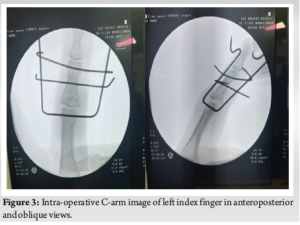
Radiographs revealed a comminuted fracture at the base of the middle phalanx with dorsal subluxation. The injury was treated with a Suzuki frame comprising the following:
- 1.2 mm axial traction pin through the proximal phalanx head
- 1 mm hook pin through the distal middle phalanx
- 1.2 mm reduction pin dorsal to the fracture site.
Sterile intravenous tubing was used to provide adjustable dynamic tension. Intraoperative fluoroscopy confirmed alignment. A post-operative structured hand therapy protocol was initiated under physiotherapy guidance, including passive and active range-of-motion exercises starting within the 1st week (Fig. 2-4).
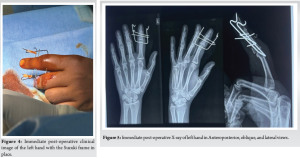
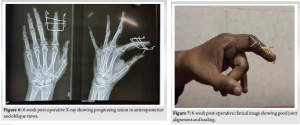
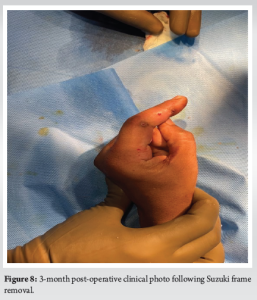
Follow-up at 6 weeks showed radiographic healing and maintained joint congruity (Fig. 5). By 3 months, the patient had regained >90% of active PIP motion. At 6 months, radiographs confirmed complete union. The patient reported minimal pain on the Visual Analog Scale (VAS) (VAS = 1/10), high satisfaction, and resumed work by the 8th week. Functional recovery was assessed using the total active motion score, with near-normal values [4] (Fig. 6-8).
The Suzuki frame permits dynamic stabilization with early mobilization, reducing the risk of joint contracture seen in static fixation. By preserving joint motion, it supports cartilage healing and facilitates better long-term outcomes [5]. Compared to ORIF, K-wire fixation, or mini external fixators, it is minimally invasive and requires fewer surgical instruments [6]. Technical considerations, such as accurate pin placement, tension calibration, and consistent follow-up are critical for successful outcomes [7]. Rehabilitation plays a pivotal role and must be tailored to ensure joint mobility and prevent stiffness [8]. While the technique has shown success in this case, it should be noted that a single case lacks statistical power. The absence of a control group, limited follow-up, and reliance on radiography without advanced imaging are notable limitations. Potential complications, including pin site infection, extensor tendon irritation, and wire migration, must be anticipated and managed with proper technique and patient education [9]. Comparative cost-analysis data were not collected, although the frame’s simplicity suggests resource efficiency. Future investigations should include validated outcome scores, longer follow-up, and cost-benefit analyses [10].
The Suzuki frame provides a viable option for intra-articular phalanx fractures with dorsal subluxation, combining simplicity, cost-efficiency, and functional preservation. However, larger comparative studies using validated outcome tools and longer follow-up are needed to establish its efficacy over standard techniques.
The Suzuki frame enables dynamic and stable fixation for complex finger fractures, ensuring early joint mobilization and good recovery. Successful outcomes depend on meticulous technique, structured rehabilitation, and patient compliance, and should be measured using objective scoring systems.
References
- 1. Hastings H 2nd, Carroll C 4th. Treatment of intra-articular fractures of the phalanges. Hand Clin 1988;4:537-52. [Google Scholar] [PubMed]
- 2. Stern PJ, Wieser MJ, Reilly DG. Complications of plate fixation in the hand skeleton. Clin Orthop Relat Res 1987;214:59-65. [Google Scholar] [PubMed]
- 3. Suzuki Y, Matsunaga T, Kamisuru T, et al. Dynamic external finger fixator for fracture dislocations of the proximal interphalangeal joint. J Hand Surg Am 1994;19:604-7. [Google Scholar] [PubMed]
- 4. Freiberg A, Sugi M. Dynamic external fixation for unstable fracture-dislocations of the PIP joint. J Hand Surg Am 1996;21:1066-73. [Google Scholar] [PubMed]
- 5. Stern PJ, Wiesler ER. Complications of fixation of fractures and dislocations in the hand. Clin Orthop Relat Res 1987;214:59-67. [Google Scholar] [PubMed]
- 6. Freiberg A. External fixation for proximal interphalangeal joint injuries. Hand Clin 1994;10:187-200. [Google Scholar] [PubMed]
- 7. Pun WK, Chow SP. Treatment of intra-articular fractures of the phalanges. J Hand Surg Br 1986;11:43-7. [Google Scholar] [PubMed]
- 8. Strauch B, De Moura W. External fixation of proximal interphalangeal joint fracture dislocations. Hand Clin 2006;22:389-403. [Google Scholar] [PubMed]
- 9. Jupiter JB, Belsky MR. Fractures and dislocations of the hand. In: Browner BD, Jupiter JB, Levine AM, Trafton PG, editors. Skeletal Trauma. 2nd ed. Philadelphia, PA: WB Saunders; 1998. p. 995-1087. [Google Scholar] [PubMed]
- 10. Ruland RT, Hogan CJ, Cannon DL, Slade JF. Use of dynamic distraction external fixation for unstable fracture-dislocations of the proximal interphalangeal joint. J Hand Surg Am 2008;33:19-25. [Google Scholar] [PubMed]


Related Articles in Journal of Orthopaedic Case Reports
 September 1, 2026 Comparative Study of Post-operative Pain and Functional Outcomes in Robotic-assisted Total Knee Replacement versus Cruciate-retaining Manual Total Knee Replacement
 September 1, 2026 Clinical Presentation, Orthopedic Outcomes, and Microbiological Spectrum in Pediatric Septic Arthritis: A Prospective Study
 September 1, 2026 Pre-operative Computed Tomography-based Sarcopenia Assessment as a Predictor of Mortality and Functional Outcome following Geriatric Hip Fracture Surgery
 September 1, 2026 Serial Magnetic Resonance Imaging Graft Signal Intensity and its Correlation with Functional Recovery Following Primary Anterior Cruciate Ligament Reconstruction