

A multimodal, ultrasound-guided rehabilitation approach can safely accelerate recovery and return-to-sport after mandibular fracture surgery, reducing typical timelines by nearly half.
DPT(c). Alexandru Mazareanu, University of Medical Sciences, Arizona, United States. E-mail: a_mazareanu@yahoo.com
Abstract
Introduction: Mandibular fractures in high-performance athletes challenge both structural stability and the rapid restoration of sport-specific function. Standard rehabilitation following open reduction and internal fixation (ORIF) often overlooks neuromuscular re-education, cervical-mandibular coordination, and the demands of elite athletic return.
Case Report: A 23-year-old elite judoka from the Romanian National Team sustained a right mandibular angle fracture during training. ORIF was performed using titanium miniplates. At week 3 post-surgery, she presented with severe trismus (maximum interincisal opening [MIO] 15 mm) and significant pain (Visual Analog Scale [VAS] 8/10). A 12-week multimodal rehabilitation program was initiated, combining ultrasound-guided dry needling (masseter, temporalis, pterygoids, suprahyoids, sternocleidomastoid, and suboccipitals), temporomandibular joint (TMJ) manual therapy, and a structured digital home-based program (Healthy TMJ, 20 min daily). Early Transfer of Energy Capacitive and Resistive therapy induced swelling and was discontinued. By week 8, her MIO improved to 43 mm and VAS to 2–3, enabling return to competitive training and a Gold Medal at the Romanian National University Championship. At week 12, MIO reached 55 mm, VAS 1, and full functional recovery was achieved, culminating in a Bronze Medal at the FISU World University Championships.
Conclusion: This case demonstrates that a multimodal, ultrasound-guided rehabilitation approach can promote faster recovery, improve mandibular kinematics, and enable safe early return to elite competition following mandibular ORIF.
Keywords: Mandibular fracture, dry needling, temporomandibular joint rehabilitation, return-to-sport, maxillofacial trauma, judo, manual therapy.

Mandibular fractures account for up to 24% of maxillofacial injuries in contact sports and may result in chronic dysfunction if rehabilitation is inadequate [1,2]. Conventional post-open reduction and internal fixation (ORIF) care prioritizes fixation and bone healing but often neglects neuromuscular and sport-specific performance. Dry needling and manual therapy have shown significant benefits in temporomandibular dysfunction [3,4,5], but their application in post-surgical rehabilitation remains limited. In addition, cervical region rehabilitation is essential due to the biomechanical coupling between the upper cervical spine (C0–C3) and the mandibular complex – particularly relevant for combat athletes requiring cervical-jaw coordination and proprioceptive control [6,7]. This report describes a successful, multimodal physiotherapy protocol that integrated ultrasound-guided dry needling, temporomandibular joint (TMJ) manual therapy, and a digital exercise platform, facilitating accelerated, medal-winning return to sport following mandibular fracture surgery.
A 23-year-old elite judoka sustained a displaced right mandibular angle fracture involving tooth 4.8 during sparring. Computed tomography reconstruction confirmed displacement (Fig. 1), and open reduction with double titanium miniplates was performed (Fig. 1).
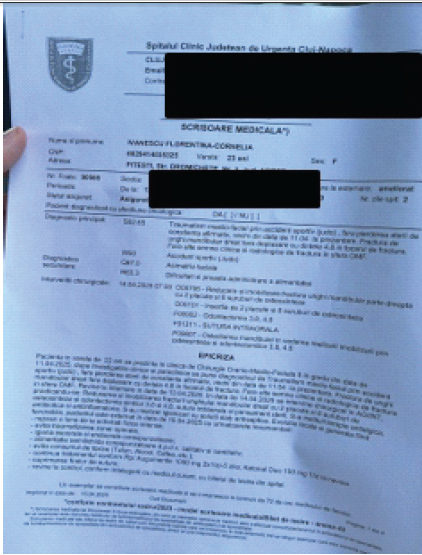
Figure 1: Hospital Surgery Report
Post-surgical management: The patient received Augmentin 1000 mg (2 × /day for 5 days) and Ketonal Duo 150 mg as needed for pain. She required analgesia for the first 5 days post-operation and once more during reintroduction to training. At week 3 post-surgery: Maximum interincisal opening: 15 mm, Visual Analog Scale pain: 8/10, Diet: Liquid only, unable to train. An external Transfer of Energy Capacitive and Resistive session induced facial swelling (Fig. 2,3) and was discontinued. Subsequently, a comprehensive physiotherapy program began at week 3.
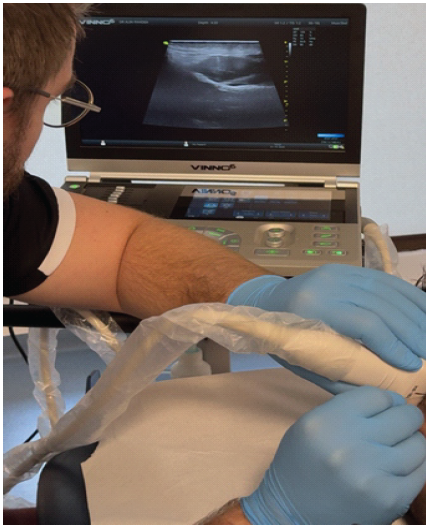
Figure 2: Ultrasound Guided Dry Needling.
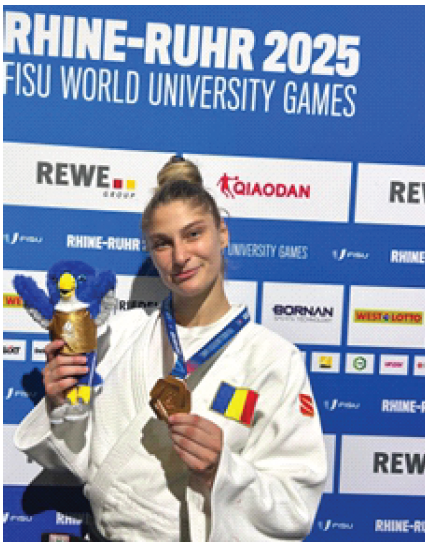
Figure 3: FISU World University Championships.
The integration of ultrasound-guided dry needling, TMJ manual therapy, and digital home exercises allowed rapid pain relief, restoration of mandibular mobility, and early return to elite competition. Traditional post-ORIF recovery often requires 12–20 weeks before athletes regain full performance [1,2]. The approach used here accelerated recovery by approximately 50%, consistent with evidence supporting neuromuscular retraining and cervical-mandibular coupling [3,4,5,6,7,8,9,10]. High adherence, facilitated by digital tracking, likely contributed to success. To our knowledge, this is the first report of an elite athlete achieving a podium finish within 3 months after mandibular fracture surgery. Further research should compare multimodal physiotherapy with standard protocols to validate these findings.
A multimodal physiotherapy protocol incorporating ultrasound-guided dry needling, TMJ manual therapy, and digital rehabilitation was associated with the earliest documented return to elite-level competition after mandibular ORIF. This integrative approach supports redefining post-surgical rehabilitation timelines in athletes recovering from maxillofacial trauma.
Targeted physiotherapy focusing on masticatory and cervical muscle re-education, guided by ultrasound and supported by digital adherence tools, enables early, safe return-to-sport following mandibular fracture surgery.
References
- 1. Brown JS, Patel MF, Rogers SN. Return to sport after facial fractures: Clinical considerations and outcomes. Br J Sports Med 2022;56:250-6. [Google Scholar] [PubMed]
- 2. Mehra P, Cottrell DA. Functional outcomes following mandibular fracture management in athletes. J Craniomaxillofac Surg 2023;51:675-82. [Google Scholar] [PubMed]
- 3. Wieckiewicz M. Physiotherapy management of temporomandibular disorders: A systematic review. J Clin Med 2022;11:3704. [Google Scholar] [PubMed]
- 4. Fernández-De-Las-Peñas C, Dommerholt J. Dry needling for the treatment of temporomandibular disorders: A narrative review. J Oral Rehabil 2023;50:145-59. [Google Scholar] [PubMed]
- 5. La Touche R. Physical therapy and exercise for TMD-related pain: An evidence-based approach. J Oral Rehabil 2023;50:422-35. [Google Scholar] [PubMed]
- 6. Greenbaum T. Orofacial pain and dysfunction in post-traumatic mandibular conditions: An interdisciplinary perspective. J Oral Rehabil 2023;50:785-93. [Google Scholar] [PubMed]
- 7. Greenbaum T, Stoyanov E, Leoni D. Cervico-cranio-mandibular rehabilitation in athletes: Integrating evidence-based physiotherapy and manual therapy. J Clin Med 2024;13:2142. [Google Scholar] [PubMed]
- 8. Ariji Y. Ultrasound imaging in TMJ and masticatory muscle rehabilitation. Oral Radiol 2022;38:387-99. [Google Scholar] [PubMed]
- 9. Al-Moraissi EA. Surgical management of mandibular fractures and functional recovery: A systematic review. Int J Oral Maxillofac Surg 2021;50:921-33. [Google Scholar] [PubMed]
- 10. Borges GF. Rehabilitation strategies for athletes following facial trauma: A multidisciplinary approach. J Sports Med Phys Fitness 2023;63:511-8. [Google Scholar] [PubMed]


Related Articles in Journal of Orthopaedic Case Reports
 October 1, 2026 Combined Endoscopic SpeedBridge™ Reinsertion and Proximal Medial Gastrocnemius Lengthening for Chronic Insertional Achilles Tendinopathy in an Elite Sprinter: A Case Report
 October 1, 2026 Blood Flow Restriction-Assisted Rehabilitation for Persistent Osgood-Schlatter Disease in an Adolescent Footballer: A Case Report with Isokinetic Evaluation
 September 1, 2026 Opportunistic Biological Augmentation during Acute Achilles Tendon Repair: A Novel Surgical Concept With Three-Year Follow-Up—A Case Report
 March 10, 2020 Giant Ganglion Cyst of the Proximal Tibiofibular Joint with Peroneal Nerve Palsy: A Case Report