

Isolated dislocation of the fifth carpometacarpal joint can be managed conservatively with good outcome if diagnosed early; however, if the initial reduction is unstable or there is a delay in diagnosis or presentation, it is imperative to use K-wires for fixation after closed/open reduction.
Dr. Rashid Anjum,
D 30 MMU Residential Complex Mullana, Ambala – 133 207, Haryana. India.
E-mail: raashidanjum@gmail.com
Introduction: Isolated pure dislocation of the fifth carpometacarpal (CMC) joint is a very rare injury and classified depending on displacement of the metacarpal base. This rare injury is often difficult to recognize and is liable to be overlooked. The purpose of this case report is to present a patient with an isolated dislocation of the fifth CMC joint that was satisfactorily treated with closed reduction and ulnar gutter pop slab.
Case Report: A 21-year-old male presented with severe pain on the right carpus following a fall with injury to right hand. There was a mild swelling at fifth CMC joint region and a bony prominence was felt dorsally, little finger presented an abduction deformity, and there was apparent shortening of the fifth ray. A diagnosis of isolated dislocation of fifth CMC dislocation was made based on radiographs. Immediate closed reduction was done in emergency room by applying longitudinal traction and direct pressure on metacarpal base dorsally, reduction was stable and confirmed by postreduction radiographs.
Conclusion: Isolated pure dislocation of the fifth CMC joint is very rare injury and is prone to be missed in emergency room and particular attention should be made to diagnose it in polytrauma patients.
Keywords: Carpometacarpal dislocation, ulnopalmar, fifth carpometacarpal.

Isolated dislocation of the carpometacarpal (CMC) joints is usually high-energy injuries with the involvement of associated structures, often neurovascular. Isolated dislocation of fifth CMC joint is very uncommon injury, and particular care must be given to the examination of ulnar nerve function because of its proximity to the fifth CMC joint [1]. We report a case of isolated dislocation of fifth CMC joint successfully managed non-operatively. The mechanism of this injury, clinical presentation, and treatment options are discussed, with a review of the literature.
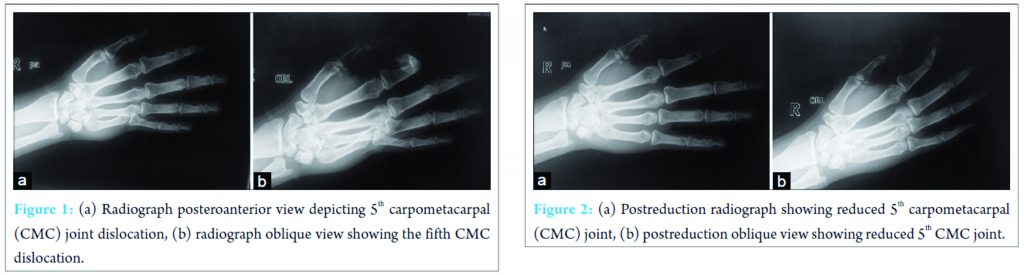
A 21-year-old male presented to the Emergency Department with severe pain on right carpus following a fall with injury to the right hand. There was a mild swelling at fifth CMC joint region and a bony prominence was felt dorsally, little finger presented an abduction deformity, and there was apparent shortening of the fifth ray. Standard radiographs were obtained which revealed isolated pure dislocation of the fifth CMC joint without any other associated injury or fracture of other metacarpals or wrist (Fig. 1a and b). A diagnosis of isolated dislocation of fifth CMC dislocation was made based on radiographs. Immediate closed reduction was done in emergency room by applying longitudinal traction and direct pressure on metacarpal base dorsally, reduction was stable and confirmed by postreduction radiographs (Fig. 2a and b), an ulnar gutter pop slab was applied for 4-6 weeks. At last follow-up, the patient was doing all routine activities with normal grip strength and full range of motion at wrist without pain.
An isolated pure dislocation of fifth CMC joint is a relatively rare injury first reported by McWhorter in 1918. This injury has been recognized to be of two types depending on dorsal or volar displacement, which may be easily missed on routine radiographs in a trauma patient [2,3,4,5,6]. Stability at the finger CMC joints is provided by a system of four ligaments. There is a high degree of variation with dorsal, multiple palmar, and two sets of interosseous ligaments (only one between the long and ring metacarpals) [7,8]; furthermore, the ECU tendon inserts on the fifth metacarpal base. Dorsal dislocations of the CMC joints are relatively more frequent as compared to volar, affecting commonly the fourth and fifth fingers [9]. CMC dislocations associated with fifth or other metacarpal fracture or hamate fractures are more frequent than pure dislocations [10,11,12]. It is also necessary in patients with a fracture of fourth metacarpal to examine a possible association of the occult fifth CMC joint dislocation. Simultaneous divergent CMC joint dislocation involving different digits is another rare injury pattern reported in literature [13]. Saleemi reported a variety of these injuries including an isolated fifth CMC joint dislocation to the ulnar side, visualized only in the posteroanterior view of hand X-ray [14]. Nalebuff classified the volar dislocations into two groups according to the displacement of the fifth metacarpal base: Radial palmar and ulnopalmar. In radial palmar type, the fifth metacarpal base is completely denuded of attachments; whereas in ulnopalmar type, the pisometacarpal ligament and tendon attachments are intact [6,7]. Although it is difficult for the patients to remember the exact mechanism of trauma, this injury is thought to be caused by a direct blow transmitted to the dorsal and ulnar aspect of the fifth metacarpal [8]. Clinical findings are those of pain and swelling at the base of fifth metacarpal and an apparent shortening of the affected metacarpal. The apparent shortening in our case was assessed using Indian salutation test. Roberts and Holland treated three patients of fifth CMC dislocation by closed reduction and splintage; however, in one patient, partial redisplacement occurred after the removal of the splint. Berg and Murphy reported successful management of an ulnopalmar dislocation of the fifth CMC joint by closed means in a splint [2].
Isolated pure dislocation of the fifth CMC joint is very rare injury and is prone to be missed in emergency room and particular attention should be made to diagnose it in polytrauma patients. It can be managed conservatively with good outcome if diagnosed early as in our case; however, if the initial reduction is unstable or there is delay in diagnosis or presentation, it is imperative to use K-wires for fixation after closed/open reduction.
Isolated pure dislocation of fifth CMC joint is very rare and is likely to be missed in the setting of polytrauma, careful evaluation is required for early diagnosis and management.
References
- 1. Kumar R, Malhotra R. Divergent fracture-dislocation of the second carpometacarpal joint and the three ulnar carpometacarpal joints. J Hand Surg Am 2001;26(1):123-129. [Google Scholar] [PubMed]
- 2. Berg EE, Murphy DF. Ulnopalmar dislocation of the fifth carpometacarpal joint-successful closed reduction: Review of the literature and anatomic re-evaluation. J Hand Surg Am 1986;11(4):521-525. [Google Scholar] [PubMed]
- 3. Chen VT. Dislocation of carpometacarpal joint of the little finger. J Hand Surg Br 1987;12(2):260-263. [Google Scholar] [PubMed]
- 4. Fischer JW, Waseem M, Gambhir A, Creedon RJ. Ulnopalmar dislocation of the fifth carpometacarpal joint. A rare injury. Acta Orthop Belg 2002;68(2):175-177. [Google Scholar] [PubMed]
- 5. Ker HR. Dislocation of the fifth carpometacarpal joint. J Bone Joint Surg Br 1955;37-B:254-256. [Google Scholar] [PubMed]
- 6. Henderson JJ, Arafa MA. Carpometacarpal dislocation. An easily missed diagnosis. J Bone Joint Surg Br 1987;69(2):212-214. [Google Scholar] [PubMed]
- 7. Dzwierzynski WW, Matloub HS, Yan JG, Deng S, Sanger JR, Yousif NJ. Anatomy of the intermetacarpal ligaments of the carpometacarpal joints of the fingers. J Hand Surg Am 1997;22(5):931-934. [Google Scholar] [PubMed]
- 8. Nakamura K, Patterson RM, Viegas SF. The ligament and skeletal anatomy of the second through fifth carpometacarpal joints and adjacent structures. J Hand Surg Am 2001;26(6):1016-1029. [Google Scholar] [PubMed]
- 9. Fisher MR, Rogers LF, Hendrix RW. Systematic approach to identifying fourth and fifth carpometacarpal joint dislocations. AJR Am J Roentgenol 1983;140(2):319-324. [Google Scholar] [PubMed]
- 10. Dennyson WG, Stother IG. Carpometacarpal dislocation of the little finger. Hand 1976;8(2):161-164. [Google Scholar] [PubMed]
- 11. McWhorter GL. Isolated and complete dislocation of the fifth carpometacarpal joint: Open operation. Surg Clin Chic 1918;2(1):793-796. [Google Scholar] [PubMed]
- 12. Roberts N, Holland CT. Isolated dislocation of the base of the fifth metacarpal. Br J Surg 1936;23(91):567-571. [Google Scholar] [PubMed]
- 13. Busa R, Internullo G, Caroli A. Divergent dislocation of the fourth and fifth carpometacarpal joints. J Hand Surg Am 1998;23(3):529-531. [Google Scholar] [PubMed]
- 14. Saleemi AJ, Iqbal MJ. Ulnar dislocation of fifth carpometacarpal joint. Hand Surg 2005;10(1):87-90. [Google Scholar] [PubMed]

Related Articles in Journal of Orthopaedic Case Reports
 November 28, 2019 Giant Cell Tumor of Third Metacarpal: A Rare Case Report and Review of Literature
 October 10, 2015 Giant Cell Tumor of the Peroneus Brevis Tendon Sheath
 January 3, 2019 Autologous Osteochondral Transplantation in Full-thickness Patella Chondral Lesion: A Case Series
- January 10, 2017 Editorial – Formation of New Reviewers Board – A JOCR initiative