


Introduction
Total knee arthroplasty (TKA) is widely recognized as the definitive intervention for patients with advanced osteoarthritis of the knee who have not benefited from conservative treatment strategies [1]. Despite advancements in surgical techniques and perioperative care, up to 20% of patients report suboptimal functional outcomes following TKA, often due to poorly controlled post-operative pain [2,3].
Optimal pain management following TKA is critical for enhancing functional recovery, reducing complication rates, and improving overall patient satisfaction [4]. A variety of analgesic modalities are available, including patient-controlled analgesia (PCA), peripheral nerve blocks, epidural anesthesia, femoral nerve blocks (FNB), and adductor canal blocks (ACB) [5]. Each technique offers unique benefits and drawbacks.
PCA, while effective, is frequently associated with side effects, such as respiratory depression, nausea, urinary retention, and constipation. Epidural analgesia can cause bilateral motor impairment and is associated with complications, such as hypotension and urinary retention, particularly when anticoagulants are used [6]. FNB is effective for pain relief but often leads to quadriceps weakness, thereby increasing the risk of falls in the early post-operative period [7,8].
In contrast, ACB selectively targets the saphenous nerve and offers comparable analgesic efficacy with less motor impairment, preserving quadriceps function and facilitating early mobilization [9,10]. The subvastus (SV) approach may provide improved intraoperative visibility of the adductor canal, which may facilitate surgeon-administered block delivery.
The aim of this study is to evaluate and compare the analgesic efficacy and early functional outcomes of surgeon-administered ACB in patients undergoing TKA through the traditional medial parapatellar (MP) versus SV approaches. The 12-h assessment period was selected deliberately to evaluate immediate post-operative pain and function during the period relevant to early mobilization, weight-bearing, and initiation of rehabilitation following TKA.
Materials and Methods
This retrospective, non-randomized, single-center comparative study was conducted between January 2024 and March 2025. Medical records of patients undergoing unilateral primary TKA for primary osteoarthritis were reviewed. Patients were grouped based on the documented surgical approach: SV or MP; allocation was not randomized. This retrospective analysis of anonymized, routinely collected clinical data did not require formal Institutional Ethics Committee approval under institutional policy; therefore, an IEC approval number and approval date were not applicable. The study was conducted in accordance with the principles of the Declaration of Helsinki.
Inclusion criteria: Age ≥18 years, unilateral primary TKA for primary knee osteoarthritis. Exclusion criteria included body weight >120 kg, cognitive impairment or inability to use IV PCA, chronic opioid use within 6 weeks pre-operatively, chronic pain syndromes, allergies to anesthetics or opioids, prior lower limb vascular surgery, peripheral neuropathy, secondary arthritis, and patient refusal.
All surgeries were performed by a single senior surgeon under spinal anesthesia. Patients were positioned supine with lateral support. Intravenous tranexamic acid (10 mg/kg) was administered after spinal anesthesia induction and before incision.
ACB technique
MP approach
ACB was performed intraoperatively following a modified technique by Pepper et al. [11]. After prosthesis implantation, the medial femoral region was accessed by blunt dissection with lateral retraction of the vastus medialis (VM) obliquus. A 22G, 10 cm needle was inserted at approximately 7 cm proximal to the joint line at a 45° angle. After negative aspiration, 15 mL of local anesthetic solution (7 mL 0.5% bupivacaine diluted with 8 mL saline) was injected.
SV approach
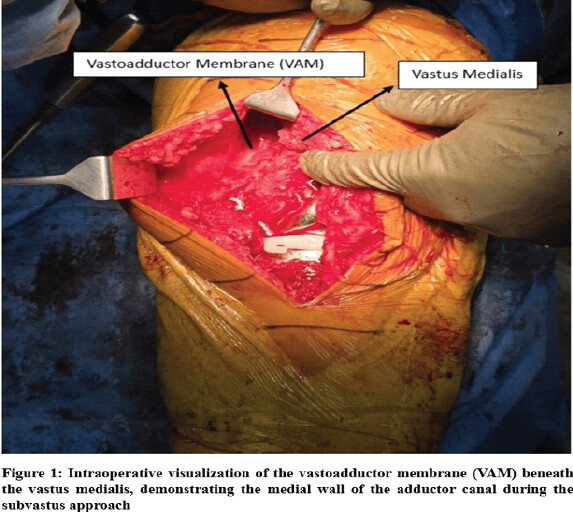
When reflecting the VM muscle during the SV approach for knee surgery, the vastoadductor membrane, also known as the subsartorial fascia, is the fascia that is seen overlying the adductor canal. This membrane forms the medial border of the adductor canal and separates it from the VM muscle (Fig. 1).
Post-operative analgesic protocol
A standardized multimodal non-opioid analgesic protocol was followed in both groups. This included Cryocool cryotherapy, intravenous paracetamol 1 g 4 times daily, and regular ibuprofen. Intramuscular diclofenac was administered as required in patients considered to be at low gastrointestinal risk. No opioids were administered during the 12-h assessment period. The surgeon-administered ACB formed part of this multimodal analgesic strategy.
Outcome measures
Data on Visual Analog Scale (VAS) pain scores at rest, Western Ontario and McMaster Universities Osteoarthritis Index (WOMAC), timed up and go (TUG) test, and knee range of motion (ROM) were extracted retrospectively from medical and physiotherapy records at pre-operative and 12 h post-operative time points. The 12-h time point was selected to assess immediate post-operative pain and functional recovery relevant to early mobilization, weight-bearing, and initiation of rehabilitation. Patient satisfaction and subjective overall benefit were not included as study outcomes.
Statistical Analysis (GraphPad Prism version 8.4.2): Mean ± standard deviation or median values were reported. Paired and unpaired t-tests and Wilcoxon signed-rank tests were used as appropriate. A P < 0.05 indicated statistical significance.
Results
Sixty patients were included, 30 in the SV and 30 in the MP group. Demographic and baseline clinical characteristics, including age, body mass index, gender distribution, and Kellgren-Lawrence grading, were statistically similar between groups (Table 1).
Baseline demographic and clinical characteristics of patients in SV and MP groups
| Variable | Measure | SV Group | MP Group |
|---|---|---|---|
| Age (years) | Mean±SD | 67.93±6.91 | 67.07±8.86 |
| Range | 54–86 (32) | 52–81 (29) | |
| Gender | Male:Female | 05:25 | 05:25 |
| BMI (kg/m2) | Mean ± SD | 30.48±4.37 | 30.53±4.26 |
| Range | 23.67–39.64 | 21.37–37.59 | |
| KL Grade (%) | Grade II | 1 (3.3) | 2 (6.7) |
| Grade III | 19 (63.3) | 14 (46.7) | |
| Grade IV | 10 (33.3) | 14 (46.7) | |
| P-value (Fisher’s exact test) | – | 0.3015 |
SV: Subvastus, MP: Medial parapatellar, SD: Standard deviation, BMI: Body mass index, KL: Kellgren-Lawrence
Post-operative outcomes
ROM
Both groups exhibited statistically significant improvements in knee ROM post-operatively (SV median increase 3°, MP median increase 5.5°; P < 0.0001 for both). The difference in post-operative ROM between groups at 12 h was not statistically significant (P = 0.083) (Table 2). However, the study may not have been powered to detect small differences in early ROM.
Post-operative knee range of motion (ROM) outcomes
| Outcome measure/comparison group | Median difference | Sum of Signed Ranks (W) | SV Group (Mean±SD) | MP Group (Mean±SD) | t value | P-value |
|---|---|---|---|---|---|---|
| SV (Pre versus Post) | –3 | –406 | <0.0001 | |||
| MP (Pre versus Post) | –5.5 | –410 | <0.0001 | |||
| Total ROM (12h) | 96.77±11.02 | 92.30±8.39 | 1.77 | 0.083 |
SV: Subvastus, MP: Medial parapatellar, SD: Standard deviation, ROM: Range of motion
VAS pain scores
Both groups showed significant reductions in pain at 12 h post-operatively. The SV group had significantly lower VAS scores than the MP group at this time (3.52 ± 0.69 vs. 4.38 ± 0.82; P = 0.0001) (Table 3).
Visual Analog Scale pain scores at pre-operative and 12-h post-operative assessment
| Group | Timepoint | Mean±SD | t-Statistic | P-value |
|---|---|---|---|---|
| SV | Pre-operative | 6.52±0.78 | 16.77 | <0.0001 |
| SV | Post-operative | 3.52±0.69 | ||
| MP | Pre-operative | 6.45±0.95 | 14.8 | <0.0001 |
| MP | Post-operative | 4.38±0.82 | ||
| SV versus | Post-operative | SV: 3.52 versus | –4.34 | 0.0001 |
| MP | Comparison | MP: 4.38 |
SV: Subvastus, MP: Medial parapatellar, SD: Standard deviation
TUG test
Both groups improved significantly post-operatively, with the SV group demonstrating superior TUG times compared to the MP group (P = 0.0104) (Table 4).
Timed Up and Go test results
| Comparison | t-value (df) | P-value | Statistical significance |
|---|---|---|---|
| Pre-operative versus Postoperative (SV group) | t=8.097 (df=29) | <0.0001 | Yes |
| Pre-operative versus Postoperative (MP group) | t=4.862 (df=29) | <0.0001 | Yes |
| Post-operative SV versus MP | t=2.707 (df=58) | 0.0104 | Yes |
SV: Subvastus, MP: Medial parapatellar
WOMAC scores
Post-operative WOMAC scores improved significantly in both groups, with the SV group showing better functional scores compared to the MP group (60.1 vs. 72.17; P < 0.0001) (Table 5).
WOMAC functional scores
| Comparison | Test type | Mean (or Median) difference | t/W Value | P-value |
|---|---|---|---|---|
| Pre-operative versus Post-operative (SV) | Wilcoxon matched-pairs test | Median: –15 | W=–465 | <0.0001 |
| Pre-operative versus Post-operative (MP) | Paired t-test | Mean: –5.9 | 1=17.34, df=29 | <0.0001 |
| Post-operative SV versus MP | SV: 60. | |||
| Unpaired t-test | 1, MP: 72.17; mean difference: 12.07±2.40 | t=5.03, df=58 | <0.0001 |
SV: Subvastus, MP: Medial parapatellar, WOMAC: Western Ontario and McMaster Universities Osteoarthritis Index
Discussion
In this retrospective comparison, the SV group had better early post-operative pain and functional outcomes than the MP group following TKA with surgeon-administered ACB. Direct visualization of the adductor canal during the SV approach may facilitate local anesthetic delivery; however, because the surgical approach and ACB delivery technique differed together, the present study cannot determine whether the observed differences resulted from the surgical approach itself, the ACB technique, or a combination of both.
Post-operative WOMAC scores were significantly better in the SV group, indicating superior early joint function. These findings align with prior studies that have emphasized the functional advantages of the SV approach in TKA [12,13,14]. The SV group demonstrated significantly greater pain reduction at 12 h post-operatively, as measured by VAS scores. These results are consistent with earlier research suggesting that less invasive surgical approaches and optimized ACB techniques contribute to improved early post-operative pain control [15,16]. Patients in the SV group also recorded shorter times on the TUG test, indicating better early mobility. This outcome is clinically relevant, as early ambulation is associated with a reduced risk of post-operative complications and shorter hospital stays [17,18]. Although both groups demonstrated significant improvement in post-operative ROM, no statistically significant intergroup difference was observed at 12 h. Previous studies have suggested that muscle-sparing approaches, such as the SV technique, may facilitate improved early knee flexion and recovery [19,20]. However, in the present study, early ROM outcomes were comparable between groups, possibly reflecting the short duration of follow-up.
The 12-h assessment window was selected deliberately because the study aimed to compare immediate post-operative pain and function during the period relevant to early mobilization, weight-bearing, and initiation of rehabilitation. These early outcomes are relevant to enhanced recovery and readiness for discharge; however, length of hospital stay was not measured, and the study was not designed to assess long-term recovery.
This study has several limitations. First, the retrospective, non-randomized design introduces potential selection bias and residual confounding and limits causal inference. Second, the sample size of 60 patients limits statistical power and the precision of between-group estimates. Third, this was a single-center, single-surgeon study, which limits external validity and may make the findings dependent on surgeon-specific technique and experience. Fourth, although the 12-h assessment period was selected specifically to evaluate immediate post-operative recovery, VAS, TUG and WOMAC results cannot establish the durability of pain relief or long-term functional recovery, and ROM at this early time point may not represent clinically meaningful longer-term recovery. Fifth, both groups received the same standardized multimodal non-opioid analgesic protocol and no opioids were administered during the assessment period; however, the availability of PRN intramuscular diclofenac means that analgesic-related confounding cannot be completely excluded. Patient satisfaction and subjective overall benefit were not evaluated. Sixth, the exclusion of patients weighing more than 120 kg, those with peripheral neuropathy, chronic pain syndromes, and other specified conditions limits generalizability to a broader TKA population. Finally, because surgical approach and ACB delivery technique differed simultaneously between groups, the observed associations cannot be attributed specifically to ACB placement accuracy or to the surgical approach alone.
The SV approach combined with surgeon-administered ACB was associated with better immediate post-operative pain and functional outcomes in this cohort. These findings should be interpreted cautiously in view of the retrospective, non-randomized design and the inability to isolate the effect of the surgical approach from that of ACB delivery.
Conclusion
In this retrospective study, surgeon-administered ACB performed through the SV approach was associated with better immediate post-operative analgesia and functional outcomes than the MP approach. Because the surgical approach and ACB delivery technique differed concurrently, these findings do not establish that improved block accuracy caused the observed differences. Prospective randomized studies with longer follow-up and formal assessment of hospital length of stay are required.
Clinical Message
The subvastus approach may facilitate direct visualization during surgeon-administered adductor canal block and was associated with better early pain and functional outcomes in this cohort; these findings require confirmation in prospective randomized studies.
Conflict of Interest:
Nil
Source of Support:
Nil
Consent
The authors confirm that informed consent was obtained from the patient for publication of this article
How to Cite this Article
Jayaprakasan V, Saraogi A, Jhanjharya H. Comparison of immediate post-operative pain and functional outcomes of surgeon-administered adductor canal block through subvastus versus medial parapatellar approach in total knee arthroplasty: A retrospective comparative study. J Orthop Case Rep. 2026 November;16(11):444-449. doi: 10.13107/jocr.2026.v16.i11.8520.
References
- Brumat P, Kunšič O, Novak S, Slokar U, Pšenica J, Topolovec M. The surgical treatment of osteoarthritis. Life (Basel) 2022;12:982. [Google Scholar] | [PubMed]
- Li JW, Ma YS, Xiao LK. Postoperative pain management in total knee arthroplasty. Orthop Surg 2019;11:755-61. [Google Scholar] | [PubMed]
- Seo SS, Kim OG, Seo JH, Kim DH, Kim YG, Park BY. Comparison of the effect of continuous femoral nerve block and adductor canal block after primary total knee arthroplasty. Clin Orthop Surg. 2017;9 3:303-309. [Google Scholar] | [PubMed]
- Koh IJ, Choi YJ, Kim MS, Koh HJ, Kang MS, In Y. Femoral nerve block versus adductor canal block for analgesia after total knee arthroplasty. Knee Surg Relat Res 2017;29:87-95. [Google Scholar] | [PubMed]
- Ibrahim MS, Khan MA, Nizam I, Haddad FS. Enhanced recovery in total hip and knee arthroplasty. BMC Med 2013;11:37. [Google Scholar] | [PubMed]
- Capdevila X, Barthelet Y, Biboulet P, Ryckwaert Y, Rubenovitch J, D'Athis F. Effects of perioperative analgesic technique on the surgical outcome and duration of rehabilitation after major knee surgery. Anesthesiology 1999;91:8-15. [Google Scholar] | [PubMed]
- Bendtsen TF, López AM, Clark TB. Ultrasound-guided saphenous nerve block Hadzic A. Hadzic's Peripheral Nerve Blocks. New York: McGraw Hill; 2012.:381-419. [Google Scholar] | [PubMed]
- Thacher RR, Hickernell TR, Grosso MJ, Shah R, Cooper HJ, Maniker R. Decreased risk of knee buckling with adductor canal block versus femoral nerve block in total knee arthroplasty: A retrospective cohort study. Arthroplast Today 2017;3:281-5. [Google Scholar] | [PubMed]
- Jaeger P, Zaric D, Fomsgaard JS, Hilsted KL, Bjerregaard J, Gyrn J. Adductor canal block versus femoral nerve block for analgesia after total knee arthroplasty: A randomized, double-blind study. Reg Anesth Pain Med 2013;38:526-32. [Google Scholar] | [PubMed]
- Kim DH, Lin Y, Goytizolo EA, Kahn RL, Maalouf DB, Manohar A. Adductor canal block versus femoral nerve block for total knee arthroplasty: A prospective, randomized controlled trial. Anesthesiology 2014;120:540-50. [Google Scholar] | [PubMed]
- Pepper AM, North TW, Sunderland AM, Davis JJ. Intraoperative adductor canal block for augmentation of periarticular injection in total knee arthroplasty: A cadaveric study. J Arthroplasty 2016;31:2072-6. [Google Scholar] | [PubMed]
- Berstock JR, Murray JR, Whitehouse MR, Blom AW, Beswick AD. Medial subvastus versus the medial parapatellar approach for total knee replacement: A systematic review and meta-analysis of randomized controlled trials. EFORT Open Rev 2018;3:78-84. [Google Scholar] | [PubMed]
- Yuan FZ, Zhang JY, Jiang D, Yu JK. Quadriceps-sparing versus traditional medial parapatellar approaches for total knee arthroplasty: A meta-analysis. BMC Musculoskelet Disord 2019;20:117. [Google Scholar] | [PubMed]
- Goyal N, Chen AF, Padgett SE, Tan TL, Kheir MM, Hopper RHJr. Otto aufranc award: A multicenter, randomized study of outpatient versus inpatient total hip arthroplasty. Clin Orthop Relat Res 2017;475:364-72. [Google Scholar] | [PubMed]
- Andersen LØ, Kehlet H. Analgesic efficacy of local infiltration analgesia in hip and knee arthroplasty: A systematic review. Br J Anaesth 2014;113:360-74. [Google Scholar] | [PubMed]
- Kwofie MK, Shastri UD, Gadsden JC, Sinha SK, Abrams JH, Xu D. The effects of ultrasound-guided adductor canal block versus femoral nerve block on quadriceps strength and fall risk: a blinded, randomized trial of volunteers. Reg Anesth Pain Med 2013;38 4:321-325. [Google Scholar] | [PubMed]
- Husted H, Lunn TH, Troelsen A, Gaarn-Larsen L, Kristensen BB, Kehlet H. Why still in hospital after fast-track hip and knee arthroplasty?. Acta Orthop 2011;82:679-84. [Google Scholar] | [PubMed]
- Thacher RR, Karadsheh MS, Wilke BK, Mihalko WM, Springer BD. Adductor canal blocks in total knee arthroplasty: A review. J Arthroplasty 2020;35:747-54. [Google Scholar] | [PubMed]
- Bellemans J, Carpentier K, Vandenneucker H. The subvastus approach in total knee arthroplasty: A review. J Knee Surg 2009;22:196-202. [Google Scholar] | [PubMed]
- Dalury DF. A state-of-the-art pain protocol for total knee replacement. J Arthroplasty 2011;26:38-44. [Google Scholar] | [PubMed]
© 2026 Journal of Orthopaedic Case Reports - Published by Indian Orthopaedic Research Group
About the Authors
-

Akash Saraogi
-

Vishnu Jayaprakasan
-

Hasan Jhanjharya
Related Articles in Journal of Orthopaedic Case Reports
 April 1, 2026 Comparing the Subvastus and Medial Parapatellar Approaches in Total Knee Arthroplasty
 October 1, 2026 Comparative Study of Effect of Periarticular Fentanyl and Dexmedetomidine Injection for Pain Management in Total Knee Arthroplasty a Randomized Control Trial
 July 1, 2026 Stepwise Surgical Correction of Fixed Flexion Deformity in Total Knee Arthroplasty: Functional Outcomes
 October 1, 2025 Comparative Evaluation of Multimodal Analgesia Techniques in Total Knee Arthroplasty: A Comparative Study