


Introduction
The World Health Organization declared COVID-19 a global pandemic on March 11, 2020, prompting national lockdowns across the United Kingdom and rapid reorganization of trauma and orthopedic services. Elective activity was suspended, staffs were redeployed, and theatres were divided into segregated pathways to minimize viral transmission. Despite these disruptions, hip fractures continued to occur, predominantly among frail older adults sustaining low-energy falls at home, and remained a major cause of acute orthopedic admission [1]. During the first pandemic wave, adherence to established hip fracture care standards declined, including delays in orthogeriatric assessment and surgical intervention [2]. Patients with concurrent COVID-19 infection also experienced substantially higher perioperative mortality, highlighting the vulnerability of this population during the pandemic [3].
Lockdown restrictions altered the daily activity patterns of older adults. Reduced mobility, sunlight exposure, and social interaction may have contributed to physical deconditioning, while prolonged confinement at home potentially increased participation in unfamiliar domestic and do-it-yourself activities. Studies from the United Kingdom and continental Europe reported that overall hip fracture incidence remained broadly stable or declined modestly during lockdown [1, 4]. However, these studies focused primarily on fracture volume and did not assess whether fracture characteristics or operative management changed. Unstable extracapsular fractures, including those with lateral wall compromise, reverse obliquity, or subtrochanteric extension, are generally treated with cephalomedullary nails, although the optimal fixation method remains debated [5]. A shift toward more unstable fracture patterns during the pandemic could therefore have influenced implant selection.
To our knowledge, no study has specifically evaluated whether the COVID-19 lockdown was associated with changes in cephalomedullary nailing for extracapsular hip fractures. Furthermore, pandemic-era evidence is predominantly derived from urban major trauma centers, with limited data from rural district general hospitals. This study compared the proportion of hip fractures treated with cephalomedullary nails during the 24 months before and after the onset of the pandemic at a rural UK district general hospital. Operative time, blood loss, reduction method, bisphosphonate use, complications and 6- and 12-month mortality were also compared. We hypothesized that cephalomedullary nail use would increase during the pandemic period.
Materials and Methods
This Level III retrospective cohort study compared the use of cephalomedullary nailing and associated perioperative outcomes in adults with extracapsular hip fractures across 2 consecutive 24-month periods before and during the COVID-19 pandemic. It was conducted at Dumfries and Galloway Royal Infirmary, the sole acute trauma and orthopedic center for south-west Scotland, which serves a predominantly rural population of approximately 148,790 across an area of about 6,426 km2. As the only hospital in the region admitting patients with hip fractures, it provided a complete, population-based denominator for the primary outcome. The pre-pandemic cohort (Group A) comprised all hip fracture admissions between March 20, 2018 and March 19, 2020. The pandemic cohort (Group B) comprised all admissions between March 20, 2020 and March 19, 2022, a period spanning the national lockdowns and subsequent phased restrictions in Scotland. The study was approved by the Research and Development Support Unit of National Health Service Dumfries and Galloway as part of the Clinical Effectiveness and Audit program. The requirement for informed consent was waived due to the retrospective analysis of anonymized records, and reporting followed the Strengthening the Reporting of Observational Studies in Epidemiology guidelines [6].
Inclusion criteria comprised patients aged 50 years or older with an extracapsular hip fracture treated with a cephalomedullary nail, with either closed or open reduction. Exclusion criteria included intracapsular fractures treated with arthroplasty, extracapsular fractures fixed with a sliding hip screw, isolated diaphyseal femoral fractures, pelvic fractures, periprosthetic fractures, and incomplete clinical records. Using equal 24-month periods on either side of the pandemic onset balanced the observation windows and limited seasonal bias in fracture presentation. It also allowed each cohort to be expressed as a proportion of all hip fractures admitted during the same period. A complete list of hip fracture admissions for both periods was obtained from the hospital information services department. Each record was verified against the electronic clinical portal and the picture archiving and communication system, which held the pre-operative anteroposterior pelvic and lateral hip radiographs and the intraoperative fluoroscopic images. Data extracted comprised patient age at admission, operative time, estimated intraoperative blood loss, reduction method, bisphosphonate therapy before injury, post-operative complications, perioperative COVID-19 status confirmed by polymerase chain reaction, and all-cause mortality at 6 and 12 months after surgery. Variables not recorded in the source documents were treated as missing and all patient identifiers were removed before analysis. Because the study was conducted as a retrospective audit of routinely collected data, fracture classification according to the Arbeitsgemeinschaft für Osteosynthesefragen/orthopaedic trauma association (AO/OTA) system, fracture morphology, and lateral femoral wall integrity were not assessed. Post-operative complications were extracted as documented in the clinical record during the index admission and subsequent follow-up, and were analyzed as a single composite outcome, because the documentation did not allow consistent grading or reliable separation into medical, wound-related and implant-related events. Mortality was assessed at fixed intervals of 6 and 12 months from the date of surgery. Consequently, for patients in Group A operated on after 20 September 2019 and after 20 March 2019, part of the 6- and 12-month follow-up windows, respectively, fell within the pandemic period.
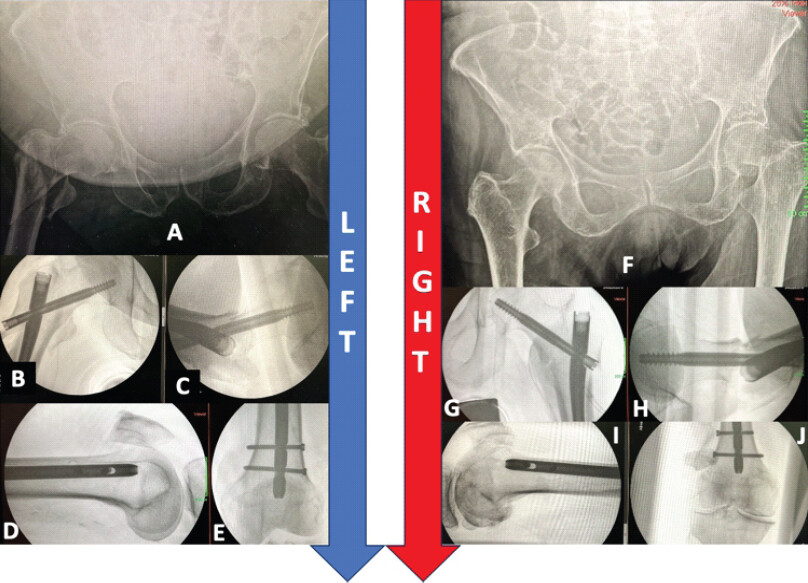
All procedures were performed on a traction table with the patient supine and the image intensifier positioned to obtain orthogonal anteroposterior and lateral views of the proximal femur. Surgeons were consultants or trainees at varying levels of seniority working under supervision. Fractures were reduced by closed traction and rotation wherever possible, with open reduction undertaken when acceptable alignment could not be achieved. Reduction was accepted when there was cortical contact without a posteromedial gap, and the neck–shaft angle was restored without varus on both views. Following the entry point at the tip of the greater trochanter, the proximal femur was reamed and the nail inserted. The cephalic lag screw was placed centrally or inferiorly in the anteroposterior view and centrally in the lateral view, with a target tip–apex distance of <25 mm to minimize the risk of cut-out [7]. Distal locking was performed as dictated by fracture configuration and nail length (Fig. 1). Implant selection rested with the operating surgeon, as no departmental protocol mandated a particular device for a given fracture pattern. The primary outcome was the proportion of all hip fractures admitted in each period that were treated with a cephalomedullary nail. Secondary outcomes were operative time, estimated blood loss, open versus closed reduction, prior bisphosphonate use, complication rate, and mortality at 6 and 12 months. Patients who tested positive for COVID-19 were described separately. They were not compared statistically, because infection could not occur in the pre-pandemic cohort.
Statistical analysis was performed using IBM Statistical Package for the Social Sciences Statistics version 28.0 (IBM Corp., Armonk, NY, USA), with statistical significance set at P < 0.05 (two-tailed). Categorical variables were summarized as frequencies and percentages. The primary outcome was compared between periods using the χ2 test, and the remaining categorical variables were compared using Fisher’s exact test because expected cell counts were below five. Continuous variables were assessed for normality. Because they were non-normally distributed, they were presented as median and interquartile range (IQR) and compared using the Mann–Whitney U test. Mortality at each time point was expressed as an odds ratio with 95% confidence interval (CI). Analyses were conducted on available data without imputation and the number of patients contributing to each variable was reported. To explore whether missing data were distributed unevenly, the proportions of patients with missing operative time and blood loss were compared between the groups using Fisher’s exact test. No a priori sample size calculation was performed, because the sample comprised all eligible patients within the fixed study windows. A post hoc estimate indicated that, with 347 and 311 admissions, the study had 80% power at a two-sided α of 0.05 to detect an increase in nailing from 13.3% to approximately 21.6%, an absolute difference of about 8% points, whereas comparisons of secondary categorical outcomes between the 46 and 49 nailed patients could detect only absolute differences of approximately 25–30% points. Multivariable adjustment of mortality for comorbidity or frailty was not undertaken, because these variables were not consistently recorded and the number of deaths (9 at 6 months and 22 at 12 months) was too small to support a stable regression model [8].
Results
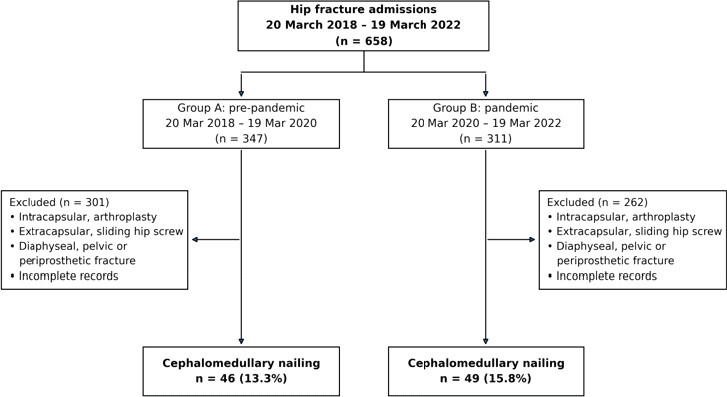
A total of 658 hip fractures were admitted during the study period: 347 in the pre-pandemic period and 311 in the pandemic period. Of these, 95 met the inclusion criteria and were treated with a cephalomedullary nail, comprising 46 patients in Group A and 49 in Group B (Fig. 2). Cephalomedullary fixation accounted for 13.3% of all hip fractures before the pandemic and 15.8% during it. This absolute difference of 2.5% was not statistically significant (χ2, P = 0.36).
The two cohorts were comparable in age, with a median of 88 years (IQR) in Group A and 85 years (IQR) in Group B (P = 0.26). Operative time was recorded in 31 patients in Group A and 39 in Group B. It was significantly longer during the pandemic, with a median of 140 min (IQR) compared with 90 min (IQR) before it (P < 0.001). Estimated blood loss was documented in only 15 patients in Group A and 14 in Group B. Median values were 700 mL (IQR) and 400 mL (IQR), respectively, and the difference was not significant (P = 0.61). Operative time was missing in 15 patients (32.6%) in Group A and 10 (20.4%) in Group B (P = 0.24), and blood loss in 31 (67.4%) and 35 (71.4%), respectively (P = 0.82), so the extent of missing data did not differ significantly between the periods. Baseline characteristics and perioperative outcomes are summarized in Table 1. Open reduction was required in 7 patients (15.2%) in Group A and 15 patients (30.6%) in Group B. Although the proportion doubled during the pandemic, the difference did not reach statistical significance (P = 0.09). Prior bisphosphonate therapy was recorded in 2 patients (4.3%) before the pandemic and 7 patients (14.3%) during it (P = 0.16). Post-operative complications occurred in 19 patients (41.3%) in Group A and 13 patients (26.5%) in Group B (P = 0.14). Three patients (6.1%) in Group B tested positive for COVID-19 during the perioperative period. This number was too small to permit separate analysis of infection-related complications or mortality.
Baseline characteristics, perioperative variables and outcomes of patients treated with cephalomedullary nailing for extracapsular hip fractures in the pre-pandemic (Group A, 20 March 2018–2019 March 2020) and pandemic (Group B, 20 March 2020–2019 March 2022) cohorts
| Variable | Group A (n =46) | Group B (n =49) | P-value |
|---|---|---|---|
| All hip fracture admissions, n | 347 | 311 | — |
| Cephalomedullary nailing, n (%) | 46 (13.3) | 49 (15.8) | 0.36a |
| Age, years, mean±SD; median | 81.6 ± 13.1; 88 | 80.9 ± 12.6; 85 | 0.26b |
| Operative time, min, mean±SD; median (n recorded) | 98.3 ± 32.5; 90 (31) | 147.6 ± 40.8; 140 (39) | < 0.001b |
| Blood loss, mL, mean±SD; median (n recorded) | 743 ± 492;700 (15) | 693 ± 586; 400 (14) | 0.61b |
| Open reduction, n (%) | 7 (15.2) | 15 (30.6) | 0.09c |
| Prior bisphosphonate use, n (%) | 2 (4.3) | 7 (14.3) | 0.16c |
| Complications, n (%) | 19 (41.3) | 13 (26.5) | 0.14c |
| COVID-19 positive, n (%) | — | 3 (6.1) | — |
| Mortality at 6 months,n (%) | 7 (15.2) | 2 (4.1) | 0.08c |
| Mortality at 12 months,n (%) | 9 (19.6) | 13 (26.5) | 0.47c |
a
χ2 test,
b
Mann-Whitney U test,
c
Fisher’s exact test. IQR: Interquartile range
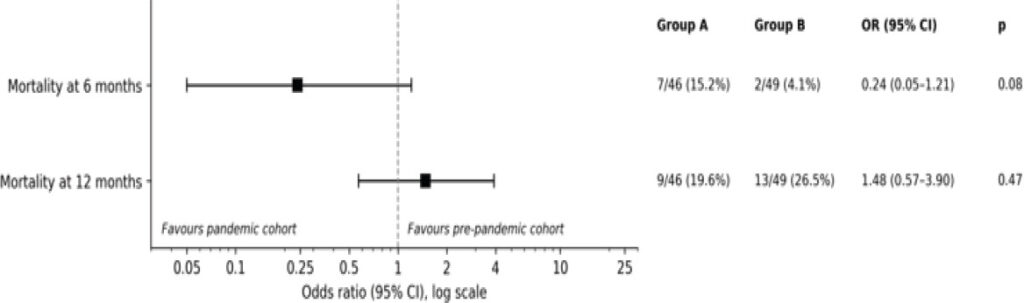
Six-month mortality was 15.2% (7 of 46) in Group A and 4.1% (2 of 49) in Group B. The odds ratio for death in the pandemic cohort was 0.24 (95% CI 0.05–1.21; P = 0.08). By 12 months, the pattern had reversed. Cumulative mortality was 19.6% (9 of 46) in Group A and 26.5% (13 of 49) in Group B, giving an odds ratio of 1.48 (95% CI 0.57–3.90; P = 0.47). Neither difference was statistically significant. These comparisons were unadjusted for comorbidity or frailty (Fig. 3).
Discussion
In this study, the proportion of hip fractures treated with cephalomedullary nails did not change significantly between the two periods, increasing only modestly from 13.3% before the pandemic to 15.8% during the pandemic. This finding is consistent with broader evidence suggesting that COVID-19 restrictions had limited impact on the overall burden of hip fractures among older adults. In a UK multicenter cohort, Malik-Tabassum et al. reported broadly stable hip fracture admissions during the first lockdown, although a greater proportion of injuries occurred at home [1]. Similarly, Paccou et al. documented a modest reduction in hip fracture hospitalizations during the first national lockdown in France, which they attributed primarily to reduced outdoor mobility rather than changes in underlying fracture susceptibility [4]. Slullitel et al. likewise found no significant change in hip fracture incidence during prolonged social lockdown in Buenos Aires; notably, all intertrochanteric fractures at their institution were treated with intramedullary nails, meaning that changes in fracture volume would have directly influenced nailing rates [9]. Conversely, a Korean nationwide interrupted time-series analysis demonstrated that the pandemic could influence surgical practice even in the absence of a formal lockdown. For intertrochanteric fractures, the proportion undergoing internal fixation fell below the predicted value, while hemiarthroplasty increased [10]. Furthermore, the optimal fixation method for extracapsular fractures remains debated, with a Cochrane review finding no consistent advantage of intramedullary over extramedullary fixation [5]. Collectively, these findings indicate that cephalomedullary nail utilization is influenced by both fracture morphology and institutional practice, and that pandemic-related changes may manifest through either pathway. In the present cohort, implant selection remained at the discretion of the operating surgeon throughout both periods. The stable nailing rate therefore provides no evidence of a substantial pandemic-associated increase in fractures perceived to require intramedullary fixation, although it cannot be interpreted as a direct surrogate for fracture instability. Thus, the proposed effects of lockdown-related deconditioning and increased unaccustomed domestic activity did not translate into a detectable increase in cephalomedullary fixation in this rural population.
The pandemic cohort had significantly longer operative times, with a median of 140 min compared with 90 min before the pandemic, and this was the only outcome that differed significantly between the periods. This is consistent with widely reported reductions in theatre efficiency during the pandemic. Mercer et al. compared emergency orthopedic lists from May 2019 and May 2020 and found that almost every recorded theatre timing increased significantly in 2020, with a similar pattern in the hip fracture subgroup. They attributed the delays largely to personal protective equipment for aerosol-generating procedures and to other infection-control measures [11]. Khadabadi et al. likewise described prolonged theatre intervals at a UK district general hospital during the first wave, arising from infection-control protocols, patient transfer and staff donning and doffing [12]. The IMPACT global survey of 160 hip fracture units found that reduced theatre efficiency was reported by over four-fifths of centers. Contributing factors included staff and resource redistribution, longer anesthetic and transfer times, preoperative COVID-19 testing and the use of personal protective equipment [13]. Orthopedic power tools were recognized early as a source of aerosol generation, prompting guidance on additional protective measures during reaming and drilling that are integral to intramedullary nailing [14]. The increase in the present study, around 50 min at the median, is larger than most of these reports. This probably reflects the full 24-month span of the pandemic cohort, during which infection-control protocols changed repeatedly, as well as the doubling of open reductions and the variable seniority of operating surgeons. Operative time was also missing for a quarter of patients, which limits how precisely the size of the difference can be estimated. The direction of the finding nonetheless agrees with the published literature and it indicates that pandemic-related delays affected a small rural unit as much as the larger centers described elsewhere.
Open reduction was needed twice as often during the pandemic (30.6% vs. 15.2%), although this difference did not reach statistical significance. Most extracapsular fractures can be reduced by closed manipulation on a traction table. Moehring et al. described a subset of intertrochanteric fractures that resist closed reduction because of fragment interlocking, sagging of the femoral shaft or wall, and subtrochanteric comminution, and these patterns are concentrated among the unstable fracture types [15]. Chang et al. showed that achieving positive medial cortical support in unstable pertrochanteric fractures is central to secondary stability after cephalomedullary nailing. This has encouraged surgeons to accept open or percutaneous reduction when closed manipulation leaves a posteromedial gap [16]. Somasundaram et al. used accessory incisions to assist reduction in 35% of 220 consecutive geriatric intertrochanteric fractures treated with cephalomedullary nails on a traction table, without any increase in reoperation, non-union, or cut-out. Their findings suggest that open-assisted reduction is safe, and that rates close to one-third are unremarkable in unstable fracture populations [17]. The higher rate of open reduction in the present pandemic cohort is therefore within published ranges. It could reflect a larger proportion of fracture patterns resistant to closed reduction, which would lend partial support to the original hypothesis. However, fracture morphology was not classified in this study, so this interpretation cannot be confirmed. An equally plausible explanation lies in the pandemic workforce. The redeployment of specialist staff and reduced senior theatre access reported during the pandemic may have lowered the threshold for open reduction among less experienced operators [13]. The two cohorts were well matched for age, with medians of 88 and 85 years. This makes a demographic shift an unlikely explanation for either the operative time or the reduction findings, and supports attributing both to injury pattern or service factors rather than patient selection.
Estimated blood loss did not differ between the periods, but it was recorded in fewer than a third of patients, so any comparison must be interpreted with caution. Intraoperative estimates also capture only part of the true loss in extracapsular fractures. Foss and Kehlet showed that hidden blood loss after hip fracture surgery greatly exceeds the visible intraoperative loss. It was greatest in extracapsular fractures and in those fixed with intramedullary devices, reflecting bleeding into the fracture hematoma and soft tissues [18]. This explains why blood loss is poorly documented in routine operation notes and why estimates vary so widely between studies. In the present cohort, open reductions doubled during the pandemic without any rise in recorded blood loss, which most likely reflects the small and selectively recorded sample rather than a true absence of effect. Prior bisphosphonate use increased from 4.3% to 14.3%, although the difference was not significant and the absolute numbers were small. This trend runs against the wider pandemic experience. The International osteoporosis foundation- national osteoporosis foundation- economic aspects of osteoporosis, osteoarthritis and musculoskeletal diseases global survey reported delays in bone densitometry, interrupted supply of osteoporosis medications and reduced delivery of parenteral treatment during the pandemic, all of which would be expected to reduce, rather than increase, treatment uptake [19]. Bisphosphonate exposure matters for two reasons in a cohort treated with cephalomedullary nails. A living systematic review and network meta-analysis confirmed that bisphosphonates reduce hip and other fragility fractures in people with osteoporosis [20]. However, Black et al. showed that the risk of atypical femoral fracture rises with the duration of bisphosphonate therapy and falls after discontinuation. Such fractures frequently occur in the subtrochanteric region and are themselves managed with cephalomedullary nails [21]. The present study did not distinguish typical fragility fractures from atypical femoral fractures, nor record treatment duration. The modest rise in prior bisphosphonate use is therefore more plausibly explained by chance, or by improved documentation of medication history, than by any real change in osteoporosis care during the pandemic.
Post-operative complications were recorded in 41.3% of patients before the pandemic and 26.5% during it. This difference was not significant, and its direction is opposite to most published pandemic cohorts. Anusitviwat et al. found that fragility hip fractures treated during the pandemic had a higher complication rate and poorer short-term function than a pre-pandemic cohort [22]. Kayani et al., in a UK multicenter study, reported substantially higher perioperative complication rates among hip fracture patients with COVID-19. Respiratory complications predominated, and admission to intensive care was more frequent [23]. Much of the complication burden after hip fracture surgery is medical rather than surgical. In their prospective cohort, Roche et al. identified chest infection and heart failure as the commonest post-operative complications, and both were strongly associated with 30-day mortality [24]. By contrast, mechanical complications specific to cephalomedullary fixation are relatively uncommon. Somasundaram et al. reported non-union, cut-out and varus collapse in 8.8% of unstable intertrochanteric fractures at 1 year, and most of these followed suboptimal reduction or a tip–apex distance above 25 mm [17]. The high rates in both cohorts of the present study therefore suggest a broad definition that combined medical and surgical events. Such composite outcomes are sensitive to how thoroughly events are documented. The apparent fall during the pandemic may reflect under-recording, since specialist teams were redeployed and inpatient areas reallocated, or earlier discharge. Competing mortality may also play a part: Patients who died before a complication could be recorded would reduce the apparent complication rate. Only three patients in the pandemic cohort had confirmed COVID-19, which is too few to reproduce the infection-related excess described by Kayani et al. Without a standardized classification separating medical, wound and implant-related events, the complication data from this study cannot be compared directly with published series. They should be regarded as hypothesis-generating only.
Mortality followed an inconsistent pattern. At 6 months it was lower in the pandemic cohort (4.1% vs. 15.2%), and at 12 months it was higher (26.5% vs. 19.6%), but neither difference was statistically significant. The most consistent finding in the pandemic literature is that concurrent COVID-19 infection sharply increases early mortality after hip fracture. In the IMPACT-Scot 2 study of 833 patients across 17 Scottish centers, 30-day survival was 65.4% among patients with COVID-19 compared with 91% among those without, and infection independently tripled the risk of death [25]. Kayani et al. and Wignall et al. reported similar excess early mortality among infected patients in English multicenter cohorts [3, 23]. For uninfected patients, however, most studies found no increase in mortality, which suggests that the pandemic’s lethal effect was concentrated in the infected minority. Only three patients in the present pandemic cohort had confirmed COVID-19, too few to produce the excess mortality described in larger series. The 12-month mortality in both cohorts also fell within the range expected after hip fracture. Roche et al. reported 1-year mortality of about one-third in a large UK prospective cohort, with deaths concentrated early and driven largely by medical complications [24]. Against this background, the pattern in the pandemic cohort warrants caution. Only 2 deaths occurred in the first 6 months, but 11 more followed between 6 and 12 months, the reverse of the early clustering typically seen after hip fracture. This may reflect a true late effect of disrupted rehabilitation and community care, or incomplete ascertainment of early deaths. The two cohorts also overlap in time: Patients treated late in the pre-pandemic period completed their follow-up during the pandemic itself, so the comparison is not a clean separation of exposure. With wide CIs and no adjustment for comorbidity or frailty, the mortality findings of this study do not support any firm conclusion that the pandemic altered survival after cephalomedullary fixation.
This study has several limitations, each of which should be weighed when interpreting the findings. First, the retrospective design depended on the completeness and accuracy of routine clinical documentation, making it susceptible to missing data, documentation bias, and residual confounding; outcomes, such as complications and blood loss are particularly sensitive to how consistently they were recorded. Second, the study was conducted at a single rural district general hospital. Because it is the sole acute trauma center for its region, it captured a complete population-based denominator, but its case mix, staffing and pandemic response may differ from those of urban major trauma centers and other healthcare systems, so the findings may not be generalizable beyond comparable settings. Third, only 95 patients underwent cephalomedullary nailing. The study was adequately powered only for an absolute change in nailing of about eight percentage points, and the secondary comparisons could detect only large differences, so modest but clinically relevant effects cannot be excluded, and non-significant results should not be interpreted as evidence of equivalence. Fourth, fracture morphology was not classified. Without AO/OTA classification and assessment of lateral wall integrity, nailing rates reflect implant choice and surgeon preference as much as fracture instability, and the primary outcome serves only as a surrogate for the hypothesized change in fracture pattern [26, 27]. Retrospective classification of the archived radiographs would allow this hypothesis to be tested directly. Fifth, operative time was missing in about one-quarter of patients and blood loss in more than two-thirds. Although the extent of missingness did not differ significantly between the periods, these data are unlikely to be missing completely at random, and the complete-case estimates may therefore be biased [28]. Sixth, mortality was compared without adjustment for comorbidity, frailty or other patient-level risk factors, such as those captured by the Nottingham Hip Fracture Score, because these were not consistently recorded and the number of deaths was too small for multivariable modeling [8, 29]. The mortality comparisons are therefore crude and susceptible to confounding. Seventh, complications were recorded as an ungraded composite outcome, rather than being graded with a standard system, such as the Clavien–Dindo classification and separated into medical, wound-related and implant-related events, which limits comparison with published series [30]. Eighth, follow-up of patients treated late in the pre-pandemic period extended into the pandemic, so exposure was not cleanly separated between the cohorts, particularly for 12-month mortality. Finally, only three patients in the pandemic cohort tested positive for COVID-19, which precluded any meaningful assessment of the effect of infection on complications and mortality. In view of these limitations, the findings should be regarded as hypothesis-generating. Prospective multicenter studies with standardized fracture classification, complete perioperative data capture, graded complication reporting and risk-adjusted survival analyses are needed to confirm them.
Conclusion
The COVID-19 pandemic was not associated with a significant change in the proportion of hip fractures treated with cephalomedullary nails in this rural UK population. Although nailing rates increased modestly from 13.3% to 15.8%, this difference was not statistically significant. Operative time was significantly prolonged during the pandemic, while differences in reduction method, blood loss, bisphosphonate use, complications and mortality were not statistically significant. The findings suggest that, despite substantial disruption to orthopedic services, the pandemic did not produce a detectable increase in the proportion of fractures managed with cephalomedullary fixation. However, the absence of fracture morphology data and substantial missingness in several secondary outcomes limit definitive interpretation. The retrospective single-center design, modest sample size and unadjusted outcome comparisons mean that these findings should be considered hypothesis-generating. Larger multicenter studies incorporating fracture classification, lateral wall integrity and risk-adjusted outcomes are required to determine whether pandemic-related changes in activity and healthcare delivery altered fracture patterns or treatment strategies.
Clinical Message
At a rural UK district general hospital, the COVID-19 pandemic did not change how often extracapsular hip fractures were treated with cephalomedullary nails, but median operative time for nailing rose by about 50 min, so service planning for future pandemics should allow for reduced theatre efficiency.
Conflict of Interest:
Nil
Source of Support:
Nil
Consent
The authors confirm that informed consent was obtained from the patient for publication of this article
How to Cite this Article
Jameel SS, Kotian RN, ElHassan H, John AP, Saran JS, Hatab S. Cephalomedullary Nailing of Extracapsular Hip Fractures Before and During the COVID-19 Pandemic: A Rural UK Cohort Study. J Orthop Case Rep. 2026 November;16(11):435-443. doi: 10.13107/jocr.2026.v16.i11.8518.
References
- Malik-Tabassum K, Robertson A, Tadros BJ, Chan G, Crooks M, Buckle C. The effect of the COVID-19 lockdown on the epidemiology of hip fractures in the elderly: A multicentre cohort study. Ann R Coll Surg Engl 2021;103:337-44. [Google Scholar] | [PubMed]
- Tyas B, Wilkinson M, Singisetti K. Effect of Covid-19 on best practice care of hip fracture patients: An analysis from the national hip fracture database (NHFD). Surgeon 2021;19:e298-303. [Google Scholar] | [PubMed]
- Wignall A, Giannoudis V, De C, Jimenez A, Sturdee S, Nisar S. The impact of COVID-19 on the management and outcomes of patients with proximal femoral fractures: A multi-centre study of 580 patients. J Orthop Surg Res 2021;16:155. [Google Scholar] | [PubMed]
- Paccou J, Lenne X, Ficheur G, Theis D, Cortet B, Bruandet A. Analysis of hip fractures in France during the first COVID-19 lockdown in spring 2020. JAMA Netw Open 2021;4:e2134972. [Google Scholar] | [PubMed]
- Lewis SR, Macey R, Gill JR, Parker MJ, Griffin XL. Cephalomedullary nails versus extramedullary implants for extracapsular hip fractures in older adults. Cochrane Database Syst Rev 2022;1:CD000093. [Google Scholar] | [PubMed]
- Von Elm E, Altman DG, Egger M, Pocock SJ, Gøtzsche PC, Vandenbroucke JP. The strengthening the reporting of observational studies in epidemiology (STROBE) statement: Guidelines for reporting observational studies. J Clin Epidemiol 2008;61:344-9. [Google Scholar] | [PubMed]
- Baumgaertner MR, Curtin SL, Lindskog DM, Keggi JM. The value of the tip-apex distance in predicting failure of fixation of peritrochanteric fractures of the hip. J Bone Joint Surg Am 1995;77:1058-64. [Google Scholar] | [PubMed]
- Peduzzi P, Concato J, Kemper E, Holford TR, Feinstein AR. A simulation study of the number of events per variable in logistic regression analysis. J Clin Epidemiol 1996;49:1373-9. [Google Scholar] | [PubMed]
- Slullitel PA, Lucero CM, Soruco ML, Barla JD, Benchimol JA, Boietti BR. Prolonged social lockdown during COVID-19 pandemic and hip fracture epidemiology. Int Orthop 2020;44:1887-95. [Google Scholar] | [PubMed]
- Jang SY, Cha Y, Kim Y, Kim KJ, Kim H, Choy W. Analysis of the effects of COVID-19 on hip fractures in Korea without lockdown: Interrupted time series analysis using a nationwide cohort. J Korean Med Sci 2023;38:e137. [Google Scholar] | [PubMed]
- Mercer ST, Agarwal R, Dayananda KS, Yasin T, Trickett RW. A comparative study looking at trauma and orthopaedic operating efficiency in the COVID-19 era. Perioper Care Oper Room Manag 2020;21:100142. [Google Scholar] | [PubMed]
- Khadabadi NA, Logan PC, Handford C, Parekh K, Shah M. Impact of COVID-19 pandemic on trauma theatre efficiency. Cureus 2020;12:e11637. [Google Scholar] | [PubMed]
- Hall AJ, Clement ND, MacLullich AM, Ojeda-Thies C, Hoefer C, Brent L. IMPACT of COVID-19 on hip fracture services: A global survey by the international multicentre project auditing COVID-19 in trauma & orthopaedics. Surgeon 2022;20:237-40. [Google Scholar] | [PubMed]
- Williams M, Blake S, Matthews H. Mitigating the risk of aerosol generation from power tools during the COVID-19 pandemic. Ann R Coll Surg Engl 2020;102:393-4. [Google Scholar] | [PubMed]
- Moehring HD, Nowinski GP, Chapman MW, Voigtlander JP. Irreducible intertrochanteric fractures of the femur. Clin Orthop Relat Res 1997;339:197-9. [Google Scholar] | [PubMed]
- Chang SM, Zhang YQ, Ma Z, Li Q, Dargel J, Eysel P. Fracture reduction with positive medial cortical support: A key element in stability reconstruction for the unstable pertrochanteric hip fractures. Arch Orthop Trauma Surg 2015;135:811-8. [Google Scholar] | [PubMed]
- Somasundaram V, Owen AR, Hidden KA, Barlow JD, Cross WW, Sems SA. Cephalomedullary nailing of unstable geriatric intertrochanteric fractures on a traction table combined with percutaneous reduction techniques is safe and results in a low rate of cutout. J Orthop Trauma 2023;37:323-9. [Google Scholar] | [PubMed]
- Foss NB, Kehlet H. Hidden blood loss after surgery for hip fracture. J Bone Joint Surg Br 2006;88:1053-9. [Google Scholar] | [PubMed]
- Fuggle NR, Singer A, Gill C, Patel A, Medeiros A, Mlotek AS. How has COVID-19 affected the treatment of osteoporosis? An IOF-NOF-ESCEO global survey. Osteoporos Int 2021;32:611-7. [Google Scholar] | [PubMed]
- Ayers C, Kansagara D, Lazur B, Fu R, Kwon A, Harrod C. Effectiveness and safety of treatments to prevent fractures in people with low bone mass or primary osteoporosis: A living systematic review and network meta-analysis for the American College of Physicians. Ann Intern Med 2023;176:182-95. [Google Scholar] | [PubMed]
- Black DM, Geiger EJ, Eastell R, Vittinghoff E, Li BH, Ryan DS. Atypical femur fracture risk versus fragility fracture prevention with bisphosphonates. N Engl J Med 2020;383:743-53. [Google Scholar] | [PubMed]
- Anusitviwat C, Vanitcharoenkul E, Chotiyarnwong P, Unnanuntana A. Surgical treatment for fragility hip fractures during the COVID-19 pandemic resulted in lower short-term postoperative functional outcome and a higher complication rate compared to the pre-pandemic period. Osteoporos Int 2022;33:2217-26. [Google Scholar] | [PubMed]
- Kayani B, Onochie E, Patil V, Begum F, Cuthbert R, Ferguson D. The effects of COVID-19 on perioperative morbidity and mortality in patients with hip fractures: A multicentre cohort study. Bone Joint J 2020;102-B:1136-45. [Google Scholar] | [PubMed]
- Roche JJ, Wenn RT, Sahota O, Moran CG. Effect of comorbidities and postoperative complications on mortality after hip fracture in elderly people: Prospective observational cohort study. BMJ 2005;331:1374. [Google Scholar] | [PubMed]
- Hall AJ, Clement ND, MacLullich AM, White TO, Duckworth AD. IMPACT-Scot 2 report on COVID-19 in hip fracture patients. Bone Joint J 2021;103-B:888-97. [Google Scholar] | [PubMed]
- Meinberg EG, Agel J, Roberts CS, Karam MD, Kellam JF. Fracture and dislocation classification compendium-2018. J Orthop Trauma 2018;32 Suppl 1:S1-170. [Google Scholar] | [PubMed]
- Hsu CE, Shih CM, Wang CC, Huang KC. Lateral femoral wall thickness. A reliable predictor of post-operative lateral wall fracture in intertrochanteric fractures. Bone Joint J 2013;95-B:1134-8. [Google Scholar] | [PubMed]
- Sterne JAC, White IR, Carlin JB, Spratt M, Royston P, Kenward MG. Multiple imputation for missing data in epidemiological and clinical research: Potential and pitfalls. BMJ 2009;338:b2393. [Google Scholar] | [PubMed]
- Maxwell MJ, Moran CG, Moppett IK. Development and validation of a preoperative scoring system to predict 30 day mortality in patients undergoing hip fracture surgery. Br J Anaesth 2008;101:511-7. [Google Scholar] | [PubMed]
- Dindo D, Demartines N, Clavien PA. Classification of surgical complications: A new proposal with evaluation in a cohort of 6336 patients and results of a survey. Ann Surg 2004;240:205-13. [Google Scholar] | [PubMed]
© 2026 Journal of Orthopaedic Case Reports - Published by Indian Orthopaedic Research Group
About the Authors
-

Syed Suhaib Jameel
-

Ronak Naveenchandra Kotian
-

Hizabr ElHassan
-

Anoop Pothen John
-

J S R G Saran
-

Sameh Hatab
Related Articles in Journal of Orthopaedic Case Reports
 October 1, 2026 Superior Gluteal Artery Injury After Cephalomedullary Nailing of a Hip Fracture in a Patient on Anticoagulation: A Case Report and Literature Review
 September 1, 2026 Distal Humerus Fracture in a 28-Year-Old Male with Achondroplasia Treated with Reconstruction Plate: Case Report and Review of Literature
 August 1, 2026 Dual Fixation in Complex Long Bone Fractures: A Case Series of 30 Patients
 July 1, 2026 Shoulder Injuries Secondary to Proning: Sequelae of Long COVID Syndrome: A Case Report