


Introduction
Proximal tibial fractures are significant intra-articular injuries that profoundly impact knee stability, alignment, and overall function [1,2]. Schatzker type V and VI fractures represent complex bicondylar injuries, frequently resulting from high-energy trauma such as road traffic accidents (RTAs) or falls from height [3, 4]. These fractures are commonly accompanied by extensive soft tissue damage, articular depression, and an increased risk of complications, which collectively render their management particularly challenging [5,6]. The primary objective in treating these fractures is to achieve anatomical reduction, restore joint congruity, and provide stable fixation while preserving the integrity of the surrounding soft tissue envelope [7]. Minimally invasive percutaneous plate osteosynthesis (MIPPO) using locking compression plates has gained prominence as an effective surgical technique, as it maintains fracture biology and minimizes surgical trauma [8,9]. By reducing periosteal stripping and preserving the blood supply, this approach facilitates early fracture healing and promotes superior functional recovery [10]. This study aims to comprehensively evaluate the functional outcomes and complication rates associated with the treatment of Schatzker type V and VI proximal tibial fractures using the MIPPO technique, thereby contributing to optimize management protocols for these complex injuries.
Materials and Methods
Study setting and duration
This study was conducted in the Department of Orthopaedics, Trauma Centre and JA Groups of Hospitals, Gajra Raja Medical College, Gwalior, Madhya Pradesh, over a period of 18 months (May 2023 – October 2024). The consecutive sampling method was used.
Study design
A prospective observational study was undertaken to evaluate the functional outcomes of Schatzker type V–VI tibial plateau fractures managed with locking compression plate fixation using the MIPPO technique.
Participants
-
Sample size: 40 patients.
-
Inclusion criteria:
-
o Schatzker type V–VI tibial plateau fractures
-
o Patients of both sexes aged 18–60 years
-
o Closed fractures
-
o Open fractures classified as Gustilo–Anderson type I.
-
-
Exclusion criteria:
-
o Open fractures type II and III
-
o Patients aged <18 years or >60 years
-
o Fractures associated with vascular injury
-
o Pathological fractures.
-
Surgical procedure
All surgeries were performed under spinal anesthesia with the patient in the supine position using either a bolster for knee flexion or a traction table. Fracture patterns were visualized intraoperatively using a C arm image intensifier.
Anterolateral MIPPO approach
-
A curvilinear incision was made between Gerdy’s tubercle and anterior to the fibular head
-
Fascia was incised in line with the skin incision
-
Indirect fracture reduction was achieved using a femoral distractor or manual traction, with articular reduction maintained by reduction clamps
-
Temporary fixation was performed with K wires.
-
An extraperiosteal plane was created using a blunt dissector, and the locking compression plate was introduced extraperiosteally.
-
Plate position was confirmed under C arm in both AP and lateral views
-
The plate was temporarily fixed proximally and distally with K wires to prevent the “helicopter effect”
-
Axial alignment was verified using the cable technique before screw application
-
A 6.5 mm locking cancellous screw was applied proximally, parallel to the articular surface
-
In cases of difficulty reducing distal fragments (varus/valgus), 4.5 mm non locking cortical screws were used for reduction
-
Remaining screws were applied through multiple stab incisions after removal of K wires.
Outcome assessment
Functional outcomes were assessed using the Modified Rasmussen scoring system, evaluating:
-
Range of motion
-
Fracture union
-
Complications
-
Knee function at final follow up.
Patients were followed up at 1 month and 3 months postoperatively, with clinical and radiological evaluation performed at each visit. Articular step-off, condylar widening, posterior slope, varus/valgus alignment, and restoration of mechanical axis are not quantitatively reported.
Post-operative protocol:
-
1. Early knee immobilization encouraged
-
2. Non-weight bearing initially
-
3. Partial weight bearing after 8 weeks
-
4. Full weight bearing after radiological union (12–14 weeks)
Statistical analysis
The statistical analysis of this study was carried out by Chi-square test and paired t-test. P > 0.05 is statistically insignificant, P < 0.05 is statistically significant, and P <0. 01 is statistically highly significant. The statistical analysis will be done using Jamovi 2.3.28 and the Statistical Package for the Social Sciences software (Version 20).
Results
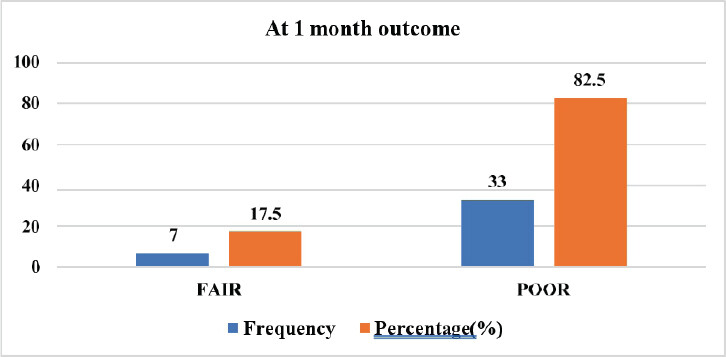
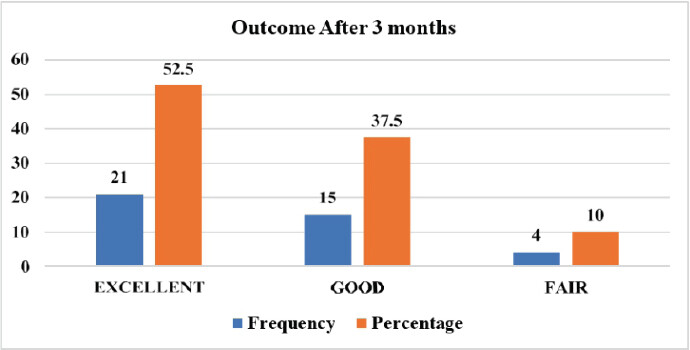
This study evaluated the management of fractures using the anterolateral approach for minimally invasive plate osteosynthesis (MIPO) technique and assessed the functional outcomes. The majority of respondents (37.5%) are aged 31–40 years, followed by 41–50 years (30.0%) and 18–30 years (25.0%) as seen in Table 1. RTAs are the leading cause of injury, accounting for 90.0% of cases. The data show that Schatzker Type VI fractures are more common, accounting for 55.0% of cases, while Type V fractures make up 45.0%, as shown in Table 2. Based on the one-sample statistics and applying the Modified Rasmussen Criteria for functional assessment. At 1-month post-treatment, the mean score was 10.20 (SD = 6.005), which generally corresponds to a fair outcome according to the Modified Rasmussen Criteria. By 3 months, the mean score had significantly increased to 26.90 (SD = 2.085), indicating a shift toward a good to excellent functional outcome. At 1 month postoperatively, the majority of patients (82.5%, 33 cases) had a poor Rasmussen’s score, while 17.5% (7 cases) showed a fair outcome. However, by 3 months or more, there was a significant improvement in functional outcomes. 52.5% (21 cases) achieved an excellent score, and 37.5% (15 cases) attained a good score. Only 10% (4 cases) remained in the fair category, with no patients classified as having a poor outcome, reflecting a notable recovery over time as shown in Table 3.
Distribution of study participants according to age groups
| Age Group | Frequency | Percentage |
|---|---|---|
| 18–30 Years | 10 | 25 |
| 31–40 Years | 15 | 37.5 |
| 41–50 Years | 12 | 30 |
| 51–60 Years | 3 | 7.5 |
Rasmussen score outcome assessment at 1 month and after 3 months
| Rasmussen score | At 1 Month | At ≥3 Months |
|---|---|---|
| Excellent | 0 | 21 (52.5 %) |
| Good | 0 | 15 (37.5 %) |
| Fair | 7 (17.5%) | 4 (10.0%) |
| Poor | 33 (82.5%) | 00 |
Distribution of study participants according to Schatzker type
| Schatzker type | Frequency | Percentage |
|---|---|---|
| V | 18 | 45 |
| VI | 22 | 55 |
Discussion
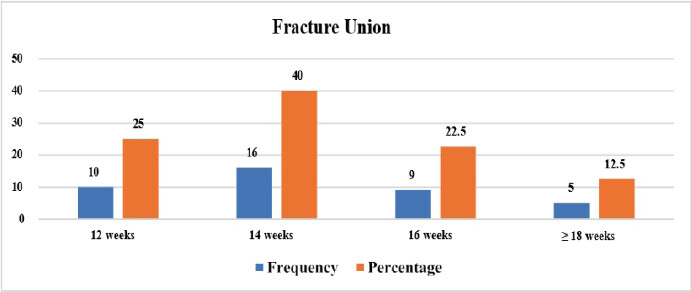
This study evaluated the management of fractures using the anterolateral approach for MIPO and assessed the functional outcomes. Relevant literature reports comparable outcomes. The analysis indicates that the majority of participants were male (85.0%), with females comprising 15.0%. The age distribution shows that 37.5% of respondents were aged 31–40 years, followed by 30.0% aged 41–50 years, and 25.0% aged 18–30 years. The data reveal that Schatzker Type VI fractures are more prevalent, accounting for 55.0% of cases, while Type V fractures constitute 45.0%, indicating a higher prevalence of severe tibial plateau fractures in the studied population. The study’s findings align with these observations, indicating a consistent pattern. At 1 month postoperatively, the functional outcome showed that 82.5% of patients had a poor outcome, while 17.5% achieved a fair outcome, reflecting limited functional recovery during the early postoperative period as the healing process continues as shown in Fig. 1. By 3 months postoperatively, there was significant improvement in the range of motion, with 87.5% of patients exhibiting good to excellent range of motion; 40.0% scored 5, and 47.5% scored 6. Only 5.0% reported moderate restriction (score 1), and 7.5% had mild limitations (score 3), indicating favorable recovery in joint mobility Fig. 2. Based on one-sample statistics, the mean score at 1-month post-treatment was 10.20 (SD = 6.005), generally corresponding to a fair outcome according to the Modified Rasmussen Criteria. By 3 months, the mean score significantly increased to 26.90 (SD = 2.085), indicating a shift toward a good to excellent functional outcome. Regarding fracture union, 25.0% (10 cases) achieved union within 12 weeks, suggesting a relatively expedited healing process. The majority, 40.0% (16 cases), attained fracture union by 14 weeks, indicating this as a common timeframe for bone healing. In addition, 22.5% (9 cases) experienced fracture union by 16 weeks, reflecting a moderate duration for recovery, while 12.5% (5 cases) required 18 weeks or longer to achieve union Fig. 3.
Limitations
The limited sample size may restrict generalizability; larger multi-center studies are needed. Although range of motion and Rasmussen’s score were assessed, other scoring systems could have evaluated recovery such as Oxford Knee Score. As a single-center study, findings may not represent populations, especially regions with different healthcare systems and surgical expertise. Quality of life, return to work, return to pre-injury activity, or patient satisfaction was not evaluated. There may be intersurgeon variability.
Conclusion
This prospective observational study shows that MIPPO via the anterolateral approach improves function in tibial plateau fractures, especially Schatzker Type V and VI. Although 1-month postoperative outcomes were poor, with 82.5% showing suboptimal function, marked recovery occurred by 3 months, when 90% achieved good to excellent outcomes by modified Rasmussen criteria. The mean Rasmussen score improved from 10.20 ± 6.005 at 1 month to 26.90 ± 2.085 at 3 months. Fracture union occurred in all patients, and 65% healed within 12–14 weeks. Complications included knee stiffness (15%), infection (10%), and malunion (7.5%), but 67.5% had no complications. MIPPO is an effective technique with minimal morbidity.
Clinical Message
Locking compression plate fixation using the minimally invasive percutaneous plate osteosynthesis (MIPPO) technique offers a reliable solution for managing complex bicondylar proximal tibial fractures (Schatzker type V–VI). Despite poor early postoperative function, significant recovery is achieved by 3 months, with most patients regaining good to excellent knee function. The technique ensures stable fixation, timely fracture union, and preservation of soft tissue integrity, thereby minimizing complications. MIPPO should be considered a preferred approach in appropriately selected cases to optimize outcomes in high-energy tibial plateau injuries.
Conflict of Interest:
Nil
Source of Support:
Nil
Consent:
The authors confirm that informed consent was obtained from the patient for publication of this article
References
- Choubisa R, Agarwal S, Meena DK, Sharma A, Prakash S. Minimally invasive percutaneous plate osteosynthesis in distal femur fractures using locking compression plate (LCP: A prospective study J Bone Joint Dis 2021;36:33-7. Google Scholar | PubMed
- Jain M, Singla B, Mavani K. A prospective study of operative results of intra-articular fractures of proximal tibia Natl J Clin Orthop 2017;1:20-4. Google Scholar | PubMed
- Jati S, Champawat V. A Midterm Analysis of Tibial Plateau Fractures: Functional Outcome and Incidence of Osteoarthritis in 240 Cases Zenodo: CERN European Organization for Nuclear Research; 2018 Google Scholar | PubMed
- Cho KY, Oh HS, Yoo JH, Kim DH, Cho YJ, Kim KI. Treatment of Schatzker type V and VI tibial plateau fractures using a midline longitudinal incision and dual plating Knee Surg Related Res 2013;25:77-83. Google Scholar | PubMed
- Porrino J, Wyatt AR Fracture Fixation Oxford:Oxford University 2019 130-3. Google Scholar | PubMed
- Pharaon SK, Schoch S, Marchand L, Mirza A, Mayberry J. Orthopaedic traumatology: Fundamental principles and current controversies for the acute care surgeon Trauma Surg Acute Care Open 2018;3:e000117. Google Scholar | PubMed
- Rodham PL, Giannoudis VP, Kanakaris NK, Giannoudis PV. Biological aspects to enhance fracture healing EFORT Open Rev 2023;8:264-82. Google Scholar | PubMed
- Shivalingaiah DK, Mahesh DU, John DB. Functional outcome in schatzker type V and VI tibial plateau fractures Natl J Clin Orthop 2018;2:109-12. Google Scholar | PubMed
- Ramachandran M, Little DG. Orthopedic principles of fracture management In: Primer on the Metabolic Bone Diseases and Disorders of Mineral Metabolism United States: Wiley 2018 588-92. Google Scholar | PubMed
- Wise PM, Saiz AM, Haller J, Wenke JC, Schaer T, Schneider P, et al. Preclinical models of orthopaedic trauma: Orthopaedic research society (ORS) and orthopaedic trauma association (OTA) symposium 2022 OTA Int 2024;7 Suppl 2 e303. Google Scholar | PubMed
© 2026 Journal of Orthopaedic Case Reports - Published by Indian Orthopaedic Research Group
About the Authors
-

Dr. Mayank Uikey
-

Dr. Vishal Singh
-

Dr. Harshit Dahiya
Related Articles in Journal of Orthopaedic Case Reports
 April 10, 2016 Erythromycin Seromadesis in Orthopedic Surgery
 September 1, 2026 Functional Outcomes of Arthroscopic Double-Row Repair Using Single Anchors in Each Row for Massive Rotator Cuff Tears
 July 10, 2018 Progressive Osteolysis with Hematoma Following Revision Total Hip Arthroplasty using Hydroxyapatite Mesh: A Case Report
 November 1, 2025 Assessment of Functional Outcome of Arthroscopic Microfractures for Osteochondral Defect of Talus