

Adderall usage may predispose patients to musculoskeletal injuries. Caution should be taken when prescribing this medication.
Dr. Christina M Melian, Department of Orthopaedic Surgery, Albany Medical Center, Albany, New York, USA. E-mail: melianc@amc.edu
Abstract
Introduction: Gastrocnemius tears most commonly occur after a forceful eccentric contraction of the muscle. Adderall (i.e., amphetamine/dextroamphetamine), a commonly prescribed medication in the United States, has been proven to have many adverse effects. However, this is the first report demonstrating a potential musculoskeletal side effect of Adderall.
Case Report: A 40-year-old male sustained an atraumatic medial gastrocnemius tear after taking Adderall. The patient presented with calf pain, swelling, and ecchymosis after having severe, sustained muscle spasms. He was found to have exquisite tenderness over the medial head of the gastrocnemius, worse with ankle dorsiflexion and knee extension. The Thompson test and deep vein thrombosis ultrasound were negative. He was diagnosed clinically with a tear of the medial head of the gastrocnemius. Adderall was discontinued, and he was treated conservatively with full resolution of symptoms.
Conclusion: The case highlights the potential for Adderall (amphetamine/dextroamphetamine) to predispose patients to musculoskeletal injuries such as gastrocnemius tears, a phenomenon not previously described in the literature.
Keywords: Gastrocnemius, Adderall, amphetamine, dextroamphetamine.

Injury to the gastrocnemius is a common cause of calf pain, ranging from muscle strain to complete rupture [1,2,3]. Initially described in athletes, tear of the medial head of the gastrocnemius tendon, “tennis leg,” has also been observed in less active, middle-aged individuals during strenuous activity [2]. It is typically caused by a rapid eccentric contraction of the gastrocnemius muscle during push-off of the foot, as in running or jumping [1]. The gastrocnemius makes up the majority of the superficial posterior compartment of the lower leg and is composed of two heads: Medial and lateral. The medial head is thought to be vulnerable to injury due to its more active role in toe off [4]. Because the gastrocnemius spans both the knee and ankle joint, it can extend the knee while plantar flexing the foot. Such simultaneous active contraction and passive stretching can result in significant strain on the muscle, ultimately leading to a tear most commonly at the myotendinous junction [2,5]. The typical presentation of a gastrocnemius tear is someone who complains of a pop in the back of the calf after strenuous activity, followed by the sudden onset of calf pain and tightness. There may even be a palpable defect in the belly of the gastrocnemius just above the myotendinous junction [1]. Diagnosis can be made clinically without the need for imaging. However, ultrasound has been shown to be useful in aiding a diagnosis and guiding treatment [2,3]. Treatment usually involves conservative measures with rest, ice, and anti-inflammatory medications; however, there have been cases of surgical repair in patients who fail to return to daily activities [5]. Risk factors for gastrocnemius tears include athletes, older individuals, patients with a previous calf injury, and higher body mass index (BMI) [4]. While not specific to gastrocnemius injury, certain medications have been associated with tendinopathy and possible rupture, including corticosteroids, fluoroquinolones, aromatase inhibitors, and statins [6]. Amphetamine/dextroamphetamine, also known as Adderall, is commonly used for the treatment of attention-deficit/hyperactivity disorder (ADHD) and has been reported to cause severe muscle pain and stiffness [7]; however, there has not been a proven association of Adderall with gastrocnemius tear. In addition, the drug label does not list muscle/tendon injury as a potential adverse effect. We report a case of a medial gastrocnemius tear in a patient initiated on Adderall for the management of ADHD. The goal of this report is to expand upon the knowledge of gastrocnemius injuries and raise awareness of a potential side effect of Adderall. The patient discussed in this case signed and agreed for their data to be submitted.
A 40-year-old male with a history of psoriasis and a recent diagnosis of ADHD presented 1 month after initiating Adderall with complaints of calf pain, swelling, and ecchymosis. The patient was prescribed 20 mg Adderall XR (extended release) twice daily for management of his ADHD. He was on medication for 1 month before experiencing severe, sustained muscle spasms in his lower extremity that woke him from sleep and lasted approximately 15 min. The following day, he experienced worsening calf pain, swelling, and ecchymosis along the medial calf (Fig. 1).
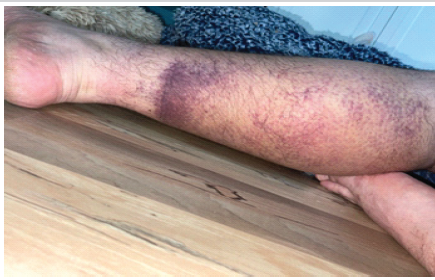
Figure 1: Clinical photograph of the posteromedial calf demonstrating significant ecchymosis following injury.
Calf pain was found to be worse with ankle dorsiflexion, particularly when his knee was extended. He presented to the emergency department, where a deep vein thrombosis (DVT) ultrasound was performed and negative for thrombus. While he had significant calf tenderness and stretch pain, compartment syndrome was ruled out, and he was discharged with outpatient referral to orthopedics. In the office, his pain, swelling, and ecchymosis were found to be improving. He had pain with direct pressure over the medial head of his gastrocnemius. The Thompson test was negative for Achilles rupture. Based on clinical examination, he was diagnosed with a tear of the medial head of his gastrocnemius. Treatment consisted of conservative measures with activity modification, ice, elevation, and anti-inflammatories. His Adderall was discontinued. At the time of initial presentation, the patient also had complaints of burning in the bilateral triceps at the distal insertion. He denied any strenuous activity in the days leading up to his injury and had never experienced these symptoms before. His pre-injury activity level was low-moderate. While in the emergency department, his laboratory markers were unremarkable, ruling out dehydration or electrolyte imbalance as a potential cause for his muscle spasms. In addition to recent Adderall use, his only other medications included Zoryve (roflumilast) creame 0.3% and clobetasol scalp foam, which he had been taking for the past several years for his psoriasis. He denied any tobacco use and had a BMI of 43.5.
In summary, this case report discusses a 40-year-old male who presented with calf pain, swelling, and ecchymosis after taking Adderall, or amphetamine/dextroamphetamine, for treatment of ADHD. History and physical examination led to a diagnosis of a tear of the medial head of the gastrocnemius tendon, which, after ruling out other causes, was thought to be due to his recent Adderall use. His Adderall was therefore discontinued, and his symptoms were managed conservatively with adequate response. Six months after discontinuation of Adderall, he reports complete resolution of calf pain and triceps tendinopathy. Adderall is a central nervous system stimulant that increases dopamine, norepinephrine, and serotonin in the synaptic cleft [8]. Increased norepinephrine can lead to increased muscle tone by amplifying glutamate-driven excitatory activity, leading to muscle contraction [9]. Swisher et al. report a case of rhabdomyolysis from non-toxic doses of dextroamphetamine as a result of muscle hyperactivity [8]. Lisdexamfetamine, more commonly known as Vyvanse, is another stimulant drug used in the treatment of ADHD, and has also been shown to cause muscle pain and stiffness in some patients [7]. In addition to muscle injury, Adderall has a black box warning for potential substance abuse. Serious adverse effects of the medication include cardiovascular events such as sudden death, stroke, and myocardial infarction. Less severe side effects include headache, dizziness, dry mouth, weight loss, and trouble sleeping [10]. Injury to the medial head of the gastrocnemius typically occurs at the myotendinous junction as a result of sudden explosive movements, overuse, or inadequate warm-up [11]. Prodromal symptoms such as muscle cramps or dull muscle pain can be seen in as many as 20% of patients [4]. Common clinical findings include posteromedial calf pain preceded by a feeling of a pop, swelling, and ecchymosis. Pain is usually exacerbated with ankle dorsiflexion or resisted ankle plantarflexion with knee extension [4]. Although diagnosis is clinical, it is important to rule out other causes of calf pain, such as DVT, compartment syndrome, thrombophlebitis, and Achilles tendon rupture [1,2]. Ultrasound can be considered to confirm a gastrocnemius tear and differentiate between partial and complete tears. It may also be used to determine the extent of soft tissue injury and evaluate for possible compressive hematoma [1,3]. The treatment for a gastrocnemius tear is usually conservative with ice, elevation, and non-steroidal anti-inflammatory medications. Kwak et al. recommend the use of crutches with a neoprene cast sleeve for 2–4 weeks after injury, followed by a passive and active stretching program for another 2 weeks [2]. Other reports recommend a more rigorous rehabilitation protocol with step-wise progression from active range of motion exercises to isometric exercises and resistance training [1]. While less common, there have also been reports of surgical repair in cases resistant to conservative measures [5]. The patient described in this report sustained a tear of his gastrocnemius without an inciting event or prodrome. His lower baseline activity level and lack of prior calf injury make this injury unusual, especially given the atraumatic nature. While this patient’s BMI is higher than normal, this alone would not explain the symptoms that occurred while he was sleeping. The only change made to this patient’s lifestyle leading up to his injury was the initiation of Adderall, making it the prime suspect for the injury. In addition, the patient reported complete resolution of symptoms 6 months after discontinuing the medication. While we cannot infer causation, this report simply suggests a potential side effect of Adderall not commonly described in the literature.
Adderall use may predispose patients to soft-tissue injuries such as a gastrocnemius tear. Caution should be taken when prescribing this medication. In addition, gastrocnemius tears may mimic other lower extremity conditions and require a thorough history and physical examination to rule out other causes of calf pain. Treatment is typically conservative, with few cases necessitating surgery. Further studies should explore the correlation between stimulant medications, such as Adderall, and myotendinous injuries better to understand the associated risks and potential mechanism of action.
Adderall may cause adverse musculoskeletal effects not listed on its drug label. Therefore, it is important that patients taking Adderall undergo serial monitoring and understand the potential risks of the medication.
References
- 1. Nsitem V. Diagnosis and rehabilitation of gastrocnemius muscle tear: A case report. J Can Chiropr Assoc 2013;57:327-33. [Google Scholar] [PubMed]
- 2. Kwak HS, Han YM, Lee SY, Kim KN, Chung GH. Diagnosis and follow-up US evaluation of ruptures of the medial head of the gastrocnemius (“tennis leg”). Korean J Radiol 2006;7:193-8. [Google Scholar] [PubMed]
- 3. Flecca D, Tomei A, Ravazzolo N, Martinelli M, Giovagnorio F. US evaluation and diagnosis of rupture of the medial head of the gastrocnemius (tennis leg). J Ultrasound 2007;10:194-8. [Google Scholar] [PubMed]
- 4. Halabchi F, Tavana MM, Seifi V, Mahmoudi Zarandi M. Medial gastrocnemius strain: Clinical aspects and algorithmic approach. Med J Islam Repub Iran 2024;38:55. [Google Scholar] [PubMed]
- 5. Cooper J, Arner JW, Peebles LA, Provencher MT. Surgical treatment of medial gastrocnemius tear. Arthrosc Tech 2021;10:e519-23. [Google Scholar] [PubMed]
- 6. Knobloch K. Drug-Induced Tendon Disorders. Adv Exp Med Biol 2016;920:229-38. [Google Scholar] [PubMed]
- 7. Kon JJ, Kon AA. Severe muscle pain and stiffness due to dexmethylphenidate. Clin Case Rep 2020;8:420-2. [Google Scholar] [PubMed]
- 8. Swisher AR, Pham R, Theodory B, Valiani S, Gowda N. Rhabdomyolysis and the use of low-dose amphetamine. Cureus 2022;14:e27357. [Google Scholar] [PubMed]
- 9. Schwarz PB, Yee N, Mir S, Peever JH. Noradrenaline triggers muscle tone by amplifying glutamate-driven excitation of somatic motoneurones in anaesthetized rats. J Physiol 2008;586:5787-802. [Google Scholar] [PubMed]
- 10. Administration FaD. Adderall XR Label. Available from: https://www.accessdata.fda.gov/drugsatfda_docs/label/2013/021303s026lbl.pdf [Last accessed 2025 Aug 20]. [Google Scholar] [PubMed]
- 11. Berthold DP, Traub F, Gilbert F, Böcker W, Holzapfel B, Bormann M. Partial tear of the medial gastrocnemius head: A case report of meniscal symptoms in a 32-year-old recreational athlete. Teilruptur des medialen Kopfs des M. gastrocnemius: Ein Fallbericht über typischerweise mit Meniskusverletzungen assoziierte Symptome bei einem 32-jährigen Freizeitsportler. Unfallchirurgie (Heidelb) 2025;128:319-23. [Google Scholar] [PubMed]


Related Articles in Journal of Orthopaedic Case Reports
 August 1, 2026 Bicruciate Ligament Avulsions, Lateral Meniscus Dual Root Avulsions – “Tibial Avulsion Tetrad” – with Menisco-capsular Injury – Floating Meniscus in Innocuous Looking Proximal Tibia Fracture
 July 1, 2026 Atypical Presentation of MRSA Septic Arthritis with Concurrent Pyomyositis of the Calf Muscles in an Immunocompetent Adult
 October 10, 2020 Combined Talus Fracture with Medial Malleolar Fracture: A Case report with Review of Literature
 January 1, 2026 Ten Foundational Principles in Hand Surgery: A Primer for Orthopedic Practice