

A progressively enlarging pulsatile scalp mass following blunt head trauma should raise suspicion for superficial temporal artery pseudoaneurysm, even in helmeted athletes.
Dr. Nathan Fitton, Department of Orthopedics, Michigan State University College of Osteopathic Medicine, 4660 S Hagadorn Rd, Suite 420, East Lansing - 48823, Michigan, USA. E-mail: fittonna@msu.edu
Abstract
Introduction: Superficial temporal artery pseudoaneurysm is a rare vascular complication of blunt head trauma and may be overlooked due to delayed presentation and minimal initial findings.
Case Report: A helmeted adolescent lacrosse player sustained blunt trauma to the right superolateral forehead after being struck by a lacrosse ball. He subsequently developed a progressively enlarging, pulsatile scalp mass. Point-of-care ultrasound demonstrated Doppler flow within the lesion, and further evaluation with ultrasound and computed tomography confirmed a pseudoaneurysm arising from the frontal branch of the superficial temporal artery. The patient underwent surgical excision and ligation of the affected vessel without complications.
Conclusion: Early recognition and appropriate imaging are essential for the diagnosis of superficial temporal artery pseudoaneurysm and allow timely surgical management with excellent clinical outcomes.
Keywords: Superficial temporal artery pseudoaneurysm, head trauma, lacrosse injury, pulsatile scalp mass.

An adolescent male presented to Michigan State University’s Primary Care Sports Medicine Clinic after experiencing head trauma from a lacrosse ball while wearing a helmet. Since the event, he had developed a gradually enlarging mass where he was struck.
Two weeks following the trauma, the patient reported persistent swelling and pain in the right superolateral forehead, exacerbated by pressure. Physical examination revealed a soft, compressible, and pulsatile mass. Beyond this, there were no neurological deficits or other examination abnormalities. The point-of-care ultrasound (POCUS) showed Doppler flow in the mass. As a result, a formal US was ordered and showed a 1.1 × 0.6 × 0.8-cm pseudoaneurysm in the superiorlateral right scalp at the trauma site, located in the deep subcutaneous fat layer. Due to the severity and location, a follow-up computed tomography (CT) was performed, which confirmed the pseudoaneurysm, which originated from the frontal branch of the superficial temporal artery, and ruled out skull fractures or intracranial involvement. Neurosurgery was consulted at this time.
The superficial temporal artery is a terminal branch of the external carotid artery that supplies the anterior temporal and parietal regions of the scalp [1]. Most pseudoaneurysms involving this vessel result from direct blunt trauma and typically present as a painless, pulsatile mass that progressively enlarges over time [2]. Unlike true aneurysms, which often occur spontaneously, pseudoaneurysms arise from disruption of the arterial wall with formation of a contained hematoma [3]. Imaging plays a critical role in diagnosis, with ultrasound demonstrating characteristic turbulent flow and CT angiography confirming vascular origin and extent [4-6]. Several repots describe similar delayed presentation following blunt trauma, emphasizing progressive enlargement of a pulsatile mass [7-10]. In this case, the patient underwent surgical excision and coagulation of the affected 3-cm arterial segment under general anesthesia (Fig. 1). The post-operative course was uncomplicated, and the patient made a full recovery with return to athletic participation.
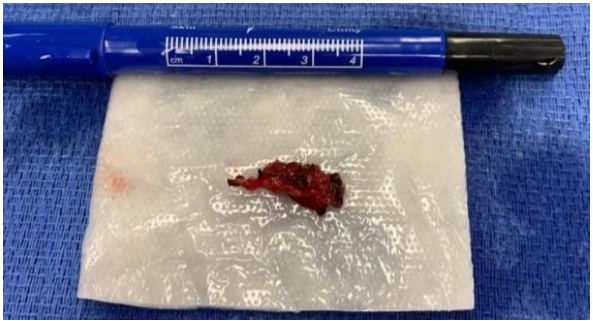
Figure 1: Resected superficial temporal artery pseudoaneurysm measuring approximately 3 cm in length.
Superficial temporal artery pseudoaneurysm is an uncommon but important diagnosis following blunt head trauma, particularly in young athletes. Delayed presentation and subtle initial symptoms may contribute to missed or late diagnosis. This case highlights the utility of POCUS as an initial diagnostic tool, followed by confirmatory imaging with CT. Prompt surgical management resulted in excellent clinical outcomes and a safe return to sport. Clinicians should maintain a high index of suspicion for vascular injury when evaluating post-traumatic scalp masses.
Persistent or enlarging pulsatile scalp masses after head trauma should be evaluated promptly with ultrasound and advanced imaging to rule out superficial temporal artery pseudoaneurysm and prevent delayed complications.
References
- 1. Tajran J, Gosman AA. Anatomy, head and neck, scalp. In: StatPearls. Treasure Island, FL: StatPearls Publishing; 2024. [Google Scholar] [PubMed]
- 2. Sommer C, Braye E, Rotman S, Joseph JM. Superficial temporal artery pseudoaneurysm after head injury in a teenager. J Pediatr Surg Case Rep 2020;61:101592. [Google Scholar] [PubMed]
- 3. Isaacson G, Kochan PS, Kochan JP. Pseudoaneurysms of the superficial temporal artery: Treatment options. Laryngoscope 2004;114:1000-4. [Google Scholar] [PubMed]
- 4. Corvino A, Di Leo G, Grassi R, Sandomenico F, Setola SV, Catalano O, et al. Superficial temporal artery pseudoaneurysm: Radiological spectrum and role of imaging. Ultrasound 2016;24:221-7. [Google Scholar] [PubMed]
- 5. Saliba E, Apruzzi L, Bossi M, Cozzi D, Cavigli E, Pradella S, et al. Superficial temporal artery pseudoaneurysm: Report of two cases and review of the literature. Int Arch Vasc Med 2021;2021:8887692. [Google Scholar] [PubMed]
- 6. Younus SM, Imran M, Qazi R. Superficial temporal artery pseudoaneurysm: A case report. Front Surg 2015;2:51. [Google Scholar] [PubMed]
- 7. Rubio-Palau J, Ferrer-Fuertes A, García-Linares J, Martínez-Lage JL, Martorell-Calatayud A, Sahuquillo-Barris J, et al. Pseudoaneurysm of the superficial temporal artery after blunt trauma: Case report and literature review. Australas Radiol 2014;58:45 [Google Scholar] [PubMed]
- 8. Alkhaibary A, Alharbi A, Alnefaie N, Aloraidi A, Almutairi A, Alhassan A, et al. Traumatic superficial temporal artery pseudoaneurysm: Case report and literature review with outcomes. J Craniofac Surg 2021;32:e445-8 . [Google Scholar] [PubMed]
- 9. Madhusudan HV, Reddy MK, Reddy KJ, Rao GV, Kumar SP, Prasad VS, et al. Superficial temporal artery pseudoaneurysm presenting as a growing pulsatile and tender mass: A case report. Surg Neurol Int 2015;6:85 . [Google Scholar] [PubMed]
- 10. Kang I, Mo YW, Jung GY, Shin HK. Pseudoaneurysm of the superficial temporal artery after blunt trauma: Case report and literature review. Arch Craniofac Surg 2022;23:130-3. [Google Scholar] [PubMed]

Related Articles in Journal of Orthopaedic Case Reports
 August 10, 2023 Subperiosteal Osteoid Osteoma in the Coronoid Fossa Mimicking Early Elbow Arthropathy: A Case Report
 April 7, 2013 Bilateral Total Hip Arthroplasty in 20 Years Old Female with Neglected Developmental Dysplasia of Hip
 July 1, 2025 A Large-diameter Corona Mortis Artery Encountered During Surgery for Acetabular Fracture: A Case Report and Review of Anatomical Significance
 March 1, 2026 Equal Shoulders, Equal Scalpel: Women in Orthopedic Residency