


Introduction
Osteoarthritis (OA) of the knee is among the most common degenerative joint disorders globally, predominantly affecting the elderly. It is marked by progressive cartilage degradation, subchondral bone remodeling, osteophyte formation, and synovial inflammation, which collectively result in pain, stiffness, deformity, and functional impairment [1]. Epidemiological data suggest that knee OA affects up to 40% of individuals over 60 years old, with a higher prevalence in women than in men [2]. The disease burden is exacerbated by risk factors such as obesity, prior joint trauma, genetic predisposition, and occupational stressors. Patients with knee OA often report discomfort, stiffness, and restricted mobility, leading to a diminished quality of life [3]. The Kellgren–Lawrence (K-L) grading system is the most widely utilized radiographic classification for assessing OA severity, with Grade IV indicating end-stage disease characterized by severe joint space narrowing, large osteophytes, subchondral sclerosis, and significant deformity [4]. At this stage, conservative treatments – including analgesics, physiotherapy, and intra-articular injections – provide limited relief, often necessitating surgical intervention [5]. Total knee arthroplasty (TKA) is considered the gold standard for treating advanced knee OA. This procedure involves resurfacing the affected joint with prosthetic components, thereby restoring alignment, stability, and mobility while alleviating pain. Globally, TKA has shown high success rates, with notable improvements in patient-reported outcomes such as the Oxford Knee Score (OKS) and quality of life indices [6]. Nonetheless, challenges persist regarding perioperative complications, implant longevity, and patient satisfaction, particularly among individuals with comorbidities or severe deformities [7]. The global burden of knee OA is significant. According to the Global Burden of Disease study (2010), hip and knee OA ranked 11th among causes of disability, with patients experiencing an average of 10 years of functional limitations [8]. The socioeconomic impact is considerable, as OA reduces workforce participation, increases healthcare costs, and limits social engagement. In India, the increasing prevalence of obesity and sedentary lifestyles has contributed to the rising incidence of knee OA, making TKA a more frequent surgical procedure in tertiary care centers [9].
Despite the widespread adoption of TKA, outcomes can vary based on patient demographics, surgical technique, prosthesis design, and rehabilitation protocols. This study was designed to prospectively evaluate the functional outcomes of TKA in patients with K-L Grade IV OA, using the OKS as a validated measure of pain, mobility, and daily activity performance [10]. By concentrating on this advanced disease stage, the research aims to provide insights into the effectiveness of TKA in restoring function and enhancing quality of life in severely disabled patients.
Materials and Methods
Study design
This was a single-center, prospective observational study conducted in the Department of Orthopaedics at LN Medical College and Research Centre, Bhopal, between January 2022 and December 2023. The study was approved by the Institutional Ethics Committee (Ref. No. LNMC&RC/Dean/2022/Ethics/083), and written informed consent was obtained from all participants before enrollment.
Participants
Inclusion criteria
-
Patients aged 50–75 years
-
Diagnosed with K-L Grade IV OA of the knee
-
Candidates for TKA.
Exclusion criteria
-
Patients with rheumatoid arthritis, post-traumatic arthritis, or prior knee surgery
-
Severe comorbidities contraindicating surgery (e.g., uncontrolled diabetes, cardiac failure), as shown in Fig. 1.
-
Refusal to participate or inability to provide informed consent.
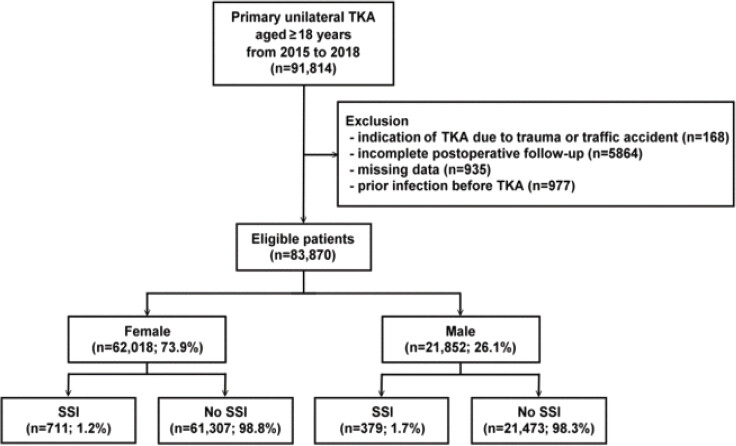
Sample size
A total of 50 patients were recruited consecutively based on inclusion criteria. Both unilateral and bilateral TKA cases were included.
Pre-operative assessment
-
Detailed clinical examination including range of motion, deformity, and fixed flexion deformity (FFD)
-
Radiographic evaluation using standing anteroposterior and lateral views
-
Baseline functional status assessed using the OKS
-
Routine blood investigations and anesthetic clearance obtained.
Surgical procedure
-
Approach: Standard median parapatellar arthrotomy.
-
Implant: Cemented posterior cruciate ligament-retaining prosthesis.
-
Steps:
-
Midline longitudinal skin incision
-
Distal femoral cut using an intramedullary guide
-
Proximal tibial cut using an extramedullary guide
-
Trial component placement and soft-tissue balancing
-
Pulsatile lavage and cementing of cut surfaces
-
Final placement of the femoral, tibial, and polyethylene components
-
Closure with absorbable sutures and skin staples.
Post-operative protocol
-
Hospital stay: Average 7–10 days
-
Rehabilitation: Early mobilization with physiotherapy initiated on post-operative day 1
-
Medications: Analgesics, antibiotics, and thromboprophylaxis as per institutional protocol
-
Follow-up: Patients were reviewed at 3, 6, and 9 months postoperatively.
Outcome measures
Functional improvement is assessed using the OKS at each follow-up interval.
Statistical analysis
Data were analyzed using the Statistical Package for the Social Sciences software (version 25.0). Continuous variables were expressed as mean ± standard deviation. Paired t-tests were used to compare pre-operative and post-operative OKS scores. P < 0.05 was considered statistically significant.
Results
A total of 50 patients with K-L Grade IV OA underwent TKA during the study period. The age distribution (Table 1) showed that most patients were between 61 and 65 years, accounting for 40% of the cohort, while the mean age was 63 years. This reflects the typical demographic profile of advanced knee OA, consistent with global epidemiological data. The sex distribution revealed a female predominance (64%), which aligns with literature indicating higher prevalence of knee OA among women. Outcomes were evaluated only up to 9 months postoperatively.
Demographic details
| Variable | Distribution | Percentage |
|---|---|---|
| Age | 55–60 years (n=18), 61–65 years (n=20), 66–70 years (n=12) | Majority between 61 and 65 years (40%) |
| Sex | Female (n=32), male (n=18) | Female predominance (64%) |
| Side involvement | Right (n=28), left (n=22) | Slight right-sided predominance |
| Occupation | Homemakers (n=25), farmers (n=10), office workers (n=8), others (n=7) | Homemakers most affected |
| BMI | Normal (n=12), overweight (n=20), obese (n=18) | Overweight/obese patients formed 76% |
BMI: Body mass index
Regarding side involvement, the right knee was more frequently affected (56%) compared to the left. Occupational analysis demonstrated that homemakers formed the largest group (50%), followed by farmers and office workers, suggesting that repetitive household and agricultural activities may contribute to disease progression. The body mass index (BMI) distribution highlighted that 76% of patients were overweight or obese, reinforcing obesity as a major risk factor for knee OA.
The mean hospital stay was 8.2 ± 1.5 days, with most patients discharged between 7 and 10 days. Pre-operative deformities were common: Angular deformity was predominantly varus (60%), whereas FFD was present in 36% of patients. Postoperatively, these deformities were corrected in all cases.
Complications were minimal. Minor wound infections occurred in 6% of patients, and post-operative stiffness occurred in 4%. Importantly, no major complications such as deep vein thrombosis (DVT) or implant loosening were reported during the follow-up period.
Functional outcomes were assessed using the OKS. As shown in Table 2, the mean OKS improved significantly from a pre-operative baseline of 18.4 ± 3.2 to 28.6 ± 4.1 at 3 months, 34.2 ± 3.8 at 6 months, and 40.1 ± 2.9 at 9 months. This represents a 118% improvement over baseline, with statistical significance (P < 0.001). The progressive rise in OKS reflects substantial pain relief, improved mobility, and enhanced quality of life. The results demonstrate that TKA in Grade IV OA patients leads to marked functional improvement, correction of deformities, and minimal complications. Both unilateral and bilateral TKA cases were included in the study.
Oxford knee score (OKS)
| Time interval | Mean OKS±SD | Improvement (%) |
|---|---|---|
| Pre-operative | 18.4±3.2 | – |
| 3 months | 28.6±4.1 | 55 |
| 6 months | 34.2±3.8 | 86 |
| 9 months | 40.1±2.9 | 118 |
SD: Standard deviation
The present prospective study evaluated the functional outcomes of TKA in patients with K-L Grade IV OA. The results demonstrated significant improvements in pain relief, mobility, and overall quality of life, as measured by the OKS. These findings reinforce the role of TKA as the gold standard treatment for end-stage knee OA, while also highlighting demographic and clinical patterns that influence outcomes.
One of the key observations was the age distribution of patients, with the majority falling between 61 and 65 years. This is consistent with global epidemiological data, which identifies the sixth and seventh decades of life as the peak incidence for advanced knee OA. The mean age of 63 years in this study closely parallels findings reported by Insall et al., who noted that most TKA candidates are in their early sixties [11]. This age group represents a critical window where patients are sufficiently active to benefit from improved mobility, yet old enough to justify surgical intervention given the progressive nature of OA. The sex distribution revealed a female predominance (64%), which is in line with previous studies showing higher prevalence of knee OA among women. Hormonal influences, differences in bone density, and lifestyle factors have been implicated in this disparity. Felson et al. reported that post-menopausal women are particularly vulnerable to rapid progression of knee OA, which may explain the predominance observed in this cohort [12]. The findings underscore the importance of gender-sensitive approaches in both prevention and management of OA.
BMI emerged as another significant factor, with 76% of patients being overweight or obese. Obesity is a well-established risk factor for both the development and progression of knee OA, due to increased mechanical loading and metabolic influences such as adipokines. The high proportion of obese patients in this study mirrors global trends, particularly in urban Indian populations where sedentary lifestyles and dietary changes have contributed to rising obesity rates. However, the influence of BMI on post-operative functional improvement or complications was not analyzed in the study. This reinforces the need for weight management strategies both before and after TKA to optimize outcomes [13].
Pre-operative deformities were common, with varus deformity predominating (60%) and FFD present in 36% of patients. These deformities were successfully corrected postoperatively, demonstrating the effectiveness of TKA in restoring alignment and stability. Similar findings have been reported by Rand and Ilstrup, who emphasized that correction of deformity is a major determinant of post-operative satisfaction [14]. The ability of TKA to address both pain and mechanical alignment makes it superior to conservative measures in advanced disease.
The functional outcomes, as measured by OKS, showed progressive improvement at each follow-up interval. The mean OKS increased from 18.4 preoperatively to 40.1 at 9 months, representing a 118% improvement. This trajectory is consistent with international literature. Murray et al., in their validation of the OKS, reported similar improvements in pain and function following TKA [15]. The statistically significant rise in OKS in this study confirms that patients not only experienced pain relief but also regained independence in daily activities. Complications were minimal, with only minor wound infections (6%) and post-operative stiffness (4%) reported. No major complications such as DVT or implant loosening occurred during the follow-up period. This low complication rate reflects meticulous surgical technique, appropriate perioperative care, and early mobilization protocols. Previous studies have reported complication rates ranging from 5% to 10%, suggesting that the outcomes in this cohort are comparable or even slightly better than international benchmarks [16].
When compared with earlier studies, the findings of this research are largely consistent. For instance, Insall et al. and Rand and Ilstrup both reported significant functional gains and high patient satisfaction following TKA. The improvement in OKS scores in this study mirrors those reported in Western populations, suggesting that TKA outcomes are universally favorable across diverse demographic settings. However, the predominance of obese and female patients in this cohort highlights the need for context-specific strategies in India, where lifestyle and cultural factors may influence disease progression and recovery.
The socioeconomic implications of these findings are considerable. Knee OA is a major cause of disability, reducing workforce participation and increasing dependency. By restoring mobility and independence, TKA not only improves individual quality of life but also reduces the societal burden of disability. In resource limited settings, however, the high cost of TKA remains a barrier. This underscores the importance of public health initiatives to improve access to surgical care, particularly for women and obese patients who are disproportionately affected. TKA provides substantial functional improvement in patients with Grade IV knee OA. The demographic profile of patients – predominantly elderly, female, and overweight-reflects broader epidemiological trends. The correction of deformities, minimal complications, and significant rise in OKS scores all support the effectiveness of TKA. These findings are consistent with international literature, reinforcing the global applicability of TKA as the definitive treatment for end-stage knee OA. Future research should focus on long-term outcomes, implant survival, and strategies to enhance access to TKA in low-resource settings.
Conclusion
This prospective study on TKA for K-L Grade IV OA shows TKA effectively improves pain, mobility, and quality of life, with OKSs rising from 18.4 preoperatively to 40.1 at 9 months. Most patients were elderly, female, and overweight. Pre-operative deformities were corrected, complications were minimal, and no major implant failures occurred. These results align with global evidence supporting TKA as the gold standard for advanced knee OA, enhancing joint function and patient independence.
Clinical Message
TKA is the suitable treatment for patients with K-L Grade IV OA, offering substantial pain relief, correction of deformities, and restoration of mobility. The procedure significantly improves functional outcomes, as reflected in the OKS, and enhances overall quality of life with minimal complications.
Conflict of Interest:
Nil
Source of Support:
Nil
Consent:
The authors confirm that informed consent was obtained from the patient for publication of this article
References
- Khan MM, Salek A, Ahmed SM, Ferdous J, Moyeenuzzaman M. Physical management of patient with osteoarthritis of knee Bangabandhu Sheikh Mujib Med Univ J 2010;2:95-8. [Google Scholar] | [PubMed]
- Jadhao AR, Dambhare PM. Study of magnitude of knee osteoarthritis among adult population with age 40 years and above in rural area: a cross sectional study International J Community Med Public Health 2021;8 2 707 DOI: https://doi.org/10.18203/2394-6040.ijcmph20210225 [Google Scholar] | [PubMed] | [CrossRef]
- Gelber AC. Knee osteoarthritis Ann Intern Med 2024;177:ITC129-44. [Google Scholar] | [PubMed]
- Hayes B, Kittelson A, Loyd B, Wellsandt E, Flug J, Stevens-Lapsley J. Assessing radiographic knee osteoarthritis: An online training tutorial for the Kellgren-Lawrence grading scale MedEdPORTAL 2016;12:10503. [Google Scholar] | [PubMed]
- Pan J, Wu Y, Tang Z, Sun K, Li M, Sun J, et al. Automatic knee osteoarthritis severity grading based on X-ray images using a hierarchical classification method Arthritis Res Therap 2024;26 1 203 https://doi.org/10.1186/s13075-024-03416-4. [Google Scholar] | [PubMed] | [CrossRef]
- Tampere T, Arnout N, Victor J. Total knee arthroplasty: The need for better patient selection Knee Surg Sports Traumatol Arthrosc 2024;33:784-8. [Google Scholar] | [PubMed]
- Jokstad A. Common complications with implants and implant prostheses Evid Based Dent 2004;5:70-1. [Google Scholar] | [PubMed]
- Langworthy M, Dasa V, Spitzer AI. Knee osteoarthritis: disease burden, available treatments, and emerging options Therapeutic Advances Musculoskeletal Dis 2024;16:1759720X241273009 DOI: https://doi.org/10.1177/1759720x241273009 [Google Scholar] | [PubMed] | [CrossRef]
- Hazra S, Mondal K, Bhattacharya D, Handa G. Prevalence of knee osteoarthritis in India: A systematic review and meta-analysis of population-based studies JOIO 2025;59:1785-96. [Google Scholar] | [PubMed]
- Jones BK, Carlson BJ, Keller HM, Vuong T, Todderud J, Scott D. Two-Year Outcomes are Equal in Kellgren-Lawrence Osteoarthritis Grades 1-4 after Total Knee Arthroplasty with Medial-Pivot Implants and Kinematic Alignment J Ortho Experience & amp; Innovation, 2024;5 (2) DOI: https://doi.org/10.60118/001c.117414 [Google Scholar] | [PubMed] | [CrossRef]
- Insall JN, Ranawat CS, Aglietti P, Shine J. A comparison of four models of total knee replacement prostheses J Bone Joint Surg Am 1976;58:754-65. [Google Scholar] | [PubMed]
- Felson DT, Zhang Y, Hannan MT, Naimark A, Weissman BN, Aliabadi P, et al. The incidence and natural history of knee osteoarthritis in the elderly The Framingham osteoarthritis study. Arthritis Rheum 1995;38:1500-5. [Google Scholar] | [PubMed]
- Blagojevic M, Jinks C, Jeffery A, Jordan KP. Risk factors for onset of osteoarthritis of the knee in older adults: A systematic review and meta-analysis Osteoarthritis Cartilage 2010;18:24-33. [Google Scholar] | [PubMed]
- Rand JA, Ilstrup DM. Survivorship analysis of total knee arthroplasty. Cumulative rates of survival of 9200 total knee arthroplasties J Bone Joint Surg Am 1991;73:397-409. [Google Scholar] | [PubMed]
- Murray DW, Fitzpatrick R, Rogers K, Pandit H, Beard DJ, Carr AJ, et al. The oxford knee score: A patient-based outcome measure Br J Bone Joint Surg 1998;80 -B:63-9. [Google Scholar] | [PubMed]
- Bourne RB, Chesworth BM, Davis AM, Mahomed NN, Charron KD. Patient satisfaction after total knee arthroplasty: Who is satisfied and who is not? Clin Orthop Relat Res 2010;468:57-63. [Google Scholar] | [PubMed]
© 2026 Journal of Orthopaedic Case Reports - Published by Indian Orthopaedic Research Group
About the Authors
-

Dr. Satendra Singh Narwaria
-

Dr. Mohamed Azlam P
-

Dr. Ajit Singh Yadav
-

Dr. Samarth Dubey
Related Articles in Journal of Orthopaedic Case Reports
 April 10, 2024 Case Report: Total Knee Arthroplasty in Ipsilateral Below-Knee Amputee
 October 1, 2026 Comparative Study of Effect of Periarticular Fentanyl and Dexmedetomidine Injection for Pain Management in Total Knee Arthroplasty a Randomized Control Trial
 October 1, 2026 Intraoperative Discovery of Incorrect Femoral Component Packaging during Bilateral Total Knee Arthroplasty: A Near-Miss Case Report
 October 1, 2026 Dynamic Computed Tomography Evaluation of Patellar Tracking Following Unrestricted Kinematic Versus Mechanical Alignment in Primary Total Knee Arthroplasty: A Prospective Comparative Study