


Introduction
Femoral neck fractures are common injuries in elderly patients, and hemiarthroplasty is widely performed for displaced femoral neck fractures in this population [1]. Although bipolar hemiarthroplasty is generally considered a reliable treatment option, post-operative dislocation remains a serious complication that can lead to impaired activities of daily living, repeated reduction procedures, and additional surgery [1,2].
Recurrent dislocation after hemiarthroplasty is particularly difficult to manage. Several patient- and surgery-related factors have been reported to contribute to instability, including cognitive impairment, neuromuscular disorders, reduced soft-tissue tension, component-related factors, and surgical approach [1,2,3]. A posterior approach has been associated with a higher risk of instability, and cognitive impairment may further increase the risk due to difficulty following post-operative restrictions [1,3].
Dual mobility total hip arthroplasty has been introduced as an option to reduce post-operative instability by increasing the effective femoral head size, jump distance, and head-to-neck ratio while preserving a wide range of motion [4,5]. Recent studies have reported favorable outcomes of dual mobility components in high-risk patients and revision total hip arthroplasty for instability [2,5].
We report a case of severe recurrent posterior dislocation after bipolar hemiarthroplasty for a femoral neck fracture in an elderly patient with dementia, successfully treated with stem-retaining conversion total hip arthroplasty using a dual mobility cup. The novelty of this report is not the dual mobility concept itself, but the practical decision-making in a frail patient with cognitive impairment, almost daily posterior dislocation, a well-fixed femoral stem, and successful 2-year stability after isolated acetabular conversion to a dual mobility construct.
Case Report
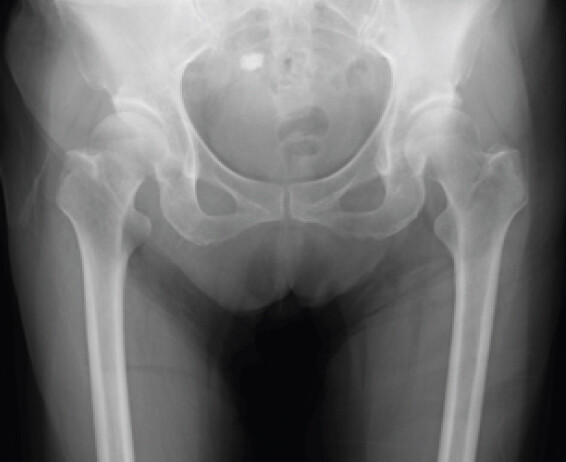
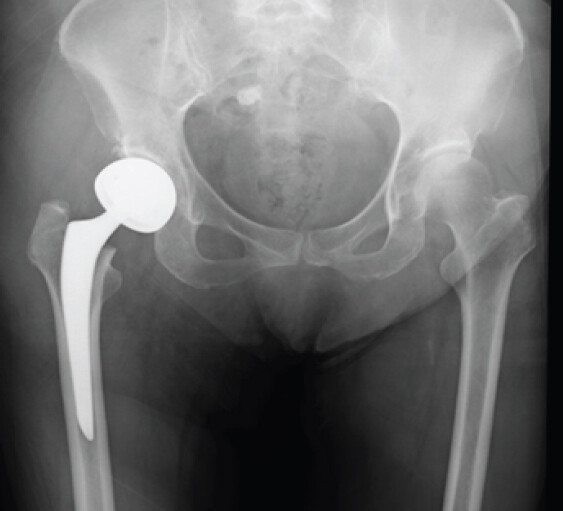
An 83-year-old woman with dementia sustained a displaced femoral neck fracture classified as Garden type III (Fig. 1). She had no history of Parkinson’s disease or paralysis. She underwent bipolar hemiarthroplasty through a posterior approach, and the post-operative radiograph after the index procedure is shown in Fig. 2. The early post-operative course was uneventful.
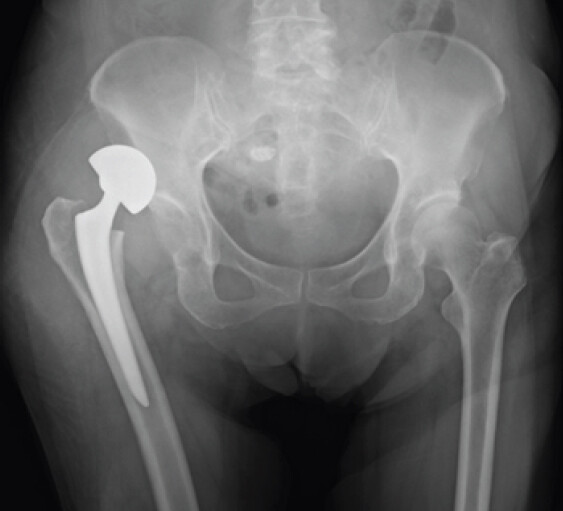
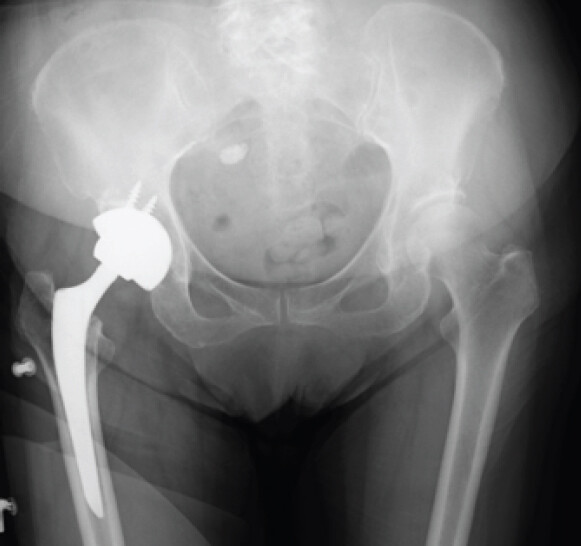
Three months after the initial surgery, she developed posterior dislocation of the operated hip (Fig. 3). Closed reduction was performed; however, the hip subsequently redislocated repeatedly. The dislocation occurred almost daily, and repeated closed reductions failed to provide durable hip stability. Pre-operative evaluation before conversion surgery included anteroposterior and lateral radiographs and computed tomography. The femoral stem showed no gross subsidence or radiographic loosening, and computed tomography (CT) assessment demonstrated a femoral stem anteversion of 21°. No obvious acetabular fracture, protrusio, or advanced acetabular bone loss was identified. Due to severe recurrent instability, surgical treatment was planned.
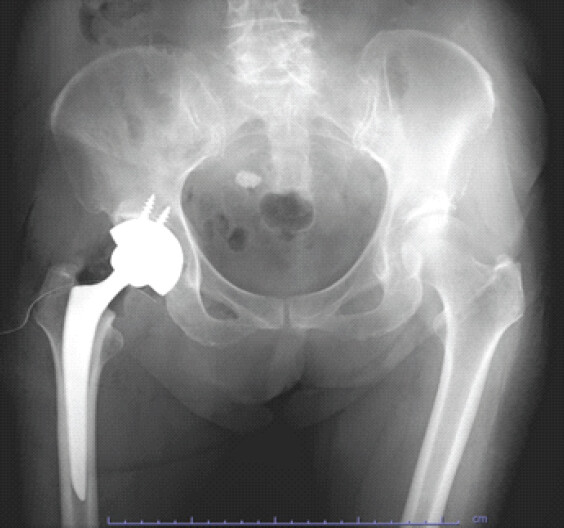
Conversion total hip arthroplasty was performed through a posterior approach. Intraoperatively, the femoral stem was well fixed and was left in situ; therefore, femoral component revision was not performed. Acetabular reconstruction was performed using a dual mobility acetabular component. A Zimmer Biomet G7 dual mobility cup was implanted with an inclination angle of 49° and an anteversion angle of 19° (Fig. 4). After confirming adequate intraoperative stability and range of motion, posterior capsular and short external rotator repair was performed as far as tissue quality allowed, and the procedure was completed.
Postoperatively, rehabilitation was initiated according to the patient’s condition. No redislocation occurred during the post-operative period. At the 2-year follow-up, the patient had experienced no further dislocation (Fig. 5). She was able to walk with a cane, and the Harris Hip Score was 80 points [6]. Radiographs showed stable implant fixation without evidence of loosening or migration (Fig. 5). Written informed consent for publication of this case report and accompanying images was obtained from the patient and her family.
Discussion
Recurrent dislocation after bipolar hemiarthroplasty for femoral neck fracture is a serious complication in elderly patients. Although the reported incidence of dislocation after hemiarthroplasty is generally low, dislocation can result in substantial morbidity, reduced mobility, repeated hospitalization, and the need for further surgery [1,2]. In the present case, the patient developed posterior dislocation 3 months after bipolar hemiarthroplasty and subsequently experienced almost daily redislocation. This clinical course indicated severe instability, and repeated closed reduction was unlikely to provide durable stability. The clinical value of this case lies in showing that stem-retaining acetabular conversion to a dual mobility construct may provide stability even in a patient with multiple risk factors, including dementia, posterior instability, and repeated dislocation episodes.
Several factors may have contributed to recurrent instability in this patient. First, the initial surgery was performed through a posterior approach, and recurrent posterior dislocation may have been associated with posterior soft-tissue insufficiency or capsular deficiency [3]. Second, the patient had dementia, which is an important risk factor for post-operative instability due to reduced ability to comply with hip precautions and activity restrictions [1,2]. Third, repeated dislocations may further compromise soft-tissue tension and create a cycle of progressive instability. Pre-operative radiographs and CT did not show gross femoral stem loosening, subsidence, acetabular fracture, protrusio, or severe acetabular bone loss. CT assessment showed a femoral stem anteversion of 21°, and excessive femoral component malversion was not considered the main cause of instability. Therefore, the recurrent dislocation was considered more likely related to posterior soft-tissue insufficiency and patient-related risk factors than to obvious implant loosening, gross acetabular structural failure, or marked femoral stem malversion.
Treatment options for recurrent dislocation after hemiarthroplasty include repeated closed reduction, revision of malpositioned components, conversion to total hip arthroplasty, constrained liners, and dual mobility components [2,7,8,9]. Conversion from failed hemiarthroplasty to total hip arthroplasty can be associated with a high risk of post-operative instability, particularly when performed for recurrent dislocation [7]. In the present case, stem revision was not selected because the femoral stem was well fixed intraoperatively, there was no gross radiographic evidence of loosening or subsidence, and CT assessment showed a femoral stem anteversion of 21° without marked malversion. A constrained liner was also not selected because constrained constructs may improve stability but can increase impingement, transmit higher stresses to the implant-bone interface, and fail through loosening or failure of the locking mechanism [8,9]. Therefore, a dual mobility cup was chosen to increase effective head size and jump distance while preserving a greater functional range of motion than a constrained construct.
Dual mobility articulation has several biomechanical advantages. The dual articulation mechanism increases the effective head size and jump distance, improves the head-to-neck ratio, and reduces impingement, thereby improving resistance to dislocation [4,10]. These features are particularly useful in high-risk patients, including elderly patients, patients with cognitive impairment, and patients undergoing revision or conversion arthroplasty for instability [4,5]. Carulli et al. reported 31 patients treated with conversion total hip arthroplasty using dual mobility cups for recurrent hemiarthroplasty dislocation, with no recurrent dislocation at a mean follow-up of 3.8 years and improvement in mean Harris Hip Score from 62.2 to 76.0 points [2]. The present case is consistent with those findings but adds a practical example of successful stem-retaining treatment in a patient with dementia and extremely frequent redislocation. A recent systematic review and meta-analysis also reported that dual mobility implants were associated with a lower risk of revision due to dislocation compared with fixed-bearing implants, particularly in revision total hip arthroplasty [5].
In the present case, the femoral stem was well fixed and was retained. A Zimmer Biomet G7 dual mobility cup was implanted with an inclination angle of 49° and an anteversion angle of 19°, which provided intraoperative stability despite the patient’s high-risk profile. At the 2-year follow-up, no redislocation had occurred, the patient was able to walk with a cane, and the Harris Hip Score was 80 points. This outcome suggests that stem-retaining conversion total hip arthroplasty using a dual mobility cup can provide durable stability even in an elderly patient with dementia and severe recurrent posterior dislocation after bipolar hemiarthroplasty. Nevertheless, this result should be interpreted as hypothesis-generating rather than as definitive evidence because dual mobility constructs are already established as an option for instability and the present report describes only one patient.
This case has several limitations. First, it is a single case report, and the result cannot be generalized to all patients with recurrent dislocation after hemiarthroplasty. Second, although CT assessment showed a femoral stem anteversion of 21°, the precise etiology of instability could not be fully determined because detailed spinopelvic evaluation and dynamic assessment were not available. Third, although the femoral stem was well fixed intraoperatively, subtle soft-tissue imbalance may have contributed to instability. Fourth, longer follow-up is necessary to evaluate late complications specific to dual mobility implants, including polyethylene wear, aseptic loosening, and intraprosthetic dislocation [11]. Despite these limitations, this case demonstrates that dual mobility total hip arthroplasty may be a useful stem-retaining salvage procedure for severe recurrent instability after femoral neck fracture treatment when the femoral stem is well fixed, femoral stem version is not markedly abnormal, and obvious radiographic loosening is absent.
Conclusion
Stem-retaining conversion total hip arthroplasty using a dual mobility cup was effective for severe, almost daily recurrent posterior dislocation after bipolar hemiarthroplasty for femoral neck fracture in an elderly patient with dementia. At the 2-year follow-up, no redislocation had occurred; the patient was able to walk with a cane, and the Harris Hip Score was 80 points. Dual mobility total hip arthroplasty may be a valuable salvage option for elderly patients with recurrent instability after hemiarthroplasty, particularly when the femoral stem is well fixed, obvious radiographic loosening is absent, and acetabular reconstruction can address instability without femoral component revision.
Clinical Message
In elderly patients with cognitive impairment and severe recurrent posterior dislocation after bipolar hemiarthroplasty for femoral neck fracture, the specific learning point from this case is that dual mobility acetabular reconstruction can be considered as a stem-retaining salvage strategy when the femoral stem is well fixed, and no gross radiographic loosening is present. Careful evaluation of the cause of instability, intraoperative stability testing, and posterior soft-tissue repair when possible remain important to optimize the outcome.
Conflict of Interest:
Nil
Source of Support:
Nil
Consent:
The authors confirm that informed consent was obtained from the patient for publication of this article
How to Cite this Article
Sakamoto T, Izaki T. Dual Mobility Total Hip Arthroplasty for Recurrent Dislocation After Femoral Neck Fracture in an Elderly Patient: A Case Report. Journal of Orthopaedic Case Reports 2026 October;16(10): 281-285.
References
- Jobory A, Kärrholm J, Hansson S, Åkesson K, Rogmark C. Dislocation of hemiarthroplasty after hip fracture is common and the risk is increased with posterior approach: Result from a national cohort of 25,678 individuals in the Swedish Hip Arthroplasty Register. Acta Orthop 2021;92:413-8. [Google Scholar] | [PubMed]
- Carulli C, Macera A, Matassi F, Civinini R, Innocenti M. The use of a dual mobility cup in the management of recurrent dislocations of hip hemiarthroplasty. J Orthop Traumatol 2016;17:131-6. [Google Scholar] | [PubMed]
- Masonis JL, Bourne RB. Surgical approach, abductor function, and total hip arthroplasty dislocation. Clin Orthop Relat Res 2002;405:46-53. [Google Scholar] | [PubMed]
- Suarez-Ahedo C, Quintero-Quintero MA, Martinez-Armenta C, Martínez-Gómez LE, Martínez-Nava GA, Pineda C. Modern dual mobility implants in total hip arthroplasty: Stability, survival, and ion safety evaluation. JB JS Open Access 2025;10:e2500141. [Google Scholar] | [PubMed]
- Saroha S, Raheman FJ, Jaiswal P, Patel A. Dual-mobility implants in primary and revision total hip arthroplasty: A systematic review and meta-analysis. J Clin Orthop Trauma 2024;54:102495. [Google Scholar] | [PubMed]
- Harris WH. Traumatic arthritis of the hip after dislocation and acetabular fractures: Treatment by mold arthroplasty. An end-result study using a new method of result evaluation. J Bone Joint Surg Am 1969;51:737-55. [Google Scholar] | [PubMed]
- Sah AP, Estok DM 2nd. Dislocation rate after conversion from hip hemiarthroplasty to total hip arthroplasty. J Bone Joint Surg Am 2008;90:506-16. [Google Scholar] | [PubMed]
- Shapiro GS, Weiland DE, Markel DC, Padgett DE, Sculco TP, Pellicci PM. The use of a constrained acetabular component for recurrent dislocation. J Arthroplasty 2003;18:250-8. [Google Scholar] | [PubMed]
- Yun AG, Padgett D, Pellicci P, Dorr LD. Constrained acetabular liners: Mechanisms of failure. J Arthroplasty 2005;20:536-41. [Google Scholar] | [PubMed]
- Guyen O, Chen QS, Bejui-Hugues J, Berry DJ, An KN. Unconstrained tripolar hip implants: Effect on hip stability. Clin Orthop Relat Res 2007;455:202-8. [Google Scholar] | [PubMed]
- Philippot R, Boyer B, Farizon F. Intraprosthetic dislocation: A specific complication of the dual-mobility system. Clin Orthop Relat Res 2013;471:965-70. [Google Scholar] | [PubMed]
© 2026 Journal of Orthopaedic Case Reports - Published by Indian Orthopaedic Research Group
About the Authors
-

Tetsuya Sakamoto
-

Teruaki Izaki
Related Articles in Journal of Orthopaedic Case Reports
 October 1, 2026 Primary Total Hip Arthroplasty for a Displaced Femoral Neck Fracture in an Above-the-Knee Amputee: A Case Report
 August 1, 2026 Total Hip Arthroplasty in Bilateral Ankylosed Hip by Direct Anterior Approach: A Case Report with Technical Tips
 June 1, 2026 Managing Periprosthetic Fracture of the Proximal Femur Using Total Hip Arthroplasty in a Patient with Sequelae of Poliomyelitis: Case Report and Literature Review
 May 1, 2026 Neglected Bipolar Hemiarthroplasty Dislocation in a Young Adult with Superior Acetabular Wall Defect – A Case Report