


Introduction
Anterior cruciate ligament (ACL) injury is one of the most common ligamentous injuries of the knee, particularly among young, physically active individuals and athletes involved in pivoting sports such as football, basketball, and skiing. ACL tears result in knee instability, impaired functional performance, reduced quality of life, and an increased risk of secondary meniscal and chondral injuries if left untreated. Arthroscopic ACL reconstruction has become the standard treatment for symptomatic ACL-deficient knees, aiming to restore stability, improve functional outcomes, and facilitate return to pre-injury activity levels. Despite advances in surgical techniques and rehabilitation protocols, persistent rotational instability following ACL reconstruction remains a significant concern, prompting increasing attention toward associated intra-articular lesions that may influence surgical outcomes and knee biomechanics [1,2].
Among these associated injuries, ramp lesions have emerged as an important but often underdiagnosed pathology. Ramp lesions refer to tears involving the peripheral attachment of the posterior horn of the medial meniscus at the meniscocapsular or meniscotibial junction. These lesions are closely associated with ACL injuries because of shared biomechanical mechanisms of injury, particularly excessive anterior tibial translation and rotational forces. The posterior horn of the medial meniscus acts as a secondary stabilizer of the knee, helping to resist anterior tibial displacement in ACL-deficient knees. Consequently, injury to this region may further compromise joint stability and contribute to abnormal knee kinematics [3,4].
The reported incidence of ramp lesions in patients undergoing ACL reconstruction varies considerably across studies, ranging from approximately 9–40%. This variation is largely attributed to differences in patient populations, timing of surgery, chronicity of ACL injury, and methods used for lesion detection. Conventional magnetic resonance imaging (MRI) demonstrates limited sensitivity for identifying ramp lesions, particularly when tears are small or concealed within the posteromedial compartment of the knee. As a result, many ramp lesions remain undetected during pre-operative assessment and may be overlooked during routine arthroscopic examination if systematic posteromedial compartment evaluation is not performed [5,6].
Growing recognition of ramp lesions has led to increased emphasis on meticulous arthroscopic assessment during ACL reconstruction. Standard anterior arthroscopic portals may not adequately visualize the posteromedial meniscocapsular junction, necessitating additional techniques such as trans-notch visualization or posteromedial portal exploration. Several investigators have demonstrated that systematic arthroscopic inspection significantly improves detection rates compared with MRI alone. Early identification and repair of ramp lesions are considered crucial because untreated lesions may contribute to persistent anteroposterior and rotational instability, increased graft stress, delayed rehabilitation, and potentially inferior clinical outcomes following ACL reconstruction [7,8].
Biomechanical studies have highlighted the functional significance of ramp lesions in ACL-deficient knees. Experimental investigations have shown that disruption of the meniscocapsular attachment increases anterior tibial translation and rotational laxity, while repair of the lesion helps restore knee stability. These findings suggest that ramp lesions are not merely associated injuries but may play an active role in the pathophysiology of residual instability. Consequently, addressing ramp lesions at the time of ACL reconstruction has become an area of growing clinical interest, with several authors reporting improved knee stability and functional outcomes following concomitant repair [9].
Although awareness of ramp lesions has increased substantially, significant gaps remain regarding their true incidence, risk factors, arthroscopic detection rates, and influence on post-operative outcomes. The prevalence of ramp lesions may vary according to patient age, sex, activity level, mechanism of injury, chronicity of ACL rupture, and associated meniscal or chondral pathology. Furthermore, evidence regarding the long-term benefits of ramp lesion repair remains heterogeneous, highlighting the need for prospective studies evaluating clinical outcomes in patients undergoing ACL reconstruction with systematic arthroscopic assessment [10].
Therefore, the present prospective observational study aims to evaluate the incidence of ramp lesions in patients undergoing ACL reconstruction, assess the effectiveness of arthroscopic detection methods, and analyze the clinical outcomes associated with these lesions. Improved understanding of the prevalence and clinical significance of ramp lesions may facilitate early diagnosis, optimize surgical management, and ultimately enhance functional recovery and knee stability following ACL reconstruction.
Materials And Methods
Study design
This prospective observational cohort study was conducted over 18 months in the Department of Orthopaedics at a tertiary care teaching hospital. The study evaluated the incidence and arthroscopic detection of meniscal ramp lesions and their association with clinical instability and post-operative functional outcomes in patients undergoing primary ACL reconstruction. The study protocol was approved by the Institutional Ethics Committee, and written informed consent was obtained from all participants before enrollment.
Participants
Inclusion criteria
-
Patients aged 18–50 years
-
Patients diagnosed with complete ACL tear confirmed clinically and by MRI
-
Patients scheduled for primary arthroscopic ACL reconstruction
-
Patients willing to participate in the study and provide written informed consent
-
Patients available for regular post-operative follow-up.
Exclusion criteria
-
Previous surgery on the affected knee
-
Multiligament knee injuries requiring additional reconstructive procedures
-
Advanced osteoarthritis of the knee joint
-
Fractures around the knee joint
-
Revision ACL reconstruction cases
-
Active infection or inflammatory arthritis affecting the knee
-
Patients unwilling to participate or unable to complete follow-up assessments.
Study sampling
A consecutive sampling technique was employed. All patients presenting to the orthopedic outpatient department with ACL injury and fulfilling the eligibility criteria during the study period were screened for enrollment. Consecutive recruitment minimized selection bias and ensured that the study population represented the routine clinical spectrum of ACL injuries encountered in the institution. Eligible patients were included until the required sample size was achieved.
Study sample size
The sample size was calculated based on the reported prevalence of ramp lesions among ACL-injured knees. Previous studies have reported an incidence of ramp lesions ranging from approximately 15% to 30% [7,11,12,13]. Assuming an expected prevalence of 25%, a confidence level of 95%, and considering the feasibility of recruitment within the study duration, a sample size of 50 patients was determined. Therefore, a total of 50 consecutive patients undergoing arthroscopic ACL reconstruction were included in the study.
Study parameters
The study evaluated a comprehensive set of demographic, clinical, radiological, arthroscopic, and outcome parameters to assess the incidence, detection, and clinical significance of ramp lesions in patients undergoing ACL reconstruction. Demographic parameters included age, sex, body mass index (BMI), occupation, and side of injury. Clinical parameters assessed were the mechanism of injury, duration between injury and surgery, results of clinical instability tests including the Lachman test, pivot shift test, and anterior drawer test, as well as the presence of associated meniscal and chondral injuries. Radiological evaluation comprised MRI confirmation of ACL tear, MRI detection of ramp lesions, and identification of associated intra-articular abnormalities. Arthroscopic parameters included the presence or absence of ramp lesions, their type and anatomical location, associated meniscal pathology, and cartilage status observed during surgery. Outcome assessment was performed using validated functional scoring systems, namely the Lysholm knee score and the International Knee Documentation Committee (IKDC) Score. In addition, post-operative knee stability and the occurrence of any post-operative complications were evaluated during follow-up to determine the clinical outcomes of ACL reconstruction and the impact of associated ramp lesions.
Study procedure
Patients presenting with symptoms suggestive of ACL injury underwent detailed clinical evaluation. History regarding mechanism of injury, duration of symptoms, episodes of instability, and previous treatment was recorded. Physical examination included assessment of knee range of motion and special tests for ACL integrity, including the Lachman test, pivot shift test, and anterior drawer test. All patients underwent MRI evaluation to confirm ACL rupture and identify associated meniscal or chondral injuries. Patients who met the inclusion criteria were scheduled for arthroscopic ACL reconstruction. During surgery, standard anterolateral and anteromedial portals were established. Initial diagnostic arthroscopy was performed to assess all compartments of the knee. Particular attention was given to the posteromedial compartment using trans-notch visualization techniques. When necessary, a posteromedial portal was created to improve visualization of the meniscocapsular junction. Ramp lesions were identified based on disruption of the meniscocapsular or meniscotibial attachment of the posterior horn of the medial meniscus. The morphology and extent of the lesion were documented. ACL reconstruction was then completed according to institutional protocols. Ramp lesions were assessed arthroscopically for stability. Unstable lesions were repaired using arthroscopic suturing techniques through standard or posteromedial portals as required, whereas stable lesions were managed according to their intraoperative characteristics and the operating surgeon’s protocol. Postoperatively, all patients underwent a standardized rehabilitation program emphasizing gradual restoration of range of motion, muscle strengthening, and return to functional activities. Follow-up assessments were conducted at regular intervals.
Study data collection
Data were collected using a structured case record form specifically designed for the study. Baseline demographic characteristics, clinical findings, MRI findings, operative observations, and post-operative outcomes were recorded. Arthroscopic findings were documented immediately after surgery by the operating surgeon. Functional outcome scores were assessed preoperatively and during follow-up visits at 3 months and 6 months postoperatively. All collected data were verified for completeness and accuracy before entry into the study database.
Data analysis
The collected data were entered into Microsoft Excel and analyzed using the Statistical Package for the Social Sciences version 26.0. Continuous variables such as age, BMI, Lysholm score, and IKDC score were expressed as mean ± standard deviation. Categorical variables such as sex, mechanism of injury, presence of ramp lesions, and associated injuries were expressed as frequencies and percentages.
Comparisons between groups were performed using the independent t-test for continuous variables and the Chi-square test or Fisher’s exact test for categorical variables. Pre-operative and post-operative functional scores were compared using paired t-tests. P < 0.05 was considered statistically significant.
Results
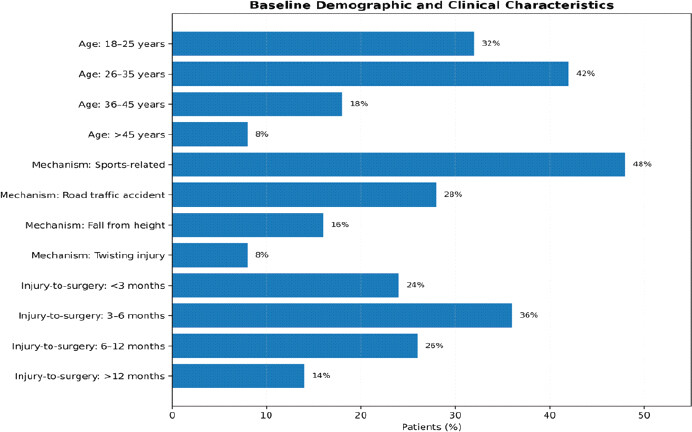
A total of 50 patients undergoing primary ACL reconstruction were included in the study. The majority of patients were aged 26–35 years (42.0%), followed by 18–25 years (32.0%), with a predominance of males (76.0%). Sports-related injuries were the most common mechanism of injury (48.0%), followed by road traffic accidents (28.0%). Most patients underwent surgery within 3–6 months of injury (36.0%) (Table 1 and Fig. 1).
Baseline demographic and clinical characteristics of study participants (n=50)
| Variable | Frequency (%) |
|---|---|
| Age 18–25 years | 16 (32.0) |
| Age 26–35 years | 21 (42.0) |
| Age 36–45 years | 9 (18.0) |
| >45 years | 4 (8.0) |
| Male | 38 (76.0) |
| Female | 12 (24.0) |
| Sports-related injury | 24 (48.0) |
| Road traffic accident | 14 (28.0) |
| Fall from height | 8 (16.0) |
| Twisting injury | 4 (8.0) |
| Surgery within 3–6 months | 18 (36.0) |
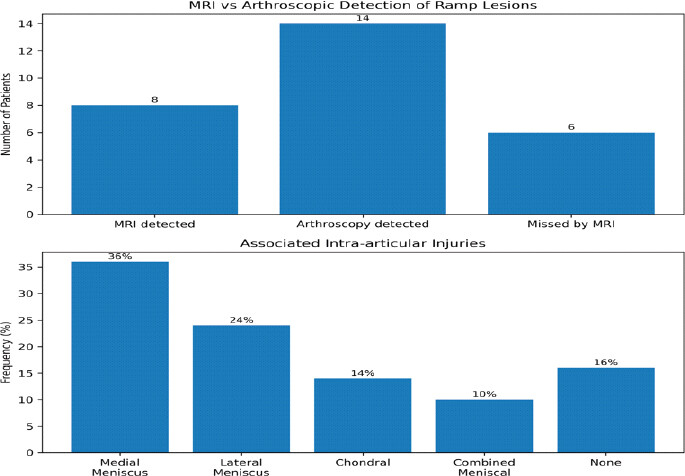
Systematic arthroscopic evaluation identified ramp lesions in 14 of 50 patients, corresponding to an incidence of 28.0%. Pre-operative MRI detected only 8 of these lesions, whereas arthroscopy identified all 14, indicating that 42.9% of ramp lesions were missed on MRI. Medial meniscal tears were the most common associated intra-articular injury (36.0%), followed by lateral meniscal tears (24.0%), chondral lesions (14.0%), and combined meniscal injuries (10.0%) (Table 2 and Fig. 2).
Arthroscopic detection of ramp lesions and associated intra-articular findings
| Parameter | Frequency (%) |
|---|---|
| Ramp lesions detected arthroscopically | 14 (28.0) |
| Ramp lesions detected on MRI | 8 |
| Ramp lesions missed on MRI | 6 (42.9) |
| Medial meniscal tear | 18 (36.0) |
| Lateral meniscal tear | 12 (24.0) |
| Chondral lesion | 7 (14.0) |
| Combined meniscal injury | 5 (10.0) |
MRI: Magnetic resonance imaging
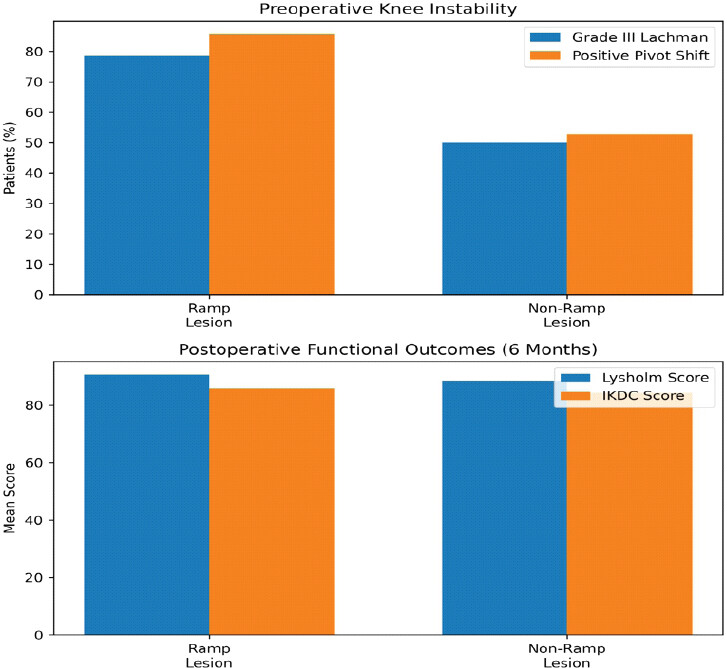
Patients with ramp lesions demonstrated significantly greater pre-operative knee instability than those without ramp lesions. Grade III Lachman positivity was observed in 78.6% of patients with ramp lesions compared with 50.0% of patients without ramp lesions (P = 0.048). Similarly, a positive pivot shift test was significantly more frequent in the ramp lesion group (85.7% vs. 52.8%; P = 0.028). Following ACL reconstruction, both groups demonstrated marked improvement in functional outcomes. The mean Lysholm score improved from 49.3 ± 8.6 to 90.6 ± 5.2 in the ramp lesion group and from 52.1 ± 9.1 to 88.4 ± 6.1 in the non-ramp lesion group. Likewise, mean IKDC scores improved from 44.7 ± 7.8 to 85.8 ± 6.0 and from 46.2 ± 8.1 to 84.3 ± 6.7, respectively. No statistically significant differences were observed between the groups in post-operative Lysholm or IKDC scores (P > 0.05). Overall, post-operative complications were uncommon, with 86.0% of patients experiencing no complications. Knee stiffness was the most frequent complication (6.0%), whereas superficial infection and recurrent instability each occurred in only 1 patient (2.0%) (Table 3 and Fig. 3).
Ramp lesion groups
| Time point | Ramp lesion group (n=14), Mean±SD | Non-ramp group (n=36), Mean±SD | P-value |
|---|---|---|---|
| Lysholm score | |||
| Pre-operative | 49.3±8.6 | 52.1±9.1 | 0.302 |
| 6 months postoperative | 90.6±5.2 | 88.4±6.1 | 0.216 |
| IKDC score | |||
| Pre-operative | 44.7±7.8 | 46.2±8.1 | 0.541 |
| 6 Months postoperative | 85.8±6.0 | 84.3±6.7 | 0.457 |
SD: Standard deviation, IKDC: International Knee Documentation Committee
Discussion
The present prospective observational study evaluated the incidence, arthroscopic detection, and clinical outcomes of ramp lesions in patients undergoing ACL reconstruction. A total of 50 patients with ACL tears were included, and systematic arthroscopic assessment was performed to identify associated ramp lesions. The findings demonstrated that ramp lesions are a relatively frequent associated injury in ACL-deficient knees and that arthroscopy remains superior to MRI for their detection. Furthermore, patients with ramp lesions exhibited greater pre-operative instability, although satisfactory post-operative functional outcomes were achieved following ACL reconstruction and appropriate management.
In the present study, the majority of patients belonged to the 26–35 years age group (42.0%), followed by 18–25 years (32.0%), with a marked male predominance (76.0%). These findings are consistent with previous reports showing that ACL injuries and associated ramp lesions occur more frequently among young and physically active males. Liu et al. [7] reported a mean age of 24.7 years among patients with ramp lesions and observed a significantly higher prevalence among patients younger than 30 years and male individuals. Similarly, Lambrey et al. [11] identified younger age and male sex as significant risk factors for the occurrence of ramp lesions among 5359 patients undergoing ACL reconstruction. The predominance of young male patients in the present study therefore aligns with the demographic characteristics reported in large-scale investigations and reflects the increased exposure of this population to sports-related and high-energy knee injuries.
Regarding the mechanism of injury, sports-related trauma accounted for 48.0% of cases, followed by road traffic accidents (28.0%), falls from height (16.0%), and twisting injuries (8.0%). ACL injuries commonly result from pivoting and rotational mechanisms that also predispose patients to meniscocapsular injuries. The high proportion of sports-related injuries observed in the present study supports the established relationship between athletic activities and ACL rupture. Since ramp lesions occur due to excessive anterior tibial translation and rotational instability, patients sustaining sports injuries may be particularly vulnerable to developing these associated lesions.
The duration from injury to surgery demonstrated that 36.0% of patients underwent reconstruction within 3–6 months, whereas 26.0% underwent surgery between 6 and 12 months after injury and 14.0% presented beyond 1 year. Chronic ACL deficiency is known to increase repetitive stress on the posterior horn of the medial meniscus, thereby increasing the risk of ramp lesion development. Liu et al. [7] demonstrated that the prevalence of ramp lesions increased with increasing time from ACL injury and reached its highest levels up to 24 months following the initial injury. The authors concluded that prolonged knee laxity contributes significantly to the development of ramp lesions. Although the present study did not specifically analyze prevalence according to injury duration, delayed presentation among a substantial proportion of patients may have contributed to the observed incidence of ramp lesions.
One of the most important findings of the present study was the incidence of ramp lesions. Arthroscopic evaluation identified ramp lesions in 14 of 50 patients, resulting in an incidence of 28.0%. This incidence is higher than that reported in several previous studies but remains within the broad range documented in the literature. Liu et al. [7] evaluated 868 ACL reconstructions and identified ramp lesions in 144 patients, corresponding to a prevalence of 16.6%. Similarly, DePhillipo et al. [12] reported an incidence of 16.6% among 301 patients undergoing ACL reconstruction, where 50 ramp lesions were identified arthroscopically. Thaunat et al. [13] examined 2156 ACL reconstructions and reported a prevalence of 15.5%, with 334 confirmed ramp lesions. More recently, Lambrey et al. [11] analyzed data from 5359 ACL reconstructions and observed a ramp lesion prevalence of 15.3%. Compared with these studies, the incidence of 28.0% observed in the present study is comparatively higher. This difference may be attributable to the smaller sample size, careful systematic arthroscopic exploration of the posteromedial compartment, differences in patient characteristics, or the proportion of chronic ACL injuries included in the study population.
The present study further demonstrated the limitations of MRI in detecting ramp lesions. MRI identified only 8 ramp lesions, whereas arthroscopy detected 14 lesions. Consequently, 6 lesions (42.9%) were missed preoperatively and diagnosed only during arthroscopic examination. These findings strongly support the concept that ramp lesions are frequently “hidden lesions” that may escape routine imaging evaluation. Similar observations were reported by DePhillipo et al., [12] who found that MRI demonstrated a sensitivity of only 48% for detecting ramp lesions when compared with arthroscopic findings. In their study, <1½ of all ramp lesions identified during surgery were diagnosed preoperatively on MRI. Likewise, Thaunat et al. [13] reported that hidden type 3 ramp lesions were the subtype most likely to be missed on MRI, with 45.9% remaining undetected before surgery. These findings closely mirror the observations of the present study and reinforce the necessity for meticulous intraoperative inspection of the posteromedial compartment during ACL reconstruction.
The present study also assessed associated intra-articular injuries and found that medial meniscal tears were the most common concomitant pathology, occurring in 36.0% of patients, followed by lateral meniscal tears (24.0%), chondral lesions (14.0%), and combined meniscal injuries (10.0%). Only 16.0% of patients had isolated ACL injuries without additional pathology. The close association between ACL rupture and meniscal injury has been extensively documented. Lambrey et al. [11] identified lateral meniscal injury as a significant risk factor for ramp lesions in their large multicenter cohort study. Similarly, Thaunat et al. [13] reported frequent associations between ramp lesions and other intra-articular injuries, particularly meniscal pathology. The findings of the present study therefore support existing evidence indicating that ACL tears rarely occur in isolation and frequently coexist with meniscal and chondral lesions.
Pre-operative instability assessment revealed significantly greater instability among patients with ramp lesions. Grade III Lachman positivity was observed in 78.6% of patients with ramp lesions compared with 50.0% in patients without ramp lesions (P = 0.048). Similarly, a positive pivot shift test was present in 85.7% of the ramp lesion group compared with 52.8% of the non-ramp lesion group (P = 0.028). These findings indicate that ramp lesions contribute substantially to both anterior and rotational instability of the knee. Comparable observations have been reported in previous studies. Thaunat et al. [13] found that gross pivot shift was significantly associated with complete ramp tears, with an odds ratio of 4.8, indicating a strong relationship between severe rotational instability and the presence of ramp lesions. Likewise, Lambrey et al. [11] identified pivot shift as a significant predictor of ramp lesions in univariate analysis. The higher frequency of positive instability tests observed in the present study therefore supports the biomechanical role of the posterior horn of the medial meniscus as a secondary stabilizer in ACL-deficient knees.
Functional outcomes were evaluated using Lysholm and IKDC scores. In the ramp lesion group, the mean Lysholm score improved from 49.3 ± 8.6 preoperatively to 90.6 ± 5.2 at 6 months, whereas in the non-ramp lesion group it improved from 52.1 ± 9.1 to 88.4 ± 6.1. Similarly, mean IKDC scores improved from 44.7 ± 7.8 to 85.8 ± 6.0 in the ramp lesion group and from 46.2 ± 8.1 to 84.3 ± 6.7 in the non-ramp lesion group. These findings demonstrate substantial post-operative improvement in knee function irrespective of ramp lesion status. The results are consistent with the systematic review conducted by Alessio-Mazzola et al., [14] which included 509 patients and reported good clinical outcomes following ACL reconstruction combined with ramp lesion treatment. The review found a treatment failure rate of only 8.3% and concluded that ramp lesion repair produced favorable functional results with a low rate of complications. The excellent post-operative outcomes observed in the present study therefore support the growing consensus that identification and treatment of ramp lesions during ACL reconstruction contribute to restoration of knee stability and function.
Post-operative complications in the present study were infrequent. Overall, 86.0% of patients experienced no complications, while knee stiffness occurred in 6.0%, persistent pain in 4.0%, superficial infection in 2.0%, and recurrent instability in 2.0% of patients. These findings indicate that ACL reconstruction with systematic arthroscopic evaluation for ramp lesions is a safe procedure with a low complication profile. The low incidence of recurrent instability observed in the present study is particularly noteworthy, as untreated ramp lesions have been implicated in persistent post-operative laxity. The favorable outcomes observed may therefore be attributable to careful identification and management of associated meniscocapsular injuries.
Overall, the present study demonstrated a ramp lesion incidence of 28.0%, which was higher than the prevalence reported by DePhillipo et al. (16.6%) [12], Liu et al. (16.6%) [7], Thaunat et al. (15.5%) [13], and Lambrey et al. (15.3%) [11]. Arthroscopy proved substantially more effective than MRI for lesion detection, identifying six additional lesions that would otherwise have remained unrecognized. Patients with ramp lesions exhibited significantly greater pre-operative instability, as evidenced by Grade III Lachman positivity in 78.6% and positive pivot shift testing in 85.7% of cases. Nevertheless, both Lysholm and IKDC scores improved markedly following surgery, demonstrating excellent functional recovery. These findings support the growing body of evidence emphasizing the importance of systematic arthroscopic exploration of the posteromedial compartment during ACL reconstruction to ensure accurate diagnosis and optimal management of ramp lesions.
The strengths of the present study include its prospective design, systematic arthroscopic evaluation of the posteromedial compartment, and comprehensive assessment of clinical instability and functional outcomes using validated scoring systems. In addition, the study directly compared pre-operative MRI findings with arthroscopic observations, highlighting the diagnostic limitations of MRI and the value of routine arthroscopic inspection during ACL reconstruction. However, several limitations should be acknowledged. The relatively small sample size and single-center design may limit the generalizability of the findings. The follow-up period was limited to 6 months, precluding assessment of long-term graft survival, recurrent instability, meniscal healing, and osteoarthritic progression. MRI findings were not correlated with post-operative imaging to evaluate healing of repaired ramp lesions, and no subgroup analyses based on age, chronicity of injury, or activity level were performed. Furthermore, although functional outcomes improved significantly following surgery, the observational design without a comparative control group limits the ability to establish causal relationships. Future multicenter studies with larger sample sizes and longer follow-up are warranted to validate these findings and determine the long-term clinical significance of systematic ramp lesion detection and management.
Conclusion
Ramp lesions are common associated injuries in ACL-deficient knees and are frequently missed on MRI. Routine arthroscopic inspection of the posteromedial compartment improves detection and facilitates appropriate treatment. Early identification and management of ramp lesions during ACL reconstruction result in excellent short-term functional outcomes and improved knee stability.
Clinical Message
Surgeons performing ACL reconstruction should routinely evaluate the posteromedial compartment for ramp lesions, particularly in patients with marked pre-operative instability. Early arthroscopic identification and appropriate management of these hidden lesions improve knee stability and functional outcomes while minimizing post-operative complications.
Conflict of Interest:
Nil
Source of Support:
Nil
Consent:
The authors confirm that informed consent was obtained from the patient for publication of this article
How to Cite this Article
Thomas A, Nayak M, Singh SK, Syal A, Akram MA, Neeraj P. Incidence, Arthroscopic Detection, and Clinical Outcomes of Ramp Lesions in Patients Undergoing Anterior Cruciate Ligament Reconstruction: A Prospective Observational Study. Journal of Orthopaedic Case Reports 2026 October;16(10): 515-523.
References
- Ahn JH, Kim SH, Yoo JC, Wang JH. All-inside suture technique using two posteromedial portals in a medial meniscus posterior horn tear. Arthroscopy 2004;20:101-8. [Google Scholar] | [PubMed]
- Bollen SR. Posteromedial meniscocapsular injury associated with rupture of the anterior cruciate ligament: A previously unrecognised association. J Bone Joint Surg Br 2010;92:222-3. [Google Scholar] | [PubMed]
- Chahla J, Dean CS, Moatshe G, Mitchell JJ, Cram TR, Yacuzzi C. Meniscal ramp lesions: Anatomy, incidence, diagnosis, and treatment. Orthop J Sports Med 2016;4:2325967116657815. [Google Scholar] | [PubMed]
- Edgar C, Ware JK, Obopilwe E, Ziegler C, Reed D, Arciero RA. Posteromedial Meniscocapsular Tear: Prevalence, Detection Sensitivity, Biomechanics, and Repair Technique. In: Paper Presented at: AAOS Annual MeetingLas Vegas NV. 2015. Available from: https://aaos2015.conferencespot.org/58906-aaos-1.1965581/t004-1.1971711/f004-1.1971712/a096-1.1971713/se81-1.1971728. [Last accessed on 15 Mar 2026].. [Google Scholar] | [PubMed]
- Geeslin AG, LaPrade RF. Location of bone bruises and other osseous injuries associated with acute grade III isolated and combined posterolateral knee injuries. Am J Sports Med 2010;38:2502-8. [Google Scholar] | [PubMed]
- Keene GC, Bickerstaff D, Rae PJ, Paterson RS. The natural history of meniscal tears in anterior cruciate ligament insufficiency. Am J Sports Med 1993;21:672-9. [Google Scholar] | [PubMed]
- Liu X, Feng H, Zhang H, Hong L, Wang XS, Zhang J. Arthroscopic prevalence of ramp lesion in 868 patients with anterior cruciate ligament injury. Am J Sports Med 2011;39:832-7. [Google Scholar] | [PubMed]
- Peltier A, Lording T, Maubisson L, Ballis R, Neyret P, Lustig S. The role of the meniscotibial ligament in posteromedial rotational knee stability. Knee Surg Sports Traumatol Arthrosc 2015;23:2967-73. [Google Scholar] | [PubMed]
- Sonnery-Cottet B, Conteduca J, Thaunat M, Gunepin FX, Seil R. Hidden lesions of the posterior horn of the medial meniscus: A systematic arthroscopic exploration of the concealed portion of the knee. Am J Sports Med 2014;42:921-6. [Google Scholar] | [PubMed]
- Stephen JM, Halewood C, Kittl C, Bollen SR, Williams A, Amis AA. Posteromedial meniscocapsular lesions increase tibiofemoral joint laxity with anterior cruciate ligament deficiency, and their repair reduces laxity. Am J Sports Med 2016;44:400-8. [Google Scholar] | [PubMed]
- Lambrey PJ, Fayard JM, Graveleau N, Toanen C, Noailles T, Letartre R. Risk factors and prevalence of ramp lesions in ACL ruptures: An analysis from the registry of the francophone arthroscopic society. Knee Surg Sports Traumatol Arthrosc 2024;32:1700-9. [Google Scholar] | [PubMed]
- DePhillipo NN, Cinque ME, Chahla J, Geeslin AG, Engebretsen L, LaPrade RF. Incidence and detection of meniscal ramp lesions on magnetic resonance imaging in patients with anterior cruciate ligament reconstruction. Am J Sports Med 2017;45:2233-7. [Google Scholar] | [PubMed]
- Thaunat M, Ingale P, Penet A, Kacem S, Haidar I, Bauwens PH. Ramp lesion subtypes: Prevalence, imaging, and arthroscopic findings in 2156 anterior cruciate ligament reconstructions. Am J Sports Med 2021;49:1813-21. [Google Scholar] | [PubMed]
- Alessio-Mazzola M, Lovisolo S, Capello AG, Zanirato A, Chiarlone F, Formica M. Management of ramp lesions of the Musculoskelet Surg 2020;104:125-33. [Google Scholar] | [PubMed]
© 2026 Journal of Orthopaedic Case Reports - Published by Indian Orthopaedic Research Group
About the Authors
-

Albin Thomas
-

Manmatha Nayak
-

Sujit Kumar Singh
-

Anuragdeep Syal
-

Mohammad Abdul Akram
-

P Neeraj
Related Articles in Journal of Orthopaedic Case Reports
 September 1, 2026 Arthroscopic ACL Tibial Spine Avulsion Fixation Using Suture Pull-Through Double-Tunnel Technique
 October 1, 2026 Magnetic Resonance Imaging-Arthroscopy Correlation in Traumatic Knee Injuries: A Retrospective Diagnostic Accuracy Study
 October 1, 2026 Arthroscopic Posterior Cruciate Ligament Tibial Spine Avulsion Fixation Using a Suture Pull-Through Single-Tunnel Technique
 October 1, 2026 All Arthroscopic Decompression and Bone Grafting of Cyst in the Talus