


Introduction
The knee is one of the most commonly injured joints, with the anterior cruciate ligament (ACL) being particularly vulnerable to injury and subsequent functional instability [1]. The increasing incidence of ACL injuries has been associated with greater participation in sports and the rising burden of road traffic accidents. The ACL, together with the other stabilizing structures of the knee, plays a critical role in maintaining joint stability and normal function [2,3]. It contributes to control of anterior–posterior translation and helps resist valgus and rotational stresses during dynamic knee movements [4]. Owing to the limited intrinsic healing potential of a completely torn ACL, surgical reconstruction is frequently required in patients with symptomatic instability and functional demands.
Both autografts and allografts have been used successfully for ACL reconstruction [5,6]. Surgical techniques have evolved from open reconstruction to minimally invasive arthroscopic procedures, which have become widely adopted because of their ability to facilitate anatomical graft placement and assessment of associated intra-articular pathology [7]. Among the available autograft options, hamstring tendon grafts provide an effective alternative to bone–patellar tendon–bone (BPTB) grafts while reducing donor-site morbidity related to the extensor mechanism.
Hamstring tendon autografts have demonstrated favorable clinical and functional outcomes in appropriately selected patients undergoing ACL reconstruction [8]. Quadrupled hamstring grafts have also demonstrated satisfactory biological incorporation following intra-articular implantation. In the early post-operative period, graft nourishment is partly supported by diffusion from the surrounding synovial fluid, which may contribute to graft cell survival and subsequent ligamentization.
Several fixation devices have been developed for hamstring tendon grafts. Appropriate fixation is essential to provide adequate initial graft stability and stiffness and to permit progressive rehabilitation. Contemporary fixation methods, including cortical button fixation on the femoral side and interference screw fixation on the tibial side, provide reliable mechanical stability and facilitate post-operative rehabilitation.
Evidence comparing hamstring and BPTB autografts has generally demonstrated comparable functional outcomes. A meta-analysis by Biau et al. in 2007 found no significant difference between hamstring and BPTB grafts with respect to functional outcomes assessed using the International Knee Documentation Committee (IKDC) score and return to pre-injury activity levels [9]. Other studies have reported a lower incidence of certain donor-site complications with hamstring grafts, further supporting their use in appropriately selected patients [7,8,9].
In the present study, arthroscopic ACL reconstruction was performed using a quadrupled hamstring tendon autograft, with cortical button fixation on the femoral side and interference screw fixation on the tibial side, with additional fixation when clinically indicated. The study evaluated post-operative knee stability and functional recovery following this reconstruction technique.
Aim
This study aims to evaluate the clinical and functional outcomes of patients undergoing arthroscopic ACL reconstruction using a hamstring tendon autograft.
Objectives
-
To assess post-operative knee stability using clinical tests, including the Lachman and pivot-shift tests, at predetermined follow-up intervals
-
To evaluate changes in knee range of motion during the post-operative follow-up period
-
To assess functional recovery following arthroscopic ACL reconstruction using the Lysholm Knee Scoring Scale
-
To assess post-operative complications following arthroscopic ACL reconstruction using a hamstring tendon autograft.
Materials and Methods
Study design and setting
A prospective observational study was conducted in the Department of Orthopaedics, M.G.M. Medical College and L.S.K. Hospital, Kishanganj, Bihar, over a period of 18 months. The study included patients aged 18–50 years with clinically and radiologically confirmed ACL tears who underwent arthroscopic ACL reconstruction using a hamstring tendon autograft. This was a single-arm study without randomization or a comparison group receiving BPTB reconstruction, allograft reconstruction, or non-operative management.
Study population and sample size
The study population comprised patients presenting with ACL injuries who were planned for primary arthroscopic ACL reconstruction using a hamstring autograft. A total of 50 patients were included in the study.
The sample size was calculated using the single-proportion formula:
n = Z2p (1−p)/E2
where Z = 1.28 for an 80% confidence level, P = 0.50 (expected proportion), and E = 0.091 (allowable margin of error). Accordingly:
n = (1.282 × 0.50 × 0.50)/(0.0912) = 49.46
The calculated sample size was rounded up to 50 participants. This single-proportion calculation did not establish statistical power for detecting changes in Lysholm scores, uncommon complications, or differences between patient subgroups. The small sample therefore limits statistical precision and generalizability.
Eligibility criteria
Patients aged 18–50 years with a clinically and radiologically confirmed ACL tear, who were willing to participate and comply with the scheduled follow-up assessments, were eligible for inclusion. Patients were also required to have no pre-existing pathology involving the contralateral knee.
Patients undergoing revision ACL reconstruction were excluded. Patients with ACL injuries associated with intra-articular fractures, previous surgery on the affected knee, or complex ligamentous injuries requiring surgical intervention, including posterior cruciate ligament injuries, collateral ligament injuries requiring reconstruction, or posterolateral corner injuries, were excluded. Patients with established osteoarthritis of the affected knee were also excluded.
Pre-operative assessment
All patients underwent a detailed clinical evaluation followed by radiological assessment and magnetic resonance imaging to confirm the ACL tear and identify associated intra-articular pathology. Pre-operative knee stability was assessed using the anterior drawer test, posterior drawer test, Lachman test, and pivot-shift test. Relevant demographic and clinical information was recorded using a standardized study pro forma.
Surgical technique
All procedures were performed using a standardized arthroscopic ACL reconstruction technique with a hamstring tendon autograft. Following routine pre-operative preparation, patients received combined spinal and epidural anesthesia and were positioned supine with the operative knee appropriately supported. A pneumatic tourniquet was applied to the proximal thigh, and the operative limb was prepared and draped under aseptic precautions.
Diagnostic arthroscopy was initially performed through standard anterolateral and anteromedial portals to confirm the ACL tear and assess associated intra-articular pathology, particularly meniscal injuries. Associated meniscal pathology identified during arthroscopy was treated according to the nature of the lesion. The torn ACL tissue was debrided as required, and the native femoral and tibial ACL footprints were identified. The reported data did not specify the numbers undergoing meniscal repair, partial meniscectomy, or other meniscal management, and functional outcomes were not stratified by meniscal treatment.
Hamstring graft harvesting and preparation
The semitendinosus and gracilis tendons were harvested through a longitudinal incision over the pes anserinus while taking care to protect the saphenous nerve and surrounding soft tissues. The tendons were carefully released from their attachments and harvested using a tendon stripper. The harvested tendons were kept moist in normal saline, and residual muscle tissue was removed.
The tendons were subsequently prepared and quadrupled over a graft preparation device. The graft was trimmed to an appropriate length and diameter and secured using whip-stitch sutures. The final graft dimensions were recorded before implantation. Although graft dimensions were recorded, graft diameter was not included in the reported outcome analysis.
Femoral and tibial tunnel preparation
The native ACL footprints were identified arthroscopically, and the femoral and tibial tunnels were created using standard anatomical tunnel-placement techniques. When required, limited notchplasty was performed to prevent graft impingement. The femoral tunnel was prepared using a femoral guide, while the tibial tunnel was created using a tibial guide positioned to reproduce the anatomical orientation of the native ACL. The tunnels were appropriately sized according to the prepared graft.
Graft placement and fixation
The prepared hamstring graft was introduced arthroscopically through the tibial and femoral tunnels. Femoral fixation was achieved using a closed-loop cortical button. After appropriate positioning and cyclic tensioning of the graft through repeated knee flexion and extension, tibial fixation was performed using an interference screw. Excess graft tissue was trimmed. Final graft positioning and knee stability were assessed intraoperatively using the Lachman and pivot-shift tests (Fig. 1).
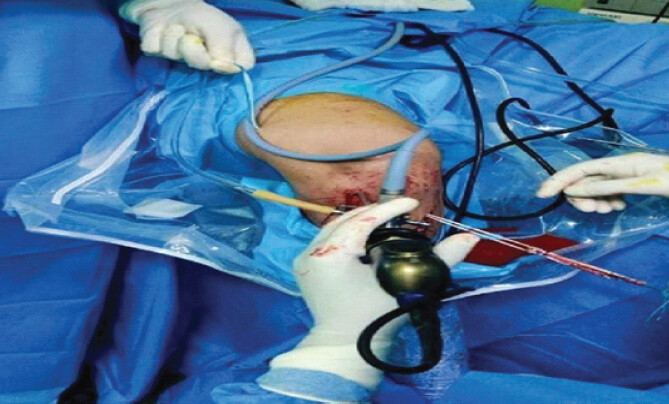
Post-operative management and rehabilitation
A standardized postoperative rehabilitation protocol was initiated from the 1st post-operative day. Wound dressings were changed on post-operative days 2 and 7, and sutures were removed on approximately post-operative day [10]. During the initial 4 weeks, the knee was supported with a long knee brace, and flexion was restricted according to the rehabilitation protocol. From the second post-operative month, progressive quadriceps and hamstring strengthening exercises were initiated following brace removal. Patient adherence to exercises and attendance at supervised physiotherapy were not quantified; a prescribed standardized protocol should therefore not be interpreted as confirmed uniform rehabilitation exposure.
Follow-up and outcome assessment
Patients were followed clinically at 1, 2, 3, 6, and 12 months after surgery. At each follow-up visit, clinical assessment of knee stability was performed using the anterior drawer, Lachman, posterior drawer, and pivot-shift tests, as appropriate. Functional outcome was assessed using the Lysholm Knee Scoring Scale. All findings were documented prospectively in a standardized pro forma. Instrumented laxity testing (such as KT-1000/KT-2000), IKDC, Knee Injury and Osteoarthritis Outcome Score (KOOS), Tegner activity scale, ACL-Return to Sport after Injury, and formal return-to-sport outcomes were not part of the study protocol. Return to the pre-injury sports level, time to return to sport, and post-operative sports participation were not evaluated. The reported clinical tests do not provide quantitative instrumented laxity estimates.
The primary assessment of functional recovery was based on the change in Lysholm knee score during postoperative follow-up. Clinical knee stability and post-operative complications were also documented. Associated meniscal pathology and the injury-to-surgery interval were recorded descriptively; the study was not designed or powered for adjusted subgroup analyses of their independent effects on functional outcome. Rehabilitation was standardized by protocol, but adherence and physiotherapy attendance were not quantitatively measured. No analysis of the relationship between surgical timing and Lysholm outcome, or between the type of meniscal treatment and post-operative function, was performed.
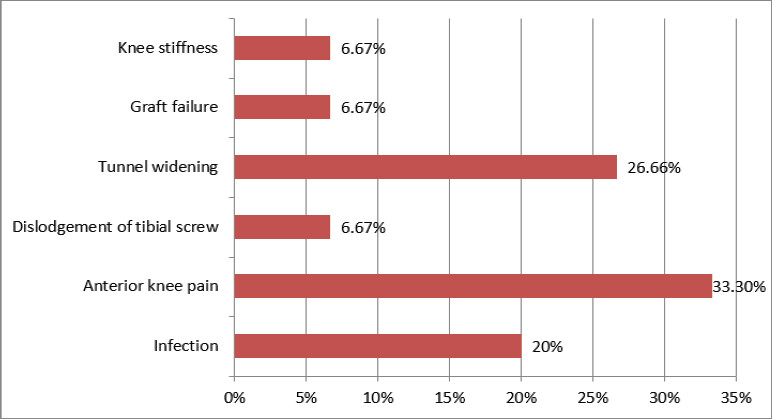
Complication frequencies were expressed using all 50 patients as the denominator; percentages in Fig. 2 used the 15 patients reported to have a complication. The available report did not provide operational definitions, diagnostic criteria, severity grades, or case-specific treatment and resolution for anterior knee pain, infection, tunnel widening, tibial screw dislodgement, graft failure, or stiffness. For tunnel widening, the imaging modality and views, measurement landmarks, baseline comparison, assessment timing, and threshold for a clinically relevant increase were not documented. These events were therefore retained as descriptive reported complications rather than standardized or independently verified endpoints.
Statistical analysis
Data were entered into a Microsoft Excel spreadsheet and analyzed using statistical software. Continuous variables were summarized using mean and standard deviation, while categorical variables were expressed as frequencies and percentages. Changes in functional outcome scores across follow-up were assessed using repeated-measures methods according to data distribution, with a two-sided P < 0.05 considered statistically significant. Because this was a small, single-arm observational study, analyses were primarily descriptive and within-cohort; no between-graft comparison or multivariable adjustment for age, sex, associated meniscal injury, injury-to-surgery interval, or activity level was performed. Effect-size estimates and confidence intervals were not available for all outcomes, and this is acknowledged as a limitation. No multivariable model assessed the independent contributions of age, sex, baseline activity, injury chronicity, meniscal pathology or treatment, graft diameter, and rehabilitation exposure. The exact repeated-measures test and P-value were not specified in the available report; the reported P < 0.05 was retained without reanalysis, and no additional inferential estimates were generated from aggregate data.
Ethical considerations
The study was conducted after obtaining approval from the Institutional Ethics Committee. Written informed consent was obtained from all participants before enrollment. Patient confidentiality was maintained throughout the study, and the study procedures were conducted in accordance with the ethical principles governing research involving human participants.
Results
Baseline characteristics
The baseline characteristics of the patients showed that the mean age of the study participants was 31.72 ± 8.88 years, with the highest proportion belonging to the 26–30-year age group (20%), followed by the 31–35-year age group (18%). The study population was predominantly male (72%), with a male-to-female ratio of 18:7. Regarding occupation, 40% were engaged in office work/housework, followed by recreational sports (32%) and labor work (28%). The left knee was more commonly involved (56%) than the right knee (40%), while bilateral involvement was observed in 4% of patients. Road traffic accidents were the most common mode of injury (44%), followed by sports-related injuries (36%) and falls (20%) (Table 1).
Sociodemographic and baseline clinical characteristics of patients undergoing arthroscopic ACL reconstruction using hamstring autograft (n=50)
| Variable | Category | Frequency | Percentage |
|---|---|---|---|
| Age group (years) | 18–20 | 5 | 10 |
| 21–25 | 8 | 16 | |
| 26–30 | 10 | 20 | |
| 31–35 | 9 | 18 | |
| 36–40 | 7 | 14 | |
| 41–45 | 6 | 12 | |
| 46–50 | 5 | 10 | |
| Mean age±SD | 31.72±8.88 years | — | |
| Gender | Male | 36 | 72 |
| Female | 14 | 28 | |
| M:F ratio | 18:07 | — | |
| Occupation | Labor work | 14 | 28 |
| Office work/housework | 20 | 40 | |
| Recreational sports | 16 | 32 | |
| Side involvement | Right | 20 | 40 |
| Left | 28 | 56 | |
| Bilateral | 2 | 4 | |
| Mode of injury | Road traffic | 22 | 44 |
| accidents | |||
| Sports | 18 | 36 | |
| Fall | 10 | 20 |
ACL: Anterior cruciate ligament
Clinical, injury-related and intraoperative characteristics
The clinical, injury-related, and intraoperative characteristics showed that the majority of patients (52%) underwent surgery within 4–6 months of injury, followed by 32% who underwent surgery within 6 weeks–3 months. Giving way was the most common presenting symptom (100%), followed by pain (76%) and swelling (28%). Medial meniscus tear was the most frequently observed associated meniscal finding (40%), followed by lateral meniscus tear (32%), while 12% had an isolated ACL tear. The mean duration of surgery was 92.6 ± 15.4 min, with a mean intraoperative blood loss of 100.0 ± 40.0 mL (Table 2). These injury-to-surgery and meniscal categories are descriptive; their associations with functional outcome were not evaluated, and treatment-specific meniscal outcomes were unavailable.
Clinical, injury-related and intraoperative characteristics of the study participants
| Variable | Category/Parameter | Number of patients, n (%)/mean±SD |
|---|---|---|
| Duration between injury and surgery | 6 weeks–3 months | 16 (32.00) |
| 4–6 months | 26 (52.00) | |
| 7 months–1 year | 4 (8.00) | |
| >1 year | 4 (8.00) | |
| Symptoms at presentation | Giving way | 50 (100.00) |
| Pain | 38 (76.00) | |
| Swelling | 14 (28.00) | |
| Associated meniscal findings | Medial meniscus tear | 20 (40.00) |
| Lateral meniscus tear | 16 (32.00) | |
| Isolated ACL tear | 6 (12.00) | |
| Medial and lateral meniscus tear | 8 (16.00) | |
| Intraoperative parameters | Duration of surgery (minutes) | 92.6±15.4 |
| Intraoperative blood loss (mL) | 100.0±40.0 |
Symptoms are not mutually exclusive; therefore, percentages may exceed 100%. ACL: Anterior cruciate ligament
Post-operative complications were recorded in 15 of 50 patients (30%). Using the entire study cohort (n = 50) as the denominator, anterior knee pain occurred in 5 patients (10%), tunnel widening in 4 (8%), infection in 3 (6%), and dislodgement of the tibial screw, graft failure, and knee stiffness in 1 patient each (2% each). Fig. 2 shows the relative distribution of these complications among the 15 affected patients. These counts are retained as reported. Event definitions, severity, management, and resolution were not available, limiting interpretation of the overall complication burden and comparisons with other cohorts.
Post-operative functional outcomes according to the Lysholm Knee Scoring Scale showed that 52.0% of patients had good outcomes and 32.0% had excellent outcomes. The mean Lysholm score improved significantly from 50.74 ± 6.342 preoperatively to 86.00 ± 10.067 postoperatively (P < 0.05) (Table 3).
Functional outcome following arthroscopic ACL reconstruction according to the Lysholm knee scoring scale
| Outcome measure | Frequency | Percentage |
|---|---|---|
| Post-operative Lysholm outcome | ||
| Excellent | 16 | 32 |
| Good | 26 | 52 |
| Fair | 5 | 10 |
| Poor | 3 | 6 |
| Pre-operative Lysholm score, mean±SD | 50.74±6.342 | |
| Post-operative Lysholm score, mean±SD | 86.00±10.067 | |
| P-value | <0.05 |
ACL: Anterior cruciate ligament, SD: Standard deviation
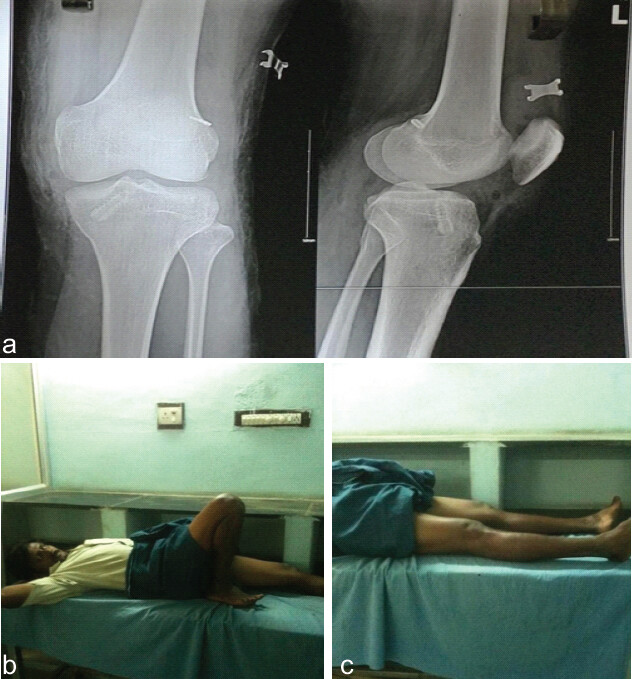
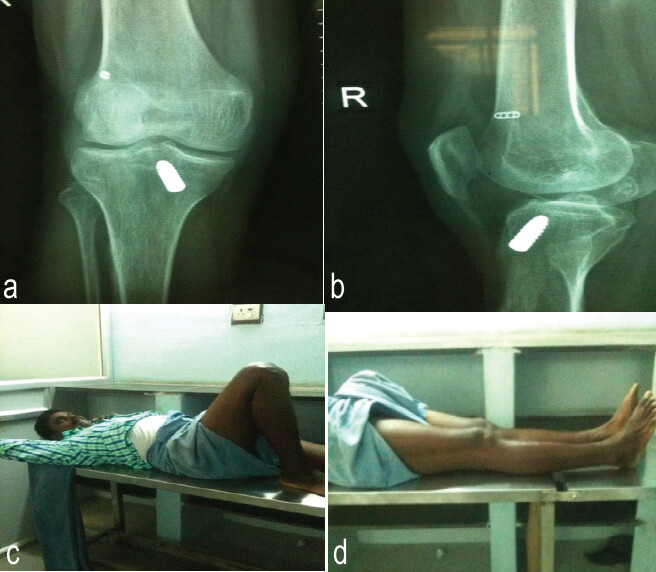
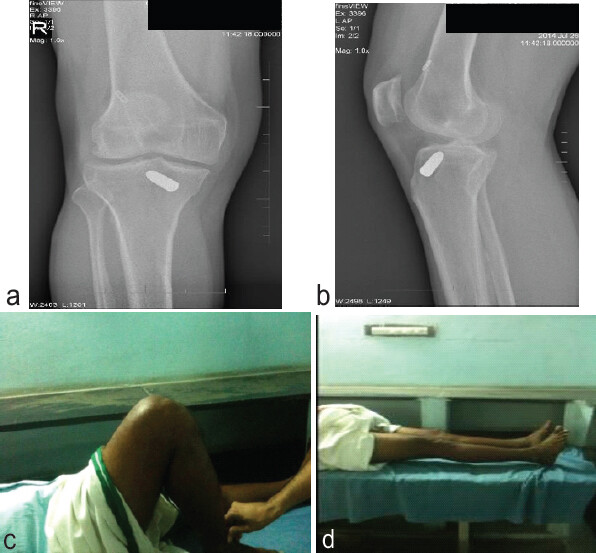
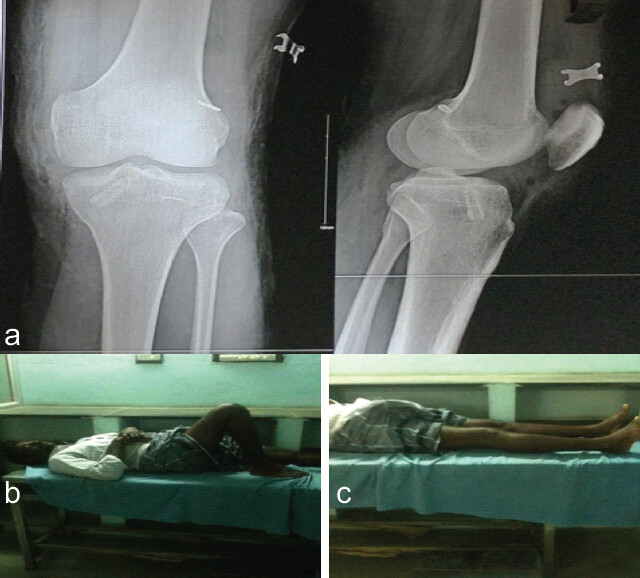
Representative post-operative radiographs and clinical photographs demonstrating post-operative knee flexion and extension are shown in Figs. 3, 4, 5, and 6.
Discussion
The present study evaluated the clinical characteristics, post-operative complications, and functional outcomes following arthroscopic ACL reconstruction. The mean age was 31.72 ± 8.88 years, with a predominance of males (72%). Road traffic accidents were the commonest mechanism of injury (44%), followed by sports-related injuries (36%). This is consistent with Sanders et al., who reported a significantly higher incidence of ACL tears among males, with peak incidence occurring in young adulthood [11].
Giving-way was the most frequent presenting symptom (100%), followed by pain (76%) and swelling (28%). Most patients underwent reconstruction within 4–6 months of injury. Medial meniscal tear was the most common associated injury (40%), followed by lateral meniscal tear (32%). Delayed reconstruction in ACL-deficient knees has been associated with an increased risk of secondary meniscal and chondral lesions [12]. The high frequency of associated meniscal pathology in the present study highlights the importance of timely assessment and management. The present study did not test the relationship between injury-to-surgery interval and post-operative function, so it cannot establish whether earlier reconstruction would have improved outcomes in this cohort.
Post-operative complications were recorded in 15 of 50 patients (30%). When calculated using the full cohort as the denominator, anterior knee pain occurred in 10%, tunnel widening in 8%, infection in 6%, and graft failure, tibial screw dislodgement, and knee stiffness in 2% each. Rout et al. similarly reported anterior knee pain following ACL reconstruction with quadrupled hamstring autograft [10]. Direct comparison of complication rates should be cautious because definitions, ascertainment methods, surgical technique, associated injuries, rehabilitation, and follow-up duration differ between studies. In particular, the present study did not prespecify a quantitative imaging protocol or diagnostic threshold for tunnel widening; therefore, the tunnel-widening observation should be interpreted descriptively rather than as a rigorously quantified radiographic endpoint. Furthermore, complication-specific diagnostic criteria, severity grading, treatment, and resolution were not reported. The clear cohort denominator does not resolve these ascertainment limitations; the data cannot support comparisons of complication severity or safety between techniques.
The principal finding was a significant improvement in functional outcome. The mean Lysholm score increased from 50.74 ± 6.342 preoperatively to 86.00 ± 10.067 postoperatively (P < 0.05). Overall, 52% of patients achieved good and 32% excellent outcomes, giving 84% good-to-excellent results. The Lysholm score is an established measure for assessing functional outcomes following knee ligament surgery [13].
The present findings are comparable with previous studies. Sudhakar et al. reported 27% excellent, 53% good, 13% fair, and 7% poor outcomes following hamstring autograft reconstruction, closely resembling the distribution observed in the present study [14]. Rout et al. reported greater improvement, with the mean Lysholm score increasing from approximately 49 to 95 and 90% of patients achieving excellent outcomes [10]. Williams et al. reported an increase from 55 preoperatively to 92 postoperatively following four-strand hamstring autograft reconstruction [15]. Differences in post-operative scores across these studies cannot be attributed to meniscal pathology or complications from the present unadjusted analysis. Differences in populations, follow-up, and outcome assessment also limit direct comparisons.
Hamstring autografts have recognized biomechanical properties and may reduce some donor-site morbidity compared with BPTB grafts [16, 17]. However, the present study did not include a BPTB, quadriceps tendon, allograft, or alternative-fixation comparison group and therefore cannot determine comparative effectiveness or graft superiority. Meta-analytic evidence has reported broadly comparable long-term clinical function and stability between hamstring and BPTB autografts [18]. Biomechanical studies have also characterized the mechanical properties of commonly used grafts [19, 20]. Non-operative management was also not evaluated, and the observed within-cohort improvement cannot isolate the effect of graft choice from surgery, rehabilitation, natural recovery, or other influences.
Successful recovery following ACL reconstruction is influenced by graft selection, fixation, associated intra-articular pathology, rehabilitation, baseline activity, and timing of surgery [21]. In this cohort, a standardized rehabilitation protocol was prescribed, but adherence was not quantified. The wide injury-to-surgery interval and frequent associated meniscal injuries may also have influenced post-operative function; these factors were not adjusted for in multivariable analyses. In particular, the types and frequencies of meniscal procedures were not reported, preventing separation of the effects of ACL reconstruction from those of concomitant meniscal treatment. Graft diameter was not analyzed, and adherence to rehabilitation could not be accounted for.
Overall, 84% of patients achieved good-to-excellent Lysholm outcomes at 12 months, and the mean Lysholm score improved from baseline. These results describe functional recovery within this treated cohort. They should not be interpreted as evidence that hamstring autograft is superior to other graft choices or fixation techniques, and they do not address long-term graft survival, recurrent instability, osteoarthritis, or return to high-level sport.
Limitations
This study included only 50 patients at a single institution, limiting statistical power, precision, detection of uncommon complications, and generalizability to other hospitals and patient populations. The sample-size calculation for a single proportion did not demonstrate power for longitudinal functional comparisons or subgroup analyses. The prospective observational design lacked randomization and a comparator receiving BPTB reconstruction, allograft reconstruction, or non-operative management. Selection bias and confounding therefore remain possible; the observed improvement cannot be attributed causally to hamstring autograft reconstruction or used to establish its superiority. The 12-month follow-up was insufficient to assess long-term graft survival, recurrent instability, osteoarthritis, or sustained sports participation.
Functional assessment relied principally on the Lysholm Knee Scoring Scale. IKDC, KOOS, and Tegner activity scores were not reported, limiting assessment across other domains of knee function and activity. Return to the pre-injury sports level, time to return to sport, and post-operative sports participation were not evaluated. Clinical Lachman and pivot-shift examinations were performed, but KT-1000/KT-2000 or other quantitative instrumented laxity measurements were not reported; objective stability could therefore not be characterized comprehensively.
Associated meniscal injuries were common, but the specific treatments and their separate effects on functional recovery were not analyzed. The injury-to-surgery interval varied from 6 weeks to more than 1 year, and its relationship with outcome was not evaluated. Rehabilitation adherence and physiotherapy attendance were not quantified. Consequently, variation in meniscal treatment, surgical timing, and rehabilitation exposure may have influenced recovery. Surgeon number, experience, and possible inter-surgeon variability were not captured in the reported dataset.
Although full-cohort denominators have been clarified, the report lacked standardized definitions, diagnostic criteria, severity grading, and management or resolution details for the recorded complications. Tunnel widening was reported without a documented imaging modality, measurement method, baseline comparison, timing, or clinically relevant threshold. Its frequency must therefore be interpreted as a descriptive observation, and its clinical significance remains uncertain. These reporting gaps also limit comparisons of complication rates with other studies.
No multivariable analysis adjusted for age, sex, activity level, injury chronicity, meniscal pathology or treatment, graft diameter, or post-operative rehabilitation. Their independent effects cannot be separated from the observed functional improvement. Confidence intervals and standardized effect sizes were not provided, and the exact statistical test and exact P-value underlying the reported significance were not specified. Larger multicenter comparative studies with longer follow-up, broader validated outcome measures, formal return-to-sport assessment, quantitative stability testing, documented rehabilitation adherence, standardized complication and imaging criteria, and prespecified adjusted analyses are needed.
Conclusion
In this prospective single-center observational cohort of 50 patients, the mean Lysholm score increased from 50.74 ± 6.342 before surgery to 86.00 ± 10.067 after hamstring autograft ACL reconstruction, and 84% had good-to-excellent Lysholm outcomes at 12 months. These findings describe short-term functional improvement within the treated cohort. The absence of a control group and adjustment for potential confounders prevents causal attribution or conclusions about superiority over BPTB reconstruction, allograft reconstruction, or non-operative management. Long-term effectiveness, graft survival, recurrent instability, osteoarthritis, and return to sport were not established by this study.
Clinical Message
Arthroscopic ACL reconstruction using a quadrupled hamstring autograft demonstrated improved Lysholm scores, with 84% of patients achieving good-to-excellent functional outcomes at 12 months. Careful patient selection, appropriate graft fixation, and structured postoperative rehabilitation are essential for functional recovery. Larger comparative studies with longer follow-up are needed to establish long-term outcomes and comparative effectiveness.
Conflict of Interest:
Nil
Source of Support:
Nil
Consent
The authors confirm that informed consent was obtained from the patient for publication of this article
How to Cite this Article
Akhil M, Singh A, Gera Y. A Study of Functional Outcome of Arthroscopic Anterior Cruciate Ligament Reconstruction Using Hamstring Graft. J Orthop Case Rep. 2026 November;16(11):419-428. doi: 10.13107/jocr.2026.v16.i11.8514.
References
- Paschos NK, Howell SM. Anterior cruciate ligament reconstruction: Principles of treatment. EFORT Open Rev 2016;1:398-408. [Google Scholar] | [PubMed]
- Pardiwala DN, Rao NN, Anand K, Raut A. Knee dislocations in sports injuries. Indian J Orthop 2017;51:552-62. [Google Scholar] | [PubMed]
- Swenson TM. Physical diagnosis of the multiple-ligament-injured knee. Clin Sports Med 2000;19:415-23. [Google Scholar] | [PubMed]
- Dargel J, Gotter M, Mader K, Pennig D, Koebke J, Schmidt-Wiethoff R. Biomechanics of the anterior cruciate ligament and implications for surgical reconstruction. Strategies Trauma Limb Reconstr 2007;2:1-12. [Google Scholar] | [PubMed]
- Macaulay AA, Perfetti DC, Levine WN. Anterior cruciate ligament graft choices. Sports Health 2012;4:63-8. [Google Scholar] | [PubMed]
- Widner M, Dunleavy M, Lynch S. Outcomes following ACL reconstruction based on graft type: Are all grafts equivalent?. Curr Rev Musculoskelet Med 2019;12:460-5. [Google Scholar] | [PubMed]
- Samitier G, Marcano AI, Alentorn-Geli E, Cugat R, Farmer KW, Moser MW. Failure of anterior cruciate ligament reconstruction. Arch Bone Jt Surg 2015;3:220-40. [Google Scholar] | [PubMed]
- Hadi H, Bagherifar A, Tayebi F, Ansaria M, Shahsavaripour A, Qomashi I. Anterior cruciate ligament reconstruction with hamstring tendons has no deleterious effecton hip extension strength. Arch Bone Jt Surg 2019;7:278-83. [Google Scholar] | [PubMed]
- Biau DJ, Tournoux C, Katsahian S, Schranz P, Nizard R. ACL reconstruction: A meta-analysis of functional scores. Clin Orthop Relat Res 2007;458:180-7. [Google Scholar] | [PubMed]
- Rout S, Garg R, Patidar R, Rout S. Functional outcome of arthroscopic anterior cruciate ligament reconstruction using a quadrupled hamstring autograft: A prospective study. Cureus 2025;17:e96654. [Google Scholar] | [PubMed]
- Sanders TL, Maradit Kremers H, Bryan AJ, Larson DR, Dahm DL, Levy BA. Incidence of anterior cruciate ligament tears and reconstruction: A 21-year population-based study. Am J Sports Med 2016;44:1502-7. [Google Scholar] | [PubMed]
- De Campos GC, Nery WJr, Teixeira PE, Araujo PH, Alves WMJr. Association between meniscal and chondral lesions and timing of anterior cruciate ligament reconstruction. Orthop J Sports Med 2016;4:2325967116669309. [Google Scholar] | [PubMed]
- Lysholm J, Gillquist J. Evaluation of knee ligament surgery results with special emphasis on use of a scoring scale. Am J Sports Med 1982;10:150-4. [Google Scholar] | [PubMed]
- Sudhakar T. Functional outcome of arthroscopic anterior cruciate ligament reconstruction using hamstring autograft. Indian J Orthop Surg 2021;7:113-7. [Google Scholar] | [PubMed]
- Williams RJ, Hyman J, Petrigliano F, Rozental T, Wickiewicz TL. Anterior cruciate ligament reconstruction with a four-strand hamstring tendon autograft. Surgical technique. J Bone Joint Surg Am 2004;86:225-32. [Google Scholar] | [PubMed]
- Macaulay AA, Perfetti DC, Levine WN. Anterior cruciate ligament graft choices. Sports Health 2012;4:63-8. [Google Scholar] | [PubMed]
- Sherman OH, Banffy MB. Anterior cruciate ligament reconstruction: Which graft is best?. Arthroscopy 2004;20:974-80. [Google Scholar] | [PubMed]
- Zhao L, Lu M, Deng M, Xing J, He L, Wang C. Outcome of bone-patellar tendon-bone vs hamstring tendon autograft for anterior cruciate ligament reconstruction: A meta-analysis of randomized controlled trials with a 5-year minimum follow-up. Medicine (Baltimore) 2020;99:e20348. [Google Scholar] | [PubMed]
- Strauss MJ, Miles JW, Kennedy ML, Dornan GJ, Moatshe G, Lind M. Full thickness quadriceps tendon grafts with bone had similar material properties to bone-patellar tendon-bone and a four-strand semitendinosus grafts: A biomechanical study. Knee Surg Sports Traumatol Arthrosc 2022;30:1786-94. [Google Scholar] | [PubMed]
- Hart D, Gurney-Dunlop T, Leiter J, Longstaffe R, Eid AS, McRae S. Biomechanics of hamstring tendon, quadriceps tendon, and bone-patellar tendon-bone grafts for anterior cruciate ligament reconstruction: A cadaveric study. Eur J Orthop Surg Traumatol 2023;33:1067-74. [Google Scholar] | [PubMed]
- Van Grinsven S, Van Cingel RE, Holla CJ, Van Loon CJ. Evidence-based rehabilitation following anterior cruciate ligament reconstruction. Knee Surg Sports Traumatol Arthrosc 2010;18:1128-44. [Google Scholar] | [PubMed]
© 2026 Journal of Orthopaedic Case Reports - Published by Indian Orthopaedic Research Group
About the Authors
-

M. Akhil
-

Amrit Singh
-

Yakshit Gera
Related Articles in Journal of Orthopaedic Case Reports
 September 1, 2026 Arthroscopic ACL Tibial Spine Avulsion Fixation Using Suture Pull-Through Double-Tunnel Technique
 October 1, 2026 Incidence, Arthroscopic Detection, and Clinical Outcomes of Ramp Lesions in Patients Undergoing Anterior Cruciate Ligament Reconstruction: A Prospective Observational Study
 October 1, 2026 Arthroscopic Posterior Cruciate Ligament Tibial Spine Avulsion Fixation Using a Suture Pull-Through Single-Tunnel Technique
 September 1, 2026 Fixed Flexion Deformity due to Displaced Hoffa Fracture: A Case Report