


Introduction
Neck and low back disorders are major causes of pain, activity limitation, and disability worldwide. Functional assessment in clinical practice commonly uses region-specific patient-reported outcome measures, particularly the Oswestry disability index (ODI) [1] for lumbar disorders and the NDI [2] for cervical disorders. Although well established, these instruments become less useful when patients present with symptoms spanning more than one spinal region.
Patient-reported outcome measures require careful translation and cultural adaptation for use in other languages, so that conceptual meaning is preserved while the instrument remains understandable to the target population. Gabel and colleagues developed the spine functional index (SFI) to evaluate functional limitation across the spine as a single kinetic chain; the original English version showed good clinimetric properties, and Spanish, Turkish, and simplified Chinese adaptations have since demonstrated satisfactory reliability and validity [3,4,5,6].
Validated Hindi instruments already exist for regional spinal disability. The Hindi ODI (ODI-Hi) shows high internal consistency and excellent test-retest reliability in low back pain [7], and Hindi versions of the NDI show good to excellent reliability in chronic neck pain, including rural populations [8,9]. However, no Hindi instrument assesses functional limitation across the whole spine.
This study aimed to translate and culturally adapt the SFI into Hindi (SFI-Hi) and to evaluate its internal consistency, test-retest reliability, measurement error, construct validity, factor structure, responsiveness, and minimal clinically important difference (MCID), and floor/ceiling effects in Indian patients with cervical, lumbar, and combined spinal disorders.
Materials and Methods
Study design and setting
This prospective, single-center, cross-sectional validation study was conducted in the orthopedics outpatient department of a tertiary-care postgraduate teaching institute in northern India between June 2025 and April 2026. The center functions as a high-volume tertiary referral site serving patients from several neighboring states in northern India, in addition to the local population. The study was approved by the Institutional Ethics Committee (IRB No. DRB/Ortho/2025/56). Written informed consent was obtained from all participants before enrolment. This research was conducted in accordance with the World Medical Association Declaration of Helsinki.
Translation and cross-cultural adaptation
The Hindi SFI (SFI-Hi) was developed using a double forward-backward translation procedure based on Beaton et al. [10] and the COSMIN framework [11,12], to achieve semantic, idiomatic, experiential, and conceptual equivalence. Two bilingual, native Hindi-speaking translators, independently prepared forward translations; an expert committee comprising an orthopedic spine surgeon, a physiotherapist, a clinical psychologist, and both translators developed a consensus version, which two further bilingual translators back-translated independently. The committee resolved discrepancies by consensus and adapted units for the Indian context (e.g., kilograms rather than pounds) [6]. The near-final questionnaire was pilot tested in 22 patients, and three items underwent minor wording changes based on their feedback to produce the final SFI-Hi.
Participants
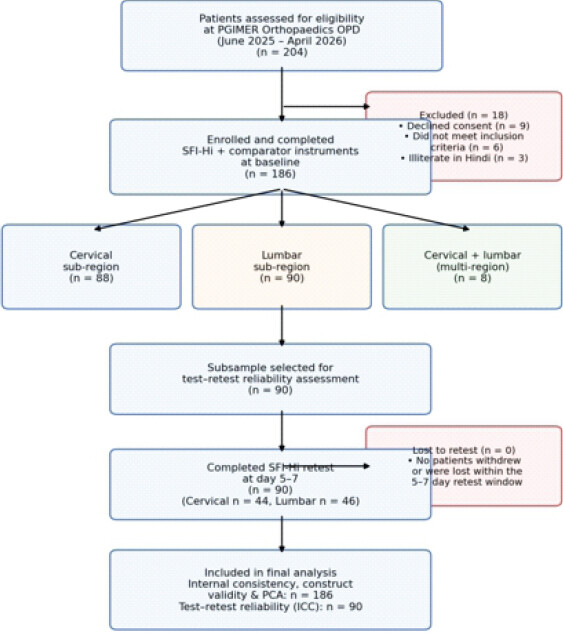
Eligible participants were aged 18 years or older, literate in Hindi, symptomatic for at least 12 weeks, and diagnosed with a cervical, lumbar, or combined spinal disorder. Exclusion criteria were spinal tumor, infection, or fracture; pregnancy; systemic rheumatological or inflammatory disease; previous spinal surgery; or neurological or psychiatric conditions likely to interfere with self-reported assessment. Of 204 eligible patients approached, 186 (91.2%) consented and completed baseline assessment; 90 clinically stable participants repeated the SFI-Hi after 5–7 days for test-retest analysis.
Outcome instruments
All participants completed the 25-item SFI-Hi (response options “Yes,” “Partly,” and “No”), the ten-item Hindi Functional Rating Index (FRI-Hi) Feise and Michael [13], Hindi SF-12, and a 100-mm pain VAS. Cervical patients also completed the Hindi NDI (NDI-Hi) [8,9], and lumbar patients completed the ODI-Hi [7]. SFI-Hi total scores were expressed on a 0–100 scale for comparison with the disability-oriented comparators, with higher scores indicating greater functional limitation. Baseline variables, included age, sex, body mass index, residence, education, occupation, smoking status, comorbidities, symptom duration, prior treatment, radiating pain, and magnetic resonance imaging (MRI), confirmed degenerative changes where available.
A priori hypotheses for construct validity
Six hypotheses were prespecified for construct validity: High correlation (r ≥ 0.60) with the FRI-Hi, with the ODI-Hi in the lumbar subgroup, and with the NDI-Hi in the cervical subgroup; high correlation (|r| ≥ 0.60) with the SF-12 physical functioning domain; weak correlation (|r| ≤ 0.30) with the SF-12 mental health domain; and moderate correlation (r = 0.31–0.60) with VAS pain. Construct validity was considered supported if at least 75% of hypotheses were confirmed [14].
Responsiveness and MCID
A subgroup of 92 participants who received a defined treatment intervention (physiotherapy, pharmacological management, or a combination) during the study period returned for a scheduled clinical follow-up visit 6 weeks after baseline and completed a repeat SFI-Hi assessment together with a patient-reported global rating of change (GRC) anchor question. Responsiveness was evaluated by comparing baseline and 6-week SFI-Hi scores and calculating the standardized response mean (mean change divided by the standard deviation of the change score). The MCID was estimated using an anchor-based approach, comparing the observed SFI-Hi change among patients reporting meaningful improvement on the GRC anchor with that among patients reporting no meaningful improvement; receiver operating characteristic (ROC) curve analysis was used to identify the SFI-Hi change score that best discriminated between these groups [12,14].
Statistical analysis
Item distributions were assessed for skewness (|Z| > 1.96 indicating non-normality), and item-total correlations below 0.30 were flagged for review. Internal consistency was assessed using Cronbach’s alpha (0.70–0.95 interpreted as acceptable to excellent) [15]. Test-retest reliability was assessed using the two-way random-effects, single-measure intraclass correlation coefficient (ICC2,1) with 95% confidence intervals, and Bland–Altman analysis was used to assess agreement. Standard error of measurement (SEM) was calculated as SD√(1−ICC), and minimal detectable change at 90% confidence (MDC90) as SEM × √2 × 1.65 [5]. Construct validity was assessed using Pearson correlation coefficients, interpreted as low (0.00–0.30), moderate (0.31–0.60), or high (≥0.60) [6]. Principal component analysis (PCA) explored factor structure using eigenvalues >1.0 and the scree plot as extraction criteria. Responsiveness was interpreted using conventional standardized-response-mean benchmarks (<0.2 trivial, 0.2–0.5 small, 0.5–0.8 moderate, and >0.8 large) [14], and the anchor-based MCID analysis used ROC-derived sensitivity, specificity, and area under the curve (AUC). Floor and ceiling effects were considered present when more than 15% of participants scored at the lowest or highest possible score [1,16]. All tests were two-sided, with P < 0.05 considered statistically significant. Analyses were performed using IBM Statistical Package for the Social Sciences Statistics version 31 (IBM Corp., Armonk, NY, USA).
Result
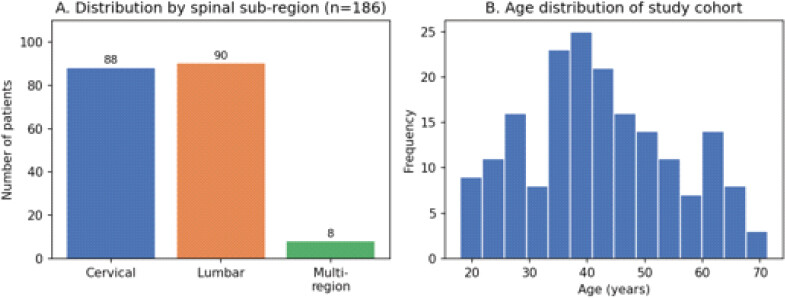
Of 204 eligible patients approached, 186 (91.2%) were enrolled and completed the baseline assessment; overall questionnaire completion was 96.8%. Fig. 1 summarizes recruitment and retest flow. Table 1 and Fig. 2 summarize the demographic and clinical characteristics of the cohort (n = 186): mean age 42.1 ± 12.9 years; 98 (52.7%) male; mean body mass index 25.4 ± 3.8 kg/m2; cervical involvement in 88 (47.3%), lumbar in 90 (48.4%), and combined cervical-lumbar involvement in eight (4.3%); and mean SFI-Hi score 49.0 ± 16.6 on the 0–100 disability scale.
Demographic and clinical characteristics of the study cohort (n=186)
| Characteristic | Value (n=186) |
|---|---|
| Age, years (mean±SD) | 42.1±12.9 |
| Sex, male / female, n (%) | 98 (52.7)/88 (47.3) |
| BMI, kg/m2 (mean±SD) | 25.4±3.8 |
| Symptom duration, months (mean±SD) | 15.9±9.6 |
| Cervical, n (%) | 88 (47.3) |
| Lumbar, n (%) | 90 (48.4) |
| Cervical+lumbar (multi-region), n (%) | 8 (4.3) |
| Residence, urban / rural, n (%) | 121 (65.1) / 65 (34.9) |
| Education–up to secondary school, n (%) | 61 (32.8) |
| Education–higher secondary / graduate/, n (%) | 99 (53.2) |
| Education–postgraduate, n (%) | 26 (14.0) |
| Occupation–manual/labor-intensive, n (%) | 103 (55.4) |
| Occupation–sedentary/desk-based, n (%) | 83 (44.6) |
| Current smoker, n (%) | 34 (18.3) |
| Comorbidity present (any), n (%) | 58 (31.2) |
| Diabetes mellitus, n (%) | 22 (11.8) |
| Hypertension, n (%) | 31 (16.7) |
| Prior treatment–physiotherapy only, n (%) | 74 (39.8) |
| Prior treatment–analgesics/NSAIDs only, n (%) | 56 (30.1) |
| Prior treatment–none, n (%) | 56 (30.1) |
| Pain radiation to limb, present, n (%) | 67 (36.0) |
| MRI-confirmed degenerative changes, n (%)* | 129 (79.1) |
| SFI-Hi score, 0–100 (mean±SD)† | 49.0±16.6 |
| VAS, 0–100 mm (mean±SD) | 52.3±19.8 |
| FRI-Hi, 0–100% (mean±SD) | 38.7±17.2 |
| NDI-Hi, 0–100%–cervical subgroup (mean±SD) | 31.4±12.6 |
| ODI-Hi, 0–100%–lumbar subgroup (mean±SD) | 33.9±15.1 |
*
Among patients who underwent MRI as part of routine clinical care (n=163).
†
SFI-Hi reported on a 0–100 disability-oriented scale, where 0 indicates no functional limitation and 100 indicates maximum functional limitation. SFI-Hi: Hindi version of the spine functional index, FRI-Hi: Hindi functional rating index, NDI-Hi: Hindi neck disability index, ODI-Hi: Hindi Oswestry disability index, VAS: Visual analog scale, SF-12: Short form-12 health survey, SD: Standard deviation, BMI: Body mass index, MRI: Magnetic resonance imaging
Content validity and item analysis
All 25 items met the prespecified item-level criteria; no item exceeded the skewness threshold or had an item-total correlation below 0.30, so none was removed. Missing responses occurred in fewer than 2% of administrations, most often for items concerning lifting/carrying and assistance with personal care.
Internal consistency and test-retest reliability
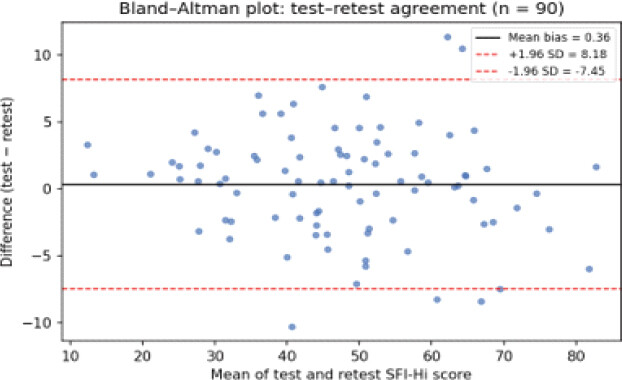
Overall Cronbach’s alpha was 0.92 (item-deleted range 0.90–0.93; Table 2). In the ninety-patient retest sample, test-retest reliability was excellent (ICC2,1 = 0.96, 95% CI 0.94–0.98), with an SEM of 2.8% and an MDC90 of 6.5%. Bland–Altman analysis demonstrated a mean test-retest bias of 0.4%, with 95% limits of agreement from approximately −7.5% to +8.2% (Fig. 3).
Internal consistency and test-retest reliability of the SFI-Hi
| Analysis sample | Cronbach’s α | SEM (%) | MDC90 (%) | ICC (2,1) [95% CI] |
|---|---|---|---|---|
| Full cohort (n=186) | 0.92 | — | — | — |
| Cervical subgroup (n=88) | 0.9 | — | — | — |
| Lumbar subgroup (n=90) | 0.91 | — | — | — |
| Retest subsample (n=90; day 5–7) | — | 2.8 | 6.5 | 0.96 [0.94–0.98] |
SEM: Standard error of measurement, MDC90: Minimal detectable change at 90% confidence, ICC: Intraclass correlation coefficient, SFI-Hi: Hindi version of the spine functional index
Structural (factor) validity
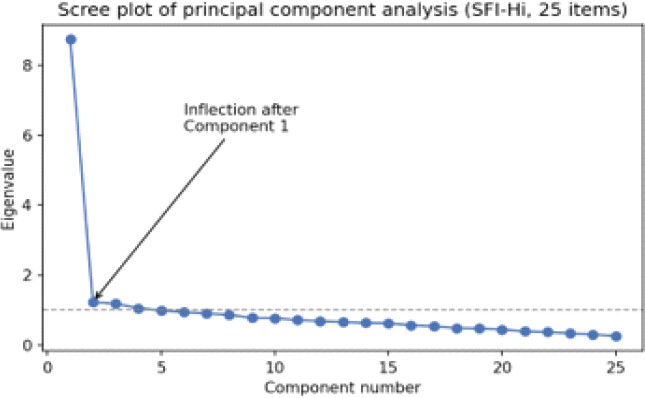
PCA identified a single dominant component, with an eigenvalue of 8.74 explaining 35.0% of the total variance; the scree plot showed a clear inflection after the first component (Fig. 4). Item loadings ranged from 0.46 to 0.75, with the highest loadings for difficulty with walking/recreation/sport, transport independence, and getting in and out of chairs, and the lowest for appetite and concentration (Table 3).
Item-total correlations and principal component loadings for the 25 SFI-Hi items
| Item | Item-total r | PCA loading |
|---|---|---|
| 1. Stay at home most of the time | 0.45 | 0.66 |
| 2. Change positions frequently for comfort | 0.38 | 0.55 |
| 3. Avoid heavy household/occupational tasks | 0.42 | 0.62 |
| 4. Rest more often than usual | 0.39 | 0.57 |
| 5. Ask others to help with tasks | 0.48 | 0.71 |
| 6. Pain present almost all the time | 0.35 | 0.51 |
| 7. Difficulty lifting and carrying | 0.44 | 0.64 |
| 8. Appetite affected by symptoms | 0.33 | 0.48 |
| 9. Difficulty walking/recreation/sport | 0.51 | 0.75 |
| 10. Difficulty with home/family duties | 0.49 | 0.72 |
| 11. Sleep less well than usual | 0.46 | 0.68 |
| 12. Need assistance with personal care/hygiene | 0.32 | 0.46 |
| 13. Difficulty with regular daily/work/social activity | 0.43 | 0.63 |
| 14. More irritable/short-tempered | 0.44 | 0.65 |
| 15. Feel weaker or stiffer than usual | 0.4 | 0.59 |
| 16. Reduced independence with transport | 0.5 | 0.73 |
| 17. Need assistance or slower while dressing | 0.42 | 0.61 |
| 18. Difficulty moving in bed | 0.4 | 0.58 |
| 19. Difficulty concentrating and/oi reading | 0.35 | 0.5 |
| 20. Sitting tolerance affected | 0.46 | 0.67 |
| 21. Difficulty getting in/out of chairs | 0.5 | 0.74 |
| 22. Can only stand for short periods | 0.48 | 0.7 |
| 23. Difficulty squatting/kneeling | 0.49 | 0.72 |
| 24. Difficulty reaching down (e.g., pick up objects) | 0.47 | 0.69 |
| 25. Slower on stairs or needs a rail | 0.44 | 0.65 |
SFI-Hi: Hindi version of the spine functional index, PCA: Principal component analysis
Construct validity: Hypothesis testing
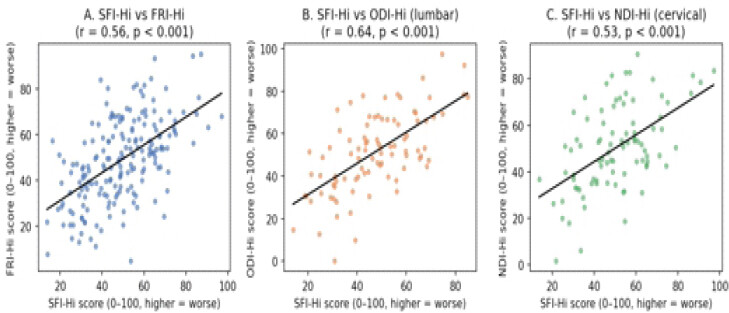
Three of the six prespecified hypotheses were confirmed – those concerning the ODI-Hi, the SF-12 mental health domain, and VAS pain (Table 4 and Fig. 5). Correlations with the FRI-Hi (r = 0.56) and NDI-Hi (r = 0.53) were moderate rather than high, and the correlation with the SF-12 physical functioning domain (r = −0.54) did not reach the prespecified threshold. The observed results therefore supported several expected construct relationships but did not meet the predefined criterion of 75% of hypotheses.
Construct validity — correlations between the SFI-Hi and comparator instruments
| Comparator measure | Total (n=186) | Cervical (n=88) | Lumbar (n=90) |
|---|---|---|---|
| FRI-Hi | r=0.56** | r=0.51** | r=0.60** |
| NDI-Hi | r=0.53** | r=0.53** | — |
| ODI-Hi | r=0.64** | — | r=0.64** |
| VAS | r=0.46** | r=0.42** | r=0.50** |
| SF-12 PF domain | r=−0.54** | r=−0.49** | r=−0.58** |
| SF-12 BP domain | r=−0.48** | r=−0.45** | r=−0.51** |
| SF-12 MH domain | r=−0.07 (ns) | r=−0.06 (ns) | r=−0.09 (ns) |
FRI: Functional rating index, NDI: Neck disability index, ODI: Oswestry disability index, VAS: Visual analog scale, SF-12: Short form-12 health survey, PF: Physical functioning, BP: Bodily pain, MH: Mental health, ns: Not significant (P>0.05). Negative correlations for PF and BP reflect opposite scoring directions: higher SF-12 domain scores indicate better health, whereas higher SFI-Hi scores indicate greater disability.
**
P<0.001
Floor and ceiling effects
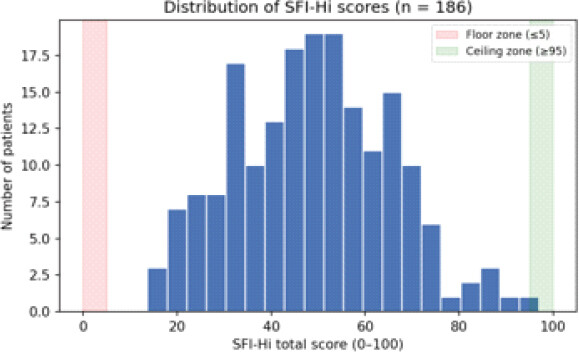
No participant (0/186) scored at the floor, and 1 (0.5%) scored at the ceiling; both values were well below the prespecified 15% threshold for a clinically important floor or ceiling effect (Fig. 6).
Responsiveness
Ninety-two treated participants completed follow-up assessment at 6 weeks. Mean SFI-Hi score improved from 51.3 ± 15.8 at baseline to 38.1 ± 16.4 at follow-up, a mean improvement of 13.2 points (95% CI, 10.8–15.6; P < 0.001), with a standardized response mean of 0.84, indicating good responsiveness (Table 5). Patients reporting meaningful improvement on the GRC anchor showed a significantly greater SFI-Hi change than those reporting no meaningful improvement.
Responsiveness and minimal clinically important difference of the SFI-Hi (treated subgroup, n=92, 6-week follow-up)
| Parameter | Value |
|---|---|
| Baseline SFI-Hi score, mean±SD | 51.3±15.8 |
| Six-week SFI-Hi score, mean±SD | 38.1±16.4 |
| Mean improvement (95% CI) | 13.2 (10.8–15.6) |
| P-value | <0.001 |
| Standardized response mean | 0.84 |
| Anchor-based MCID | 8 points |
| ROC-derived threshold | 7.8 points |
| Area under the curve | 0.81 |
| Sensitivity | 78% |
| Specificity | 76% |
MCID: Minimal clinically important difference, ROC: Receiver operating characteristic, CI: Confidence interval, SFI-Hi: Hindi version of the spine functional index
MCID
Anchor-based analysis identified an estimated MCID of 8 points on the 0–100 SFI-Hi scale. ROC analysis identified an optimal discriminating threshold of 7.8 points, with an AUC of 0.81, sensitivity of 78%, and specificity of 76% (Table 5).
Discussion
This study translated and culturally adapted the SFI-Hi and evaluated the measurement properties of the resulting SFI-Hi in an Indian orthopedic cohort. The questionnaire demonstrated high internal consistency, excellent test-retest reliability, and a predominantly unidimensional factor structure. The observed relationships with established measures of spinal disability, pain, and health-related quality of life were generally consistent with the expected construct relationships, although the predefined 75% criterion for construct validity was not reached.
The overall Cronbach’s alpha of 0.92 indicates strong internal consistency and is comparable with the values reported for the original English version (α = 0.91) and the simplified Chinese version (α = 0.91) [3,6]. It was higher than the values reported in the Turkish and Spanish adaptations (α = 0.85 for both) [4,5] and is comparable with the internal consistency reported for the Hindi ODI and Hindi NDI [7,8,9]. Test-retest reliability was excellent (ICC2,1 = 0.96, 95% CI 0.94–0.98); the SEM of 2.8% and MDC90 of 6.5% provide useful estimates for interpreting change in SFI-Hi scores among stable patients.
The PCA findings support a predominantly one-factor structure, with the first component explaining 35.0% of the total variance and item loadings ranging from 0.46 to 0.75. This finding is consistent with previous SFI adaptations, although the proportion of variance explained differs among language versions [3,4,5,6]. Because PCA is exploratory, the present factor structure should be regarded as preliminary; confirmatory factor analysis in a larger, independent cohort would be appropriate in future studies.
Construct validity showed a mixed but clinically interpretable pattern. The high correlation with the ODI-Hi (r = 0.64) supported the expected relationship between whole-spine and lumbar disability, whereas correlations with the FRI-Hi (r = 0.56) and NDI-Hi (r = 0.53) were moderate rather than high. The correlation with the SF-12 physical functioning domain was moderate and inverse (r = −0.54), whereas the relationship with the SF-12 mental health domain was negligible (r = −0.07), supporting the expected distinction between physical disability and mental health. The VAS correlation was moderate (r = 0.46), as hypothesized. Overall, three of the six a priori hypotheses were confirmed, so the predefined 75% criterion was not achieved; this should be considered when interpreting the construct-validity evidence for the SFI-Hi.
The SFI-Hi also demonstrated good responsiveness to clinical change, with a standardized response mean of 0.84 in the treated subgroup, conventionally regarded as indicating large responsiveness [14]. The anchor-based MCID of approximately 8 points, supported by a ROC-derived AUC of 0.81, provides an initial benchmark for interpreting clinically meaningful change on the SFI-Hi and complements the measurement-error estimates reported above (SEM 2.8%, MDC90 6.5%); the MCID reflects a clinically important change, whereas the MDC90 reflects the smallest change exceeding measurement error, and the two should be interpreted separately.
Several limitations should be considered. The study was conducted at a single tertiary-care orthopedic center, which may limit generalizability to primary-care, community, rural, or other regional populations. Participants were required to be literate in Hindi and able to complete a written questionnaire, so the findings may not extend to individuals with limited literacy or those who primarily use regional dialects. Responsiveness and the MCID were evaluated in a subgroup of 92 treated participants using a single 6-week follow-up assessment and an anchor-based method; longer-term responsiveness, and MCID estimation using additional distribution-based and multiple-timepoint anchor methods, warrant further study. Confirmatory factor analysis was not performed, and the factor structure identified by PCA therefore remains exploratory. Only eight participants had combined cervical-lumbar disease, reflecting consecutive clinical recruitment during the study period; this limits conclusions about multiregional spinal disease, and larger studies with more patients with multiregional involvement would be valuable.
Conclusion
The SFI was successfully translated and culturally adapted into Hindi, resulting in the SFI-Hi. In this cohort of 186 Indian patients with chronic cervical, lumbar, or combined spinal disorders, the instrument demonstrated high internal consistency, excellent short-term test-retest reliability, low measurement error, and a single dominant component on exploratory factor analysis. The observed correlations with established disability, pain, and health measures provided partial support for construct validity, although the predefined 75% hypothesis-confirmation threshold was not reached. The SFI-Hi also demonstrated good responsiveness to clinical change (standardized response mean 0.84) and an anchor-based MCID of approximately 8 points, supporting its use for monitoring clinically meaningful change. Further multicenter studies involving larger and more diverse Hindi-speaking populations, including confirmatory factor analysis, are warranted before broader generalization of the instrument’s measurement properties.
Clinical Message
The SFI-Hi provides Hindi-speaking clinicians with a single, reliable, and responsive, instrument for assessing functional limitation across the whole spine, rather than relying on separate cervical- or lumbar-specific tools, and may be useful for tracking outcomes – including clinically meaningful change of approximately 8 points or more – in patients with mixed or multi-regional spinal complaints, pending further multicenter validation.
Conflict of Interest:
Nil
Source of Support:
Nil
Consent:
The authors confirm that informed consent was obtained from the patient for publication of this article
How to Cite this Article
Raj S, Kumar D, Kumar V, Jose A, Kumar SR, Goni VG. Translating and Validating a Hindi Version of the Spine Functional Index: Cross-cultural Adaptation and Psychometric Testing in an Indian Orthopaedic Population. Journal of Orthopaedic Case Reports 2026 October;16(10): 415-422.
References
- Fairbank JC, Pynsent PB. The oswestry disability index. Spine (Phila Pa 1976) 2000;25:2940-52. [Google Scholar] | [PubMed]
- Vernon H, Mior S. The neck disability index: A study of reliability and validity. J Manipulative Physiol Ther 1991;14:409-15. [Google Scholar] | [PubMed]
- Gabel CP, Melloh M, Burkett B, Michener LA. The spine functional index: Development and clinimetric validation of a new whole-spine functional outcome measure. Spine J 2013;13:173-82. [Google Scholar] | [PubMed]
- Cuesta-Vargas AI, Gabel CP. Validation of a Spanish version of the spine functional index. Health Qual Life Outcomes 2014;12:96. [Google Scholar] | [PubMed]
- Tonga E, Gabel CP, Karayazgan S, Cuesta-Vargas AI. Cross-cultural adaptation, reliability and validity of the Turkish version of the spine functional index. Health Qual Life Outcomes 2015;13:30. [Google Scholar] | [PubMed]
- Zhou XY, Xu XM, Fan JP, Wang F, Wu SY, Zhang ZC. Cross-cultural validation of simplified Chinese version of spine functional index. Health Qual Life Outcomes 2017;15:203. [Google Scholar] | [PubMed]
- Sharma AK, Chaudhary K, Gandhi H, Nag A, Vatkar A, Nimesh R. Validity and reliability of Hindi version of oswestry disability index in Indian population. N Am Spine Soc J 2025;22:100593. [Google Scholar] | [PubMed]
- Geete DB, Mhatre BS, Vernon H. Cross-cultural adaptation and psychometric validation of the Hindi version of the neck disability index in patients with chronic neck pain. Spine (Phila Pa 1976) 2023;48:1663-9. [Google Scholar] | [PubMed]
- Sidiq M, Ramachandran A, Janakiraman B, Kashoo FZ, Chahal A, Singh J. Adaption and psychometric evaluation of the Hindi version of neck disability index in the rural population of Northern India: A cross-cultural study. F1000Res 2024;12:1599. [Google Scholar] | [PubMed]
- Beaton DE, Bombardier C, Guillemin F, Ferraz MB. Guidelines for the process of cross-cultural adaptation of self-report measures. Spine (Phila Pa 1976) 2000;25:3186-91. [Google Scholar] | [PubMed]
- Mokkink LB, Terwee CB, Patrick DL, Alonso J, Stratford PW, Knol DL. The COSMIN study reached international consensus on taxonomy, terminology, and definitions of measurement properties for health-related patient-reported outcomes. J Clin Epidemiol 2010;63:737-45. [Google Scholar] | [PubMed]
- Mokkink LB, Terwee CB, Patrick DL, Alonso J, Stratford PW, Knol DL. The COSMIN checklist for assessing the methodological quality of studies on measurement properties of health status measurement instruments: An international Delphi study. Qual Life Res 2010;19:539-49. [Google Scholar] | [PubMed]
- Feise RJ, Michael MJ. Functional rating index: A new valid and reliable instrument to measure the magnitude of clinical change in spinal conditions. Spine (Phila Pa 1976) 2001;26:78-86. [Google Scholar] | [PubMed]
- Terwee CB, Bot SD, De Boer MR, Van der Windt DA, Knol DL, Dekker J. Quality criteria were proposed for measurement properties of health status questionnaires. J Clin Epidemiol 2007;60:34-42. [Google Scholar] | [PubMed]
- Cronbach LJ. Coefficient alpha and the internal structure of tests. Psychometrika 1951;16:297-334. [Google Scholar] | [PubMed]
- McHorney CA, Tarlov AR. Individual-patient monitoring in clinical practice: Are available health status surveys adequate?. Qual Life Res 1995;4:293-307. [Google Scholar] | [PubMed]
© 2026 Journal of Orthopaedic Case Reports - Published by Indian Orthopaedic Research Group
About the Authors
-

Sharath Raj
-

Deepak Kumar
-

Vishal Kumar
-

Ajay Jose
-

Saloni Rani Kumar
-

Vijay G Goni
Related Articles in Journal of Orthopaedic Case Reports
 July 10, 2023 Osteochondroma of Dorsal Scapula: A Case Report and Review of Literature
 April 30, 2015 Finger Flexion Contracture: First Manifestation of Gout
 November 10, 2016 Total Hip Arthroplasty Indicated for a Tuberculous Coxitis Complicating a Controlled Acquired Imunodefficiency Syndrom Condition: A Preliminary Report Concerning a Case
 September 1, 2026 Musculoskeletal Hydatid Cyst around Pelvis: A Case Report and Review of Literature