


Introduction
Hip osteoarthritis (OA) is a recognized indication for total hip replacement (THR) in India, but unlike the knee, where OA accounts for the overwhelming majority of arthroplasty burden, end-stage hip disease in the Indian population is etiologically heterogeneous. Avascular necrosis (AVN) of the femoral head, associated with corticosteroid use, chronic alcohol consumption, and idiopathic causes, is one of the most common indications for THR in India, characteristically affecting young adults with a marked male predominance [1]. Neck-of-femur fracture and its sequelae, post-traumatic arthritis, developmental dysplasia of the hip, septic sequelae, and failed prior fixation together add further complexity to the indications for THR, producing a demographic and diagnostic profile that differs substantially from the largely OA-driven, older, female-predominant population that typically undergoes total knee replacement (TKR) in India [2]. THR, however, shares with TKR the fundamental problem of cost: It is an implant-intensive, resource-heavy procedure whose expense has traditionally placed it beyond the reach of a large section of India’s population.
The Ayushman Bharat Pradhan Mantri Jan Arogya Yojana (PM-JAY), a national health insurance scheme launched by the Government of India in 2018, is the world’s largest publicly funded health insurance program; it provides coverage of up to 5 lakh (approximately US $6,000) per family per year for secondary and tertiary care through a network of empanelled public and private hospitals [3,4]. Since inception, PM-JAY has been increasingly utilized for high-cost procedures across specialties, with institutional and national analyses documenting rising surgical volumes and improved financial protection in fields ranging from cardiac surgery to general surgery and orthopedics [5,6]. A recent multispecialty audit of PM-JAY claims at a North Indian tertiary institution found that orthopedics was the most-utilized surgical specialty, and that within orthopedics, cementless THR was the single most frequently claimed individual package, ahead of primary TKR [7]. This indicates that THR may in fact anchor PM-JAY’s orthopedic caseload, yet institution-level analyses characterizing PM-JAY utilization for THR, its demographic and diagnostic correlates, and its implant-selection consequences remain scarce.
A further point of interest concerns implant pricing regulation. In 2017, the National Pharmaceutical Pricing Authority (NPPA) imposed a ceiling price on orthopedic knee implants, reducing costs by up to 70%; this ceiling remains in force, most recently renewed to November 2026 [8,9]. No equivalent ceiling has been notified for hip implants, discussion of which remains preliminary [10]. THR therefore offers a useful setting to examine whether PM-JAY’s fixed-package reimbursement alone, independent of price regulation, is sufficient to influence implant selection. In several states, PM-JAY also operates alongside complementary, state-funded schemes; in Himachal Pradesh, the Mukhya Mantri Himachal Health Care Scheme (Himcare) extends an equivalent, mutually exclusive safety net to residents ineligible for PM-JAY [11].
The present study therefore analyses PM-JAY utilization, alongside the complementary Himcare scheme, for THR at a tertiary care center in North India over a 2-year period, examining demographics, diagnostic profile, temporal financing trends, surgical complexity, and implant utilization, to provide an institution-level assessment of the scheme’s impact on access to hip arthroplasty in India.
Material and Methods
Study design and setting
This was a retrospective, single-center observational study, reported in accordance with the Strengthening the Reporting of Observational Studies in Epidemiology statement for cohort studies, conducted in the Department of Orthopedic Surgery of a tertiary care referral center in North India. The study analyzed all THR procedures performed at the institute over a 2-year period, from January 2024 to December 2025.
Institutional ethics committee approval
This study was approved by the Institutional Ethics Committee of the study institute (IRB No. DRB/Ortho/2026/54). The study involved a retrospective review of anonymized data obtained from routine institutional operative registers and did not involve direct patient contact or intervention; consistent with institutional and national norms for retrospective, register-based audits of this kind, individual informed patient consent was waived by the Committee. The study was conducted in accordance with the ethical principles of the World Medical Association Declaration of Helsinki (1964) and its later amendments.
Study population
All patients who underwent primary (unilateral or bilateral) or revision THR at the institute during the study period were included, with no exclusions based on age or indication. Two patients who underwent combined ipsilateral or contralateral TKR and THR in the same sitting were retained and analyzed as a distinct “combined” category. Hip procedures other than THR (e.g., isolated core decompression or osteotomy) and procedures unrelated to the hip were excluded.
Data sources and variables
Data were collected retrospectively from the institutional THR operative register. Variables extracted included patient age and sex, a unique hospital case-registration (CR) number, clinical diagnosis, type of surgical procedure (laterality, primary versus revision), implant system used, and mode of financial coverage (PM-JAY/Ayushman Bharat, self-paid, Himcare, or non-governmental organization [NGO]/grant-supported). These entries were not independently cross-verified against PM-JAY or Himcare scheme portals, a limitation discussed below. Patient names were re-coded before analysis to preserve confidentiality. Of 191 raw register entries, three exact duplicates were removed, leaving 188 unique THR procedures for analysis, with age, sex, and CR number recorded for all.
Outcome measures
The primary objective was to evaluate patterns of access to THR in relation to healthcare financing, with emphasis on PM-JAY utilization, year-wise trends, and comparison with other financing modes, including Himcare. Secondary objectives were to characterize the demographic and diagnostic profile of the cohort, the distribution of primary versus revision and unilateral versus bilateral procedures, and implant brand utilization stratified by financing mode. Formal assessment of clinical or functional outcomes, length of hospital stay, and out-of-pocket expenditure was not undertaken, as these data were not captured in the source registers.
Statistical analysis
Continuous variables (age) were summarized as mean ± standard deviation; categorical variables were expressed as frequencies and percentages. Comparative analysis of financing-mode distribution and surgical-category distribution across the two study years was performed using the Chi-square test. An independent-samples t-test was used to compare age, and the chi-square test to compare sex distribution, between years. A two-sided P < 0.05 was considered statistically significant, and exact P-values are reported throughout. Analyses were performed using Python (pandas and SciPy libraries).
Results
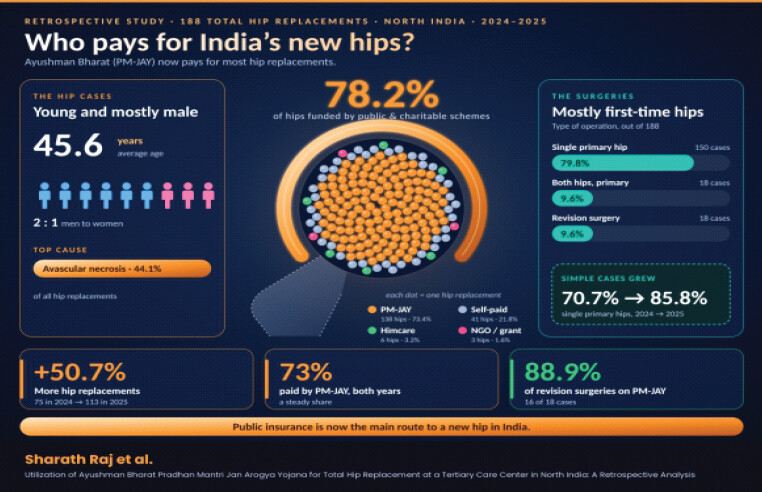
A total of 188 unique THR procedures were performed during the 2-year study period, comprising 75 procedures in 2024 and 113 in 2025, an increase in annual surgical volume of approximately 50.7%.
Patient demographics
The mean age of the cohort was 45.6 ± 14.4 years (range 16–78 years), and patients undergoing THR in 2025 were significantly older than those in 2024 (t = −1.99, P = 0.048). Sex was recorded for all 188 patients: 126 (67.0%) were male, and 62 (33.0%) were female, a male-to-female ratio of approximately 2.0:1, in contrast to the older, female-predominant demographic typically reported for knee OA and TKR in India [2], but consistent with the male predominance of AVN of the femoral head, the leading indication in this cohort [1]. Sex distribution was near-identical across the two study years (χ2 = 0.00, P = 1.000), as summarized in Table 1.
Patient demographic characteristics (2024–2025, n=188)
| Parameter | Value |
|---|---|
| Total patients | 188 |
| Mean age±standard deviation (years) | 45.6±14.4 (range 16-78) |
| Mean age, 2024/2025 | 43.0±14.4/47.2±14.2 (t−1.99, P =0.048) |
| Male sex | 126/188 (67.0%) |
| Female sex | 62/188 (33.0%) |
| Male:Female ratio | 2.0:1 |
Surgical and diagnostic profile
AVN of the femoral head was the single most common diagnosis (83/188, 44.1%), followed by primary or secondary OA of the hip (35, 18.6%) and neck-of-femur fracture or its sequelae (21, 11.2%); the remaining diagnoses are detailed in Table 2 and Fig. 1. Unilateral primary THR was the most common procedure (150/188, 79.8%), followed by bilateral primary THR (18, 9.6%) and revision THR (18, 9.6%), with two combined THR-and-TKR cases (1.1%). The distribution of surgical category differed significantly between the 2 years (χ2 = 8.46, degrees of freedom [df] = 3, P = 0.037): The bilateral-primary share fell from 14.7% to 6.2% and the revision share fell from 12.0% to 8.0%, while the unilateral-primary share rose correspondingly from 70.7% to 85.8%, indicating that the rise in annual caseload was driven predominantly by growth in straightforward unilateral primary THR rather than by an increasingly complex case-mix.
Surgical and diagnostic profile of THR cases (n=188)
| Category | n | Percentage |
|---|---|---|
| Unilateral primary THR | 150 | 79.8 |
| Bilateral primary THR | 18 | 9.6 |
| Revision THR | 18 | 9.6 |
| Combined THR+TKR (same sitting) | 2 | 1.1 |
| Diagnosis | ||
| Avascular necrosis of femoral head | 83 | 44.1 |
| Primary/Secondary osteoarthritis of hip | 35 | 18.6 |
| Neck-of-femur fracture/Sequelae | 21 | 11.2 |
| Post-traumatic arthritis/Failed fixation | 10 | 5.3 |
| Developmental dysplasia of hip | 7 | 3.7 |
| Tuberculosis of hip | 5 | 2.7 |
| Septic sequelae/Infected hip | 5 | 2.7 |
| Implant loosening (failed THR) | 3 | 1.6 |
| Ankylosed hip | 3 | 1.6 |
| Post-Girdlestone status | 1 | 0.5 |
| Pseudotumor (failed THR) | 1 | 0.5 |
| Other/unspecified diagnosis | 14 | 7.4 |
THR: Total hip replacement, TKR: Total knee replacement
Financing pattern of THR
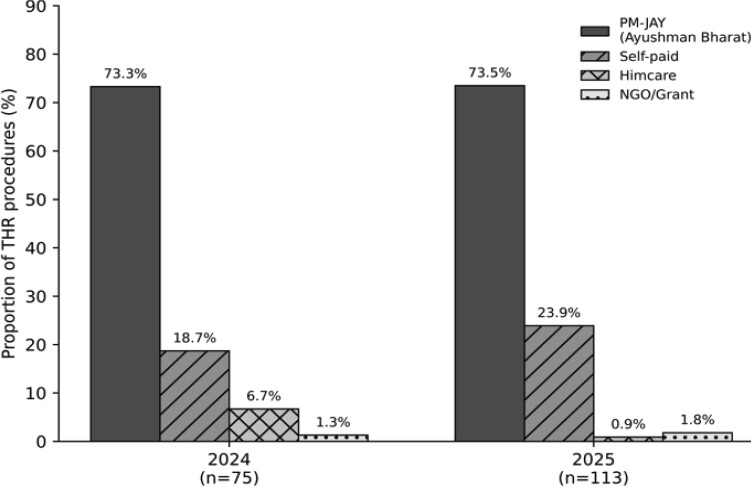
Of the 188 procedures, 138 (73.4%) were funded under PM-JAY, 41 (21.8%) were self-financed, 6 (3.2%) through Himcare, and 3 (1.6%) through NGO/grant-funded care; combined, publicly or charitably funded schemes accounted for 147 procedures (78.2%) (Table 3, Fig. 2). PM-JAY’s share of THR was remarkably stable between years, from 73.3% in 2024 to 73.5% in 2025, while self-financed procedures rose from 18.7% to 23.9% and Himcare-funded procedures fell from 6.7% to 0.9%; comparative analysis across the full distribution of financing modes did not reach statistical significance (χ² = 5.34, df = 3, P = 0.148). PM-JAY funded the large majority of revision THR procedures (16/18, 88.9%), while Himcare funded 4 of 18 bilateral primary THRs (22.2%), a comparatively larger role than it played in unilateral or revision cases.
Year-wise THR case distribution by financing mode
| Year | PM-JAY (Ayushman Bharat) (%) | Self-paid (%) | Himcare (%) | NGO/Grant (%) | Total |
|---|---|---|---|---|---|
| 2024 | 55 (73.3) | 14 (18.7) | 5 (6.7) | 1 (1.3) | 75 |
| 2025 | 83 (73.5) | 27 (23.9) | 1 (0.9) | 2 (1.8) | 113 |
| Total | 138 (73.4) | 41 (21.8) | 6 (3.2) | 3 (1.6) | 188 |
THR: Total hip replacement, PM-JAY: Pradhan Mantri Jan Arogya Yojana, NGO: Non-governmental organization
Implant utilisation
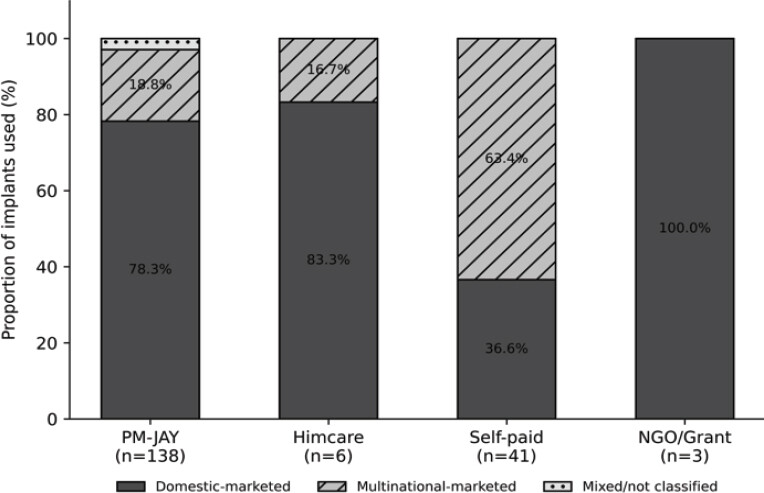
Implant brand was recorded for all 188 procedures. Domestically-manufactured implants (principally Evolutis, Biorad, Orthotech/Orthotek, Meril, and Maxx/Max) accounted for 131/188 implants overall (69.7%), and multinational-manufactured systems (principally Zimmer and Smith and Nephew) for 53 (28.2%); the remainder comprised mixed or unclassified cases. This distribution varied substantially by financing mode (Table 4, Fig. 3): Domestically-branded systems were used in 108/138 PM-JAY-funded procedures (78.3%) and 5/6 Himcare-funded procedures (83.3%), compared with only 15/41 self-financed procedures (36.6%), where multinational-brand systems predominated (26/41, 63.4%). This pattern is notable because, unlike knee implants, hip implants have not been subject to NPPA price capping [8,9,10], so the domestic-implant predominance observed under PM-JAY and Himcare funding cannot be attributed to exogenous price regulation.
Implant brand category (domestic- vs. multinational-marketed) by financing mode
| Financing mode | n | Domestic, n (%) | Multinational, n (%) | Mixed/Not classified, n (%) |
|---|---|---|---|---|
| PM-JAY (Ayushman Bharat) | 138 | 108 (78.3) | 26 (18.8) | 4 (2.9) |
| Himcare | 6 | 5 (83.3) | 1 (16.7) | 0 (0.0) |
| Self-paid | 41 | 15 (36.6) | 26 (63.4) | 0 (0.0) |
| NGO/Grant | 3 | 3 (100.0) | 0 (0.0) | 0 (0.0) |
PM-JAY: Pradhan Mantri Jan Arogya Yojana, NGO: Non-governmental organization
Discussion
This retrospective single-center analysis demonstrates that publicly and charitably funded schemes, principally PM-JAY together with the complementary state-funded Himcare scheme, financed 78.2% of all THR procedures performed at this tertiary care center over the 2-year study period, with PM-JAY alone accounting for 73.4% of cases. This high level of public financing for an implant-intensive, resource-heavy procedure is consistent with broader national evidence of rising PM-JAY utilization for high-cost surgical procedures across specialties, including orthopedics [5,6], and with a recent multispecialty audit finding orthopedics the most-utilized PM-JAY surgical specialty nationally, with cementless THR the single most-utilized individual orthopedic package [7].
A notable feature of this cohort is the stability of PM-JAY’s financing share over time, essentially unchanged despite a 50.7% rise in total annual THR volume. This suggests that PM-JAY utilization for THR at this center may already be operating at a high plateau rather than continuing to rise, an interpretation supported by Palo et al., who reported that in women undergoing TKA the proportion funded through central health schemes rose sharply from 12% in the pre-PM-JAY era to 42% post-scheme, with essentially no rejection of pre-authorization requests, suggesting that once institutional processes for scheme-funded arthroplasty are established, utilization stabilizes at a high plateau [12]. Himcare’s contribution fell over the same period while self-financed procedures rose modestly. Because financing-mode entries in this register were not cross-verified against scheme portals, misclassification between PM-JAY and Himcare, two structurally similar, cashless, family-floater schemes, cannot be excluded, and this trend should be interpreted cautiously pending prospective, portal-verified audit.
The demographic and diagnostic profile of this cohort differed sharply from the OA-driven population typically described for knee arthroplasty in India. The mean age and male predominance observed here reflect fundamentally different disease drivers for THR: AVN of the femoral head and neck-of-femur fracture or its sequelae together substantially outweighed primary or secondary OA, in contrast to the older, female-predominant population underpinning TKR in India [2]. This pattern is consistent with published epidemiology of femoral head osteonecrosis in North India, where a large single-center series reported a mean age of 34.7 years and a male-to-female ratio of 5:1 [1]; our cohort, which also incorporates fracture- and OA-driven disease alongside AVN, showed a somewhat older age and a less pronounced but still clear male predominance, consistent with a mixed etiological case-mix rather than a pure AVN series.
PM-JAY funded a strikingly high proportion of revision THR in this cohort (88.9%). Revision arthroplasty is typically more resource-intensive and costly than primary surgery, and this finding suggests that PM-JAY’s fixed-package reimbursement extends robustly into complex, revision-level care at this institution, an encouraging finding from an access perspective, as revision surgery would otherwise represent a catastrophic expense for self-paying patients.
The implant-utilization pattern offers a useful mechanistic insight alongside the regulatory landscape for orthopedic implants in India. For knee implants, domestic-brand substitution has previously been attributed in part to the 2017 NPPA price cap, which reduced costs by up to 70% and disproportionately affected globally-marketed premium systems [8,9]. By contrast, hip implants have not been subject to an equivalent NPPA ceiling, and discussion of hip-implant pricing data remains at a preliminary stage [10]. That domestic implants nonetheless predominate under PM-JAY and Himcare funding for THR is consistent with the fixed-package tariff structure common to both schemes exerting an influence on implant selection toward lower-cost domestic systems, independent of exogenous price regulation. However, as an observational association derived from a retrospective, single-center cohort, this finding does not by itself establish that PM-JAY or Himcare reimbursement directly caused the implant-selection pattern observed; unmeasured confounding by diagnosis, disease severity, surgeon or institutional preference, and patient-level top-up payments cannot be excluded, and the relationship should be regarded as hypothesis-generating pending confirmation in adjusted, prospective analyses. This dissociation between price-cap-driven and package-tariff-driven cost containment nonetheless suggests that formally extending NPPA price oversight to hip implants would likely reduce absolute costs further without materially altering the implant-selection pattern that scheme-funded reimbursement appears to have already established.
Beyond procedural access, the broader financial-protection implications of PM-JAY and Himcare merit consideration, although this study did not directly measure out-of-pocket expenditure. THR was fixed at a package rate of 90,000 (approximately US $1,080) at the scheme’s 2018 launch, and a recent multispecialty audit found cementless THR the single most-utilized individual orthopedic health-benefit package nationally, with a mean orthopedic package cost of approximately 86,740 [7], figures broadly consistent with the 85,927 average cost of an uncomplicated primary TKA reported in a public-hospital cost audit at another Indian center [13]. By analogy with PM-JAY-funded cardiac surgery patients, who have been shown to incur minimal out-of-pocket expenditure compared with substantial residual costs among privately insured and uninsured patients [14], the 78.2% combined public financing rate observed here for THR suggests a similarly protective effect, though this requires direct confirmation in future work that captures billing data.
These findings should be interpreted within the context of highly uneven national PM-JAY uptake: A rural Bihar study found only 1.3% utilization among eligible respondents despite 69% awareness [15], and state-level analyses have documented gender-specific inequities in scheme coverage [16]. The present findings are drawn from a single urban tertiary center with an established PM-JAY and Himcare workflow, and may therefore overstate the schemes’ reach relative to more peripheral facilities. Periodic revision of PM-JAY health benefit packages to reflect true procedural and implant costs, as documented for other packages in at least one Indian state [17], together with deliberate cross-verification of financing-mode attribution, a challenge that mirrors experience from other integrated-scheme settings in India [18], will be important to ensure that rising utilization of PM-JAY and Himcare for THR continues to translate into equitable and clinically appropriate care.
Finally, the pattern of rising surgical volume accompanied by a falling relative share of bilateral and revision procedures, and a rising share of straightforward unilateral primary THR, is reassuring from a case-selection standpoint: It suggests that the observed growth in scheme-funded access reflects an expanding pool of primary unilateral cases rather than an increasingly complex, potentially reimbursement-driven case-mix.
A key strength of this study is its use of consecutive, real-world institutional data spanning two full calendar years from a high-volume tertiary orthopedic center, encompassing 188 THR procedures with complete demographic and identifier capture following data cleaning, and a transparent, reproducible algorithmic approach to identifying and removing duplicate register entries.
Several limitations should be acknowledged. The retrospective, register-based design precludes causal inference, since it relies on data that were not collected for research purposes and, as such, cannot establish cause-and-effect relationships between financing mode and the demographic, diagnostic, or implant-selection associations reported and did not permit formal evaluation of clinical or functional outcomes or length of hospital stay, as these were not systematically captured in the source documents; nor, for the same reason, was out-of-pocket expenditure directly measured, so the financial-protection effect of PM-JAY and Himcare discussed above remains an inference by analogy rather than a directly demonstrated finding; the absolute and relative-risk estimates reported are also not accompanied by confidence intervals, which should be sought in future prospective work; nor did the analysis adjust for potential confounding factors, including differences in diagnosis, disease severity, patient characteristics, and procedural complexity, that may have varied systematically across financing modes and could have influenced the associations reported, including the implant-selection pattern. Financing-mode entries were not independently cross-verified against PM-JAY or Himcare scheme portals, so misclassification between schemes cannot be excluded. Implant-brand origin (domestic versus multinational) was inferred from product naming conventions rather than verified against manufacturer or regulatory records, and should be interpreted as indicative rather than definitive. Three exact-duplicate register entries were removed using a reproducible algorithmic rule, but near-duplicate entries with differing diagnoses, implants, or financing modes for the same patient and CR number (most plausibly representing staged bilateral surgery) were retained as separate procedures, which may not be correct in every instance. This was, in addition, a single-center study of 188 THR procedures conducted over a 2-year period; the sample, while substantial for a single-institution series, remains modest for subgroup comparisons, and the 2-year window, though capturing consecutive institutional experience, is too short to assess longer-term temporal trends in scheme utilization or case-mix. Finally, as a single-center, tertiary academic-hospital experience over a 2-year window, these findings may not generalize to district-level facilities, high-volume private centers, or regions with a different burden of AVN, trauma, or scheme availability, and do not permit assessment of longer-term implant survivorship, including revision rates, implant survival, and late complications, or functional outcome.
Conclusion
This retrospective analysis of 188 THR procedures demonstrates that Ayushman Bharat PM-JAY, together with the complementary Himcare scheme, is the predominant financing mechanism for THR at this tertiary care center, jointly funding over three-quarters of procedures overall and the large majority of revision surgery, in a patient population that is distinctly younger and more male-predominant than the OA-driven population typically described for knee arthroplasty in India, reflecting the substantial contribution of AVN and fracture sequelae to hip disease in this setting. This scheme-driven pattern of predominantly domestic implant selection persists even though hip implants, unlike knee implants, remain outside NPPA price-capping regulation, indicating that fixed-package reimbursement tariffs alone can effectively shift implant selection independent of direct price control. These findings support an expanding role for public and state-level insurance schemes in improving financial access to major arthroplasty in India, while pointing to the continued need for scheme-portal cross-verification, audit of reimbursement adequacy relative to true procedural cost, consideration of extending NPPA price oversight to hip implants, and ongoing institutional audit of surgical indications to ensure equitable and clinically appropriate utilization.
Clinical Message
For orthopedic surgeons practicing in resource-limited public-hospital settings in India, this study shows that publicly funded insurance, principally Pradhan Mantri Jan Arogya Yojana together with the complementary Himcare scheme, now underwrites the great majority of total hip replacement, including complex revision surgery, at a high-volume tertiary center, and does so in a younger, male-predominant, avascular necrosis- and trauma-driven population that differs markedly from the typical knee-arthroplasty profile. Because fixed-package reimbursement alone appears sufficient to shift implant selection toward domestic-brand systems, even in the absence of national pharmaceutical pricing authority price-cap regulation for hip implants, surgeons counseling scheme-funded patients on implant choice, and policymakers considering the extension of price oversight to hip implants, should account for this reimbursement-driven effect independent of formal price control.
Conflict of Interest:
Nil
Source of Support:
Nil
Consent
The authors confirm that informed consent was obtained from the patient for publication of this article
How to Cite this Article
Raj S, Kumar D, Biswas P, Das S, Shah A, Goni VG. Utilization of Ayushman Bharat Pradhan Mantri Jan Arogya Yojana for Total Hip Replacement at a Tertiary Care Center in North India: A Retrospective Analysis. J Orthop Case Rep. 2026 November;16(11): 411-418. doi: 10.13107/jocr.2026.v16.i11.8512.
References
- Vardhan H, Tripathy SK, Sen RK, Aggarwal S, Goyal T. Epidemiological profile of femoral head osteonecrosis in the North Indian population. Indian J Orthop 2018;52:140-6. [Google Scholar] | [PubMed]
- Pal CP, Singh P, Chaturvedi S, Pruthi KK, Vij A. Epidemiology of knee osteoarthritis in India and related factors. Indian J Orthop 2016;50:518-22. [Google Scholar] | [PubMed]
- Grewal H, Sharma P, Dhillon G, Munjal RS, Verma RK, Kashyap R. Universal health care system in India: An in-depth examination of the Ayushman Bharat initiative. Cureus 2023;15:e40733. [Google Scholar] | [PubMed]
- National Health Authority. Health Benefit Packages 2.0 User Guidelines. New Delhi. National Health Authority, Government of India 2020. [Google Scholar] | [PubMed]
- Iyer H, Gupta U, Patil S, Krishna L, Dubey S, Zadey S. Assessing surgical care under the government-funded health insurance scheme-Pradhan Mantri Jan Arogya Yojana in India. Ann Glob Health 2025;91:85. [Google Scholar] | [PubMed]
- Garg S, Bebarta KK, Tripathi N. The Ayushman Bharat Pradhan Mantri Jan Arogya Yojana (AB-PMJAY) after four years of implementation: Is it making an impact on quality of inpatient care and financial protection in India?. BMC Health Serv Res 2024;24:919. [Google Scholar] | [PubMed]
- Chaturvedi R, Kumari R, Singh BP, Mishra P, Singh AK. Utilisation pattern of health benefit packages under Ayushman Bharat Pradhan Mantri Jan Arogya Yojana. Ann Natl Acad Med Sci (India) 2026;62:72-6. [Google Scholar] | [PubMed]
- Sanghavi S. CORR International-Asia pacific: Is price capping of knee replacement implants in India a good idea?. Clin Orthop Relat Res 2018;476:469-72. [Google Scholar] | [PubMed]
- National Pharmaceutical Pricing Authority Notification S. O 2668(E): Fixation of Ceiling Price of Knee Implants Under Paragraph 19 of the Drugs (Prices Control) Order, 2013, and Subsequent Annual Extension Notifications (Most Recently Extended to 15 November 2026). New Delhi. Government of India. 2017-2025. [Google Scholar] | [PubMed]
- Medical Dialogues NPPA Panel Defers Decision on Separate Price Cap for Cementless Knee Implants; 2026. Available from: https://medicaldialogues.in/news/industry/medical-devices/nppa-panel-defers-decision-on-separate-price-cap-for-cementless-knee-implants-164954. [Last accessed on 2026 Jul 19]. [Google Scholar] | [PubMed]
- Himachal Pradesh Swasthya Bima Yojana Society. Mukhya Mantri Himachal Health Care Scheme Himcare. Shimla. Department of Health and Family Welfare, Government of Himachal Pradesh. Available from: https://hpsbys.in. [Last accesed on 2026 Jul 19]. [Google Scholar] | [PubMed]
- Palo N, Dey PC, Lakhanpal M, Shukla A, Choudhary GN, Singh A. Funding pattern comparison pre- and post-Ayushman Bharat National Health Scheme (AB-PMJAY) in active females undergoing TKA for advanced knee arthritis with clinical, QoL analysis and AB-PMJAY technical data. Indian J Orthop 2024;58:550-7. [Google Scholar] | [PubMed]
- Vaidya SV, Desai KB, Chavan AS, Vaghasia DT, Vaidya CS. Functional and cost audit of primary total knee arthroplasty in public vs private hospitals: A retrospective cohort study. Indian J Orthop 2021;55:1306-16. [Google Scholar] | [PubMed]
- Kamath S, Singhal N, Jeffin J, Brand H, Kamath R. Out-of-pocket expenditure for selected surgeries in the cardiology department for Ayushman Bharat Pradhan Mantri Jan Arogya Yojana (AB-PMJAY), private health insurance, and uninsured patients in a tertiary care teaching hospital in Karnataka, India. Cureus 2024;16:e62444. [Google Scholar] | [PubMed]
- Prasad SS, Singh C, Naik BN, Pandey S, Rao R. Awareness of the Ayushman bharat-pradhan mantri jan arogya yojana in the rural community: A cross-sectional study in Eastern India. Cureus 2023;15:e35901. [Google Scholar] | [PubMed]
- Sharma SK, Nambiar D, Sankar H, Joseph J, Surendran S, Benny G. Gender-specific inequalities in coverage of publicly funded health insurance schemes in southern states of India: Evidence from national family health surveys. BMC Public Health 2023;23:2414. [Google Scholar] | [PubMed]
- Prinja S, Dixit J, Nimesh R, Garg B, Khurana R, Paliwal A. Impact of health benefit package policy interventions on service utilisation under government-funded health insurance in Punjab, India: analysis of Ayushman Bharat Pradhan Mantri Jan Arogya Yojana (PM-JAY). Lancet Reg Health Southeast Asia 2024;28:100462. [Google Scholar] | [PubMed]
- Kolekar PD, Todkar SS, Mulaje SM. Utilization of integrated ayushman bharat-pradhan mantri jan arogya yojana and mahatma jyotirao phule jan arogya yojana at a tertiary care center in Solapur, India: An epidemiological study. Cureus 2024;16:e74680. [Google Scholar] | [PubMed]
© 2026 Journal of Orthopaedic Case Reports - Published by Indian Orthopaedic Research Group
About the Authors
-

Sharath Raj
-

Deepak Kumar
-

Pronay Biswas
-

Souvik Das
-

Aditya Shah
-

Vijay G Goni
Related Articles in Journal of Orthopaedic Case Reports
 July 1, 2026 Managing Complications of Total Hip Arthroplasty for Avascular Necrosis Hip Performed Via Anterior Approach
 June 11, 2021 Neglected Posterior Hip Dislocation in Adults presenting after One Year Managed Successfully with Single Stage Total Hip Arthroplasty: A Case Series
 November 1, 2026 Cross-Cultural Adaptation and Validation of the Hindi Version of the Fukushima Lumbar Spinal Stenosis Scale-25 in Indian Patients with Lumbar Spinal Stenosis: A Cross-Sectional Psychometric Study
 October 1, 2026 Arthrokinematic and Magnetic Resonance Imaging-Based Outcomes of Customized Lateral Wedge Insoles in Medial Compartment Knee Osteoarthritis: Six-Month Interim Findings of a Prospective Cohort Study