


Introduction
The clavicle serves as the only bony link between the upper limb and the axial skeleton. It functions as a strut that maintains the shoulder girdle in its normal position. This anatomical configuration allows for the full range of motion (ROM) and strength required for activities involving the upper limb. Biomechanically, the clavicle transmits forces from the upper limb to the trunk and acts as a rigid support for the muscles that control the shoulder and arm [1,2,3].
The clavicle also protects vital neurovascular structures in the cervico-axillary canal, including the brachial plexus and subclavian vessels. Its double curvature and subcutaneous position make it prone to fractures, yet this unique shape also contributes to both stability and flexibility [2]. The clavicle’s dual curvature allows it to absorb and dissipate axial and torsional loads, while its articulations provide both mobility and strength to the shoulder girdle [2].
Given these critical roles, a total claviclectomy could theoretically cause major biomechanical disruption [4,5,6]. The absence of the clavicle eliminates the strut mechanism that maintains scapular position, potentially leading to scapular droop, protraction, reduced shoulder elevation, weakness in abduction, and overall reduction in upper limb power [1,2,3]. Loss of clavicular support may also impair the force coupling of the deltoid and trapezius, resulting in inefficient shoulder mechanics and cosmetic deformity.
However, limited literature suggests that compensatory muscular adaptations and soft-tissue reconstructions can partially restore shoulder mechanics [6,7,8]. Despite the anatomical disadvantage, some patients maintain near-normal function and minimal pain, demonstrating the remarkable adaptability of the shoulder complex. This case report adds to the growing evidence that excellent functional outcomes are possible following total claviclectomy, which provided that the soft-tissue envelope and dynamic stabilizers are preserved.
Case Report
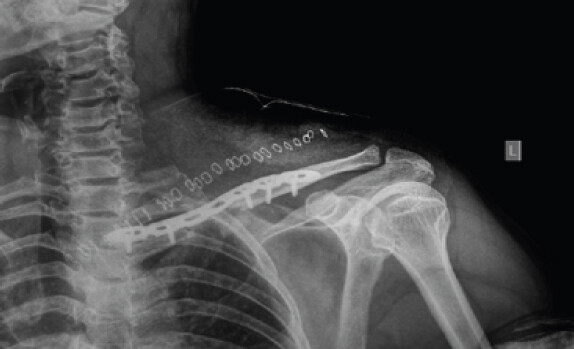
A 50-year-old male with no comorbidities presented to our department with polytrauma after a road traffic accident. He was diagnosed with a fracture of the middle third of his left clavicle, subdural hemorrhage, and a Monteggia fracture of the left forearm. The subdural hemorrhage was conservatively treated, the Monteggia fracture was fixed with plate and screws, and his clavicle fracture was treated conservatively with a clavicle brace and arm pouch. However, as satisfactory reduction and union of the clavicle was not found after 1 month, he was taken up for fixation of the clavicle with plate and screws (Fig. 1).
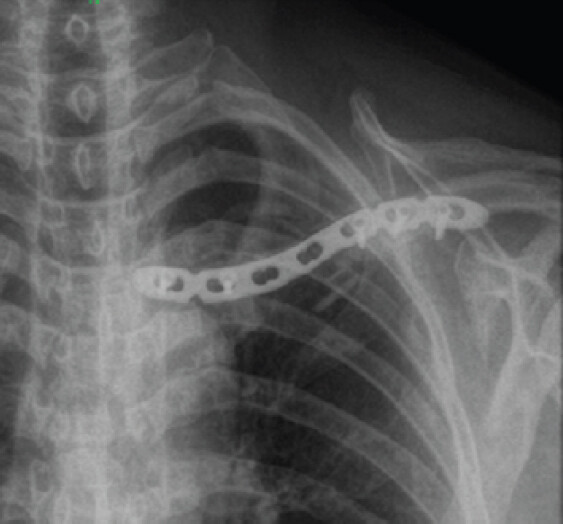
Two months after the plating, the patient presented with pain and purulent discharge from the surgical wound over the left clavicle. Investigations revealed surgical-site infection with raised inflammatory markers, and he was managed with wound care and intravenous antibiotics. However, infection recurred, and he presented again after 2 months with a discharging sinus and pain.
Radiographs and computed tomography imaging revealed implant loosening, cortical destruction, and non-union of the clavicle with surrounding sclerosis suggesting chronic osteomyelitis (Fig. 2). It was decided to proceed with a total claviclectomy. The entire clavicle was excised, and wound debridement was performed.
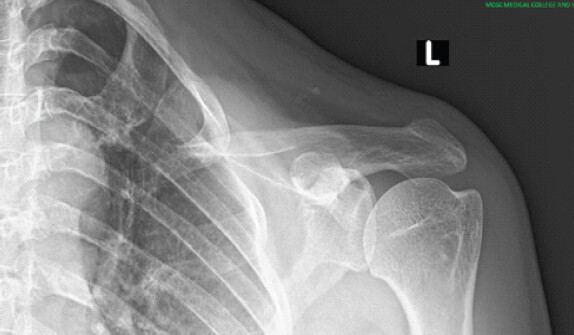
Postoperatively, the patient was immobilized in an arm sling for 3 weeks, followed by supervised active/passive physiotherapy and strengthening exercises. Full range of shoulder movement was achieved immediately after the procedure. At 6 weeks, he had near-complete pain relief and regained full shoulder movements. He returned to work as an electrician, with only mild difficulty performing overhead activities and lifting heavy objects. He also reported discomfort while sleeping on the operated side.
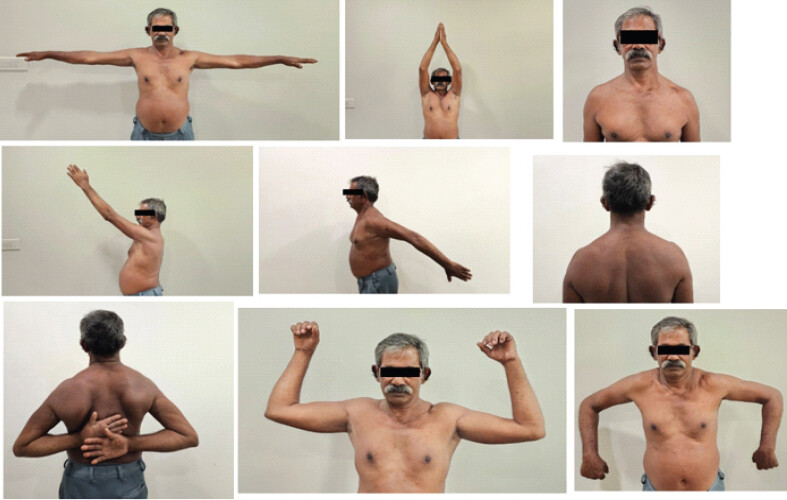
At 2-year follow-up (Fig. 3), his shoulder ROM was full and comparable to the contralateral side (Fig. 4). Functional assessment: American Shoulder and Elbow Surgeons 88, Disabilities of the Arm, Shoulder, and Hand (DASH) 40.8, QuickDASH 32.5 – indicating excellent functional recovery.
Discussion
Total claviclectomy is an uncommon but well-described salvage procedure for refractory pathology such as chronic osteomyelitis, primary bone tumors, non-union with implant failure, and vascular complications. Literature on outcomes is limited by small series and case reports, but several medium- to long-term studies offer insight into functional recovery [5,6,7,8,9].
Rubright et al. [8] reported satisfactory long-term function after claviclectomy, with preservation of motion and acceptable strength. Similarly, Oheim et al. [5] reported successful infection control and functional preservation at several years of follow-up. A recent systematic review by Smolle et al. [9] concluded that partial or total claviclectomy yields acceptable mid- to long-term outcomes with low complication rates.
Case series addressing claviclectomy for infection report favorable outcomes. Poitevin et al. [6] demonstrated predictable pain relief and infection control, with most patients returning to pre-operative activities. Liu et al. [10] also reported successful infection eradication and good function. Smaller series show that while esthetic deformity and localized weakness may occur, most patients adapt well and regain satisfactory daily function at 1–10 years follow-up [11,12,13]. Very long-term reports (≥10 years) demonstrate minimal impairment due to muscular adaptation and strengthening [11,13].
Biomechanically, the clavicle maintains lateral shoulder positioning and transmits forces from the upper limb to the axial skeleton. Its removal disrupts deltoid–trapezius force coupling, causing scapular droop and reduced mechanical efficiency during elevation [1,2,3]. However, several studies emphasize that preserving or reconstructing the coracoclavicular/acromioclavicular stabilizers significantly reduces this functional loss [5,6,14].
Rehabilitation focusing on periscapular and deltoid strengthening helps compensate for clavicle loss, explaining why long-term shoulder function is often satisfactory [7,8,10].
Functional outcomes are generally good: Near-normal ROM, adequate strength for daily activities, and significant pain relief, although overhead labor may remain limited [6,7,8,9]. Total claviclectomy reliably eradicates infection when combined with thorough debridement and appropriate antibiotics [5,6,10].
Limitations of current literature include small sample sizes, heterogeneous indications, and inconsistent outcome measures. Future multicentric prospective studies using standardized instruments are required to better define predictors of outcome and optimal surgical strategies.
Conclusion
Total claviclectomy can provide excellent pain relief and functional outcomes in patients with chronic osteomyelitis unresponsive to conventional management. With structured rehabilitation, shoulder mechanics can be well preserved despite the absence of the clavicle.
Clinical Message
Total claviclectomy, though a radical procedure, can result in excellent functional recovery when combined with coracoclavicular reconstruction and early rehabilitation.
Conflict of Interest:
Nil
Source of Support:
Nil
Consent:
The authors confirm that informed consent was obtained from the patient for publication of this article
How to Cite this Article
Jos S, Paul P, Antony J, Unnithan NM, Benny K, Alappattu F. Shoulder without a Clavicle: Movement and Function after Total Claviclectomy: J Orthop Case Rep. 2026 November;16(11):171-174. doi: 10.13107/jocr.2026.v16.i11.8428.
References
- Collin P, Treseder T, Denard PJ.. Shoulder function after clavicle resection: Biomechanical implications and compensatory mechanisms. Orthop Traumatol Surg Res 2015;101:973-8. [Google Scholar] | [PubMed]
- Ogawa K, Yoshida A, Takahashi M.. Functional outcomes after resection of the clavicle for benign and malignant tumors. J Shoulder Elbow Surg 1997;6:356-60. [Google Scholar] | [PubMed]
- Pandhi NG, Esquivel AO, Hanna JD, Lemos DW, Staron JS, Lemos SE.. The biomechanical stability of distal clavicle excision versus symmetric acromioclavicular joint resection. Am J Sports Med 2013 Feb: 41 (2):291-5. doi: 10.1177/0363546512469873. Epub 2012 Dec 27 PMID: 23271005. [Google Scholar] | [PubMed] | [CrossRef]
- Simpson NS, Jupiter JB.. Claviculectomy for posttraumatic osteomyelitis of the clavicle. J Shoulder Elbow Surg 1996;5:269-73. [Google Scholar] | [PubMed]
- Oheim R, Schulz AP, Schoop R, Grimme CH, Gille J, Gerlach UJ.. Medium-term results after total clavicle resection in cases of osteitis: a consecutive case series of five patients. Int Orthop 2012 Apr 36 4:775-81. doi: 10.1007/s00264-011-1342-3. Epub 2011 Sep 1 PMID: 21881884; PMCID: PMC3311807. [Google Scholar] | [PubMed] | [CrossRef]
- Wessel RN, Schaap GR.. Outcome of total claviculectomy in six cases. J Shoulder Elbow Surg 2007 May-Jun;16 (3):312-5. doi: 10.1016/j.jse.2006.07.007.Epub 2006 Dec 22 PMID: 17188905. [Google Scholar] | [PubMed] | [CrossRef]
- Singh A, Patel V, Kumar R.. Total claviculectomy for chronic osteomyelitis: Case report with two-year follow-up. Indian J Orthop 2020;54:741-5. [Google Scholar] | [PubMed]
- Rubright J, Kelleher P, Beardsley C, Paller D, Shackford S, Beynnon B, Shafritz A.. Long-term clinical outcomes, motion, strength, and function after total claviculectomy. J Shoulder Elbow Surg 2014 Feb;23 2:236-44. doi: 10.1016/j.jse.2013.05.011. Epub 2013 Aug 12 PMID: 23942010. [Google Scholar] | [PubMed] | [CrossRef]
- Liu PC, Kao FC, Chen YJ, Yu SW.. Chronic osteomyelitis of the clavicle treated with total claviculectomy: A case report. BMC Musculoskelet Disord 2019;20:115. [Google Scholar] | [PubMed]
- Eskola A, Vainionpää S, Korkala O.. Total claviculectomy for chronic osteomyelitis: Report of two cases. Acta Orthop Scand 1986;57:558-60. [Google Scholar] | [PubMed]
- Eardley WG, Smith J, Ball CM.. Functional results following total claviculectomy for infection. Shoulder Elbow 2013;5:174-9. [Google Scholar] | [PubMed]
- Throckmorton TW, Kuhn JE.. Functional outcomes following clavicle resection: A long-term review and biomechanical considerations. Am J Orthop 2007;36:157-62. [Google Scholar] | [PubMed]
- Wada T, Sato K, Fujita T. Reconstruction after total claviculectomy using fibular grafts and soft-tissue techniques. J Orthop Sci 2017;22:568-74. [Google Scholar] | [PubMed]
© 2026 Journal of Orthopaedic Case Reports - Published by Indian Orthopaedic Research Group
About the Authors
-

Sujit Jos
-

Prannoy Paul
-

Antony Joseph
-

Nikhil Manoj Unnithan
-

Kiran Benny
-

Freddy Alappattu
Related Articles in Journal of Orthopaedic Case Reports
 August 1, 2026 Management of Infected Non-union of Long Bones Using Antibiotic Cement-Coated Intramedullary Nails: A Prospective Case Series
 August 1, 2026 Outcome Analysis of Loop Endobutton Repair for Acromioclavicular Joint Dislocation
 July 1, 2026 Management of Chronic Osteomyelitis Bone Defect with Titanium Cage Combined with the Masquelet Technique: A Case Report
 July 1, 2026 Continuous Local Antibiotic Perfusion for Refractory Musculoskeletal Infections: Functional and Patient-reported Outcomes in a 13-Case Series