


Introduction
The knee extensor mechanism, comprising the quadriceps tendon, patella, and patellar tendon, is essential for active knee extension and normal gait. Disruption of this mechanism is uncommon but can result in significant functional disability if not diagnosed and treated promptly [1]. Quadriceps tendon ruptures are typically seen in middle-aged and elderly individuals, whereas patellar tendon ruptures are more common in younger patients following high-energy trauma [2, 3].
Simultaneous involvement of the extensor mechanism is rare, and asymmetric patterns such as contralateral quadriceps tendon rupture with patellar tendon rupture are exceedingly uncommon [4]. These injuries are frequently associated with systemic comorbidities that predispose to tendon degeneration. Chronic kidney disease (CKD) is a well-recognized risk factor, with metabolic disturbances such as secondary hyperparathyroidism, uremia, and altered calcium phosphate metabolism leading to weakening of the osteotendinous junction [5,6]. In addition, systemic inflammatory conditions, including chronic infections like hepatitis C virus (HCV), may impair collagen integrity and contribute to tendon degeneration [7].
Such pathological changes can result in tendon rupture even after trivial trauma, making diagnosis challenging. Early recognition and timely surgical intervention are crucial for optimal functional recovery. We report a rare case of simultaneous contralateral quadriceps tendon and patellar tendon rupture in a patient with CKD and hepatitis C infection.
Case Report
A 51-year-old male presented with complaint of pain and swelling over bilateral knee since 2 days with inability to walk and inability to actively extend both knees following a trivial fall while getting out from his bed. He was a known case of CKD and chronic HCV managed with medical therapy for 2 years.
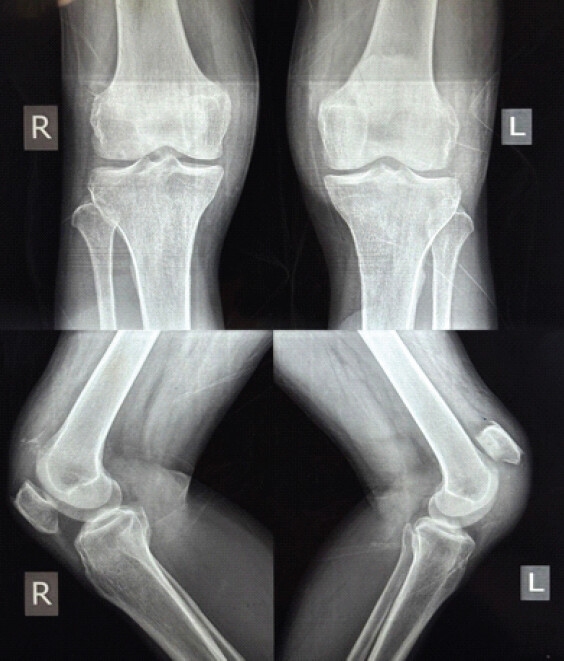
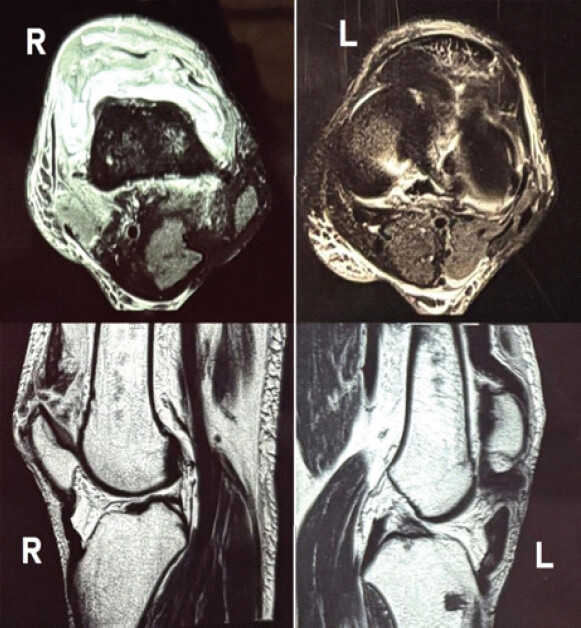
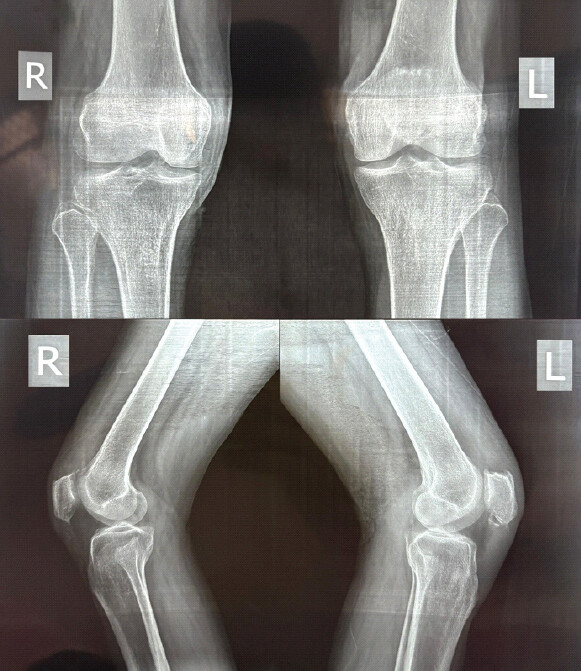
On clinical examination, a palpable suprapatellar gap was noted in the right knee suggestive of quadriceps tendon rupture, while an infrapatellar gap was appreciated in the left knee indicating patellar tendon rupture. Active straight leg raising was not possible bilaterally. Radiographs (Fig. 1) revealed patella baja on the right side and patella alta on the left side. The patient was given bilateral long knee braces and admitted to the ward with proper limb elevation. Magnetic resonance imaging (MRI) of both knees was performed which showed complete rupture of the quadriceps tendon on the right side and patellar tendon on the left side (Fig. 2).
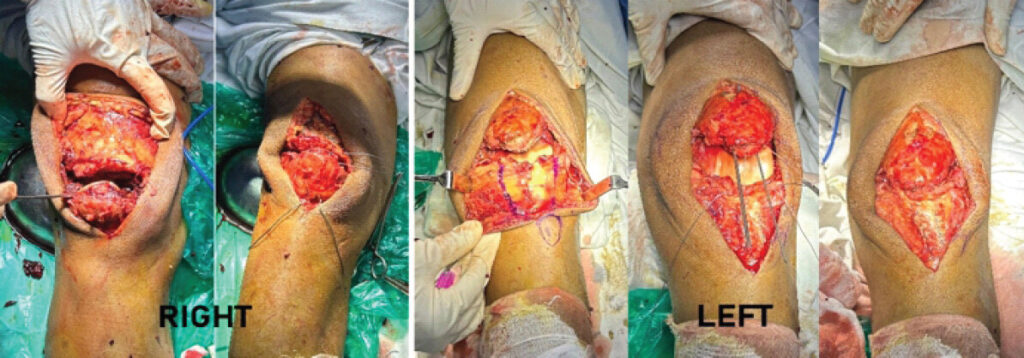
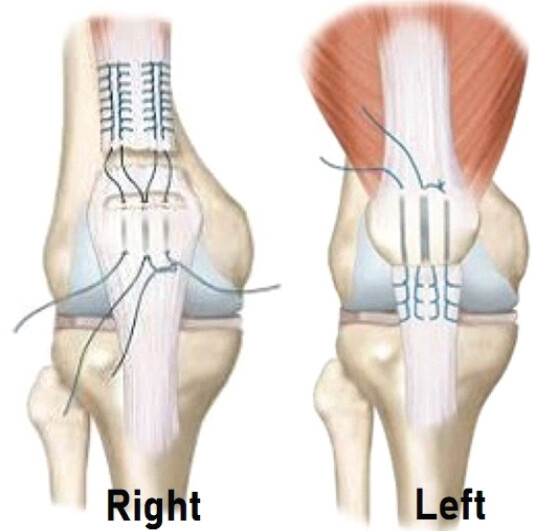
The patient underwent surgical management on the 3rd day after trauma with open repair of both tendons. Through a midline incision, the torn ends were identified and freshened. The quadriceps tendon on the right side and the patellar tendon on the left side were repaired using transosseous tunnels and non-absorbable Ethibond sutures (Fig. 3). Retinacular tears were also repaired. A schematic diagram of transosseous suture repair is shown in (Fig. 4).
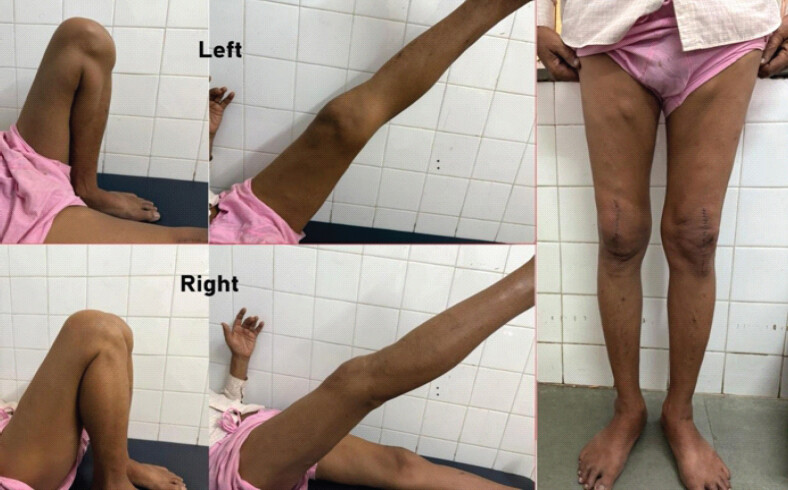
Postoperatively, both knees were immobilized in extension for a period of 1 month. However, the patient was allowed to walk with a brace during this time. This was followed by gradual flexion of the knee with closed-chain knee range of motion (ROM) exercises and static quadriceps exercises under supervised physiotherapy. At 3-month follow-up, the patient demonstrated satisfactory functional recovery with restoration of active knee extension and no significant extensor lag. Follow-up radiographs (Fig. 5) were satisfactory and showed maintained alignment with an intact extensor mechanism repair. At 1 year of follow up patient had full ROM of knee with no extensor lag, walking full weight bearing and doing all activities of daily living comfortably (Fig. 6).
Discussion
Extensor mechanism injuries of the knee are uncommon and most often occur unilaterally. Bilateral or asymmetric involvement is rare, with contralateral quadriceps and patellar tendon rupture representing an extremely unusual injury pattern [1,8]. Recent literature continues to emphasize the rarity of such presentations, with only a limited number of case reports describing this entity [4, 9].
Systemic diseases play a crucial role in tendon vulnerability. CKD is one of the most frequently implicated conditions, due to metabolic disturbances such as secondary hyperparathyroidism, uremia, and calcium metabolic disturbance in the contralateral quadriceps and patellar tendon [6]. Previous studies have identified CKD as a major risk factor for bilateral or simultaneous tendon ruptures [10]. Patients on long-term dialysis are particularly susceptible to spontaneous or low-energy tendon ruptures [11]. Recent evidence further supports this association, with increased incidence of extensor mechanism injuries reported in CKD patients undergoing dialysis [6].
Hepatitis C infection may further contribute through chronic inflammation and alterations in collagen metabolism, leading to reduced tendon strength [7]. The coexistence of CKD and HCV in our patient likely created a synergistic effect, predisposing to tendon rupture even after trivial trauma.
Recent reports have described injury patterns similar to our case. Radaideh et al. reported successful management of simultaneous contralateral quadriceps and patellar tendon rupture in a patient with chronic renal failure [4]. Similarly, Zhang et al. described spontaneous quadriceps tendon rupture in a CKD patient following trivial trauma, reinforcing the role of metabolic derangements in tendon degeneration [12].
Other rare variants, such as the tendon rupture in a simultaneous ipsilateral quadriceps and patellar tendon rupture, have also been described, further highlighting the spectrum of extensor mechanism injuries [13].
Clinically, patients present with acute pain, swelling, palpable defects, and inability to actively extend the knee. However, diagnosis may be delayed, particularly in asymmetric cases. Radiographic findings such as patella alta and patella baja can aid in diagnosis, while MRI is highly sensitive for confirming tendon rupture and is particularly useful in equivocal or complex cases [1,14].
Early surgical repair remains the cornerstone of management. Techniques such as transosseous suturing using non-absorbable material provide strong fixation and favorable outcomes [15]. Recent studies continue to report favorable functional outcomes with early intervention and structured rehabilitation protocols [16,17]. In contrast, delayed treatment may lead to poor outcomes and require more complex reconstructive procedures.
The rarity of this injury pattern makes it clinically significant. While several reports have described bilateral or ipsilateral tendon ruptures, asymmetric contralateral involvement remains exceedingly uncommon, with only a limited number of cases reported [4,9]. Our case adds to the growing body of evidence linking systemic diseases, particularly CKD, with complex extensor mechanism injuries and highlights the importance of early diagnosis and prompt surgical management.
Conclusion
Simultaneous contralateral quadriceps tendon and patellar tendon rupture is a rare injury pattern, particularly in patients with systemic comorbidities such as CKD and hepatitis C infection. These conditions predispose to tendon degeneration and increase the risk of rupture even after trivial trauma. A high index of suspicion, careful bilateral knee examination, and prompt surgical intervention are essential for early diagnosis and optimal functional outcomes.
Clinical Message
In patients with chronic kidney disease, trivial trauma may lead to rare asymmetric extensor mechanism ruptures; careful bilateral evaluation and early surgical repair are key to successful outcomes and prevent long-term disability.
Conflict of Interest:
Nil
Source of Support:
Nil
Consent
The authors confirm that informed consent was obtained from the patient for publication of this article
How to Cite this Article
Kunwar SS, Pawar AV, Vora AK, Dussa AG. Simultaneous Contralateral Quadriceps Tendon and Patellar Tendon Rupture in a Patient with Chronic Kidney Disease and HCV Infection: A Rare Case Report. J Orthop Case Rep. 2026 November;16(11): 246-250. doi: 10.13107/jocr.2026.v16.i11.8458.
References
- Tandogan RN, Terzi E, Gomez-Barrena E, Violante B, Kayaalp A. Extensor mechanism ruptures. EFORT Open Rev 2022;7:384-95. [Google Scholar] | [PubMed]
- Pengas IP, Assiotis A, Khan W, Spalding T. Adult native knee extensor mechanism ruptures. Injury 2016;47:2065-70. [Google Scholar] | [PubMed]
- Matava MJ. Patellar tendon ruptures. J Am Acad Orthop Surg 1996;4:287-96. [Google Scholar] | [PubMed]
- Radaideh AM, Audat ZA, Sunallah AW, Bani-Younes HM, Obeidat O. A simultaneous rupture of the patellar tendon and the con-tralateral quadriceps tendon in a patient with chronic renal failure undergoing long term hemodialysis. Med Arch 2021;75:317-20. [Google Scholar] | [PubMed]
- Jones N, Kjellstrand CM. Spontaneous tendon ruptures in patients on chronic dialysis. Am J Kidney Dis 1996;28:861-6. [Google Scholar] | [PubMed]
- Tao Z, Liu W, Ma W, Luo P, Zhi S, Zhou R. A simultaneous bilateral quadriceps and patellar tendons rupture in patients with chronic kidney disease undergoing long-term hemodialysis: A case report. BMC Musculoskelet Disord 2020;21:179. [Google Scholar] | [PubMed]
- Cacoub P, Renou C, Rosenthal E, Cohen P, Loury I, Loustaud-Ratti V. Extrahepatic manifestations associated with hepatitis C virus infection. A prospective multicenter study of 321 patients. The GERMIVIC. Groupe d'etude et de recherche en medecine interne et maladies infectieuses sur le virus de l'hepatite C. Medicine (Baltimore) 2000;79:47-56. [Google Scholar] | [PubMed]
- Negrin LL, Nemecek E, Hajdu S. Extensor mechanism ruptures of the knee: Differences in demographic data and long-term outcome after surgical treatment. Injury 2015;46:1957-63. [Google Scholar] | [PubMed]
- Camarda L, D'Arienzo A, Morello S, Guarneri M, Balistreri F, D'Arienzo M. Bilateral ruptures of the extensor mechanism of the knee: A systematic review. J Orthop 2017;14:445-53. [Google Scholar] | [PubMed]
- Shah MK. Simultaneous bilateral rupture of quadriceps tendons: Analysis of risk factors and associations. South Med J 2002;95:860-6. [Google Scholar] | [PubMed]
- Garner MR, Gausden E, Berkes MB, Nguyen JT, Lorich DG. Extensor mechanism injuries of the knee: Demographic characteristics and comorbidities from a review of 726 patient records. J Bone Joint Surg Am 2015;97:1592-6. [Google Scholar] | [PubMed]
- Zhang H, Lin Z, Zhong J, Nie D, Gao S, Zhang J. Spontaneous rupture of the right quadriceps tendon in a patient undergoing long-term hemodialysis: A case report. J Int Med Res 2020;48:300060520959221. [Google Scholar] | [PubMed]
- Chraibi O, Messoudi A, Lamris MA, Rajaallah A, Rahmi M, Rafai M. Floating patella: Ipsilateral and simultaneous rupture of the quadriceps and patellar tendons in a young individual (a surgical case report). Int J Surg Case Rep 2024;116:109429. [Google Scholar] | [PubMed]
- Neubauer T, Wagner M, Potschka T, Riedl M. Bilateral, simultaneous rupture of the quadriceps tendon: A diagnostic pitfall? Report of three cases and meta-analysis of the literature. Knee Surg Sports Traumatol Arthrosc 2007;15:43-53. [Google Scholar] | [PubMed]
- Bui CN, Learned JR, Scolaro JA. Treatment of patellar fractures and injuries to the extensor mechanism of the knee: A critical analysis review. JBJS Rev 2018;6:e1. [Google Scholar] | [PubMed]
- Haskel JD, Fried JW, Hurley ET, Mojica ES, Alaia MJ, Strauss EJ. High rates of return to play and work follow knee extensor tendon ruptures but low rate of return to pre-injury level of play. Knee Surg Sports Traumatol Arthrosc 2021;29:2695-700. [Google Scholar] | [PubMed]
- Rosteius T, Jettkant B, Brinkemper A, Rausch V, Lotzien S, Geßmann J. Long-term follow up of extensor tendon ruptures of the knee using electromyography and three-dimensional gait analysis. Knee 2021;29:251-61. [Google Scholar] | [PubMed]
© 2026 Journal of Orthopaedic Case Reports - Published by Indian Orthopaedic Research Group
About the Authors
-

Saurabh Satyanarayan Kunwar
-

Akshay Vilas Pawar
-

Abhi Ketan Vora
-

Abhishek Ganeshkumar Dussa
Related Articles in Journal of Orthopaedic Case Reports
 September 1, 2026 Role of Denosumab in Chronic Kidney Disease with Paget’s Disease of Bone: A Case Report and Review of Literature
 July 1, 2026 Tuberculosis of the Elbow in a Chronic Kidney Disease Patient with Arteriovenous Fistula: A Case Report
 November 1, 2025 Bilateral Distal Quadriceps Tendon Rupture in a Young Male Following Minimal Trauma: First Presentation of Primary Hyperparathyroidism Due to a Parathyroid Adenoma
 May 1, 2025 A Rare Case of Anterior Osteochondroma of Distal Femur with Quadriceps Rupture: A Case Report