


Introduction
Titanium is a preferred material in joint arthroplasty due to its corrosion resistance and perceived low allergenicity. While uncommon, metal hypersensitivity has increasingly been reported as a contributing factor to persistent pain and arthroplasty failure [1]. Pigmented villonodular synovitis (PVNS) is a rare synovial proliferative disorder which may necessitate arthroplasty in young patients, leading to potentially complicated outcomes in those with superimposed allergy [2]. This case describes a patient with a history of PVNS who underwent bilateral total knee arthroplasties (TKAs) and multiple revisions before a titanium allergy was confirmed, underscoring the importance of considering rare causes in complex cases.
Case Report
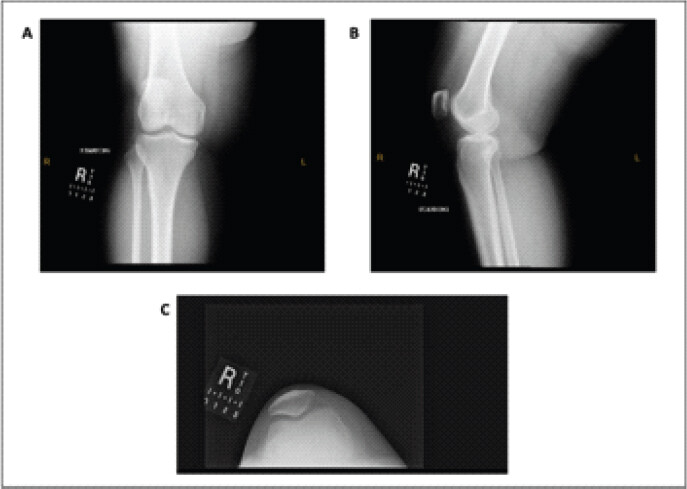
A 46-year-old Caucasian woman with a history of bilateral PVNS initially presented to clinic in 2005 with chronic bilateral knee pain. She initially underwent arthroscopic synovectomies in 2005, followed by additional arthroscopies in 2009 and 2010. The patient’s right knee radiographs from 2009 are shown in Fig. 1 and include anteroposterior, lateral, and sunrise views (Fig. 1A, B, and C, respectively). At this time, the imaging was taken for the right knee pain and showed a questionable right knee joint effusion without degenerative changes or bone abnormalities; joint spaces noted to be intact. However, there was a 1–2 mm calcific density projected in the medial patellofemoral joint on the tangential patellar view of uncertain significance. In 2012, at age 33, she underwent simultaneous bilateral TKAs using consensus implants. Despite an initially uncomplicated post-operative course, she experienced persistent bilateral knee pain, swelling, stiffness, and mechanical symptoms. She described the pain as sharp, stabbing, and aching, with a sense of instability and frequent giving way of the knees. These symptoms significantly limited her mobility and daily functioning.
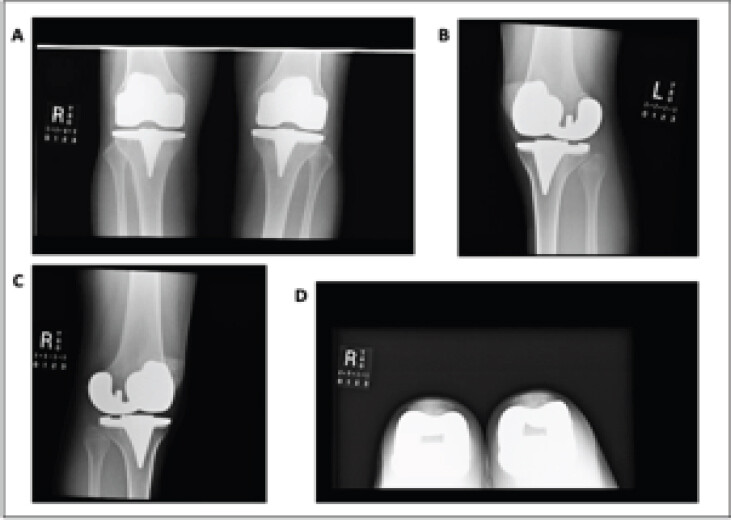
Following her initial TKA, she experienced little improvement and eventually underwent a revision of the left knee in 2016 due to suspicion of component malalignment and sizing issues. X-ray imaging of the bilateral knees from before the left TKA revision in 2016 are shown in Fig. 2. These radiographs show 3 views of the bilateral knees with bilateral TKAs with cemented components. Both knees are noted to have well seated components. Films are negative for joint-line angulation, patellar subluxation, and periprosthetic fracture. Trace joint effusion is appreciated in the right knee (Fig. 2C). Although she reported initial improvement, the relief was temporary. Pain soon recurred and progressed, with swelling, clunking sensations, and continued mechanical symptoms. Her right knee pain also worsened, with episodes of locking that would leave her unable to bend the knee for days.
Despite multidisciplinary efforts, she continued to experience daily pain and systemic inflammation characterized as fatigue and diffuse stiffness. She reported worsening function, difficulty climbing stairs, and dependence on a cane for ambulation. From 2023 to 2025, she gained over 90 pounds, attributed largely to reduced mobility, medication side effects, and the psychological toll of chronic pain.
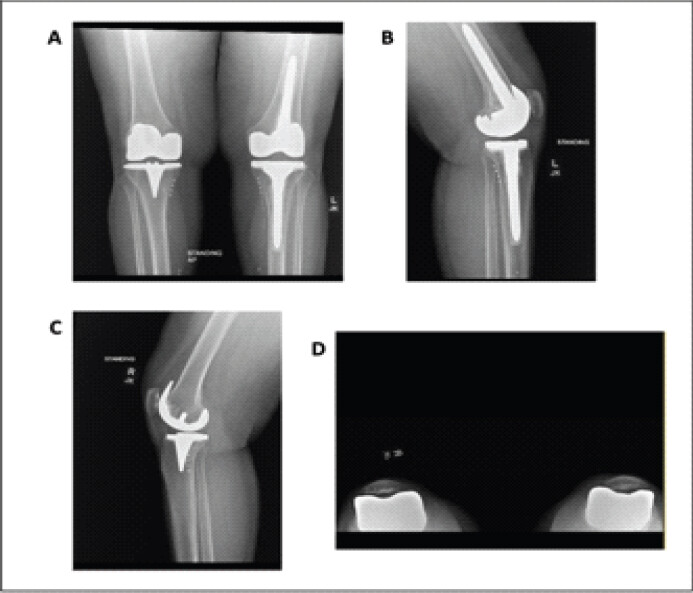
Her systemic flares became increasingly frequent. On multiple occasions, she presented with acute swelling in the knees and pain radiating to other joints including the shoulders, elbows, and wrists. Despite multiple workups, including joint aspirations, blood cultures, and imaging, no infectious or mechanical cause was found. Erythrocyte sedimentation rate and C-reactive protein were frequently elevated, yet synovial fluid analysis was non-inflammatory. Extensive rheumatologic testing was unrevealing. The patient’s most recent radiographs, bilateral knees standing, were completed in April 2025 and are shown in Fig. 3. Fig. 3A is a radiograph of bilateral knees standing anteroposterior. Lateral left and right views are shown in Fig. 3B and C, respectively. Fig. 3D is the sunrise view. The radiographs in Fig. 3 show stable bilateral knee arthroplasties without significant interval change from prior study. No acute fracture or dislocation appreciated with normal bone density and stable alignment. There was no focal soft-tissue swelling or joint effusions, bilaterally.
These episodes responded partially to steroids, but the relief was always temporary. Over the years, she underwent escalating pain interventions, including bilateral genicular nerve ablations, spinal cord stimulator trial, and long-term opioid and adjunctive medication management. Of the procedures pursued, the patient underwent peripheral nerve stimulator (PNS) trials for bilateral knees which lead to permanent placement. The PNS trial resulted in improved function measured by the Oswestry disability index and reduced opiate use, but her symptoms persisted.
In 2025, after 13 years of continued unexplained symptoms and failed investigations of the source, she was referred to an allergist. Patch testing revealed a strong positive reaction to titanium oxalate. This diagnosis provided long-awaited clarity. Given the chronicity and systemic nature of her symptoms, and her known history of cutaneous reactions to metals, titanium hypersensitivity emerged as the unifying explanation.
Following this diagnosis, she was counseled to avoid titanium exposure. Her treatment team discussed future revision options using non-titanium or ceramic-coated implants should her symptoms worsen. The patient expressed both relief and frustration, having endured over a decade of unexplained pain.
Discussion
This case highlights a clinically significant but underrecognized complication of arthroplasty: metal hypersensitivity, specifically titanium. Although titanium is generally considered inert and hypoallergenic, studies suggest a prevalence of titanium hypersensitivity ranging from 0.2% to 3% [3, 4]. The patient’s constellation of chronic pain, cutaneous symptoms, systemic inflammation, and poor response to multiple interventions illustrates the profound morbidity that this diagnosis can cause when overlooked.
Clinicians may want to be alert for red flags in patients with unexplained post-arthroplasty pain: Persistent symptoms despite well-positioned implants, negative infectious workups, and failure to respond to standard pain management approaches. Other signs include recurrent joint swelling, dermatitis near the implant site, systemic joint flares, and elevated inflammatory markers in the absence of autoimmune disease. More described reactions include stiffness, persistent pain at rest, decreased range of motion, and even eczematous dermatitis [5]. A personal history of allergic contact dermatitis, particularly to metals like nickel or costume jewelry, should raise suspicion [1].
In our case, years of progressive disability and trial-and-error treatments led to increased medication burden, reduced mobility, substantial weight gain, and emotional distress. Earlier consideration of implant allergy could have dramatically reduced morbidity. The patient underwent over a decade of ineffective interventions, including invasive procedures such as genicular ablations and spinal cord stimulator trial. While permanent bilateral PNS provided some relief, she remained in daily pain and was not treating a clearly identifiable source. Her eventual diagnosis—confirmed by patch testing—offered a clear explanation that had eluded providers for years.
Management of metal hypersensitivity begins with symptom control using non-steroidal anti-inflammatory drugs, corticosteroids, antihistamines, and physical therapy. However, in many reported cases, definitive resolution was only achieved through revision surgery using non-allergenic implants such as ceramic or poly-ether-ether-ketone [6,7,8,9,10,11]. Fortunately, the literature shows that a revision as an endpoint for a TKA in patients with a metal allergy has a survival rate 95.1% at 10 years, with significant improvements in range of motion and patient reported outcomes [12]. In our patient’s case, her care team is currently exploring the feasibility of revision using hypoallergenic components.
The limitations of titanium allergy testing are well-documented. Patch testing is the most accessible but has poor skin penetration and low sensitivity for titanium [13]. Lymphocyte transformation testing and in vitro memory lymphocyte immuno-stimulation assay testing, though more specific, are expensive and rarely available [14]. Nonetheless, clinical suspicion remains key. In high-risk patients with persistent unexplained symptoms, initiating allergy testing could spare years of morbidity.
The importance of maintaining diagnostic humility may be highlighted in this case. When a patient’s symptoms persist despite exhaustive interventions, and when standard etiologies such as infection, malalignment, or instability have been ruled out, it may be valuable for clinicians to consider the less common causes. Earlier consideration of hypersensitivity could have mitigated the patient’s pain, preserved her function, and potentially prevented much of the psychological and physical morbidity she has endured.
Conclusion
Surgeons and physicians may want to maintain a high index of suspicion for titanium or metal hypersensitivity in patients with unexplained, persistent pain and inflammation after arthroplasty. Although rare, titanium allergy is a real and clinically significant condition that should be considered once mechanical, infectious, and autoimmune causes have been excluded. Earlier diagnosis may reduce unnecessary interventions and prolonged disability.
Clinical Message
Titanium allergy, though rare, can result in chronic pain and systemic inflammation following TKA. It should be considered in patients with persistent symptoms unresponsive to standard interventions and unremarkable imaging. Early recognition and testing may prevent prolonged morbidity and lead to more effective, targeted care.
Conflict of Interest:
Nil
Source of Support:
Nil
Consent
The authors confirm that informed consent was obtained from the patient for publication of this article
How to Cite this Article
Bakaes Y, Rosen EP, Nazir SE, Bajaj PS. Chronic Bilateral Knee Pain Following Total Knee Arthroplasty Due to Titanium Allergy: A Case Report. J Orthop Case Rep. 2026 November;16(11): 241-245. doi: 10.13107/jocr.2026.v16.i11.8456.
References
- Teo WZ, Schalock PC. Metal hypersensitivity reactions to orthopedic implants. Dermatol Ther (Heidelb) 2017;7:53-64. [Google Scholar] | [PubMed]
- Bernthal NM, Ishmael CR, Burke ZDC. Management of pigmented villonodular synovitis (PVNS): An orthopedic surgeon's perspective. Curr Oncol Rep 2020;22:63. [Google Scholar] | [PubMed]
- Singh R, Lehl G, Hussain AB, Abhang TN, Kulkarni MM, Elagib MF. Prevalence of titanium hypersensitivity in patients with titanium implants: A systematic review and meta-analysis. J Pharm Bioallied Sci 2021;13 Suppl 2:S1345-9. [Google Scholar] | [PubMed]
- Van Der Merwe JM. Metal hypersensitivity in joint arthroplasty. JAAOS: Glob Res Rev 2021;5:e2000200. [Google Scholar] | [PubMed]
- Saccomanno MF, Sircana G, Masci G, Cazzato G, Florio M, Capasso L. Allergy in total knee replacement surgery: Is it a real problem?. World J Orthop 2019;10:63-70. [Google Scholar] | [PubMed]
- Yoon JR, Jeong JU, Lee SH. hypersensitivity reaction after total knee arthroplasty caused by titanium nitride coated implant: A case report. JOS Case Rep 2023;2:30-3. [Google Scholar] | [PubMed]
- Bouguennec N, Colombet P, Graveleau N, Jambou S. The migratory cortical button: A rare case of hypersensitivity to titanium after an anterior cruciate ligament reconstruction. Knee Surg Relat Res 2019;31:132-6. [Google Scholar] | [PubMed]
- Bergschmidt P, Bader R, Mittelmeier W. Metal hypersensitivity in total knee arthroplasty: Revision surgery using a ceramic femoral component - a case report. Knee 2012;19:144-7. [Google Scholar] | [PubMed]
- Goutam M, Giriyapura C, Mishra SK, Gupta S. Titanium allergy: A literature review. Indian J Dermatol 2014;59:630. [Google Scholar] | [PubMed]
- Prasanna S, Rane M, Singh S, Kharkar V. Cutaneous metal hypersensitivity syndrome in total knee arthroplasty with titanium-coated implant. Indian J Dermatol 2022;67:812-3. [Google Scholar] | [PubMed]
- Wang LF, Wu J, Zheng C, Li SL, Huang RR, Zhang JK. Long-term fever after hallux valgus surgery secondary to titanium allergy: A case report and review of the literature. J Foot Ankle Surg 2016;55:1282-6. [Google Scholar] | [PubMed]
- Rossi SM, Perticarini L, Mosconi M, Ghiara M, Benazzo F. Ten-year outcomes of a nitrided Ti-6Al-4V titanium alloy fixed-bearing total knee replacement with a highly crosslinked polyethylene-bearing in patients with metal allergy. Knee 2020;27:1519-24. [Google Scholar] | [PubMed]
- Voves J, Měrka O, Čabanová K, Janošek J, Bajor G. Type IV titanium hypersensitivity: Rare, or rarely detected?. Acta Chir Orthop Traumatol Cech 2023;90:85-91. [Google Scholar] | [PubMed]
- Sagoo NS, Sharma R, Alaraj S, Sharma IK, Bruntz AJ, Bajaj GS. Metal hypersensitivity and complex regional pain syndrome after bilateral total knee arthroplasty: A case report. JBJS Case Connect 2021;11:3. [Google Scholar] | [PubMed]
© 2026 Journal of Orthopaedic Case Reports - Published by Indian Orthopaedic Research Group
About the Authors
-

Yianni Bakaes
-

Elisabeth P Rosen
-

Syed Eesa Nazir
-

Prempreet Singh Bajaj
Related Articles in Journal of Orthopaedic Case Reports
 July 1, 2026 Lipoma Arborescens of the Knee: An Intraoperative Mimicker of Pigmented Villonodular Synovitis in Bilateral Knee Osteoarthritis – A Case Report
 November 1, 2026 First Reported Case of Periprosthetic Fungal Knee Joint Infection Caused by Candida viswanathii: A Case Report
 November 1, 2026 Intraoperative Proximal Fibula Fracture during Total Knee Arthroplasty for Moderate Valgus Knee Deformity: A Case Report
 November 1, 2026 Management of Periprosthetic Total Knee Infection with Partial Hardware Removal: A Case Report