


Introduction
Achilles tendon rupture and ankle fracture are common orthopedic injuries in isolation, but their simultaneous occurrence in the same limb is rare, with reported patterns ranging from isolated medial or lateral malleolar fractures to bimalleolar and trimalleolar fractures, open tibia-fibula fractures, and even talar neck fractures [1,2,3,4,5,6,7,8,9,10,11,12,13,14,15]. Because pain, swelling, and functional limitation from an ankle fracture can obscure the clinical findings of an Achilles rupture – and vice versa – one injury is frequently missed on initial evaluation, in some cases not identified until days to weeks after the index surgery [1,2,3,4,5,6,7,8,9,13,14]. Prior reports describe forced dorsiflexion, hyperextension, or inversion under tendon tension as the typical mechanism, often in high-energy settings such as skiing, snowboarding, motor vehicle collisions, and falls; non-sporting mechanisms involving rapid deceleration during exercise have also been reported [1,2,5,6,7,8,11]. Diagnosis is generally achievable with a thorough clinical examination and radiographs, with ultrasound or magnetic resonance imaging added when tendon injury is suspected, depending on clinical circumstances and the surgeon’s practice pattern.
We present a closed Weber B bimalleolar ankle fracture with a complete Achilles tendon rupture sustained during a snowboarding accident, in which both injuries were diagnosed preoperatively. Intraoperative stress testing, rather than fracture displacement alone, guided the decision to withhold fixation of a non-displaced medial malleolar fracture. Following fixation, the patient successfully underwent a structured early weight-bearing protocol.
Case Report
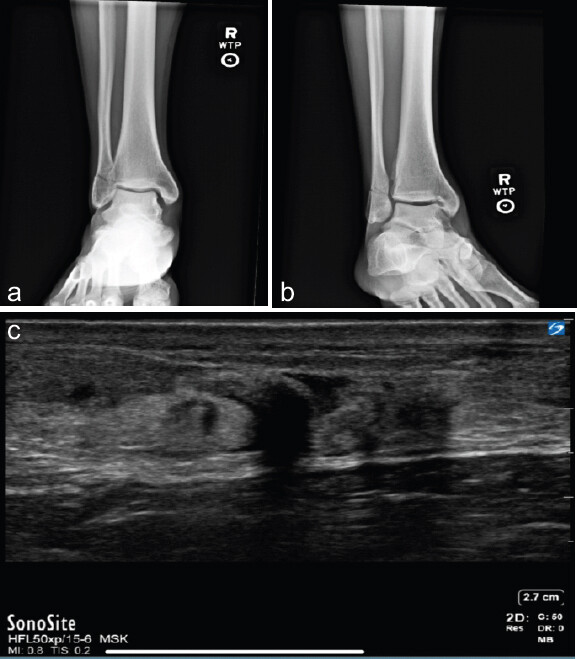
A 34-year-old male presented with right ankle pain and weakness after a high-energy snowboarding injury in January of 2025, sustained when the bottom of his snowboard struck a tree, forcing the ankle into sudden dorsiflexion. Examination revealed diffuse swelling, tenderness over both malleoli, a palpable Achilles tendon defect, and positive Thompson and Matles tests. Radiographs demonstrated a Weber B distal fibular fracture with an associated non-displaced medial malleolar fracture with no talar shift (Fig. 1a and b). Ultrasonography confirmed a full-thickness Achilles tendon rupture approximately 4 cm proximal to its calcaneal insertion with approximately 2 cm of retraction (Fig. 1c).
One week after injury, the patient underwent surgery under regional anesthesia in the prone position. A lateral approach of the fibula was used to access the lateral malleolus, and a posterior longitudinal incision was used to access the Achilles. Open reduction and internal fixation of the lateral malleolus was performed first using a distal fibula plate (Arthrex, Naples, FL). Following fibular fixation, intraoperative stress testing demonstrated a stable ankle mortise without talar shift or displacement of the medial malleolus fracture; therefore, no internal fixation was required. The Achilles tendon rupture, identified approximately 4 cm proximal to its calcaneal insertion, was repaired using suture tape in a Krackow-type locking configuration docked into the calcaneus utilizing two SwiveLock anchors (Arthrex Naples, FL), restoring tendon continuity and tension. The ankle was placed in plantarflexion and immobilized in a post-operative splint.
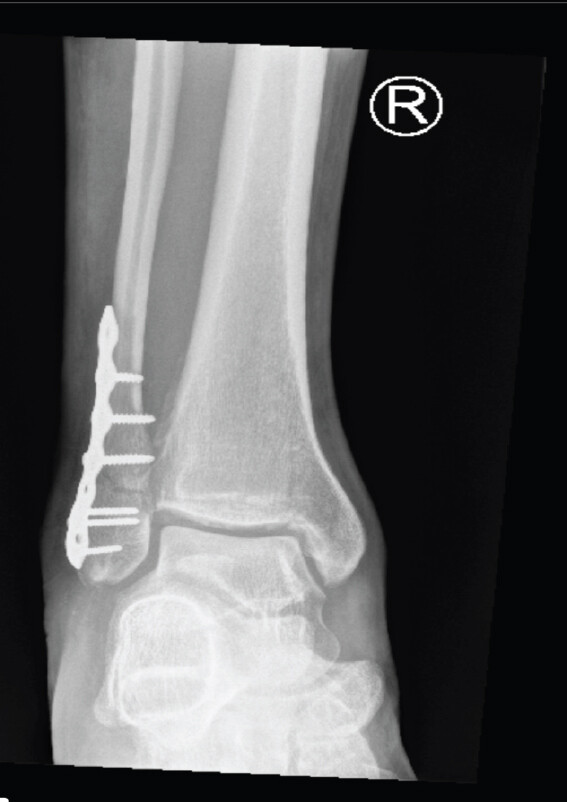
At 1 week postoperatively, radiographs were taken, which confirmed appropriate hardware alignment and progressive healing of the fractures (Fig. 2). The patient transitioned to a controlled ankle-motion boot with a heel wedge, remaining touchdown weight-bearing. At 2 weeks, he was allowed to fully weight-bear in the boot. Formal physical therapy began at 4 weeks.
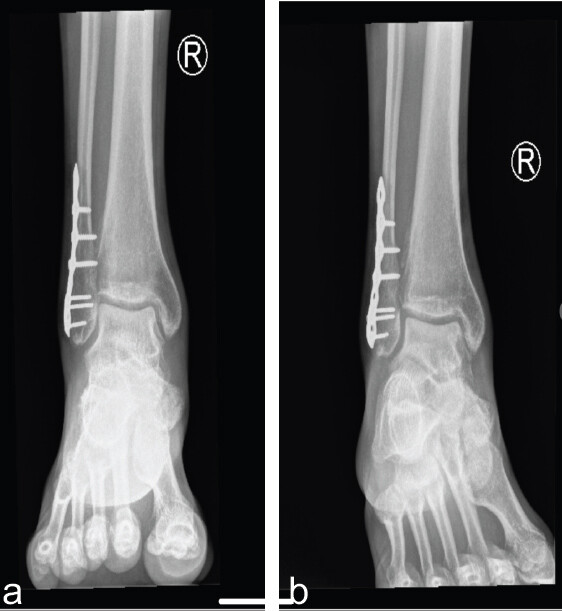
At 3 months postoperatively, radiographs continued to demonstrate anatomical alignment and complete healing of both fractures (Fig. 3). The Achilles tendon remained clinically intact, with 10° of dorsiflexion and 30° of plantarflexion, independent ambulation without a boot, and the ability to perform a double-leg toe rise. There were no signs of infection or wound complication, and the patient reported satisfaction with his recovery.
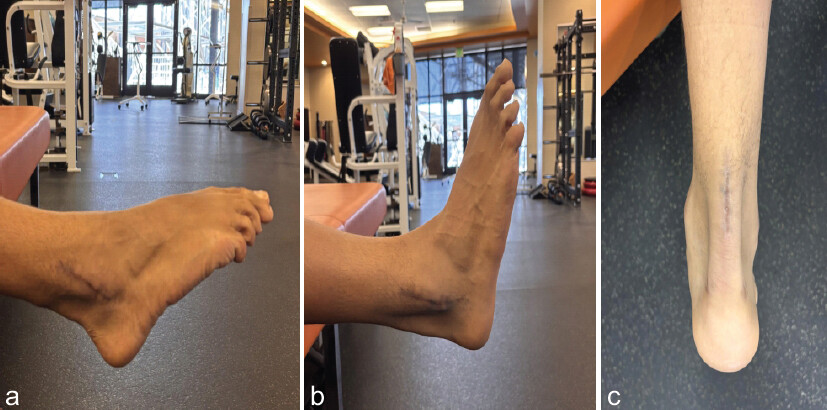
At 6 months postoperatively, physical examination demonstrated well-healed surgical sites, a non-tender, intact Achilles, 5/5 strength, full range of motion, and a stable ankle joint (Fig. 4).
At 1 year postoperatively, the patient reported via telephone that he had returned to snowboarding again without issues.
Discussion
Combined Achilles tendon rupture and ipsilateral ankle fracture is uncommon, and the two injuries can mask one another on initial presentation [1,2,3,4,5,6,7,8,9]. A thorough examination assessing both Achilles continuity and osseous integrity is warranted in high-energy ankle trauma. In this case, both injuries were identified before surgery through clinical examination and ultrasonography, allowing single-stage operative treatment.
The medial malleolar fracture was left unfixed based on intraoperative confirmation of mortise stability after fibular fixation, rather than fracture displacement alone. Prior reports have shown that select non-displaced medial malleolar fractures can be managed nonoperatively [2,3], but this case adds the specific step of stress-testing the mortise intraoperatively after fibular fixation as the basis for that decision, limiting additional medial dissection while confirming stability objectively rather than presumptively.
Early weight-bearing following isolated Achilles tendon repair or isolated ankle fracture fixation is well established, but published reports have not consistently applied this pace to the combined injury. Maffulli and Richards allowed their patient to weight bear “as soon as he felt comfortable,” [2] but their medial malleolar fracture was non-displaced and never surgically addressed, making weight bearing patient-paced rather than protocol-driven. Cruz et al. described a soldier with bilateral Achilles ruptures and an ipsilateral, surgically fixed medial malleolar fracture who underwent an accelerated rehabilitation protocol; even there, the fracture-affected limb was started at 6 weeks postoperatively, slower than the contralateral limb without a fracture [16]. This gap has been noted directly in the recent literature: Morley et al. described the same injury combination as posing a “rehabilitation dilemma,” noting that no international consensus exists for its optimal management [17]. In the present case, a structured protocol advanced to full weight bearing by 4 weeks despite an internally fixed fibula, based on objective intraoperative confirmation of mortise stability rather than fracture displacement, patient comfort, or the presence of surgical fixation alone. This distinguishes the present case from prior reports and suggests that, when mortise stability is explicitly confirmed at the time of surgery, an early rehabilitation timeline comparable to that used for isolated injuries can be extended to the combined injury.
The Achilles tendon was repaired with a Krackow-type locking suture technique with anchors, consistent with prior reports of combined injury [1,2,5]. As a single case, this cannot establish that early rehabilitation is superior to more conservative protocols, but it illustrates that it can be implemented successfully in a carefully selected patient once mortise stability is intraoperatively confirmed and the Achilles repair is secure.
Conclusion
Concomitant Achilles tendon rupture and ankle fracture require a high index of suspicion for both injuries, particularly after high-energy sporting trauma. Intraoperative stress testing after fibular fixation can objectively guide the decision to withhold medial malleolar fixation, and early, protected rehabilitation can be successfully implemented in select patients with a stable, surgically treated ankle fracture.
Clinical Message
Following combined Achilles tendon repair and stable ankle fracture fixation, implementing an early protected weight-bearing protocol (advancing to full weight-bearing in a boot at 2 weeks) is feasible and does not compromise structural stability.
Conflict of Interest:
Nil
Source of Support:
Nil
Consent
The authors confirm that informed consent was obtained from the patient for publication of this article
How to Cite this Article
Curran JA, Pappas MW, Grimm NL, Curran AR. Concomitant Achilles Tendon Rupture and Ankle Fracture in a Snowboarder Managed with Early Rehabilitation: A Case Report. J Orthop Case Rep. 2026 November;16(11): 271-275. doi: 10.13107/jocr.2026.v16.i11.8468.
References
- Chung HJ, Bae SY, Min BK, Song MC. Achilles tendon rupture associated with ipsilateral bimalleolar fracture: A case report. J Korean Foot Ankle Soc 2011;15:107-9. [Google Scholar] | [PubMed]
- Maffulli N, Richards PJ. Subcutaneous rupture of the Achilles tendon and ipsilateral fracture of the medial malleolus. BMC Musculoskelet Disord 2006;7:59. [Google Scholar] | [PubMed]
- Nakajima K, Taketomi S, Inui H, Nakamura K, Sanada T, Tanaka S. Missed medial malleolar fracture associated with Achilles tendon rupture: A case report and literature review. J Foot Ankle Surg 2016;55:169-72. [Google Scholar] | [PubMed]
- Elmajee M, Rafee A, Williams T. Ankle fracture associated with rupture of the achilles tendon: Case report and review of the literature. J Foot Ankle Surg 2017;56:1320-2. [Google Scholar] | [PubMed]
- Brueton RN, Javid KS. Trimalleolar fracture and associated Achilles tendon rupture: Ten year follow up of an unusual water-skiing injury. Trauma Case Rep 2018;17:33-8. [Google Scholar] | [PubMed]
- Sarrel K, Girard P. Gustilo IIIA open bimalleolar fracture dislocation of ankle with ipsilateral Achilles tendon rupture: A case report and review of literature. JBJS Case Connect 2021;11:e20.00435. [Google Scholar] | [PubMed]
- Thomsen BP, Lykkeberg LG. Simultaneous Achilles tendon rupture and medial malleolus fracture. Ugeskr Laeger 2023;185:V09220571. [Google Scholar] | [PubMed]
- Jadib I, Veyrat G, Ionescu S, Belvisi B, Chirpaz-Cerbat JM. Trimalleolar fracture associated with subcutaneous rupture of the Achilles tendon and traumatic peroneal dislocation: A case report and review of the literature. JBJS Case Connect 2024;14:e23.00564. [Google Scholar] | [PubMed]
- Martin JW, Thompson GH. Achilles tendon rupture. Occurrence with a closed ankle fracture. Clin Orthop Relat Res 1986;210:216-8. [Google Scholar] | [PubMed]
- Lubin JW, Miller RA, Robinson BJ, Blevins FT. Achilles tendon rupture associated with ankle fracture. Am J Orthop (Belle Mead NJ) 2000;29:707-8. [Google Scholar] | [PubMed]
- Dinato MC, Freitas MF, D'Elia CO, Bitar AC, Rodrigues Gonçalves FM. Acute calcaneus tendon rupture associated with ipsilateral malleolar fracture: Case report and literature review. J Foot Ankle Surg 2010;49:565.e1-4. [Google Scholar] | [PubMed]
- Hill GN, Barksfield R, Ramesh P. Achilles tendon rupture with open distal tibia and fibula fracture. Foot Ankle Spec 2011;4:171-4. [Google Scholar] | [PubMed]
- Pieper HG, Radas CB, Quack G, Krahl H. Mediomalleolar fracture combined with Achilles tendon rupture--a rare simultaneous injury of the ankle. Int J Sports Med 1998;19:68-70. [Google Scholar] | [PubMed]
- Lu J, Maruo Holledge M. Medial malleolus fracture of the ankle combined with rupture of the Achilles tendon. J Surg Case Rep 2016;2016:rjw062. [Google Scholar] | [PubMed]
- Komarasamy B, Vadivelu R, Boyd KT, Pandey R, Rennie W. Concomitant talar neck fracture and Achilles tendon rupture. J Foot Ankle Surg 2007;46:188-91. [Google Scholar] | [PubMed]
- Cruz CA, Wake JL, Bickley RJ, Morin L, Mannino BJ, Krul KP. Bilateral Achilles tendon rupture: A case report and review of the literature. Osteology 2022;2:70-6. [Google Scholar] | [PubMed]
- Morley HL, Hama B, Hannant G. Vertical fracture of the medial malleolus with concurrent ipsilateral Achilles tendon rupture in a patient with progressive collapsing foot deformity: A rehabilitation dilemma. Cureus 2024;16:e57750. [Google Scholar] | [PubMed]
© 2026 Journal of Orthopaedic Case Reports - Published by Indian Orthopaedic Research Group
About the Authors
-

John A Curran
-

Michael W Pappas
-

Nathan L Grimm
-

Andrew R Curran
Related Articles in Journal of Orthopaedic Case Reports
 November 1, 2026 Optimizing Post-operative Analgesia for Early Rehabilitation after Orthopedic Knee Surgery: A Randomized Comparison of Adductor Canal, Infiltration between the Popliteal Artery and Capsule of the Posterior Knee and Genicular Nerve Blocks
 September 1, 2026 Opportunistic Biological Augmentation during Acute Achilles Tendon Repair: A Novel Surgical Concept With Three-Year Follow-Up—A Case Report
 May 1, 2026 Surgical Treatment of Anchor-induced Heel Pain after Minimally Invasive Repair of Acute Achilles Tendon Rupture Using Percutaneous Achilles Repair System Achilles Midsubstance SpeedBridge™ Repair: A Case Report
 September 10, 2023 Achilles Rupture in the Setting Posterior Tibial Osteochondroma: A Case Report and Guidelines for Management of Osteochondromas Adjacent to Tendons