


Introduction
Proximal tibial stress or insufficiency fractures are uncommon but important complications of advanced knee arthritis, especially in elderly patients with severe varus deformity and compromised bone quality. An insufficiency fracture occurs when physiological loading exceeds the mechanical capacity of weakened bone. In an arthritic varus knee, the medially displaced mechanical axis concentrates repetitive load across the proximal tibia, while reduced mobility and systemic osteopenia may further diminish bone strength [1,2]. The result is a combined “arthritis-fracture complex” in which pain, deformity, and fracture instability reinforce one another.
The problem is particularly difficult when the fracture is chronic, mobile, malunited, or associated with medial tibial plateau collapse. Isolated fracture fixation leaves the arthritic joint and its abnormal loading environment untreated, whereas conventional primary knee arthroplasty does not provide sufficient distal fixation to control an unstable stress fracture. Staged fixation followed by later arthroplasty can prolong disability and expose patients to repeated hospitalization and surgery. Published series and systematic reviews increasingly support single-stage total knee arthroplasty (TKA) with a stemmed tibial component that bypasses the fracture and simultaneously restores alignment [3,4].
The long tibial stem functions as an internal splint. By obtaining diaphyseal support beyond the fracture, it limits bending and shear while the arthroplasty corrects the varus deformity that produced the adverse mechanical environment. However, technical errors in stem trajectory, excessive cement in the fracture gap, poor management of medial plateau deficiency, or cortical impingement may compromise this strategy. The present prospective study evaluated the clinical and radiographic outcomes of single-stage long-stem TKA in patients with advanced knee arthritis and concomitant proximal tibial stress or insufficiency fractures. The principal objectives were to assess improvement in Knee Society scores (KSS), range of motion (ROM), coronal alignment, fracture union, and implant-related complications, and to describe practical technical measures that facilitate stable bypass fixation.
Materials and Methods
Study design and participants
This prospective clinical study was conducted at a high-volume tertiary orthopedic referral center between January 2021 and January 2024. Eighteen consecutive patients with advanced symptomatic knee arthritis and a concomitant proximal tibial stress or insufficiency fracture were included. Thirteen patients had osteoarthritis, and five had rheumatoid arthritis. Six fractures were acute, presenting within 4 weeks of symptom onset, whereas 12 were chronic, delayed presentations or established non-unions. Three patients had intra-articular proximal tibial fracture extension with medial plateau compromise.
Patients were eligible when they had symptomatic advanced knee arthritis requiring arthroplasty, radiographic evidence of a proximal tibial stress or insufficiency fracture, and the potential for at least 24 months of follow-up. Patients with active infection, a history suggesting ongoing systemic infection, or fracture secondary to primary or metastatic malignancy were excluded.
Institutional ethics committee approval and consent
This study was approved by the RHL Ethics Committee, Rajasthan Hospital, Jaipur (Ethics Approval No.: RHL EC/P 08/2021) on January 07, 2021. All participants provided written informed consent before enrolment in the study. This research was conducted ethically in accordance with the World Medical Association Declaration of Helsinki.
Preoperative assessment
Clinical assessment included pain and function, KSS, Knee Society Function Score, and knee ROM measured with a goniometer. Standard weight-bearing anteroposterior and lateral radiographs and full-length lower-limb radiographs were obtained to characterize arthritis severity, fracture level, deformity, and mechanical axis. Assisted-standing radiographs were used when independent weight bearing was not possible.
Because insufficiency fractures may reflect impaired skeletal health, serum calcium, phosphorus, alkaline phosphatase, parathyroid hormone, and Vitamin D were assessed. Dual-energy X-ray absorptiometry was performed in all patients. Seventeen patients were osteoporotic, and one was osteopenic. Vitamin D deficiency was corrected when present, and patients with osteoporosis received post-operative teriparatide as part of the treating team’s bone-health protocol.
Operative technique
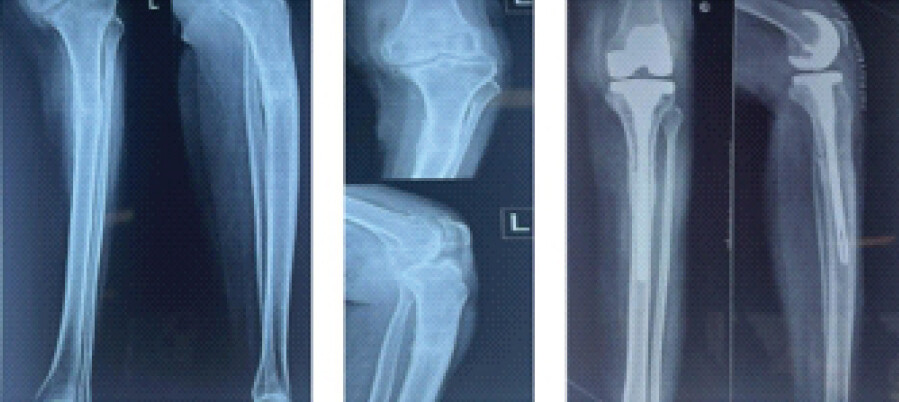
All procedures were performed using a standard midline approach and medial parapatellar arthrotomy. A posterior-stabilized TKA design was used. The defining feature of the procedure was a long intramedullary tibial stem, generally 100–150 mm in length, selected to extend at least two cortical diameters beyond the fracture site (Fig. 1). This allowed the stem to act as an internal splint without routinely opening the fracture site or stripping the periosteum.
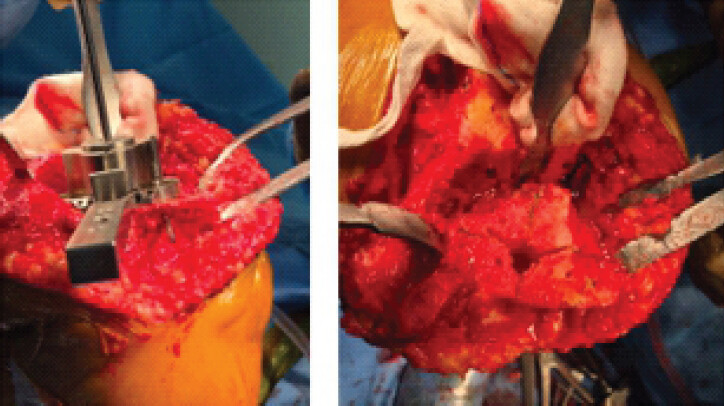
Mechanical alignment principles were followed. In severe varus deformity with medial plateau attenuation, the tibial canal entry point was intentionally lateralized relative to the residual plateau so that the reamer and definitive stem remained centered in the longitudinal diaphyseal canal (Fig. 2). Fluoroscopy was used during guide-wire passage, reduction, and sequential reaming. Hand reaming was preferred to improve tactile feedback in osteoporotic bone and reduce the risk of cortical breach.
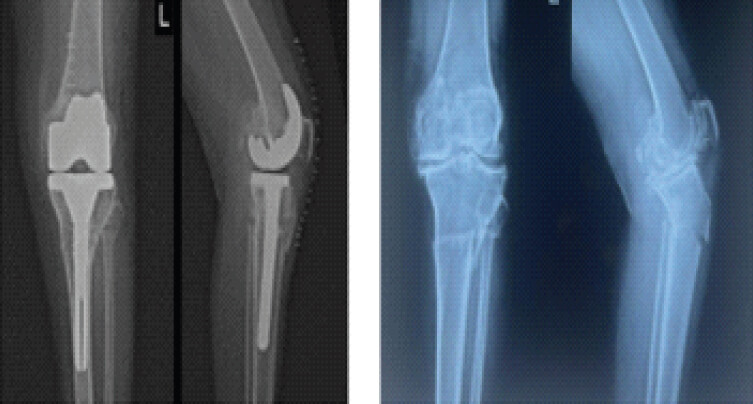
Fractures near the tibial tuberosity were vulnerable to proximal fragment recurvatum when the tibia was delivered anteriorly. A heavy-gauge Kirschner wire or reduction clamp was used when necessary to maintain a neutral sagittal profile during reaming (Fig. 3). Trial components were inserted to confirm fracture stability, coronal and sagittal alignment, and balanced flexion and extension gaps.
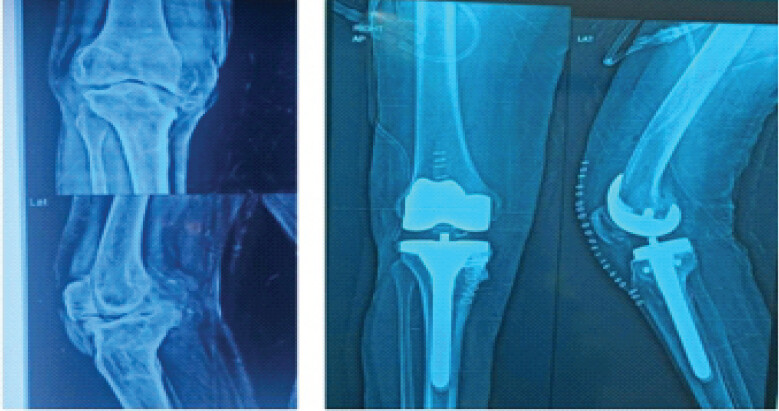
A hybrid cementation strategy was used. Bone cement was applied to the tibial baseplate and proximal metaphyseal portion of the stem, while the distal stem was allowed to obtain a snug diaphyseal fit. Cement was deliberately kept away from the fracture gap to preserve secondary bone healing. In the three intra-articular fractures with medial plateau deficiency, cancellous screws or metallic augmentation were used to create structural support beneath the tibial baseplate (Fig. 4).
Post-operative management and outcomes
Range-of-motion exercises began on the 1st post-operative day. Seventeen patients were allowed immediate full weight bearing with walking support because satisfactory stem fixation and fracture stability had been achieved. In one patient with proximal tibial comminution, weight bearing was delayed for 1 month. Follow-up assessments were scheduled at 2 weeks, 6 weeks, 3 months, 6 months, 1 year, and thereafter as clinically indicated.
Primary clinical outcomes were KSS, Knee Society Function Score, and ROM. Radiographic outcomes included correction of varus deformity, fracture union, alignment, and evidence of stress shielding, implant loosening, or periprosthetic fracture. Fracture union was defined by bridging callus on at least three of four cortices. Continuous pre- and post-operative variables were compared using paired t-tests, with statistical significance defined as P < 0.05.
Results
Eighteen patients completed the required follow-up. Mean age was 61.89 ± 6.31 years and mean follow-up was 24.44 ± 7.10 months. Thirteen patients (72.2%) had osteoarthritis and five (27.8%) had rheumatoid arthritis. Six fractures (33.3%) were acute, and 12 (66.7%) were chronic or established non-unions. Three patients (16.7%) had intra-articular proximal tibial involvement. Seventeen patients were osteoporotic, and one was osteopenic; the mean pre-operative Vitamin D level was 20.2 ng/mL (Table 1).
Baseline clinical and fracture characteristics of the study cohort
| Characteristic | Value (%) |
|---|---|
| Number of patients | 18 |
| Age, years | 61.89±6.31 |
| Follow-up, months | 24.44±7.10 |
| Osteoarthritis | 13 (72.2) |
| Rheumatoid arthritis | 5 (27.8) |
| Acute fractures | 6 (33.3) |
| Chronic fracture/non-union | 12 (66.7) |
| Intra-articular proximal tibial involvement | 3 (16.7) |
| Osteoporosis | 17 (94.4) |
| Osteopenia | 1 (5.6%) |
| Mean preoperative Vitamin D, ng/mL | 20.2 |
Clinical and radiographic outcomes improved significantly after surgery. Mean knee ROM increased from 103.89° ± 20.04° pre-operatively to 122.78° ± 8.95° at final follow-up (P < 0.001). Mean varus deformity improved from 24.72° ± 5.87° to 5.94° ± 0.94° (P < 0.001). Mean KSS improved from 15.44 ± 10.26 to 90.72 ± 2.85, while mean Knee Society Function Score increased from 8.06 ± 5.72 to 85.00 ± 5.42; both differences were significant at P < 0.001 (Table 2).
Pre- and post-operative clinical and radiographic outcomes
| Outcome | Preoperative | Final follow-up | P-value |
|---|---|---|---|
| Range of motion, degrees | 103.89±20.04 | 122.78±8.95 | <0.001 |
| Varus deformity, degrees | 24.72±5.87 | 5.94±0.94 | <0.001 |
| Knee Society Score | 15.44±10.26 | 90.72±2.85 | <0.001 |
| Knee Society Function Score | 8.06±5.72 | 85.00±5.42 | <0.001 |
All fractures united during follow-up, including all 12 chronic fractures. Both acute and chronic fracture groups demonstrated improvement in alignment and functional scores. However, subgroup comparisons should be interpreted as exploratory because of the small numbers (acute, n = 6; chronic/non-union, n = 12; osteoarthritis, n = 13; rheumatoid arthritis, n = 5). Only three patients had intra-articular proximal tibial involvement; therefore, no reliable subgroup conclusion regarding intra-articular fractures can be drawn from this cohort.
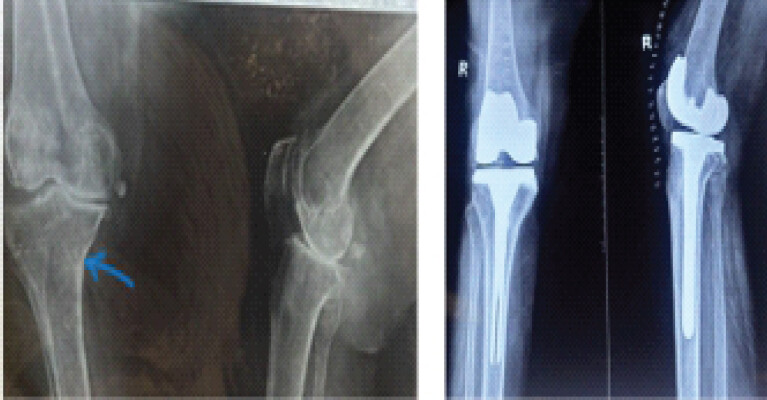
No implant loosening, radiographic stress shielding, or periprosthetic fracture was recorded. The radiographic pattern shown in Fig. 5 illustrates the severe pre-operative varus overload and subsequent restoration of a more neutral mechanical environment after long-stem arthroplasty.
Discussion
The principal finding of this study is that a single-stage long-stem TKA can address the two dominant components of the arthritis-fracture complex at the same operation: Joint degeneration with malalignment and mechanical instability of the proximal tibial fracture. All 18 fractures united, including 12 chronic lesions, while KSS, ROM, and coronal alignment improved substantially. These findings are consistent with previous series in which long tibial stems provided reliable union and functional recovery in arthritic knees complicated by proximal tibial stress fractures [1,5,6,7].
The pathomechanics of this condition explain why correction of alignment is central to treatment. In a severe varus knee, the mechanical axis shifts medially and increases the bending moment across the proximal tibia. Repetitive overload may progress from cortical stress reaction to complete insufficiency fracture, particularly when bone mineral density is reduced. Once a fracture develops, continued varus loading can maintain motion at the fracture site and contribute to delayed union, non-union, or progressive deformity [2,8,9]. The long stem changes this environment by transferring load into the diaphysis while the arthroplasty corrects the deformity.
Systematic reviews have found long-stem TKA to be the most frequently reported single-stage strategy for advanced knee arthritis with proximal tibial stress fractures, with generally favorable union and functional outcomes [3,4]. Reddy et al. and Pai et al. similarly reported meaningful improvement in KSS and union after long-stem arthroplasty [5,6]. Jabalameli et al. reported fracture resolution and improved alignment in an elderly cohort treated with stemmed components [7]. The present series extends this experience by including a high proportion of chronic fractures and by emphasizing preservation of fracture biology through closed bypass stabilization.
Several technical details appear important. First, stem length must provide adequate distal purchase beyond the fracture. Second, the entry point should follow the true diaphyseal canal rather than the apparent center of an eroded medial plateau. Failure to respect the canal trajectory may result in cortical impingement, end-of-stem pain, or a new stress riser. Long-stem constructs have been studied in other arthroplasty settings and can perform well when alignment and fixation are appropriate [10]. Third, cement should not be allowed to interpose at the fracture site. Proximal cementation with distal diaphyseal fit preserves the fracture hematoma and periosteal blood supply while providing immediate implant stability.
Intra-articular fracture extension requires additional consideration because the tibial baseplate may lack a stable medial foundation. In this series, three such cases were supported with cancellous screws or metallic augmentation beneath the baseplate in addition to the long stem. Contemporary reviews support selective augmentative procedures when fracture morphology or bone loss prevents stable arthroplasty fixation [3,4]. Alternative biomechanical adjuncts, including proximal fibular resection, have also been investigated [11], while recent medium-term clinical experience continues to support long-stem arthroplasty as a practical single-stage strategy [12]. A recent narrative review likewise emphasizes fracture morphology, limb alignment, and bone quality in individualized treatment planning [13].
Bone health is another relevant component. Seventeen patients were osteoporotic, and one was osteopenic. This supports the concept that proximal tibial insufficiency fractures result from the interaction of abnormal mechanics and deficient bone strength. Screening for Vitamin D deficiency and reduced bone mineral density therefore has practical value. All 17 osteoporotic patients received post-operative teriparatide as part of the bone-health protocol. Because there was no untreated group or alternative bone-health treatment group, the independent contribution of teriparatide to fracture union cannot be determined. Accordingly, the observed union should be interpreted as the result of a combined treatment strategy that included fracture bypass stabilization, correction of mechanical alignment, preservation of local fracture biology, rehabilitation, and optimization of skeletal health rather than as an effect of any single component.
A staged approach may still be required in infection, severe soft-tissue compromise, or fracture patterns that cannot be controlled by an intramedullary stem. Nevertheless, repeated procedures carry additional morbidity and may prolong the period in which the limb remains malaligned. Reports from developing-country settings have also emphasized delayed presentation and chronic deformity as important contributors to treatment complexity [8]. In appropriately selected patients, a definitive single-stage procedure may therefore reduce treatment burden while allowing early mobilization.
This study has several limitations. The sample size was limited to 18 patients, which reduces statistical power, widens uncertainty around effect estimates, and limits the ability to detect clinically meaningful differences. The study was conducted at a single tertiary referral center, which limits generalizability to other institutions and patient populations. In addition, no control group undergoing conventional fracture fixation, staged treatment, or another arthroplasty strategy was included; therefore, comparative efficacy cannot be established. Selection bias is also possible because the cohort comprised patients considered appropriate for single-stage long-stem TKA at a specialist referral center, even though eligible patients were enrolled consecutively.
The cohort was clinically heterogeneous, including both osteoarthritis and rheumatoid arthritis, as well as acute fractures and chronic/non-union fractures. Only three patients had intra-articular fracture extension. These small and uneven subgroup sizes preclude adequately powered comparisons according to arthritis type, fracture chronicity, or intra-articular involvement. Any subgroup observations in this study should therefore be regarded as descriptive and hypothesis-generating rather than confirmatory.
The mean follow-up of 24.44 months was adequate to document early fracture healing and short- to mid-term functional outcomes but is insufficient to determine long-term implant survivorship, late loosening, stress shielding, or periprosthetic fracture risk. Although fracture union was assessed radiographically, time to union was not systematically analyzed as a separate standardized endpoint. Patient-reported outcome measures beyond the KSS were not collected, and no formal cost-effectiveness analysis was performed. Finally, because most patients received teriparatide and all patients underwent simultaneous alignment correction, fracture bypass fixation, and bone-health optimization, the 100% union rate cannot be attributed specifically to the long-stem technique. Larger multicenter controlled studies with standardized union-time assessment, broader patient-reported outcomes, economic evaluation, and longer follow-up are needed.
Conclusion
In this small prospective single-center cohort, single-stage TKA with a long tibial stem was associated with fracture union, functional improvement, and correction of varus deformity in patients with advanced knee arthritis complicated by proximal tibial stress or insufficiency fractures. The technique offers a practical means of treating the arthritic joint and bypassing the fracture without routine fracture-site exposure. However, the absence of a control group, heterogeneous case mix, concurrent bone-health treatment, and limited follow-up prevent attribution of the observed outcomes to the long-stem component alone. These findings should be considered preliminary and hypothesis-generating, and require confirmation in larger multicenter comparative studies with longer follow-up.
Clinical Message
In an arthritic varus knee with a proximal tibial stress fracture, a correctly aligned long tibial stem can act as an internal splint while TKA corrects the deforming mechanical axis. Preserving fracture biology, avoiding cement interposition, and optimizing bone health can support union even in chronic presentations.
Conflict of Interest:
Nil
Source of Support:
Nil
Consent
The authors confirm that informed consent was obtained from the patient for publication of this article
How to Cite this Article
Jain JK, Goyal R, Bansal H. Long-Stem Bypass Fixation for Concomitant Tibial Stress Fractures and Advanced Knee Arthritis: A Prospective Clinical Study. J Orthop Case Rep. 2026 November;16(11): 338-344. doi: 10.13107/jocr.2026.v16.i11.8492.
References
- Soundarrajan D, Rajkumar N, Dhanasekararaja P, Rajasekaran S. Proximal tibia stress fracture with osteoarthritis of knee - radiological and functional analysis of one stage TKA with long stem. SICOT J 2018;4:13. [Google Scholar] | [PubMed]
- Mullaji A, Shetty G. Total knee arthroplasty for arthritic knees with tibiofibular stress fractures: Classification and treatment guidelines. J Arthroplasty 2010;25:295-301. [Google Scholar] | [PubMed]
- Saini MK, Singh M, Singh DP, Seervi PM, Reddy PJ, Reddy NR. Management of proximal tibial stress fracture associated with advanced knee osteoarthritis: A systematic review. Chin J Traumatol 2023;27:147-52. [Google Scholar] | [PubMed]
- Shekhar S, Rai A, Prakash S, Khare T, Malhotra R. Single-stage long-stem total knee arthroplasty in severe arthritis with stress fracture: A systematic review. Knee Surg Relat Res 2023;35:4. [Google Scholar] | [PubMed]
- Reddy NV, Saini MK, Reddy PJ, Thakur AS, Reddy CD. Analysis of clinical and radiological outcomes of long tibial stemmed total knee arthroplasty in knee osteoarthritis complicated by tibial stress fracture. Knee Surg Relat Res 2022;34:7. [Google Scholar] | [PubMed]
- Pai SN, Kumar MM, Vanchi PK, Ravi R, Kiswanth P. Total knee arthroplasty with long tibial stem for tibial stress fractures with knee osteoarthritis: Two birds with one stone. Chin J Traumatol 2022;25:357-61. [Google Scholar] | [PubMed]
- Jabalameli M, Hadi HA, Bagherifard A, Rahbar M, Minator Sajjadi M. Long- stem total knee arthroplasty for proximal tibial stress fractures in the elderly patients. Arch Bone Jt Surg 2018;6:376-80. [Google Scholar] | [PubMed]
- Gill UN, Noor SS, Haneef M, Ahmed N, Iqbal F, Najjad MK. Management of early and late presenting tibial stress fracture with advanced osteoarthritis of the knee: A dilemma among arthroplasty surgeons in developing countries. Knee 2021;29:95-100. [Google Scholar] | [PubMed]
- Sawant MR, Bendall SP, Kavanagh TG, Citron ND. Nonunion of tibial stress fractures in patients with deformed arthritic knees. Treatment using modular total knee arthroplasty. J Bone Joint Surg Br 1999;81:663-6. [Google Scholar] | [PubMed]
- Prudhon JL, Verdier R, Caton JH. Primary cementless total knee arthroplasty with or without stem extension: A matched comparative study of ninety eight standard stems versus ninety eight long stems after more than ten years of follow-up. Int Orthop 2019;43:1849-57. [Google Scholar] | [PubMed]
- Shah VI, Upadhyay S, Shah K, Sheth A, Kshatriya A, Patil J. Proximal fibular resection improves knee biomechanics and enhances tibial stress fracture healing in patients with osteoarthritis with varus deformity: A prospective, randomized control analysis. Arthroplasty 2020;2:11. [Google Scholar] | [PubMed]
- El-Aidy S, Abd El Wahab AM, Safwat Y. Surgical management of combined osteoarthritis knee and proximal tibial stress fracture via long tibial stem total knee arthroplasty: Assessment of medium-term results. Egypt Orthop J 2024;59:286-92. [Google Scholar] | [PubMed]
- Vosoughi F, Firoozabadi MA, Mortazavi SM. Proximal tibial stress fracture in patients with advanced knee osteoarthritis: A narrative review. EFORT Open Rev 2025;10:763-70. [Google Scholar] | [PubMed]
© 2026 Journal of Orthopaedic Case Reports - Published by Indian Orthopaedic Research Group
About the Authors
-

Jitesh Kumar Jain
-

Ruchi Goyal
-

Harish Bansal
Related Articles in Journal of Orthopaedic Case Reports
 April 10, 2024 Cruciate-retaining Arthroplasty in Patients with Severe Varus Deformity: A Retrospective Comparative Study
 November 1, 2026 Functional Outcome of Titanium Elastic Nailing in Pediatric Lower-Limb Fractures: A Prospective Study
 November 1, 2026 First Reported Case of Periprosthetic Fungal Knee Joint Infection Caused by Candida viswanathii: A Case Report
 November 1, 2026 Intraoperative Proximal Fibula Fracture during Total Knee Arthroplasty for Moderate Valgus Knee Deformity: A Case Report