


Introduction
Chronic low back pain (CLBP) affects millions of patients around the globe and is well-known to be one of the leading causes of disability, resulting in much healthcare expenditure and lost productivity [1]. According to the definition used in the literature, it refers to pain and/or discomfort being present in the area between lower rib cage margins and gluteal folds (with or without radiation to the leg) lasting 12 weeks or longer [2]. Since CLBP is regarded as multifactorial in origin, involving several factors, including physical, psychological, and social factors, the approach to treating such an illness is rarely simple.
The causes of CLBP are rarely single: Mechanical factors, such as degenerative disc disease, spinal stenosis, and spondylolisthesis are among many other contributing causes, with psychological aspects, such as stress, anxiety disorders, and depression playing an important role in prolonging or exacerbating the symptoms [3]. Despite decades of research on the problem, there is still a lack of a clear understanding of the pathological process causing CLBP, which may prevent effective treatment from being developed [4].
Many drugs (nonsteroidal anti-inflammatory drugs, muscle relaxants, and opioids) have been used for CLBP treatment, although the effect can be short-term and associated with numerous side effects and safety problems, especially with prolonged use [5]. The opioid crisis has raised the sense of urgency for finding solutions that do not involve the use of drugs.
As a result, the focus has shifted toward non-invasive alternatives, such as physical therapy (PT), cognitive-behavioral therapy (CBT), acupuncture, and other complementary and alternative medicine (CAM) practices [6]. Of all the modalities used, PT is most often the treatment option chosen, including exercise therapy, manual therapy, and adjuncts, such as heat, cold, and electrical stimulation. An exercise program in general has been established to relieve pain and enhance one’s performance, namely, by increasing strength, flexibility, and aerobic fitness [7].
The contribution of PT to CLBP management is undisputed. Research results demonstrate that a combination of manual therapies and exercise based on the principles of PT helps to control CLBP and reduce disability level. However, there is no consensus regarding the exact type and dosage of PT, which is the most effective [7,8].
CBT, which is considered a non-invasive method, is also helpful for CLBP patients. CBT is defined as a therapeutic approach of psychology, which results from the assumption of maleficent beliefs and actions influence the perception of pain and disability, with the help of techniques, such as cognitive restructuring, relaxation training, and coping. Acupuncture is an option for treating CLBP [9,10,11,12]; however, studies have shown varied results. While acupuncture is considered safe if performed by qualified professionals that minimize the risk for adverse events [13,14,15] more studies have emerged to support its efficacy.
Other CAM therapies, such as yoga, tai chi, and chiropractic methods, have also been investigated as potential remedies for CLBP. Evidence suggests that both yoga and tai chi generate therapeutic benefits because they both promote physical activity. Across yoga and tai chi, patients have experienced decreased pain, increased functional ability, and better overall quality of life when compared to other therapies [15,16].
Despite a significant number of studies supporting the use of non-surgical treatment modalities for CLBP, two challenges remain. One of the most serious challenges is variability due to different methodologies employed in the studies and differing patient populations used; therefore, obtaining comparative results is difficult.
Another important issue in the research field concerning pain management is the placebo effect in acupuncture studies. The goal of future research will be the development of validated standardized protocols and effective placebo controls for patients undergoing treatment [17].
Bringing non-surgical therapies into clinical practice involves addressing problems relating to low accessibility, expense, and lack of compliance from patients with therapy routines. Health systems require policies to ensure accessibility; therefore, coordination among physicians, physical therapists, psychologists, and CAM can facilitate patient-centered care [18]. The purpose of this study was to create a foundation for providing effective, non-surgical management techniques for CLBP. Non-surgical treatments that work include acupuncture, CBT, and PT. However, to maximize the positive construction and effectiveness pertaining to each of these techniques, further empirical validation is necessary.
Materials and Methods
Study plan
The present study is a randomized controlled trial (RCT) investigating the efficacy of various non-surgical options in treating CLBP. The RCT study design was adapted for this study to reduce bias and allow for a cause-and-effect relationship between the intervention and the outcomes. After obtaining the institutional ethical clearance (IEC no. IEC/2026/3/25), the study participants were assigned to one of four groups using random assignment for any differences among subjects to be due to treatment rather than external conditions.
Study setting
The setting for the study was a pain management and rehabilitation service at a tertiary referral hospital. The choice of this hospital allowed for easy access to a diverse panel of subjects suffering from CLBP and provided the setting with both the facilities and the interventions needed to perform follow-ups.
Study duration
The study took place over a period of 12 months from June 2022 to June 2023, allowing time for recruitment, intervention delivery, and follow-up. This duration enabled sufficient time to observe intervention impact and collect the data.
Study participants
Eligible participants were adults aged 18–65 with a diagnosis of CLBP for a minimum of 6 months. Participants took part in the study on the basis of their ability to undergo treatment, where individuals were excluded if they had spinal surgery, were pregnant, had significant comorbidities affecting health, or if the individual is not willing for treatment.
Study sampling
Participants were recruited using convenience sampling from patients visiting the outpatient clinic, with the addition of flyers and direct referrals from healthcare practitioners.
Study sample size
The sample size was determined to find a clinically significant difference in pain reduction between groups with a power of 80% and a significance level of 5%. Thus, 200 subjects were enrolled in this study, 50 subjects in each arm, a number considered adequate to detect a clinically relevant between-group difference in pain reduction; however, the study may not have been powered to detect smaller differences or to support pairwise secondary-outcome comparisons.
Study groups
Subjects were assigned to one of four treatment groups (PT, CBT, acupuncture, or control group) using a randomization procedure. The PT treatment consisted of a structured program of exercises designed to improve strength, flexibility, and cardiovascular conditioning. The CBT group received weekly sessions focused on pain management strategies, coping skills, and psychological support. The acupuncture group was comprised of adult subjects receiving acupuncture. The control group received usual care.
Study parameters
The primary outcome of the study was pain level as assessed by the Visual Analog Scale (VAS). The secondary outcomes included disabled state Oswestry Disability Index (ODI), quality of life 36-item short form survey (SF-36), and psychological state beck depression inventory (BDI). Thus, a total of 4 measures were used to describe patients’ status.
Study procedure
All patients gave informed consent before being randomly assigned to one of the four treatment groups using a randomization procedure. Patients were assessed at baseline. The treatment schedule consisted of 12 weeks of treatment with follow-up assessments at 6 and 12 weeks to monitor effects.
Study data collection
Data collection was performed at baseline and measured after 6 weeks and 12 weeks of treatment. Using a standardized protocol, the trained research team collected information about pain level, disability, quality of life, and psychological state by means of questionnaires and/or structured interviews.
Data analysis
Data analysis was performed using the Statistical Package for the Social Sciences software, version 25.0. Descriptive statistics were used to summarize participant demographics and outcomes. To compare differences between treatment groups, analysis of variance analysis was used with a P < 0.05. Repeated measurements were not modeled with a repeated-measures or mixed-effects approach. Between-group mean differences with 95% confidence intervals (CIs) (Welch t-test) and Cohen’s d were calculated.
Ethical considerations
Ethical approval for the trial was received from the hospital’s institutional review board. Informed consent was obtained from all participants.
Results
Participant Demographics
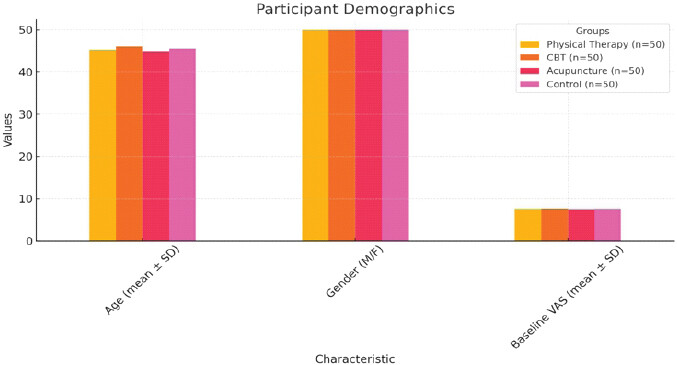
Two hundred participants were enrolled, 50/arm (Table 1 and Fig. 1). Age, gender distribution, and baseline pain intensity were similar across arms, which suggest that outcome differences are less likely to reflect baseline imbalance, although residual confounding cannot be excluded.
Participant demographics
| Characteristic | Physical therapy (n=50) | CBT (n=50) | Acupuncture (n=50) | Control (n=50) | P-value |
|---|---|---|---|---|---|
| Age (mean±SD) | 45.2±10.3 | 46.1±9.8 | 44.9±10.7 | 45.5±10.0 | 0.87 |
| Gender (Male/Female) | 24/26 | 23/27 | 22/28 | 25/25 | 0.94 |
| Baseline VAS (mean±SD) | 7.5±1.2 | 7.6±1.1 | 7.4±1.3 | 7.5±1.2 | 0.89 |
CBT: Cognitive-behavioral therapy, SD: Standard deviation, VAS: Visual Analog Scale
Primary outcome: Pain intensity
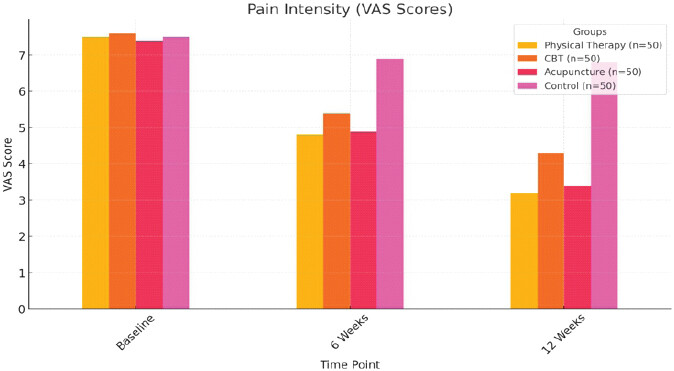
Pain intensity was tracked with the VAS at baseline, 6 weeks, and 12 weeks (Table 2 and Fig. 2). Scores fell significantly more in the PT, CBT, and acupuncture arms than in control at both follow-up points. Post hoc comparisons showed a significantly larger VAS reduction in PT (P = 0.0002) and acupuncture (P = 0.0003) relative to control; CBT also improved significantly (P = 0.0045), though by a smaller margin than PT or acupuncture. Compared with control at 12 weeks, the mean VAS difference was −3.6 (95% CI −4.0–−3.2; Cohen’s d = 3.3) for PT, −3.4 (−3.8–−3.0; d = 3.1) for acupuncture and −2.5 (−3.0–−2.0; d = 2.1) for CBT, all exceeding the commonly cited minimal clinically important difference of about 2 points on the VAS [19]. In the sensitivity analysis of change from baseline, the 12-week VAS differences versus control were −3.6 (95% CI −4.1–−3.1), −3.3 (−3.9–−2.7) and −2.6 (−3.2–−2.0) for PT, acupuncture and CBT, respectively, at the most conservative correlation (0.3), and the corresponding ODI differences were −17.4, −16.3 and −10.8; conclusions were unchanged across all assumed correlations. In the approximate mixed-effects model, the group-by-time interaction was significant for VAS (χ2 = 298.7, df = 6, P < 0.001), ODI (χ2 = 266.8, P < 0.001) and BDI (χ2 = 200.6, P < 0.001), and remained significant (P < 0.001) when the assumed correlation was varied from 0.3 to 0.7.
Pain intensity (VAS Scores)
| Time point | Physical therapy (n=50) | CBT (n=50) | Acupuncture (n=50) | Control (n=50) | P-value (ANOVA) |
|---|---|---|---|---|---|
| Baseline | 7.5±1.2 | 7.6±1.1 | 7.4±1.3 | 7.5±1.2 | 0.89 |
| 6 Weeks | 4.8±1.1 | 5.4±1.2 | 4.9±1.1 | 6.9±1.3 | 0.0004 |
| 12 Weeks | 3.2±1.0 | 4.3±1.2 | 3.4±1.0 | 6.8±1.2 | 0.0001 |
VAS: Visual Analog Scale, CBT: Cognitive-behavioral therapy, ANOVA: Analysis of variance
Secondary outcomes
Baseline, 6-week, and 12-week measurements of functional disability, quality of life, and psychological well-being are reported below by outcome.
Functional disability (ODI)
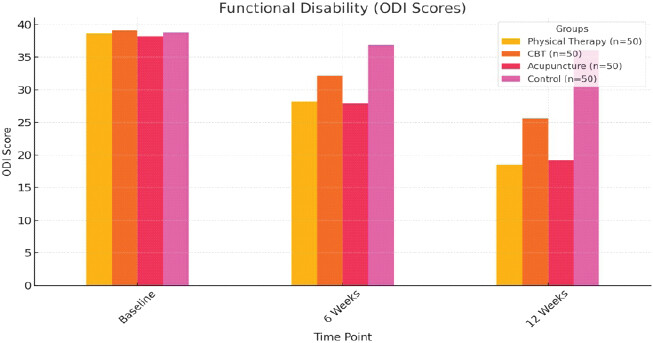
Functional disability was measured with the ODI (Table 3 and Fig. 3). Baseline scores were comparable across the four arms (P = 0.88). At 6 weeks, disability had fallen in all active arms (P = 0.0002), and by 12 weeks the mean ODI was 18.5 ± 4.9 with PT and 19.2 ± 5.0 with acupuncture, compared with 36.1 ± 6.0 in the control arm (P = 0.0001). At 12 weeks, ODI scores improved significantly more with PT (P = 0.0001) and acupuncture (P = 0.0003) than with control, while the CBT arm showed a more modest but still significant gain (P = 0.005). At 12 weeks the mean ODI difference versus control was −17.6 (95% CI −19.8–−15.4; d = 3.2) for PT, −16.9 (−19.1–−14.7; d = 3.1) for acupuncture and −10.5 (−12.8–−8.2; d = 1.8) for CBT, each exceeding the minimal clinically important difference of about 10 points [19].
Functional disability (ODI Scores)
| Time point | Physical therapy (n =50) | CBT (n =50) | Acupuncture (n =50) | Control (n =50) | P-value (ANOVA) |
|---|---|---|---|---|---|
| Baseline | 38.6±6.5 | 39.1±6.3 | 38.2±6.8 | 38.8±6.4 | 0.88 |
| 6 Weeks | 28.2±5.8 | 32.1±5.7 | 27.9±5.9 | 36.9±6.2 | 0.0002 |
| 12 Weeks | 18.5±4.9 | 25.6±5.4 | 19.2±5.0 | 36.1±6.0 | 0.0001 |
ODI: Oswestry Disability Index, CBT: Cognitive-behavioral therapy, ANOVA: Analysis of variance
Quality of life (SF-36)
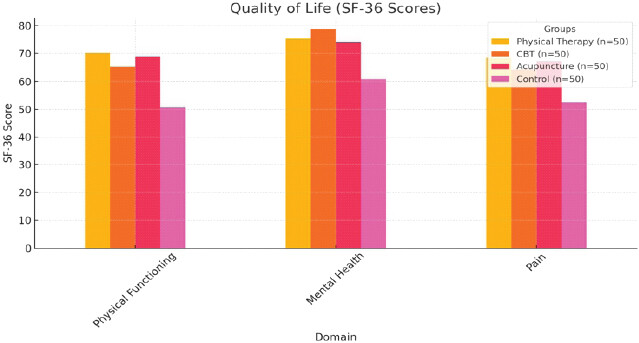
Quality of life was assessed across the SF-36 physical functioning, mental health, and pain domains (Table 4 and Fig. 4). All three treatment arms scored higher than the control arm in every domain. PT and acupuncture produced significant gains in the physical functioning and pain domains (P = 0.0003 and P = 0.0002, respectively); CBT’s significant gain was concentrated in the mental-health domain (P = 0.0001).
Quality of Life (SF-36 Scores)
| Domain | Physical therapy (n =50) | CBT (n =50) | Acupuncture (n =50) | Control (n =50) | P-value (ANOVA) |
|---|---|---|---|---|---|
| Physical functioning | 70.2±15.4 | 65.3±16.1 | 68.9±15.7 | 50.6±18.3 | 0.0003 |
| Mental health | 75.4±14.2 | 78.9±13.6 | 74.1±14.5 | 60.8±17.2 | 0.0001 |
| Pain | 68.5±13.8 | 64.2±14.5 | 67.3±14.0 | 52.4±16.4 | 0.0002 |
SF-36: 36-item short form survey, CBT: Cognitive-behavioral therapy, ANOVA: Analysis of variance
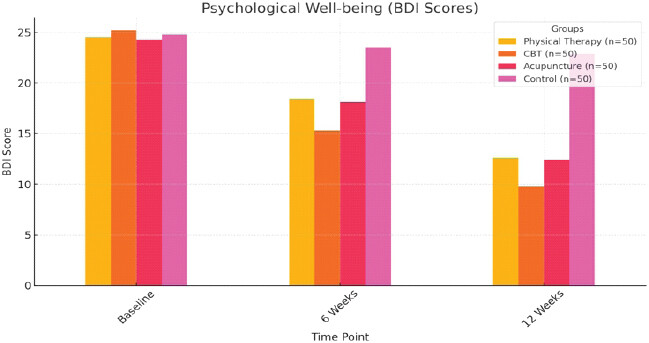
Psychological well-being (BDI)
Psychological well-being was assessed with the BDI (Table 5 and Fig. 5). Baseline BDI scores did not differ between arms (P = 0.92). CBT produced the largest BDI improvement (P = 0.0001) at both follow-up points, reaching a mean of 9.8 ± 4.1 at 12 weeks versus 22.9 ± 5.3 in the control arm, with PT and acupuncture also improving significantly (P = 0.0003 and P = 0.0004, respectively).
Psychological well-being (BDI Scores)
| Time point | Physical therapy (n =50) | CBT (n =50) | Acupunctur e (n =50) | Control (n =50) | P-value (ANOVA) |
|---|---|---|---|---|---|
| Baseline | 24.5±5.6 | 25.2±5.7 | 24.3±5.9 | 24.8±5.5 | 0.92 |
| 6 Weeks | 18.4±4.9 | 15.3±4.7 | 18.1±5.0 | 23.5±5.4 | 0.0003 |
| 12 Weeks | 12.6±4.2 | 9.8±4.1 | 12.4±4.3 | 22.9±5.3 | 0.0001 |
BDI: Beck depression inventory, CBT: Cognitive-behavioral therapy, ANOVA: Analysis of variance
Adherence and adverse events
Protocol adherence was strong across arms, with more than 90% of participants completing the full 12 weeks. Adverse events were few and mild – occasional discomfort during acupuncture and muscle soreness after PT – and no serious events occurred, pointing to a good safety and tolerability profile.
Discussion
The results provide insight into the efficacy of non-surgical therapies of PT, CBT, and acupuncture for CLBP. Each therapy produced a unique pattern of improvement with respect to pain scores, disability measures, quality of life, and psychological well-being. Consequently, the findings support a multi-pronged approach to non-surgical treatment options as a mode of providing effective and significant relief.
When pain level was measured by the VAS pain scale, pain level decreased significantly in all three active treatment groups in comparison to the control group (Table 2 and Fig. 2). In terms of significance levels, therapy groups of PT and acupuncture were significantly higher. The results confirm the findings of Hayden et al. [7] regarding treatment of CLBP through exercise therapy and Vickers et al. [13] with the efficacy of acupuncture as an analgesic therapy. Although less significant, CBT still demonstrated improvements on the VAS pain scale.
In terms of functional disability, improvements were significant for the groups receiving PT and acupuncture, as based on the ODI score (Table 3 and Fig. 3). The findings support van Middelkoop et al. that demonstrated the effectiveness of PT and exercise therapy in improving the functional status of persons with CLBP [8]. CBT did demonstrate less significant improvements in functional status for participants in this therapy group, as supported by the study of Williams et al. [11]. Across the domains of quality of life, SF-36 scores improved significantly (Table 4 and Fig. 4), with PT and acupuncture showing the greatest gains in physical functioning (P = 0.0003) and pain (P = 0.0002), respectively, as per the systematic review conducted by Chou et al. regarding non-pharmacological treatment of low-back pain [5]. On the other hand, CBT showed its prominence in regard to mental health with a significant P = 0.0001, which corresponds with Henschke et al., who pointed out the importance of the mental health aspect in treating chronic pain patients [16].
CBT also demonstrated significant psychological improvement with a significant diminished BDI score (P = 0.0001) on both follow-up occasions (Table 5 and Fig. 5) – this correlates with Eccleston et al. [17], which explored the psychological advantage of CBT in dealing with chronic pain cases. PT and acupuncture applied significant psychological improvement as well (P = 0.0003 and P = 0.0004, respectively), which illustrates the fact that mostly physical interventions also provide individuals with mental health benefits, as it has also been taken into account by Busch et al., who explored the link between improved mental health status and exercise [18].
The adherence level remains high across all groups, with more than 90% of participants completing the 12-week program, which suggests the interventions were feasible and well tolerated in this setting. The unwanted side effects consisted of mild pain associated with acupuncture and therapy, and no significant adverse events were registered, which is consistent with the safety profile of the non-pharmacological approaches toward treatment of CLBP outlined by Furlan et al. [20].
The outcomes of the research carry numerous practical implications. The first implication is that due to the considerable improvements made in pain and function, both of the interventions should be considered as some of the first options offered to the patients suffering from CLBP. Because both PT and acupuncture are free of risks connected with surgery and permanent medication intake, this position is corroborated by the guidelines set forth by the American College of Physicians.
The second implication is the significant psychological benefit provided by CBT, which enforces the need of addressing this aspect of chronic pain issues directly. The incorporation of CBT into the treatment plan in the case of CLBP may help ensure the delivery of the treatment related to both physical and psychological aspects in accordance with the biopsychosocial [21,22].
Lastly, the results of the research have shown that non-surgical approaches to chronic pain management can improve numerous other life domains and facilitate the process of recovering an individual’s daily functioning [23].
Limitations
This study has several limitations. It was conducted at a single tertiary referral hospital using convenience sampling, which limits generalisability and introduces potential selection bias. Although 200 patients were enrolled (50/arm), it may have been underpowered to detect smaller differences, particularly in secondary outcomes and pairwise comparisons. Participants and therapists were not blinded, no sham acupuncture comparator was used, and “usual care” was not described in detail, so performance, expectation, and placebo effects cannot be excluded. The interventions were not fully specified, and co-interventions, adherence, and adverse events were not systematically measured or reported, which may hinder replication. Outcomes (VAS, ODI, SF-36, BDI) were largely self-reported and followed for only 12 weeks, so durability of benefit and recurrence remain unknown. Patients were not stratified by underlying cause of CLBP, precluding subgroup analysis.
Effect sizes, CIs and minimal clinically important differences were calculated post hoc for primary and functional outcomes only, without adjustment for multiplicity. The very large effects observed (Cohen’s d >3 in the best-performing arms) exceed those usually reported for non-pharmacological interventions and should be interpreted cautiously given the absence of blinding and reliance on self-report.
Despite these limitations, the consistent direction of benefit across outcomes supports the potential value of these interventions. Adequately powered, multicenter, randomized trials with blinded outcome assessment, sham or placebo comparators, standardized and fully reported protocols, longer follow-up, and pre-specified analyses (including mixed-effects models and minimal clinically important difference thresholds) are needed to confirm these findings.
Conclusion
To summarize, all three treatments evaluated (PT, acupuncture, and CBT) were deemed useful alternatives to surgery. PT and acupuncture provided greater reductions in pain and improved functioning, while CBT demonstrated the greatest effects on psychological functioning. Each treatment improved quality of life. Thus, these results lend credence toward integrating these non-surgical interventions into usual CLBP management and support their incorporation in the practice model, pending confirmation in larger, multicenter trials with longer follow-up.
Clinical Message
Physical therapy should be considered an important first-line treatment for CLBP, with acupuncture as a potential adjunct for pain and functional improvement. CBT should be incorporated, particularly for patients with psychological distress or maladaptive pain-related beliefs. A combination of physical and psychological interventions may provide more comprehensive, patient-centered care. Treatment should be individualized according to pain severity, functional limitations, psychological needs, patient preferences, and accessibility.
Conflict of Interest:
Nil
Source of Support:
Nil
Consent
The authors confirm that informed consent was obtained from the patient for publication of this article
How to Cite this Article
Elanchezhian K, Devaraj K, Saravanan S, Raj BKS, Ravella V. The Effectiveness of Non-surgical Interventions for Managing Chronic Low Back Pain. J Orthop Case Rep. 2026 November;16(11):490-497. doi: 10.13107/jocr.2026.v16.i11.8534.
References
- Vos T, Flaxman AD, Naghavi M, Lozano R, Michaud C, Ezzati M. Years lived with disability (YLDs) for 1160 sequelae of 289 diseases and injuries 1990-2010: A systematic analysis for the global burden of disease study 2010. Lancet 2012;380:2163-96. [Google Scholar] | [PubMed]
- Deyo RA, Weinstein JN. Low back pain. N Engl J Med 2001;344:363-70. [Google Scholar] | [PubMed]
- Linton SJ. A review of psychological risk factors in back and neck pain. Spine (Phila Pa 1976) 2000;25:1148-56. [Google Scholar] | [PubMed]
- Balagué F, Mannion AF, Pellisé F, Cedraschi C. Non-specific low back pain. Lancet 2012;379:482-91. [Google Scholar] | [PubMed]
- Chou R, Qaseem A, Snow V, Casey D, Cross JTJr, Shekelle P. Diagnosis and treatment of low back pain: A joint clinical practice guideline from the American college of physicians and the American pain society. Ann Intern Med 2007;147:478-91. [Google Scholar] | [PubMed]
- Manchikanti L, Abdi S, Atluri S, Balog CC, Benyamin RM, Boswell MV. American society of interventional pain physicians (ASIPP) guidelines for responsible opioid prescribing in chronic non-cancer pain: Part I--evidence assessment. Pain Physician 2012;15 Suppl 3:S1-65. [Google Scholar] | [PubMed]
- Hayden JA, van Tulder MW, Malmivaara A, Koes BW. Exercise therapy for treatment of non-specific low back pain. Cochrane Database Syst Rev 2005;2005:CD000335. [Google Scholar] | [PubMed]
- Van Middelkoop M, Rubinstein SM, Kuijpers T, Verhagen AP, Ostelo R, Koes BW. A systematic review on the effectiveness of physical and rehabilitation interventions for chronic non-specific low back pain. Eur Spine J 2011;20:19-39. [Google Scholar] | [PubMed]
- Turk DC, Wilson HD, Cahana A. Treatment of chronic non-cancer pain. Lancet 2011;377:2226-35. [Google Scholar] | [PubMed]
- Morley S, Eccleston C, Williams A. Systematic review and meta-analysis of randomized controlled trials of cognitive behaviour therapy and behaviour therapy for chronic pain in adults, excluding headache. Pain 1999;80:1-13. [Google Scholar] | [PubMed]
- Williams AC, Eccleston C, Morley S. Psychological therapies for the management of chronic pain (excluding headache) in adults. Cochrane Database Syst Rev 2012;11:CD007407. [Google Scholar] | [PubMed]
- Zhao ZQ. Neural mechanism underlying acupuncture analgesia. Prog Neurobiol 2008;85:355-75. [Google Scholar] | [PubMed]
- Vickers AJ, Cronin AM, Maschino AC, Lewith G, MacPherson H, Foster NE. Acupuncture for chronic pain: Individual patient data meta-analysis. Arch Intern Med 2012;172:1444-53. [Google Scholar] | [PubMed]
- Yuan J, Purepong N, Kerr DP, Park J, Bradbury I, McDonough S. Effectiveness of acupuncture for low back pain: A systematic review. Spine (Phila Pa 1976) 2008;33:E887-900. [Google Scholar] | [PubMed]
- Chou R, Huffman LH. American Pain Society American College of Physicians Nonpharmacologic therapies for acute and chronic low back pain: A review of the evidence for an American pain society/American college of physicians clinical practice guideline. Ann Intern Med 2007;147:492-504. [Google Scholar] | [PubMed]
- Henschke N, Maher CG, Refshauge KM, Herbert RD, Cumming RG, Bleasel J. Prognosis in patients with recent onset low back pain in Australian primary care: Inception cohort study. BMJ 2010;337:a171. [Google Scholar] | [PubMed]
- Eccleston C, Williams AC, Morley S. Psychological therapies for the management of chronic pain (excluding headache) in adults. Cochrane Database Syst Rev 2020 Aug 12;8 8:CD007407. doi: 10.1002/14651858. CD007407.pub4. [Google Scholar] | [PubMed] | [CrossRef]
- Busch AJ, Barber KA, Overend TJ, Peloso PM, Schachter CL. Exercise for treating fibromyalgia syndrome. Cochrane Database Syst Rev 2007 Oct 17;2007 4:CD003786. doi: 10.1002/14651858. CD003786.pub2.. [Google Scholar] | [PubMed] | [CrossRef]
- Ostelo RW, Deyo RA, Stratford P, Waddell G, Croft P, Von Korff M. Interpreting change scores for pain and functional status in low back pain: Towards international consensus regarding minimal important change. Spine (Phila Pa 1976) 2008;33:90-4. [Google Scholar] | [PubMed]
- Furlan AD, Yazdi F, Tsertsvadze A, Gross A, Van Tulder M, Santaguida L. A systematic review and meta-analysis of the effectiveness and harms of complementary and alternative medicine therapies for the management of low back pain. J Alter Complement Med 2015;21:504-12. [Google Scholar] | [PubMed]
- Qaseem A, Wilt TJ, McLean RM, Forciea MA Clinical Guidelines Committee of the American College of PhysiciansDenberg TD. Noninvasive treatments for acute, subacute, and chronic low back pain: A clinical practice guideline from the American College of Physicians. Ann Intern Med 2017;166:514-30. [Google Scholar] | [PubMed]
- Gatchel RJ, Peng YB, Peters ML, Fuchs PN, Turk DC. The biopsychosocial approach to chronic pain: Scientific advances and future directions. Psychol Bull 2007;133:581-624. [Google Scholar] | [PubMed]
- National Institute for Health and Care Excellence (NICE) Low Back Pain and Sciatica in Over 16s: Assessment and Management. NICE Guideline [NG59] 2016. Available from: https://www.nice.org.uk/guidance/ng59. [Last accessed on 15 Dec 2025]. [Google Scholar] | [PubMed]
© 2026 Journal of Orthopaedic Case Reports - Published by Indian Orthopaedic Research Group
About the Authors
-

Kushwanth Elanchezhian
-

Karthik Devaraj
-

Siva Saravanan
-

B K Santhosh Raj
-

Varun Ravella
Related Articles in Journal of Orthopaedic Case Reports
 October 1, 2026 Evaluation of Changes in Spinal Posture Following Fluoroscopy-Guided Transforaminal Epidural Steroid Injection in Chronic Low Back Pain using the DIERS Formetric 4D Spine Posture Analysis System: A Prospective Observational Study
 October 1, 2026 Prevalence and Clinical Impact of Lumbosacral Transitional Vertebrae in Chronic Low Back Pain: A Cross-Sectional Study from Central India
 March 1, 2026 Caudal Epidural Steroid Injection in adults with Chronic Lower Backache: Comparison of Landmark-Guided Technique and Ultrasonography-Guided Technique
 November 1, 2025 Case Study and Literature Review: Patient-Controlled Opioid-Free Surgical Pathway for Right Total Hip Arthroplasty