

Ganz-type trochanteric osteotomy provides excellent exposure of the acetabulum and proximal femur, allowing safe femoral head excision, management of abductor contracture, and implantation of a primary total hip arthroplasty without the need for subtrochanteric shortening osteotomy.
Dr. Siddhant Pundalik Pol, Department of Orthopedics, LTMMC and Sion Hospital, Mumbai, Maharashtra, India. E-mail: siddhantpol@gmail.com
Abstract
Introduction: Neglected posterior hip dislocation is uncommon and can cause soft-tissue contracture, proximal migration of the femur, limb length discrepancy, and secondary degenerative changes. In chronic cases with joint destruction, total hip arthroplasty is often the preferred reconstructive option. However, reduction can be difficult and may require additional procedures, such as femoral shortening osteotomy.
Case Report: A 41-year-old male presented with right hip pain for 2 years and difficulty in walking for 18 months following a road traffic accident. Imaging showed neglected posterior dislocation of the right hip with superior migration of the proximal femur, near-complete femoral head resorption, and pseudoarthrosis. The patient underwent 3 weeks of pre-operative skin traction followed by total hip arthroplasty through a posterior approach using a Ganz-type greater trochanteric osteotomy and abductor pie-crusting without subtrochanteric shortening osteotomy. At the 6-month follow-up, the patient was pain-free, walking full weight-bearing, with no limb length discrepancy, no neurological deficit, and radiological union of the trochanteric osteotomy site.
Conclusion: In selected cases of neglected posterior hip dislocation, pre-operative traction, soft-tissue balancing, and Ganz-type trochanteric osteotomy may allow reduction without subtrochanteric shortening osteotomy. This approach may reduce the risk of nerve stretch injury, preserve femoral bone stock, and allow use of a primary femoral implant.
Keywords: Neglected hip dislocation, total hip arthroplasty, ganz osteotomy, subtrochanteric osteotomy, traction.

Neglected posterior hip dislocation is rare but can be severely disabling, particularly where delayed presentation is common. With time, chronic dislocation leads to soft-tissue contracture, proximal migration of the femur, limb length discrepancy, acetabular remodeling, and secondary degenerative changes, all of which make reconstruction more difficult [1,2,3,4,5,6,7,8]. When the joint is no longer salvageable, total hip arthroplasty is a reasonable option for pain relief and restoration of function. Reduction during arthroplasty can be difficult because chronic shortening and soft-tissue adaptation increase tension when limb length is restored. Subtrochanteric shortening osteotomy is often used to facilitate reduction and reduce neurovascular tension, but it also carries risks, such as non-union, implant-related complications, and altered femoral biomechanics [7,8,9,10]. It may also necessitate the use of longer revision-type stems instead of a standard primary implant. Ganz-type trochanteric osteotomy provides extensile exposure of the acetabulum and proximal femur and is useful in complex hip reconstruction. Recent case reports have shown that arthroplasty can be performed successfully in chronic post-traumatic hip dislocation, although the surgical plan depends on soft-tissue contracture, altered anatomy, and available resources. This case describes the use of preoperative traction, a Ganz-type greater trochanteric osteotomy, and soft-tissue balancing to avoid subtrochanteric shortening osteotomy during total hip arthroplasty.
A 41-year-old man presented with right hip pain for 2 years and difficulty walking for 18 months after a road traffic accident. He had sustained a posterior dislocation of the right hip at the time of injury and had received no definitive treatment. On examination, he had an antalgic gait, painful restriction of right hip movements, and limb length discrepancy, with about 2 cm apparent shortening and 4 cm true shortening (Fig. 1a). Radiographs demonstrated neglected posterior dislocation of the right hip with superior migration of the proximal femur (Fig. 1b). Clinical examination showed limb length discrepancy and altered gait pattern (Fig. 1a). Computed tomography revealed near-complete resorption of the femoral head, flattening of the acetabulum, cystic degeneration, and pseudoarthrosis. Three-dimensional reconstruction showed marked distortion of the native hip anatomy (Fig. 1c). Radiographically, the injury corresponded to a posterior hip dislocation. In long-standing neglected dislocations, progressive superior migration of the femoral head and acetabular remodeling may result in pseudoacetabulum formation and marked alteration of local anatomy (Fig. 1b and c). A three-dimensional pelvic model was also used to demonstrate the altered relationship between the pelvis and the proximal femur (Fig. 2a and b).
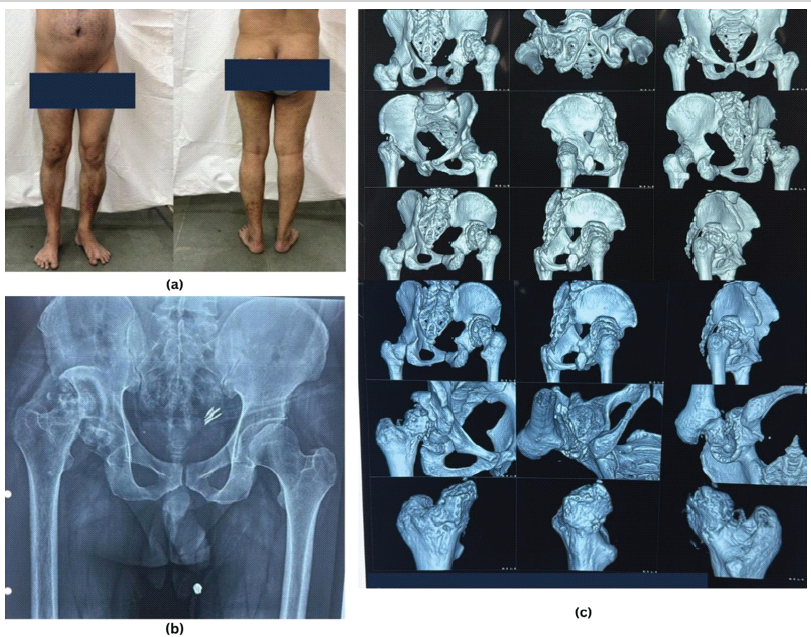
Figure 1: Pre-operative clinical and radiological assessment. (a) Clinical photographs showing limb length discrepancy and altered posture with appropriate groin coverage. (b) Pre-operative anteroposterior radiograph of the pelvis demonstrating neglected posterior dislocation of the right hip with superior migration of the proximal femur. (c) Three-dimensional computed tomography reconstruction demonstrating chronic posterior dislocation, distorted acetabular anatomy, and severe deformity of the proximal femur.
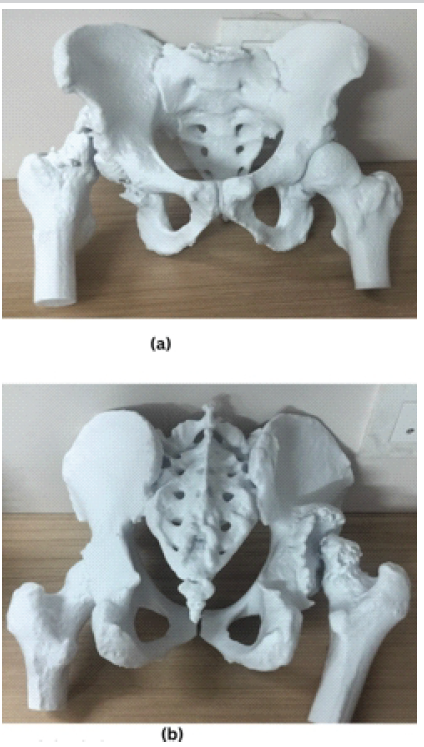
Figure 2: Three-dimensional pelvic model demonstrating pathological anatomy. (a) Anterior view of the pelvic model showing chronic dislocation with superior migration of the proximal femur and distorted hip anatomy. (b) Posterior view demonstrating the altered relationship of the pelvis and proximal femur in the neglected dislocation.
Preoperative preparation:
Because of the chronic dislocation and limb shortening, adaptive shortening of the sciatic nerve and periarticular soft-tissue contracture were anticipated. In such cases, sudden restoration of limb length may increase the risk of nerve stretch injury. The patient was therefore placed on skin traction for 3 weeks before surgery to allow gradual soft-tissue and neural accommodation. A radiograph obtained during the traction period demonstrated partial improvement in femoral alignment and reduction in soft-tissue tension.
Surgical technique:
The patient was operated in November 2025 in the lateral position through a posterior approach. Because exposure was limited by soft-tissue contracture and proximal migration of the femur, a Ganz-type greater trochanteric osteotomy was performed to improve access to the acetabulum and proximal femur (Fig. 3a). Because exposure was limited by soft-tissue contracture and proximal migration of the femur, a Ganz-type greater trochanteric osteotomy was performed to improve access to the acetabulum and proximal femur (Fig. 3a). This allowed safe excision of the severely resorbed femoral head (Fig. 3d), followed by acetabular preparation and implantation of the prosthetic components (Fig. 3b). The greater trochanteric osteotomy was then reduced and fixed after stable reduction of the hip (Fig. 3c).
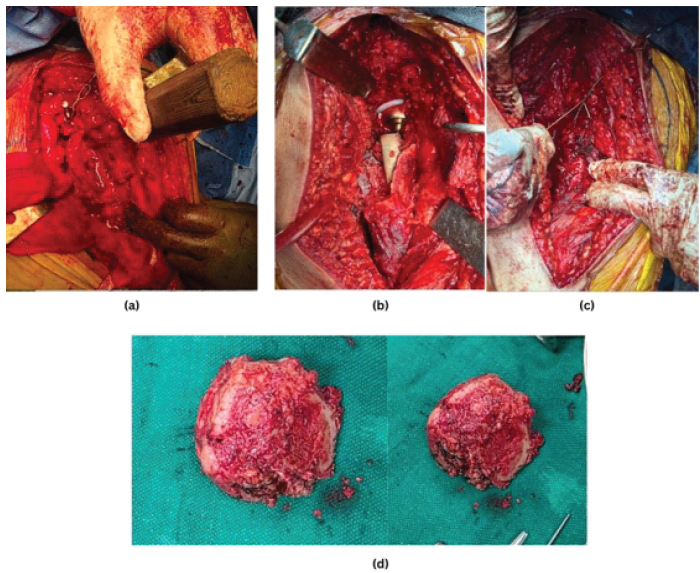
Figure 3: Intraoperative findings and surgical procedure. (a) Intraoperative photograph showing exposure after greater trochanteric osteotomy. (b) Intraoperative photograph demonstrating final implantation after reduction of the hip. (c) Intraoperative photograph after reduction and fixation of the greater trochanteric osteotomy. (d) Excised femoral head showing marked deformity and resorption consistent with long-standing neglected dislocation.
Abductor tightness was addressed with pie-crusting release, which allowed adequate mobilization of the proximal femur and reduction without subtrochanteric shortening osteotomy. Total hip arthroplasty was then performed using an uncemented acetabular shell of 56 mm secured with two cancellous screws measuring 30 mm and 25 mm. A polyethylene liner of 36 mm inner diameter with a +4 mm and 10° elevated rim was inserted. On the femoral side, an uncemented size 12 stem and a 36 mm femoral head with −2 mm offset were used. The articulation was metal-on-polyethylene. Stable reduction was achieved with restoration of limb length and without excessive tension. The greater trochanteric osteotomy was reduced and fixed with a fully threaded 38 mm cannulated screw supplemented with stainless-steel wiring (Fig. 3c). Immediate post-operative radiographs demonstrated satisfactory implant position and restoration of hip alignment (Fig. 4a and b).
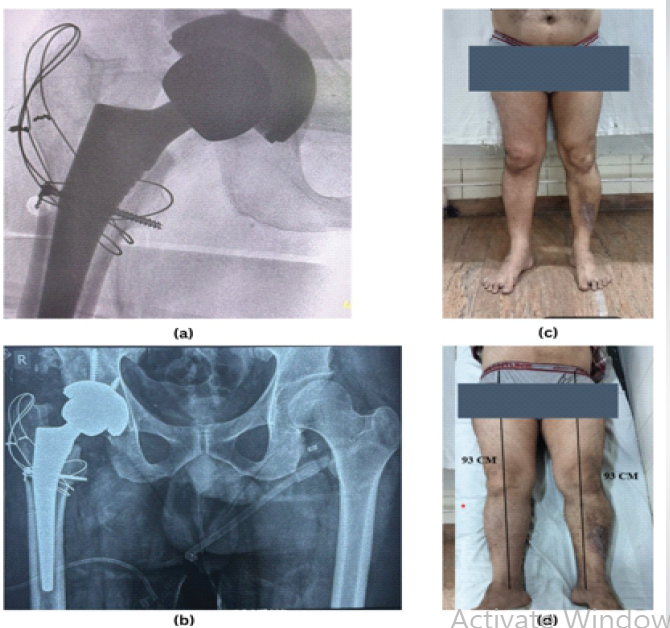
Figure 4: Post-operative radiological and clinical outcome. (a) Intraoperative fluoroscopic image demonstrating final implant position and fixation of the greater trochanteric osteotomy. (b) Post-operative anteroposterior radiograph of the pelvis showing a well-positioned total hip prosthesis with restoration of hip alignment. (c) Standing clinical photograph at follow-up showing improved posture and limb alignment. (d) Supine clinical photograph demonstrating restoration of equal limb length.
Follow-up:
At 6 months, the patient was pain-free and walking full weight-bearing without support. There was no residual limb length discrepancy and no sciatic nerve palsy. Serial radiographs showed progressive healing, with union of the greater trochanteric osteotomy site. Follow-up clinical photographs demonstrated improved posture, restoration of limb alignment, and equal limb length (Fig. 4c and d).
Neglected posterior hip dislocation remains a difficult reconstructive problem because chronic displacement leads to soft-tissue contracture, altered biomechanics, limb-length discrepancy, acetabular remodeling, and secondary degeneration [1,2,4,5,6,8]. When the joint surfaces are no longer salvageable, arthroplasty is often the most reliable option for pain relief and restoration of function. The main challenge during total hip arthroplasty in chronic dislocation is achieving reduction without excessive neurovascular tension. Recent case reports have emphasized the need for careful planning, including management of pseudoacetabulum, contracted soft tissues, and altered surgical planes. Older reports have also demonstrated satisfactory outcomes following total hip arthroplasty for neglected hip dislocations, although many authors required femoral shortening procedures or accepted residual limb length discrepancy to achieve stable reduction [11,12]. Subtrochanteric shortening osteotomy is a useful adjunct in selected cases, particularly when severe proximal migration prevents reduction or when limb length restoration would otherwise place undue stretch on the sciatic nerve [7,8,9,10]. However, this adds another osteotomy site and carries the risk of non-union, implant-related complications, and altered femoral biomechanics. Avoiding femoral shortening in this case allowed use of a standard primary femoral stem rather than a revision-type implant, thereby preserving bone stock and keeping future revision options open. Another concern is the risk of nerve injury during limb length restoration. Chronic dislocation causes not only muscular contracture but also adaptive shortening of neural structures, so sudden reduction may increase the risk of post-operative neurological deficit. For this reason, preoperative skin traction was used as a gradual method of soft-tissue and neural accommodation before arthroplasty. Although evidence is limited, this strategy may help in selected patients with moderate shortening when combined with careful intraoperative soft-tissue balancing. Adequate exposure is also essential in these cases. Severe abductor contracture, superior migration of the femur, and distorted anatomy can make acetabular access difficult through conventional exposure alone. In this case, Ganz-type trochanteric osteotomy provided extensile exposure of the acetabulum and proximal femur, allowed excision of the resorbed femoral head, and enabled controlled mobilization of the proximal femur without forceful reduction. Recent literature has also shown that chronic post-traumatic hip dislocation may require individualized reconstructive strategies depending on the direction of displacement, the presence of a false acetabulum, limb length discrepancy, and available local resources [1,2,11,12]. Our case further demonstrates that preoperative traction, targeted abductor release, and Ganz-type trochanteric osteotomy can facilitate reduction without subtrochanteric shortening osteotomy in selected neglected posterior hip dislocations [3]. This case highlights the importance of careful planning in neglected hip dislocation, balancing restoration of biomechanics with preservation of bone stock and protection of neural structures [1,2,3,9,10].
Preoperative traction, soft-tissue release, and Ganz-type trochanteric osteotomy allowed reduction without subtrochanteric shortening osteotomy in this case [1,2,3]. Avoiding femoral shortening may permit use of a primary femoral implant, preserve bone stock, and reduce the complexity of reconstruction.
Careful pre-operative planning with traction, extensile exposure, and selective soft-tissue release can eliminate the need for femoral shortening osteotomy while minimizing the risk of neurological injury in selected neglected posterior hip dislocations
Senga I, Ishikura H, Kaminaga N, Sato M, Tanaka T, Tanaka S. Combined anterolateral and posterior approach in total hip arthroplasty for chronic post-traumatic hip dislocation: A case report. Cureus 2024;16:e61558.
Olasinde AA, Faola AA, Oluwadiya KS. Chronic posterior dislocation of the right hip treated with bipolar hemiarthroplasty in a resource-limited environment—a case report. Int J Surg Case Rep 2023;105:108065.
Ganz R, Gill TJ, Gautier E, Ganz K, Krugel N, Berlemann U. Surgical dislocation of the adult hip: a technique with full access to the femoral head and acetabulum without the risk of avascular necrosis. J Bone Joint Surg Br 2001;83:1119-24.
Garrett JC, Epstein HC, Harris WH, Harvey JP Jr., Nickel VL. Treatment of unreduced traumatic posterior dislocations of the hip. J Bone Joint Surg Am 1979;61:2-6.
Sahin V, Karakas ES, Aksu S, Atlihan D, Turk CY, Halici M. Traumatic dislocation and fracture-dislocation of the hip: A long-term follow-up study. J Trauma 2003;54:520-9.
Hougaard K, Thomsen PB. Traumatic posterior dislocation of the hip—prognostic factors influencing the incidence of avascular necrosis of the femoral head. Arch Orthop Trauma Surg (1978) 1986;106:32-5.
Tiwari A, Sharma V, Kamboj P, Kundu ZS. Total hip arthroplasty in neglected posterior dislocation of the hip. Journal of Clinical Orthopaedics and Trauma. 2017;8(Suppl 2):S48–S52.
Jain AK, Aggarwal PK. Neglected traumatic dislocation of the hip. Clin Orthop Relat Res 2000;377:9-17.
Paavilainen T, Hoikka V, Solonen KA. Cementless total replacement for severely dysplastic or dislocated hips. J Bone Joint Surg Br 1990;72:205-11.
Eggli S, Hankemayer S, Muller ME. Nerve palsy after leg lengthening in total replacement arthroplasty for developmental dysplasia of the hip. J Bone Joint Surg Br 1999;81:843-5.
Sharma H, Kakar R, Dhal A. THA in neglected dislocation with limb length discrepancy. Indian J Orthop 2009;43:295-8.
Kumar S, Malhotra R. Neglected posterior dislocation treated with THA. Indian J Orthop 2008;42:305-8.






Related Articles in Journal of Orthopaedic Case Reports
 September 1, 2026 Undiagnosed von Willebrand Disease Presenting as Delayed Hematoma after Total Hip Arthroplasty: A Case Report
 August 1, 2026 Case Report of Rapidly Destructive Osteoarthritis of the Hip following Multiple High-dose Intra-articular Steroid Injections
 August 1, 2026 Total Hip Arthroplasty in Bilateral Ankylosed Hip by Direct Anterior Approach: A Case Report with Technical Tips
 August 1, 2026 Metallosis Following Total Hip Arthroplasty: A Case Report