

An irreducible pediatric proximal interphalangeal joint of the lesser toe with a collateral ligament injury can be repaired with a JuggerKnot™ soft mini-anchor, demonstrating promising 1-year follow-up outcomes.
Dr. Ho Man Cheung, Congruence Orthopaedics and Rehabilitation Centre, Hong Kong SAR, China, People’s Republic of China, Hong Kong. Email: cheung_ho_man@hotmail.com
Abstract
Introduction: Irreducible lesser-toe interphalangeal joint dislocation in children is rare but may cause pain, recurrent dislocations, and soft-tissue injury. The optimal method of fixation remains unclear. We present the first-ever reported case of an irreducible fourth toe proximal interphalangeal joint dislocation in a 5-year-old boy, successfully fixed with a JuggerKnot™ soft mini-anchor.
Case Report: A 5-year-old boy with a crush injury to his left fourth toe showed persistent dorsolateral dislocation of the proximal interphalangeal joint. Intraoperatively, close reduction failed, and we found a complete tear of the medial collateral ligament to be the culprit of the complex dislocation. It was repaired with the JuggerKnot™ soft mini-anchor and tied down to the proximal phalanx.
Conclusion: This rare case illustrates the technique of soft mini-anchors in fixing irreducible dislocations with ligamentous injuries. It is safe and effective in children with similar injuries because it is a one-stage operation that does not disrupt the growing cartilage and preserves joint motion.
Keywords: Interphalangeal joint, dislocation, soft anchor, medial collateral ligament, juggerknot™.

Interphalangeal joint dislocation of the toes is rare, but it can cause great morbidity. If left untreated, pain, recurrent dislocations, and soft-tissue injury may arise. In adults, after failing closed reduction, the option is usually Kirschner wire (K-wire) fixation or cross-toe strapping [1]. However, there is no consensus on how to treat pediatric complex dislocation not amenable to closed reduction. There exist in the literature two reports on the use of suture anchors for proximal interphalangeal (PIP) joint dislocations. One reported [2] the use of an all-suture mini anchor for open reduction of the PIP joint of the second toe, and another reported [3] plantar plate repair using suture anchors for chronic plantar plate rupture of the first interphalangeal joint. Whether this choice of fixation offers reproducible results in a similar setting of PIP joint dislocation of the toe is not known. We present an irreducible dislocation of the fourth toe PIP joint, undergone open reduction with JuggerKnot™ all-suture mini soft anchor fixation with repair of the medial collateral ligament (MCL). The parents of the patient offered informed consent to the publication of this case.
A 5-year-old boy with good past health accidentally crushed his left foot’s fourth toe into a hard object. The parents brought the patient to a Traditional Chinese Medicine practitioner for closed reduction and herb application. However, the PIPJ remained dislocated in an abducted position (Fig. 1). The radiograph confirmed a dorsolateral dislocation (Fig. 2). The toe appeared pink with good circulation. Magnetic resonance images (Fig. 3) revealed a dorsolateral dislocation of the fourth toe at the PIP joint.
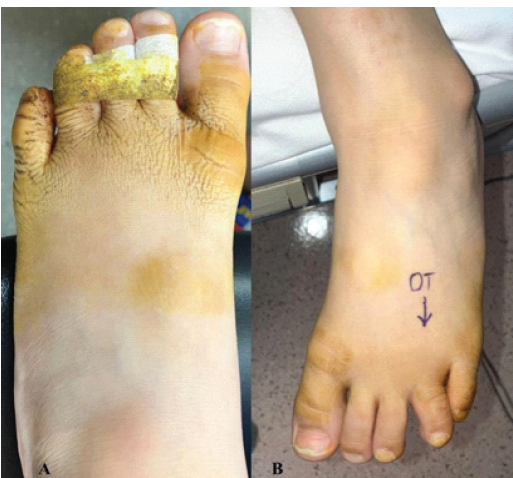
Figure 1: Clinical presentation at first visit. (a) Evidence of prior cross-toe strapping done by a Traditional Chinese Medicine practitioner. (b) Abducted position of the fourth toe dislocation once the strapping removed.
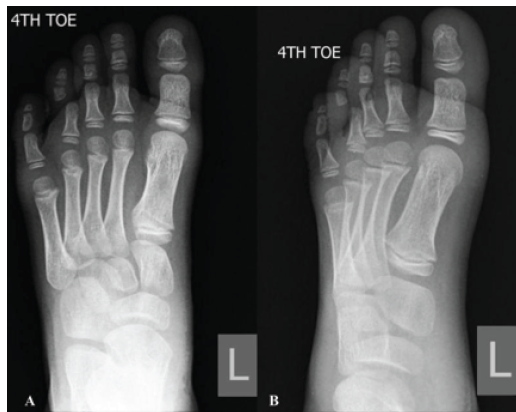
Figure 2: Radiograph of the left fourth toe at first visit showing dorsolateral dislocation of the proximal interphalangeal joint. (a) Anteroposterior view. (b) Lateral view.
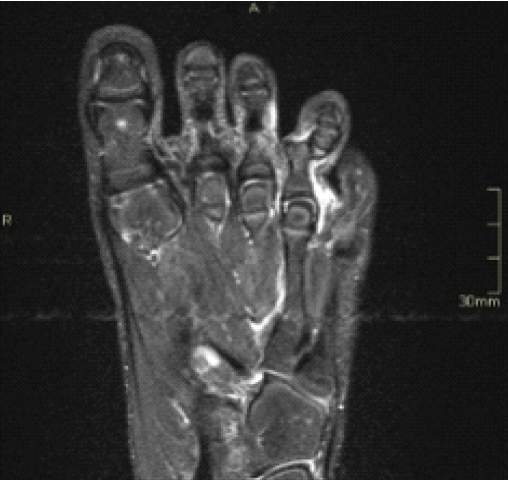
Figure 3: Magnetic resonance image of the left fourth toe showing dislocation of the proximal interphalangeal joint.
After the attempt for close reduction failed, open reduction was arranged. With the patient under general anesthesia, a dorsal incision [4,5] was made in a zigzag manner to expose the PIP joint [6,7]. The complete MCL tear was identified, with one end attached to the middle phalanx (Fig. 4a). We used the JuggerKnot™ Soft Anchor 1.0 mm mini with 2-0 needles. It incorporates a 1.0mm deployable anchor that is completely suture-based. The implant was made from a #1 polyester sleeve loaded with a #2-0 MaxBraid™ [8]. A 1.0 mm drill bit was used to create a track just deep enough to allow the suture anchor to be passed through the drill sleeve. The anchor was deployed automatically in the proximal phalanx (Fig. 4b), with sutures through the MCL through a simple horizontal mattress technique [9] and tied down towards the proximal phalanx origin (Fig. 4c).
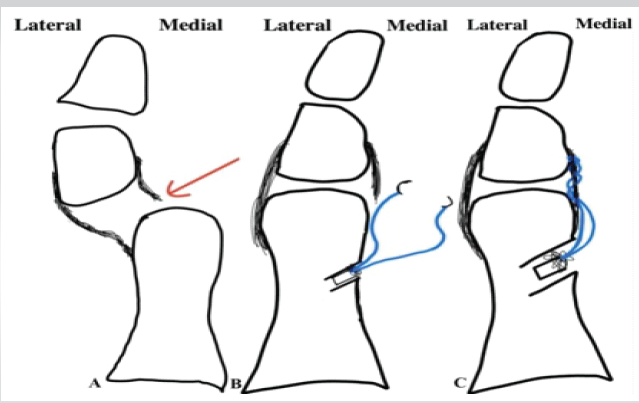
Figure 4: Schematic diagram of JuggerKnot™ repair. (a) The complete rupture of the MCL is shown by the red arrow. (b) The suture anchor is automatically anchored in the track in fourth proximal phalanx. (c) MCL is being tied down by sutures through a simple horizontal mattress technique. MCL: Medial collateral ligament.
Reduction was found to be stable, and alignment was checked with an intraoperative radiograph. The skin was then closed with 2O Vicryl Rapide™. The patient’s fourth toe was then immobilized with splintage for 2 weeks. Afterwards, he was allowed to use a shoe with a rigid shoe box for a month. At the 1-year follow-up (Fig. 5), the range of motion of the PIP joint was the same as the other toes, with growth of the left fourth toe being symmetrical to the right one. The radiograph showed normal growth of the left fourth toe (Fig. 6).
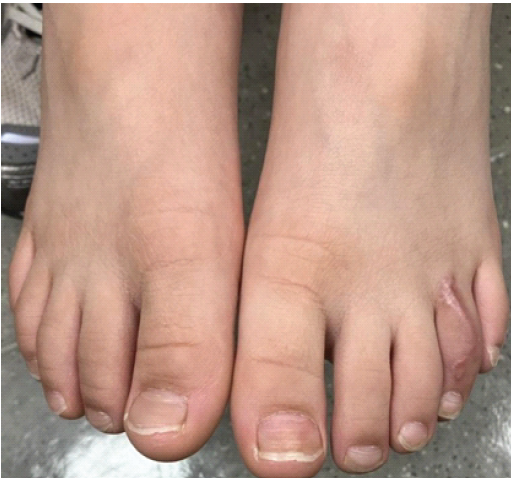
Figure 5: Clinical appearance at one-year follow-up.
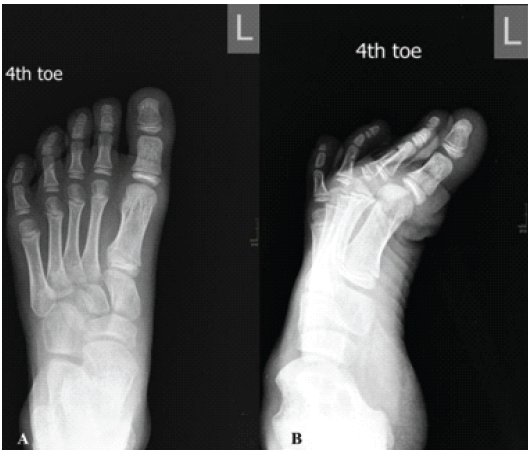
Figure 6: Radiograph of the left fourth toe at 1-year follow-up. (a) Anteroposterior view. (b) Lateral view.
Mechanism of dorsolateral dislocation:
PIP joint dislocation is rare in pediatric patients. Hyperextension and abduction forces play a role in dorsolateral dislocations [4], which cause a combination of palmar plate injury and collateral ligament injury [10]. The hypothesis for complex dislocation not amenable to closed reduction is tightening of the collateral ligament when the joint becomes hyperextended [11], together with the plantar plate interposition in the joint space [6]. The exact mechanism could be MCL [4] avulsion and rupture [2]. The “buttonhole” phenomenon [4,7,12] should be considered in irreducible cases, when the distal dislocated fragment (the button) is trapped by split fibers of the collateral ligament (the buttonhole), necessitating open reduction to physically free the trapped fragment.
Indications for open reduction:
Closed reduction should be attempted whenever possible [13,14] as it produces satisfactory outcomes. Open reduction becomes necessary when there are concomitant open injuries and irreducible complex dislocations [1,15]. A case series [16] of traumatic PIP dislocation of the lesser toes demonstrated the volar plate interposition as an indication for open reduction, as these patients all failed closed reduction, with or without an open wound concomitantly. Reducing to anatomical alignment is necessary as chronic dislocation is associated with pain until reduced [4], and to prevent further dislocation, resection arthroplasty [13] or even fusion [2] may be required.
The considerations in choosing different fixation methods:
There is no consensus for the method of fixation for irreducible dislocations of the lesser toes. Some reported temporary stabilization using K-wire [4] for a period of 3 [17], 4 [12,18], or 6 [19] weeks. This is unlike the more common PIP joint deformities like hammertoe or claw toe, where stabilization with an intramedullary implant would eventually lead to fusion [20]. Despite the temporary nature, the axial insertion of a K-wire may damage the cartilage and physeal growth plates in children, and the period of immobility may cause stiffness. Compared to K-wires, non-metal suture anchors [9] do not require second-stage removal and avoid the risk of breakage [21] or superficial skin infection due to percutaneous wires.
Pediatric irreducible complex dislocation of the fourth toe PIP joint can be caused by a ruptured MCL. The use of an all-suture anchor in open reduction to repair the ligament is a safe and effective option alone, without the need for metallic implants.
Ligament rupture should be suspected in patients with complex dislocation of the PIP joint, and open reduction with repair with an all-suture anchor is a promising option.
References
- 1. </p> [Google Scholar] [PubMed]
- 2. <p>1. Yang IB, Sun K, Sha WL, Yu KS, Choew YY. Interphalangeal dislocation of toes: A retrospective case series and review of the literature. J Foot Ankle Surg 2011;50:580-4. [Google Scholar] [PubMed]
- 3. Nabi W, Kurup H. Irreducible dislocation of the proximal interphalangeal joint of the second toe in a six-year-old child: A case report. JBJS Case Connect 2018;8:e66. [Google Scholar] [PubMed]
- 4. Ikuta Y, Nakasa T, Kawabata S, Adachi N. Plantar plate repair using suture anchors for chronic plantar plate rupture of the first interphalangeal joint in a pediatric patient: A case report. J Orthop Case Rep 2023;13:83-7. [Google Scholar] [PubMed]
- 5. Vaseenon T, Cheewawattanachai C, Sirirungruangsarn Y. Chronic irreducible dislocation of the proximal interphalangeal joint of the fifth toe: A case report. BMC Res Notes 2014;7:76. [Google Scholar] [PubMed]
- 6. Katayama M, Murakami Y, Takahashi H. Irreducible dorsal dislocation of the toe. Report of three cases. J Bone Joint Surg Am 1988;70:769-70. [Google Scholar] [PubMed]
- 7. Córdoba-Fernández A. Management of nonreducible lesser toe interphalangeal dislocation: An unusual injury. J Am Podiatr Med Assoc 2012;102:252-5. [Google Scholar] [PubMed]
- 8. Veen M, Schipper IB. Irreducible fracture of the proximal interphalangeal joint of the fifth toe. J Emerg Med 2013;44:e63-5. [Google Scholar] [PubMed]
- 9. Swan KG Jr., Baldini T, McCarty EC. Arthroscopic suture material and knot type: An updated biomechanical analysis. Am J Sports Med 2009;37:1578-85. [Google Scholar] [PubMed]
- 10. Cheung JP, Fung B, Ip WY. Peak load resistance of the JuggerKnot™ soft anchor technique compared with other common fixation techniques for large mallet finger fractures. Hand Surg 2013;18:381-8. [Google Scholar] [PubMed]
- 11. Arora R, Lutz M, Fritz D, Zimmermann R, Gabl M, Pechlaner S. Dorsolateral dislocation of the proximal interphalangeal joint: Closed reduction and early active motion or static splinting; a retrospective study. Arch Orthop Trauma Surg 2004;124:486-8. [Google Scholar] [PubMed]
- 12. Miki T, Yamamuro T, Kitai T. An irreducible dislocation of the great toe. Report of two cases and review of the literature. Clin Orthop Relat Res 1988;230:200-6. [Google Scholar] [PubMed]
- 13. Al-Sedais D, Korkoman A, Binown K, AL-Hajjaj A. Irreducible proximal interphalangeal joint dislocation of the 5th toe in a child. Foot Ankle Surg: Tech Rep Cases 2024;4:100375. [Google Scholar] [PubMed]
- 14. Karn NK, Nepal P, Subedi N, Virmani S, Singh MP, Singh GK. A closed dorsolateral dislocation of PIP joint of the fourth toe-a case report and review of literature. Internet J Med Update 2009;4. [Google Scholar] [PubMed]
- 15. Stienstra JJ, Derner R. Closed reduction of a proximal interphalangeal joint dislocation. J Foot Surg 1990;29:385-7. [Google Scholar] [PubMed]
- 16. Mayr J, Peicha G, Grechenig W, Hammerl R, Weiglein A, Sorantin E. Fractures and dislocations of the foot in children. Clin Podiatr Med Surg 2006;23:167-89. [Google Scholar] [PubMed]
- 17. Brunet JA, Tubin S. Traumatic dislocations of the lesser toes. Foot Ankle Int 1997;18:406-11. [Google Scholar] [PubMed]
- 18. Vij N, Belthur M, Ranade AS. Acute isolated irreducible proximal interphalangeal joint dislocation of the fifth toe in a toddler: A case report. Cureus 2022;14:e25630. [Google Scholar] [PubMed]
- 19. Woon CY. Dislocation of the interphalangeal joint of the great toe: Is percutaneous reduction of an incarcerated sesamoid an option? Surgical technique. J Bone Joint Surg Am 2011;93 Suppl 1:109-12. [Google Scholar] [PubMed]
- 20. Kushare IV, Elabd A, Attia E. Missed fracture dislocation of the fifth toe in a two-year-old child: A case report. J Foot Ankle Surg 2021;60:172-5. [Google Scholar] [PubMed]
- 21. Coillard JY, Petri GJ, Van Damme G, Deprez P, Laffenêtre O. Stabilization of proximal interphalangeal joint in lesser toe deformities with an angulated intramedullary implant. Foot Ankle Int 2014;35:401-7. [Google Scholar] [PubMed]
- 22. Kramer WC, Parman M, Marks RM. Hammertoe correction with k-wire fixation. Foot Ankle Int 2015;36:494-502. [Google Scholar] [PubMed]




Related Articles in Journal of Orthopaedic Case Reports
 November 1, 2025 Irreducible Dislocation of the Great Toe Interphalangeal Joint Secondary to an Incarcerated Sesamoid: A Retrospective Case Series of Six Patients
 April 1, 2025 Severe Type 1 Thumb Boutonniere Deformity with Interphalangeal Joint Dislocation in a Young Patient: A Case Report
 September 10, 2023 Plantar Plate Repair using Suture Anchors for Chronic Plantar Plate Rupture of the first Interphalangeal Joint in a Pediatric Patient: A Case Report
 September 1, 2026 Traumatic Volar Dislocation of a Hemi-Scaphoid-Lunate Complex across the Carpal Ligament: A Case Report