


Introduction
Non-union following ankle fractures is relatively uncommon owing to the favorable cancellous bone environment and robust vascularity of the ankle region. Reported non-union rates after operative fixation of malleolar fractures range from <1% to approximately 5%, with increased risk in the presence of compromised soft tissues, infection, metabolic comorbidities, smoking, and inadequate mechanical stability. When non-union does occur, it can result in persistent pain, deformity, instability, and substantial functional impairment [1, 2, 3].
Revision internal fixation with or without bone grafting remains the standard treatment for ankle fracture non-unions. However, repeated surgical interventions may compromise local biology, diminish bone stock, and increase the risk of further failure, thereby limiting the effectiveness of conventional revision strategies [4]. In advanced cases with joint destruction or instability, tibiotalocalcaneal (TTC) arthrodesis is frequently employed as a salvage procedure. Despite its role as a definitive solution, TTC arthrodesis is associated with considerable complication and non-union rates, particularly in revision settings and in patients with poor bone quality or altered biomechanics [5, 6].
In cases of failed TTC arthrodesis or when conventional fusion strategies are no longer viable, circular external fixation using the Ilizarov method has emerged as a viable salvage option. The Ilizarov technique provides multiplanar stability, allows controlled compression across non-union sites, and facilitates correction of alignment or soft-tissue issues, thereby improving the likelihood of union [5, 7].
The addition of a fibular strut graft – serving both as a mechanical support and a biological stimulus – has been described as an effective adjunct in complex limb salvage settings, especially when bone loss or poor local biology is present [8].
While recent case reports have documented the use of external fixation with bone graft in distal tibial non-union contexts, there is limited literature on its application in ankle fracture non-union following failed internal fixation and failed TTC arthrodesis. This case report describes a patient with a bimalleolar ankle fracture non-union, sequential failure of screw fixation and TTC arthrodesis, and successful salvage using a fibular strut graft combined with Ilizarov ring fixation – demonstrating an effective limb-preserving strategy in a difficult clinical scenario.
Case Report
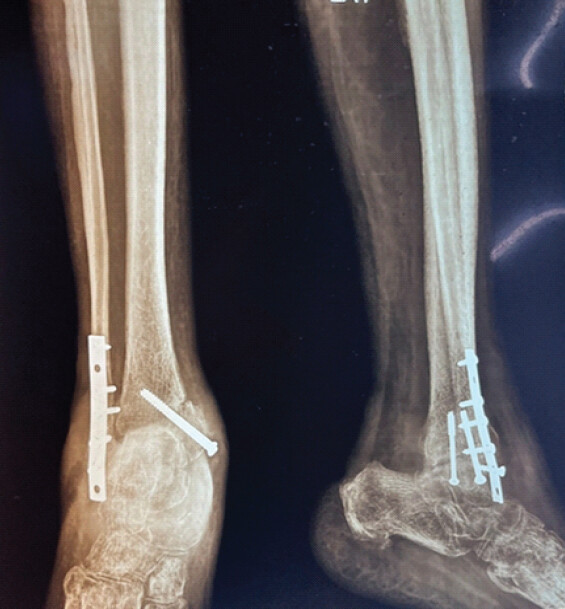
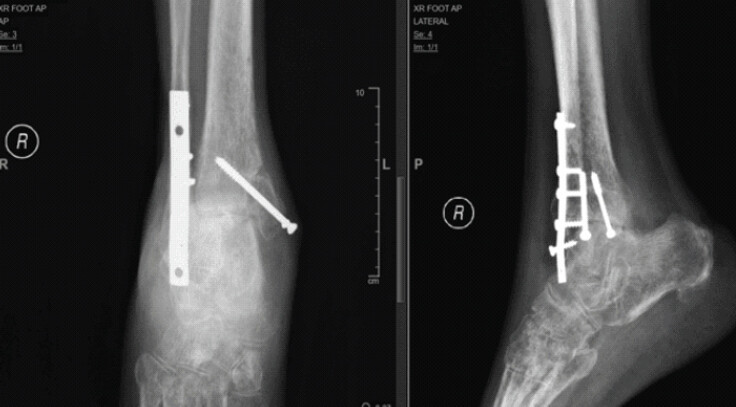
A 39-year-old male manual laborer presented to our institution with persistent pain and inability to bear weight on his right ankle following multiple surgical interventions performed elsewhere. He had sustained a closed bimalleolar fracture of the right ankle after a road traffic accident approximately 18 months earlier and was initially treated at an outside hospital with open reduction and internal fixation (Fig. 1). The post-operative course was complicated by failure of fracture union, resulting in established bimalleolar non-union (Fig. 2).
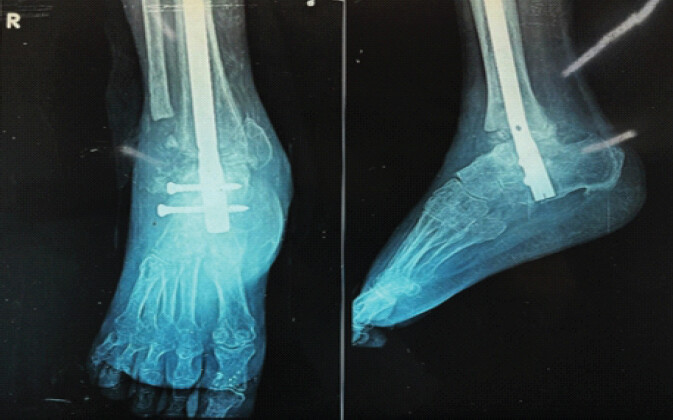
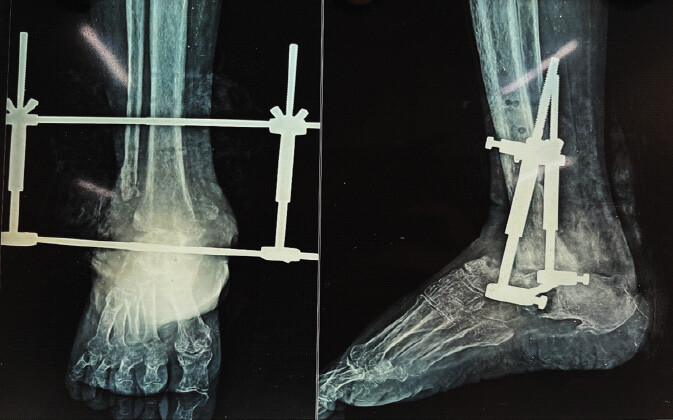
Subsequently, at the same outside institution, he underwent TTC arthrodesis as a salvage procedure. However, this also failed to achieve fusion, and the patient continued to experience pain and functional limitation (Fig. 3). A further attempt at salvage using a Charnley compression arthrodesis was performed at the outside hospital, which again failed to result in union (Fig. 4).
The patient then presented to our center for further management. Radiological evaluation demonstrated persistent non-union with ankle deformity (Fig. 5). Clinical examination revealed tenderness around the ankle with pathological mobility. The overlying skin was healthy, with no signs of infection, and distal neurovascular status was intact. Laboratory investigations, including inflammatory markers, were within normal limits, supporting a diagnosis of aseptic non-union.
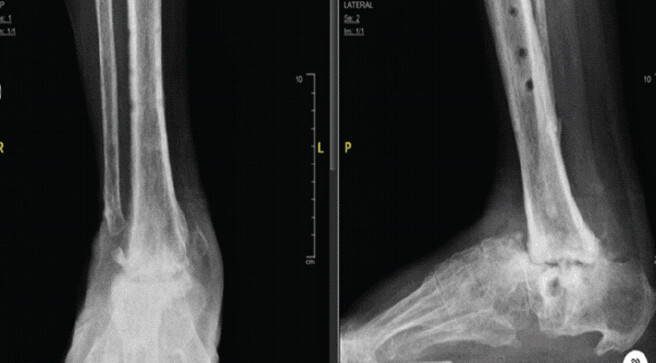
Given the failure of multiple prior procedures performed elsewhere, a definitive limb-salvage approach was planned at our institution. The patient underwent thorough debridement of the non-union sites followed by reconstruction using an autologous fibular strut graft combined with Ilizarov circular external fixation (Fig. 6). Controlled compression was applied across the arthrodesis site to enhance stability and promote fusion.
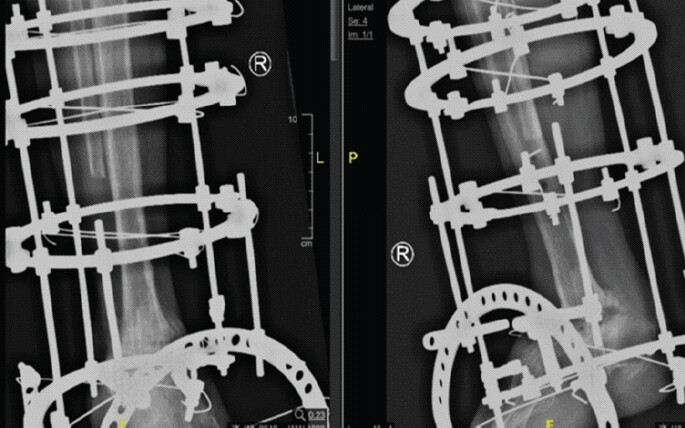
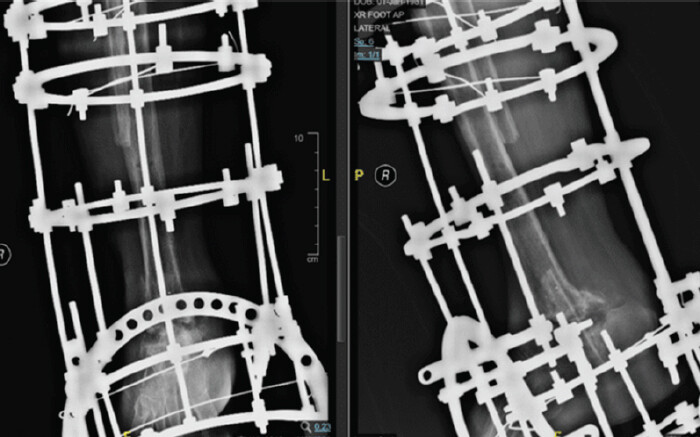
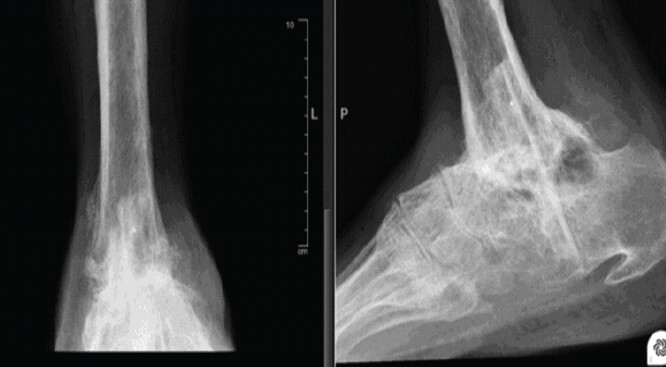
The post-operative course was uneventful. Gradual progression to weight bearing was permitted under frame protection. Serial radiographs demonstrated progressive consolidation. The Ilizarov frame was removed after 6 months once union was achieved (Fig. 7). At final follow-up, 1 year after frame removal, the patient was pain-free, ambulating independently without support, and able to perform activities of daily living. Follow-up radiographs confirmed solid union with maintained alignment (Fig. 8).
Discussion
Non-union remains one of the most challenging complications following ankle fractures, particularly when compounded by multiple failed surgical interventions. The biological and mechanical factors contributing to non-union are complex and interdependent, involving impaired vascularity, inadequate stability, and repeated surgical insult to local tissues, as highlighted in contemporary non-union research [1]. In ankle fractures, although union rates are generally favorable, functional outcomes can deteriorate significantly when union is delayed or fails to occur, leading to persistent pain and disability [2].
Management of malleolar fracture non-union requires careful consideration of both stability and biology. Recent evidence supports revision fixation with adequate mechanical support and biological augmentation as the primary strategy for most malleolar non-unions [3]. However, when repeated fixation attempts fail, local bone stock is compromised and joint mechanics deteriorate, limiting the effectiveness of further conventional fixation strategies [4]. In such settings, salvage procedures become necessary.
TTC arthrodesis is frequently employed as a salvage option in cases of complex ankle pathology, providing pain relief and stability by eliminating motion at the ankle and subtalar joints. Nevertheless, TTC arthrodesis is associated with considerable complication and non-union rates, particularly in revision settings and in patients with altered bone biology or alignment [5]. Recent reports, especially in high-risk populations, continue to demonstrate that even TTC nailing may fail to achieve reliable fusion, underscoring the limitations of intramedullary fixation alone in compromised environments [6].
Failure of TTC arthrodesis presents a difficult limb-salvage dilemma, often leaving limited options short of amputation. In this context, circular external fixation using the Ilizarov method offers distinct advantages. The Ilizarov frame provides multiplanar stability, allows controlled compression across non-union sites, facilitates gradual correction of deformity, and permits early functional weight bearing. These biomechanical benefits make it particularly suitable for managing complex ankle and distal tibial non-unions, as demonstrated in recent case reports [7].
In cases of persistent non-union following TTC arthrodesis, external compression techniques such as Charnley compression arthrodesis have historically been employed as a further salvage measure. While Charnley fixation provides rigid compression across the ankle joint, its effectiveness is limited in the presence of poor bone quality, deformity, or multiple prior surgeries, and failure rates remain significant in complex revision scenarios. Failure of both intramedullary and compression arthrodesis techniques leaves few limb-salvage options short of amputation [8].
Biological augmentation plays a crucial role in achieving union in resistant non-unions. The use of an autologous fibular strut graft provides both structural support and osteogenic stimulus, acting as a biological scaffold while enhancing stability across the non-union site. Recent literature has shown favorable outcomes with the combined use of fibular grafting and Ilizarov fixation in refractory distal tibial non-unions after multiple failed procedures [9]; however, the present case is distinct in that it originated from a bimalleolar ankle fracture and progressed through failed TTC and Charnley compression arthrodesis, representing a more advanced and uncommon salvage scenario. This approach allowed preservation of limb length, restoration of alignment, and achievement of union without reliance on further internal fixation. Recent studies continue to support the role of circular external fixation as a reliable limb-salvage strategy in complex ankle and hindfoot reconstruction when conventional methods have failed [10, 11, 12, 13]
Furthermore, contemporary evidence suggests that external fixation may reduce the risk of deep infection and hardware-related complications in revision settings, particularly when soft-tissue conditions are compromised or bone quality is poor [14]. Long-term outcomes reported in recent series indicate satisfactory functional recovery and acceptable complication profiles with circular fixation-based salvage procedures [15, 16].
This case highlights the importance of individualized treatment planning in complex ankle non-unions. Even after failed TTC arthrodesis, limb salvage using circular external fixation combined with biological augmentation can provide a reliable alternative to amputation in selected young, high-demand patients.
Limitations
This report has several limitations. As a single-patient case report describing a rare sequence of failed internal fixation, failed TTC arthrodesis, and failed Charnley compression arthrodesis, the findings cannot be generalized to a broader patient population. Follow-up was limited to 1 year after frame removal and, therefore, does not permit assessment of long-term durability of fusion, adjacent joint degeneration, or late complications.
Conclusion
Bimalleolar ankle fracture non-union with sequential failure of internal fixation, TTC arthrodesis and Charnley’s procedure represents a complex salvage challenge with limited treatment options. This case demonstrates that limb salvage using a combination of fibular strut grafting and Ilizarov circular external fixation can achieve reliable union and functional recovery even after failed arthrodesis. In young, high-demand patients, circular fixation with biological augmentation should be considered a viable alternative to further internal fixation or amputation.
Clinical Message
In complex ankle non-unions after failed internal fixation and failed arthrodesis, fibular strut grafting combined with Ilizarov circular fixation can be considered as a limb-salvage option to achieve stable fusion and preserve function in carefully selected patients.
Conflict of Interest:
Nil
Source of Support:
Nil
Consent:
The authors confirm that informed consent was obtained from the patient for publication of this article
References
- Gómez-Barrena E, Padilla-Eguiluz NG, Rosset P. Frontiers in non-union research. EFORT Open Rev 2020;5:574-83. [Google Scholar] | [PubMed]
- Egol KA, Tejwani NC, Walsh MG, Capla EL, Koval KJ. Predictors of short-term functional outcome following ankle fracture surgery. J Bone Joint Surg Am 2006;88:974-9. [Google Scholar] | [PubMed]
- Tan CY, Thevendran G. Management of non-unions of the malleolar fractures- Current Evidence. J Clin Orthop Trauma 2024;51:102395. [Google Scholar] | [PubMed]
- Kyriacou H, Mostafa AM, Davies BM, Khan WS. Principles and guidelines in the management of ankle fractures in adults. J Perioper Pract 2021;31:427-34. [Google Scholar] | [PubMed]
- McKean J, Cuellar DO, Hak D, Mauffrey C. Osteoporotic ankle fractures: An approach to operative management. Orthopedics 2013;36:936-40. [Google Scholar] | [PubMed]
- Elgoyoushi SM, Morrah AN, Kholeif AM, Elbadry AA. Outcomes of tibiotalocalcaneal (TTC) nailing in ankle fractures in diabetic patients with Charcot neuropathy. Trauma Case Rep 2025;57:101158. [Google Scholar] | [PubMed]
- Reddy VN, Reddy R, Safiullah M. A case of “nonunion distal tibia and fibula malleoli fracture with posterior malleoli fracture” treated with ilizarov: A case report. J Orthop Case Rep 2024;14:121-4. [Google Scholar] | [PubMed]
- Ferguson Z, Anugraha A, Janghir N, Pillai A. Ankle arthrodesis: A long term review of the literature. J Orthop 2019;16:430-3. [Google Scholar] | [PubMed]
- Aravind S, Harshavardhan G, Suryakumar S. Resistant and refractory distal tibia non-union using an intramedullary free fibular graft and ilizarov fixation - an illustrative case report. J Orthop Case Rep 2024;14:45-9. [Google Scholar] | [PubMed]
- Tay KS, Langit M, Fenton C, Grupping R, Muir R, Moulder E. Complex ankle fusion with circular frames: Factors influencing outcomes, complications, and patient satisfaction. Foot Ankle Int 2023;44:403-14. [Google Scholar] | [PubMed]
- Cibura C, Lotzien S, Rosteius T, Ull C, Godolias P, Schildhauer TA. Rate of progressive healing with a carbon-fiber orthosis in cases of partial union and non-union after ankle arthrodesis using the Ilizarov external fixator. J Foot Ankle Res 2023;16:15. [Google Scholar] | [PubMed]
- Blazek CD, Powers NS, Leatham PR, Burns PR. Complications of circular ring external fixation of the foot and ankle. J Am Podiatr Med Assoc 2025;115:22-228. [Google Scholar] | [PubMed]
- McCoy TH, Goldman V, Fragomen AT, Rozbruch SR. Circular external fixator-assisted ankle arthrodesis following failed total ankle arthroplasty. Foot Ankle Int 2012;33:947-55. [Google Scholar] | [PubMed]
- Wang S, Li B, Yu X, Wu H, Liu L. Is Ankle arthrodesis with an ilizarov external fixator an effective treatment for septic ankle arthritis? A study with a minimum of 6 years of follow-up. Clin Orthop Relat Res 2023;481:717-25. [Google Scholar] | [PubMed]
- Zhao Z, Chen X, Guo F, Liu Y, Shi B, Ji G. Carefix hexaxial spatial frame versus Ilizarov circular external fixator in treating high-energy tibial shaft fractures: A retrospective study. BMC Musculoskelet Disord 2025;26:601. [Google Scholar] | [PubMed]
- Ibrahim MA, Alhomayani KM, Gaber U, Bukhary HA, Nematallah SA, Elgahel MM. Radiographic and functional results of Ilizarov fixation in the management of non-union of tibia and femur fractures: A retrospective case series. Ann Saudi Med 2024;44:146-52. [Google Scholar] | [PubMed]
© 2026 Journal of Orthopaedic Case Reports - Published by Indian Orthopaedic Research Group
About the Authors
-

Kirubakaran Pattabiraman
-

Anirudh Dwajan
-

Jagdish Menon
-

B Karthikeyan
-

Amber Agarwal
-

Nibras Chereykkatt
Related Articles in Journal of Orthopaedic Case Reports
 August 1, 2026 Augmentation Plating with Intramedullary Nailing for Aseptic Long Bone Non-union: A Prospective Observational Study of Clinical, Radiological, and Functional Outcomes
 August 1, 2026 Why the Ilizarov Ring Fixator Remains the Preferred Technique for Knee Arthrodesis in Complex Knee Conditions: A Case Series
 May 1, 2026 Aneurysmal Bone Cyst Presenting as a Pathological Subtrochanteric Femur Fracture in an Adolescent: A Case Report
 May 1, 2026 Aneurysmal Bone Cyst of Lateral Cuneiform: Challenge in Diagnosis and Management