


Introduction
Spinal cord injury (SCI) is a debilitating neurological condition with profound physical, psychological, and socioeconomic impacts. It results from trauma or disease that disrupts motor, sensory, and autonomic functions [1]. Globally, the annual incidence is estimated at 23.77 cases/million, often leading to long-term complications, such as paralysis, chronic pain, bladder and bowel dysfunction, and significantly reduced quality of life (QOL) [2]. In India, a recent analysis by Neomotion Solutions (2023–2025) estimated approximately 1.5 million people are living with SCI, with around 20,000 new cases annually. Two-thirds of these occur in males, predominantly in the 16–30 age group. Road traffic accidents account for 44–45% and falls from height 38–39% of cases [3].
Most individuals remain wheelchair-bound 1-year post-injury [4], experiencing persistent deficits in mobility, self-care, and independence. SCI also imposes a substantial economic burden. In high-income countries, the lifetime cost ranges from USD 0.7–2.5 million/person, contributing to national healthcare expenditures exceeding USD 2.7 billion annually [5]. In India, median direct and indirect costs are estimated at 5.52 lakh and 1.2 lakh, respectively, with productivity losses amounting to 5,400 crore annually [6].
Pathophysiologically, SCI consists of a primary injury followed by a complex secondary injury cascade involving oxidative stress, excitotoxicity, inflammation, apoptosis, and demyelination [7], culminating in permanent disability and psychological distress. A major therapeutic hurdle is the failure of injured neurons to regenerate or re-establish functional connections [8], largely due to the post-injury hostile microenvironment [9], characterized by glial scar formation [10] persistent oxidative damage, and inhibitory signaling molecules that prevent axonal regrowth [8].
Despite advancements in surgical intervention, rehabilitation, and supportive care, current pharmacologic options – such as corticosteroids (e.g., methylprednisolone), anticonvulsants (e.g., gabapentin), Vitamin D, and methylcobalamin – offer only symptomatic relief with limited regenerative potential. Similarly, non-pharmacologic interventions, such as intensive rehabilitation and neuromodulation often fall short in restoring meaningful independence, especially in incomplete injuries [11]. These limitations highlight the urgent need for multimodal neuroprotective therapies capable of targeting early and chronic phases of SCI.
Emerging evidence underscores the importance of addressing both neuroprotection and neuroplasticity in SCI recovery [12]. Neuroprotection involves preserving viable neurons by mitigating excitotoxicity, oxidative stress, and inflammation. Neuroplasticity refers to the central nervous system’s ability to reorganize and form compensatory pathways post-injury [13]. Facilitating synaptogenesis, axonal sprouting, and remyelination is essential for functional recovery, yet most current therapies lack the breadth to address both mechanisms effectively.
CGXNW is a novel formulation comprising three bioactive compounds, each targeting complementary neurobiological pathways. Inosine monophosphate, a purine nucleoside, in the initial studies has been shown to aid in axonal regeneration by activating Mst3b kinase [14,15,16] and upregulating growth-associated protein (GAP)-43 expression [17,18,19]. Agmatine sulphate, an endogenous polyamine [20], provides neuroprotection through n-methyl-d-aspartate (NMDA) receptor antagonism [21], inducible nitric oxide synthase (iNOS) inhibition [22], and imidazoline receptor modulation, reduces excitotoxicity and inflammation [23,24]. L-carnosine, a dipeptide of β-alanine and L-histidine, offers antioxidant, anti-glycation, and metal-chelating effects that mitigate oxidative and mitochondrial damage [25,26].
Materials and Methods
Study design and participants
The study was conducted in accordance with the principles of good clinical practice and the Declaration of Helsinki. Ethical approval was obtained from the Institutional Ethics Committee of Shree Hospital, Pune, on May 18, 2024 (Approval No. EC/19/000271). The Committee is registered with the Central Drugs Standard Control Organization, Government of India, under registration number ECR/93/Inst/MH/2013/RR-21. Written informed consent was obtained from all participants before enrolment.
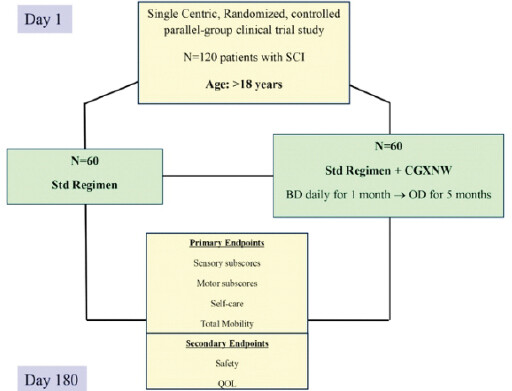
This single-center, randomized, controlled, parallel-group trial evaluated the efficacy and safety of CGXNW as an adjunctive therapy in patients with SCI. A total of 120 eligible patients meeting the pre-defined inclusion and exclusion criteria (Table 1) were randomized in a 1:1 ratio to receive either standard treatment alone or standard treatment plus CGXNW for a 6-month intervention period (Fig. 1).
Baseline characteristics of patients
| Demographic parameter of study patients (n [%]) | ||
|---|---|---|
| Variables | Standard regimen (n=60) (%) | Standard regimen+CGXNW (n=60) (%) |
| Male | 50 (83.3) | 54 (90) |
| Female | 10 (16.6) | 6 (10) |
| Age | 41.07 | 38.78 |
| BMI | 20.32 | 19.77 |
| AIS scale basement (n [%]) | ||
| AIS grade | Standard regimen (n=60) (%) | Standard regimen+CGXNW (n=60) |
| B | 53 (83.3) | 57 (95.0) |
| C | 7 (11.7) | 3 (5) |
| Cause of injury (n [%]) | ||
| Standard regimen (n=60) (%) | Standard Regimen+CGXNW (n=60) (%) | |
| Motorcycle accidents | 37 (61.6) | 33 (55) |
| Fall | 15 (25) | 14 (23.3) |
| Automobile accident | 08 (13.3) | 11 (18.3) |
| Others | – | 02 (3.34) |
| Time of injury (days) | ||
| Mean days | 10.78 | 8.37 |
| Type of injury (n [%]) | ||
| Acute | 3 (5) | 7 (11.67) |
| Sub-acute | 56 (93.33) | 53 (88.63) |
| Chronic | 1 (1.67) | 0 |
BMI: Body mass index, AIS: ASIA impairment scale
Inclusion Criteria included – (1) Female or male aged ≥18 years. (2) Diagnosis of SCI confirmed by clinical evaluation and imaging studies (e.g., magnetic resonance imaging, computed tomography scan). (3) Onset of SCI within the past 6 months. (4) Stable neurological status with evidence of sensory and/or motor deficits consistent with the level of injury. (5) Ability to provide informed consent. (6) Willingness to comply with study procedures and follow-up assessments. (7) Able to receive the investigational therapy (CGXNW) as part of the trial protocol. (8) Ability to understand and communicate in the language used for study procedures and assessments.
Exclusion Criteria included – (1) Presence of severe cognitive impairment or psychiatric disorders that may interfere with the ability to provide informed consent or comply with study procedures. (2) Previous participation in a clinical trial investigating investigational therapies for SCI within the past 6 months. (3) ASIA impairment scale (AIS) grade A. (4) History of significant allergic reactions or hypersensitivity to any components of the investigational therapy (CGXNW). (5) Known cases of Gout as determined by hyperuricemia (Serum uric acid above 10 mg/dL). (6) Pregnancy or breastfeeding. (7) History of malignancy within the past 5 years, with the exception of adequately treated non-melanoma skin cancer or carcinoma in situ of the cervix. (8) Chronic use of medications known to affect neurological function, such as Parkinson’s disease (e.g., levodopa, dopamine agonists), epilepsy (antiepileptic drugs), multiple sclerosis (immunomodulators), or other centrally acting agents known to affect neurological function or interfere with the interpretation of study outcomes. (9) Unstable medical condition, including uncontrolled hypertension, uncontrolled diabetes mellitus, or significant cardiovascular disease. (10) Presence of conditions that may independently contribute to neurological deficits or impairments in sensory or motor function unrelated to SCI (Fig. 1).
Study objective
The primary objectives of this study were to evaluate whether a fixed-dose combination of CGXNW add-on therapy with standard treatment can improve the functional outcome compared to traditional treatment standalone (Standard of care) in patients with SCI. Secondary objectives are to evaluate the safety of CGXNW (Inosine monophosphate, Agmatine sulphate and L- Carnosine) as an experimental drug and to measure the SCI data set – QOL.
Standard treatment and investigational therapy
Standard SCI management included pressure sore prevention (two-hourly repositioning), cardiopulmonary rehabilitation, and structured occupational and physiotherapy to restore independence and facilitate community reintegration. Supportive pharmacotherapy comprised thromboprophylaxis (enoxaparin), gastric protection (pantoprazole), analgesics for acute pain, duloxetine and pregabalin for neuropathic pain, baclofen for spasticity, and tamsulosin with cranberry extract for neurogenic bladder care.
In the intervention arm, CGXNW was added to standard care (BD for 1 month, then OD for 5 months). CGXNW is a fixed-dose combination of inosine monophosphate (500 mg), agmatine sulphate (250 mg), and L-carnosine (50 mg), designed to promote neurorepair and enhance neuroplasticity.
Baseline characteristics
A total of 120 patients were equally randomized into standard care and standard care plus CGXNW groups (60 each). Baseline characteristics were comparable, including age, body mass index, and male predominance. Most participants were AIS grade B at enrollment. Motorcycle accidents were the primary cause of injury, and the majority of cases were subacute, with similar time since injury across both groups (Table 1).
Outcome measures
Primary outcomes
Motor scores
Motor function was assessed bilaterally using the international standards for neurological classification of spinal cord injury (ISNCSCI) motor score. Ten key muscle groups (5 upper, 5 lower) were graded from 0 (paralysis) to 5 (normal strength), with separate right and left subscores. Upper extremity motor score (UEMS, C5–T1) and lower extremity motor score (LEMS, L2–S1) were calculated (maximum 25 points per side).
Functional independence and neurological status
Functional independence was evaluated using the spinal cord independence measure III (SCIM-III), including self-care and mobility domains. The total SCIM score (maximum 100) was calculated at baseline, Day 90, and Day 180 by a blinded assessor. Neurological status was classified using the AIS according to ISNCSCI criteria (AIS A-E).
Sensory scores
Sensory function was assessed using light touch and pin prick (PP) across 28 dermatomes on each side of the body. Each dermatome was scored from 0 (absent) to 2 (normal). Right and left scores were recorded separately, and total light touch and PP scores were calculated by summing both sides, with a maximum of 112 for each modality.
Secondary outcomes
QOL was measured using a standardized 1–10 numerical rating scale (NRS). Adverse events were monitored throughout 180 days and graded for severity, with causality and drug exposure documented at each assessment point.
Statistical methods
Data were analyzed using paired and unpaired t-tests for within-group and between-group comparisons, respectively. Statistical significance was set at P < 0.05. Inter-group comparisons at each time point (Day 90 and Day 180) were made for all outcome measures, and mean differences with standard deviations were calculated. Sensitivity analyses were conducted to account for dropouts. All statistical analyses were performed using validated statistical software, and results were reported with appropriate confidence intervals and effect sizes where applicable.
Results
A total of 120 patients with confirmed SCI were enrolled and randomized into two equal groups: 60 received the standard regimen, and 60 received the CGXNW plus standard regimen. The analysis was conducted at 2 time points: Day 90 and Day 180 post-treatment initiation.
Motor function improvement
Motor recovery (right and left total scores)
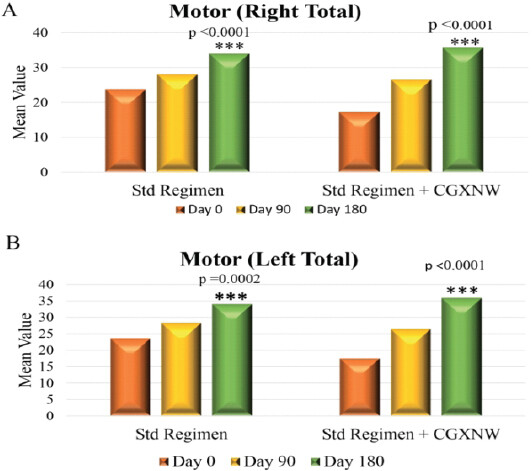
Both treatment arms demonstrated progressive motor improvement over 180 days. For motor (right total), mean scores increased from 23.83 to 34.12 in the Standard Regimen group and from 17.32 to 35.80 in the Standard Regimen + CGXNW group, with significant gains from baseline to Day 180 in both groups (P < 0.0001) (Fig. 2a). Similarly, motor (left total) scores improved from 23.67 to 34.08 under Standard Regimen (P = 0.0002) and from 17.60 to 35.93 with adjunct CGXNW (P < 0.0001) (Fig. 2b). Although both groups showed statistically significant recovery, the CGXNW arm demonstrated numerically greater gains at Day 180 for both right and left motor totals (Fig. 2).
Upper and lower extremity motor outcomes
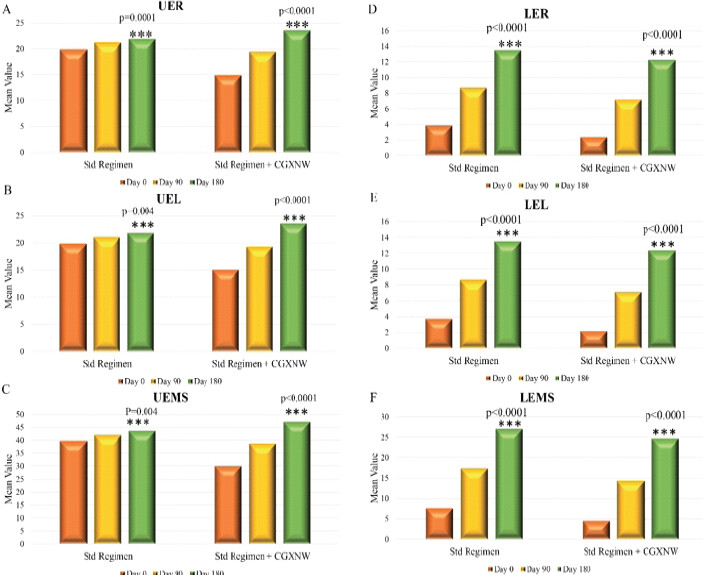
Both treatment arms demonstrated progressive motor recovery over the 180-day period. Upper extremity parameters (upper extremity recovery, upper extremity lymphedema, and UEMS) improved significantly in both groups; however, the CGXNW add-on arm exhibited a greater magnitude of improvement, particularly in composite UEMSs, indicating enhanced and sustained recovery (Fig. 3a, b, c). Similarly, lower extremity measures (lower extremity right, lower extremity left, and LEMS) showed significant time-dependent improvement in both groups, reflecting continued neurological recovery. Although both regimens were effective, gains were consistently robust in the combination therapy arm. Collectively, these findings indicate meaningful motor restoration across upper and lower extremities, with adjunct CGXNW supporting enhanced functional recovery over time (Fig. 3d, e, f).
Self-care – patient improvements
By Day 180, a higher proportion of patients receiving CGXNW in addition to standard care achieved functional independence compared with standard treatment alone, indicating improved recovery in activities of daily living (Table 2).
SCIM-III self-care subtotal: Dependency status at baseline and 180 days
| Self-care subtotal | ||||
|---|---|---|---|---|
| Standard regimen+CGXNW | Standard regimen | |||
| Day 0 | Day 180 | Day 0 | Day 180 | |
| Severe dependency | 60 (100.0) | 0 | 60 (100.0) | 5 (8.3) |
| Moderate assistance | 0 | 06 (10.00) | 0 | 11 (18.3) |
| Largely independent | 0 | 54 (90.0) | 0 | 44 (73.3) |
SCIM-III: Spinal cord independence measure III
Functional independence and QOL outcomes
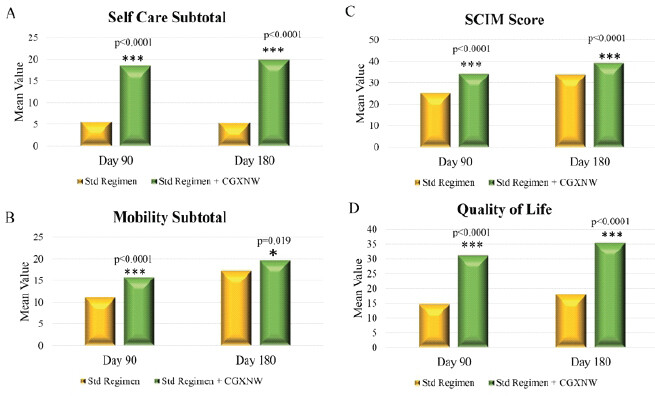
Adjunct CGXNW therapy was associated with superior functional gains over time. The self-care subtotal improved in both groups, with greater enhancement observed in the combination arm by Day 180, reflecting improved independence in daily activities (Fig. 4a). For the mobility subtotal, early improvement favored the CGXNW group, and although both groups progressed over time, between-group differences remained statistically significant at later follow-up (Fig. 4b). Consistently, SCIM total scores and QOL demonstrated significantly greater improvement with CGXNW add-on therapy at both assessment points, indicating that neurological gains translated into meaningful functional recovery and enhanced patient-reported well-being (Fig. 4c and d).
ASIA grade progression
At Day 180, a higher proportion of patients in the CGXNW group progressed to more favorable ASIA grades (e.g., C to D), indicating improved neurological function. The standard group showed fewer shifts in grade. This qualitative improvement in ASIA grade was supportive of the SCIM and motor outcome results (Table 3).
Distribution of Asia impairment scale grades over 180 days between treatment groups
| Asia Impairment Scale | ||||||
|---|---|---|---|---|---|---|
| AIS grade | CGXNW Group | Standard treatment group | ||||
| Day 0 | Day 90 | Day 180 | Day 0 | Day 90 | Day 180 | |
| B | 57 (95.00) | 53 (83.33) | 22 (36.67) | 53 (83.33) | 51 (85.00) | 21 (35.00) |
| C | 3 (5.00) | 7 (11.67) | 15 (25.00) | 7 (11.67) | 9 (15.00) | 21 (35.00) |
| D | 0 (0.00) | 0 (0.00) | 21 (35.00) | 0 (0.00) | 0 (0.00) | 18 (30.00) |
| E | 0 (0.00) | 0 (0.00) | 2 (2.33) | 0 (0.00) | 0 (0.00) | 0 (0.00) |
AIS: ASIA impairment scale
Sensory subscores
Sensory outcomes: Light touch and PP
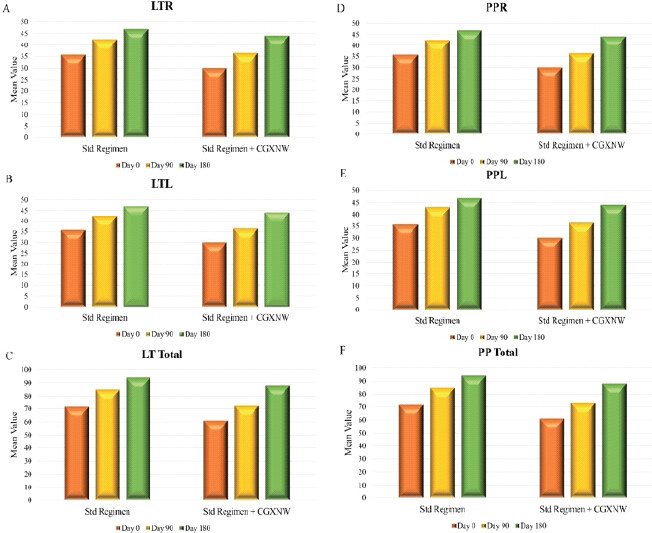
Both treatment arms showed progressive improvement in light touch sensation over the 180-day period. Light Touch Right, Light Touch Left, light touch total scores increased steadily in both groups, with no statistically significant between-group differences, indicating comparable long-term recovery (Fig. 5a, b, c). Similarly, PP sensation (PP right, PP left, PP total) improved consistently over time in both groups. Although numerical differences were observed, intergroup comparisons were not statistically significant, suggesting that sensory recovery was similar with standard therapy alone and with adjunct CGXNW (Fig. 5d, e, f).
Safety and adverse events
Three adverse events gastritis, hypertension, and hyperuricemia, were documented in the CGXNW group, occurring in three patients. The gastritis and hypertension cases had NRS scores of 4 and 6, respectively. All events were transient, self-limiting, and did not require discontinuation of the study drug. No serious adverse events or mortality occurred during the study period. Physician’s advice was taken and managed as per the treatment advised by the physician.
Discussion
This randomized, controlled study demonstrates that CGXNW—a fixed-dose combination of inosine monophosphate, agmatine sulphate, and L-carnosine—provides clinically meaningful benefit as an adjunct to standard care in subacute SCI over 180 days. Treatment resulted in significant improvements in motor recovery (motor right total, motor left total, and UEMS; P < 0.0001 at Days 90 and 180), functional independence (SCIM total, self-care, mobility), and QOL, without serious adverse events, indicating favorable tolerability. Gains were most pronounced in upper extremity motor function, suggesting enhanced corticospinal plasticity, potentially mediated through purine-sensitive Mst3b kinase activation and GAP-43 upregulation [15,16,17,27]. In contrast, sensory subscores did not differ significantly between groups, possibly reflecting limited reversibility of subacute sensory pathway damage or selective motor circuit responsiveness [18,19,28].
Mechanistically, CGXNW targets complementary neurorestorative pathways: Inosine monophosphate promotes axonal outgrowth; agmatine modulates iNOS [22], NMDA receptor signaling [21], polyamine toxicity [20], and neurotrophic/bone morphogenetic protein pathways [29]; and L-carnosine mitigates oxidative stress and excitotoxic injury [30]. Together, these multimodal actions address key pathological drivers of SCI.
The principal limitation is the 6-month follow-up, which restricts conclusions regarding durability of effect. While the CGXNW arm showed accelerated and greater early recovery, longer observation is required to determine persistence, convergence of outcomes, and the impact of extended therapy. Surgical interventions were not analyzed separately but were incorporated into overall outcome assessment.
Conclusion
Adjunct therapy with CGXNW significantly improved motor recovery, functional independence (SCIM-III), ASIA grade progression, and QOL over 180 days compared with standard care alone in patients with subacute SCI. Sensory recovery was comparable between groups. The formulation was well tolerated, with only mild, transient adverse events and no serious safety concerns. These findings support CGXNW as a promising multimodal neurorestorative strategy warranting validation in larger, multicenter trials.
Clinical Message
Adjunct CGXNW significantly enhanced motor recovery: Patients receiving CGXNW plus standard care demonstrated greater improvements in ISNCSCI motor scores (Motor Right/Left Total and UEMS) at Day 90 and Day 180 compared to standard care alone (P < 0.0001).
Improved functional independence (SCIM-III): The CGXNW group achieved significantly higher SCIM total scores and greater gains in self-care and mobility domains, with 90% becoming largely independent at Day 180 versus 73.3% in the control group.
Better neurological grade conversion: A higher proportion of patients in the CGXNW arm improved to favorable ASIA grades (including progression to AIS D and E) by Day 180, indicating meaningful neurological recovery.
Quality of life markedly improved: QOL scores were significantly higher in the CGXNW group at both Day 90 and Day 180 (P < 0.0001), reflecting enhanced physical and psychosocial outcomes.
Favorable safety profile: Only three mild, transient adverse events (gastritis, hypertension, hyperuricemia) were reported in the CGXNW group, with no serious adverse events or treatment discontinuations.
Conflict of Interest:
Nil
Source of Support:
Nil
Consent:
The authors confirm that informed consent was obtained from the patient for publication of this article
References
- Tian T, Zhang S, Yang M. Recent progress and challenges in the treatment of spinal cord injury Protein Cell 2023;14:635-52. Google Scholar | PubMed
- Lu Y, Shang Z, Zhang W, Pang M, Hu X, Dai Y, et al. Global incidence and characteristics of spinal cord injury since 2000-2021: A systematic review and meta-analysis BMC Med 2024;22:285. Google Scholar | PubMed
- NeoMotion Solutions. Spinal Cord Injury Statistics 2023-2025: Global, India, USA, UK Data and Solutions 2025. Available from: https://www.neomotion.in/post/spinal-cord-injury-statistics-2023-2025-global-india-usa-uk-data-solutions. [Last accessed on 2025 Jul 26]. Google Scholar | PubMed
- Van Koppenhagen CF, De Groot S, Post MW, Van Asbeck FW, Spijkerman D, Faber WX, et al. Wheelchair exercise capacity in spinal cord injury up to five years after discharge from inpatient rehabilitation J Rehabil Med 2013;45:646-52. Google Scholar | PubMed
- Diop M, Epstein D. A systematic review of the impact of spinal cord injury on costs and health-related quality of life Pharmacoecon Open 2024;8:793-808. Google Scholar | PubMed
- Velho VL, Skhandeshwaran P, Kharosekar H. Traumatic spinal cord injuries: An institutional experience J Spinal Surg 2023;10:54-60. Google Scholar | PubMed
- Ortega MA, Fraile-Martinez O, García-Montero C, Haro S, Álvarez-Mon MÁ, De Leon-Oliva D, et al. A comprehensive look at the psychoneuroimmunoendocrinology of spinal cord injury and its progression: Mechanisms and clinical opportunities Mil Med Res 2023;10:26. Google Scholar | PubMed
- Chen X, Huang R, Yang Z, Zhang J, Yang Y, Gao F, et al. Biological engineering approaches for modulating the pathological microenvironment and promoting axonal regeneration after spinal cord injury Front Neurosci 2025;19:1574763. Google Scholar | PubMed
- Ma D, Fu C, Li F, Ruan R, Lin Y, Li X, et al. Functional biomaterials for modulating the dysfunctional pathological microenvironment of spinal cord injury Bioact Mater 2024;39:521-43. Google Scholar | PubMed
- Bhatt M, Sharma M, Das B. The role of inflammatory cascade and reactive astrogliosis in glial scar formation post-spinal cord injury Cell Mol Neurobiol 2024;44:78. Google Scholar | PubMed
- Portaro S, Alito A, Leonardi G, Marotta N, Tisano A, Bruschetta D, et al. Efficacy of neuromodulation and rehabilitation approaches on pain relief in patients with spinal cord injury: A systematic review and meta-analysis Neurol Sci 2025;46:2995-3020. Google Scholar | PubMed
- Punjani N, Deska-Gauthier D, Hachem LD, Abramian M, Fehlings MG. Neuroplasticity and regeneration after spinal cord injury N Am Spine Soc J 2023;15:100235. Google Scholar | PubMed
- Martin JH. Neuroplasticity of spinal cord injury and repair Handb Clin Neurol 2022;184:317-30. Google Scholar | PubMed
- Irwin N, Li YM, O'Toole JE, Benowitz LI. Mst3b, a purine-sensitive Ste20-like protein kinase, regulates axon outgrowth Proc Natl Acad Sci U S A 2006;103:18320-5. Google Scholar | PubMed
- Lorber B, Howe ML, Benowitz LI, Irwin N. Mst3b, an Ste20-like kinase, regulates axon regeneration in mature CNS and PNS pathways Nat Neurosci 2009;12:1407-14. Google Scholar | PubMed
- Kim D, Zai L, Liang P, Schaffling C, Ahlborn D, Benowitz LI. Inosine enhances axon sprouting and motor recovery after spinal cord injury PLoS One 2013;8:e81948. Google Scholar | PubMed
- Yuan Q, Hu B, Su H, So KF, Lin Z, Wu W. GAP-43 expression correlates with spinal motoneuron regeneration following root avulsion J Brachial Plex Peripher Nerve Inj 2009;4:18. Google Scholar | PubMed
- Zai L, Ferrari C, Subbaiah S, Havton LA, Coppola G, Strittmatter S, et al. Inosine alters gene expression and axonal projections in neurons contralateral to a cortical infarct and improves skilled use of the impaired limb J Neurosci 2009;29:8187-97. Google Scholar | PubMed
- Chung YG, Seth A, Doyle C, Franck D, Kim D, Cristofaro V, et al. Inosine Improves Neurogenic Detrusor Overactivity following Spinal Cord Injury PLoS One 2015;10:e0141492. Google Scholar | PubMed
- Gibson DA, Harris BR, Rogers DT, Littleton JM. Radioligand binding studies reveal agmatine is a more selective antagonist for a polyamine-site on the NMDA receptor than arcaine or ifenprodil Brain Res 2002;952:71-7. Google Scholar | PubMed
- Wang WP, Iyo AH, Miguel-Hidalgo J, Regunathan S, Zhu MY. Agmatine protects against cell damage induced by NMDA and glutamate in cultured hippocampal neurons Brain Res 2006;1084:210-6. Google Scholar | PubMed
- Wang CC, Chio CC, Chang CH, Kuo JR, Chang CP. Beneficial effect of agmatine on brain apoptosis, astrogliosis, and edema after rat transient cerebral ischemia BMC Pharmacol 2010;10:11. Google Scholar | PubMed
- Park YM, Lee WT, Bokara KK, Seo SK, Park SH, Kim JH, et al. The multifaceted effects of agmatine on functional recovery after spinal cord injury through Modulations of BMP-2/4/7 expressions in neurons and glial cells PLoS One 2013;8:e53911. Google Scholar | PubMed
- Park YM, Kim JH, Lee JE. Neural stem cells overexpressing arginine decarboxylase improve functional recovery from spinal cord injury in a mouse model Int J Mol Sci 2022;23:15784. Google Scholar | PubMed
- Paterniti I, Filippone A, Naletova I, Greco V, Sciuto S, Esposito E, et al. Trehalose-carnosine prevents the effects of spinal cord injury through regulating acute inflammation and zinc(II) ion homeostasis Cell Mol Neurobiol 2023;43:1637-59. Google Scholar | PubMed
- Ouyang L, Tian Y, Bao Y, Xu H, Cheng J, Wang B, et al. Carnosine decreased neuronal cell death through targeting glutamate system and astrocyte mitochondrial bioenergetics in cultured neuron/astrocyte exposed to OGD/recovery Brain Res Bull 2016;124:76-84. Google Scholar | PubMed
- Doyle C, Cristofaro V, Sullivan MP, Adam RM. Inosine - a multifunctional treatment for complications of neurologic injury Cell Physiol Biochem 2018;49:2293-303. Google Scholar | PubMed
- Barua S, Kim JY, Lee JE. Role of agmatine on neuroglia in central nervous system injury Brain Neurorehabil 2019;12:e2. Google Scholar | PubMed
- Freitas AE, Egea J, Buendia I, Gómez-Rangel V, Parada E, Navarro E, et al. Agmatine, by improving neuroplasticity markers and inducing Nrf2, prevents corticosterone-induced depressive-like behavior in mice Mol Neurobiol 2016;53:3030-45. Google Scholar | PubMed
- Di Paola R, Impellizzeri D, Salinaro AT, Mazzon E, Bellia F, Cavallaro M, et al. Administration of carnosine in the treatment of acute spinal cord injury Biochem Pharmacol 2011;82:1478-89. Google Scholar | PubMed
© 2026 Journal of Orthopaedic Case Reports - Published by Indian Orthopaedic Research Group
About the Authors
-

Dr. Vishal Kundnani
Related Articles in Journal of Orthopaedic Case Reports
 September 1, 2026 Blunt Traumatic Posterior Cord Syndrome Following a Hangman Fracture: A Case Report
 September 1, 2026 Three-Grade Neurological Recovery (ASIA Impairment Scale A to D) Following Surgical Stabilization of Traumatic D11–D12 Meyerding Grade IV Spondylolisthesis: A Case Report
 February 1, 2026 Virtual reality rehabilitation to enhance functional recovery initiated from the acute phase following cervical cord injury: A case report
 September 1, 2025 Treatment of Bilateral Distal Femoral Shaft Fractures in a Paraplegic Patient with Intramedullary Nailing: A Case Report