


Introduction
Clavicle fracture is a common injury which accounts for approximately 5–10% of all fractures and nearly 1/3rd of injuries involving shoulder girdle. Clavicle fractures are frequently encountered in orthopedic and emergency practice, particularly in active individuals. The annual incidence ranges between 29 and 64/100,000 population, reflecting high prevalence in the general population [1, 2].
Clavicle fractures demonstrated a bimodal age distribution. It is found that the first peak occurs in young active males <30 years of age, typically associated with high-energy trauma. The second peak is observed in elderly females due to osteoporotic bone and low-energy fall [3]. The displacement and shortening are important outcome determinants. Complete displacement (100% translation) or shortening (above 2 cm) of fractures have been found to be associated with increased risk of nonunion and symptomatic malunion. Nonunion was experienced in about 6%, which has been found to rise to 15% in the displaced. The absolute risk of nonunion in the case of surgical fixation was considerable in patients who were selected [4].
Surgical techniques like operative fixation methods such as plate fixation and intramedullary devices such as Titanium Elastic Nailing System (TENS) have gained increasing popularity. Many studies have demonstrated that operative fixation provides better anatomical alignment, earlier functional recovery, and improved patient satisfaction compared to conservative treatment. In spite of several findings, there is a lacuna in the optimal treatment modality, particularly for mid-shaft clavicle fracture.
While it is important to mention that several existing studies primarily compared plate fixation with conservative management, relatively fewer randomized studies have specifically evaluated intramedullary fixation using TENS versus figure-of-eight bandage treatment in adults with displaced midshaft clavicle fracture.
Therefore, the present study was undertaken to compare the functional outcomes, radiological union, and complication rates between operative management using TENS and non-operative management using figure-of-eight bandage in patients with displaced midshaft clavicle fractures. Thereby, we can address the existing gap in evidence and contribute to the identification of an optimal treatment strategy. The study aims to study the functional outcome of operative – TENS versus non-operative figure-of-eight bandage treatment for adults presenting with Allman group I displaced middle one-third clavicle fracture. We compared the functional outcome of operative – TENS versus non-operative figure-of-eight bandage treatment for adults presenting with Allman group I displaced middle one-third clavicle fracture in terms of Constant–Murley and disabilities of the Arm, Shoulder, and Hand (DASH) scores.
Materials and Methods
Study design
The present study was based on a randomized controlled trial conducted to compare the functional outcomes of operative management using TENS and non-operative management using a figure-of-eight bandage in patients with displaced middle 1/3rd clavicle fractures.
Study setting
The study was conducted in the Department of Orthopaedics, Indira Gandhi Medical College and Research Institute, Puducherry, India.
Duration of the study
Duration of the study was 2 years.
Study population
The population included adult patients presenting to the casualty and outpatients in the Department of Orthopedics with Allman group I displaced fracture of the middle 1/3rd of the clavicle.
Sample size
-
The sample size of the present study was 60
-
There are two groups: Group A and Group B.
-
Group A: Operative management with TENS (n = 30)
-
Group B: Non-operative management with figure-of-eight bandage (n = 30).
Inclusion criteria
Age between 18 and 65 years, Allman group I displacement in the middle 1/3rd of clavicle, displacement ≥2 cm, injury duration <2 weeks, Patients willing to participate and provide informed consent.
Exclusion criteria
Pathological fracture, fractures associated with neurovascular injury, polytrauma patients, previous fracture, surgery involved in the ipsilateral side, open fracture, patients unfit for anesthesia.
Operative (TENS) – group A
-
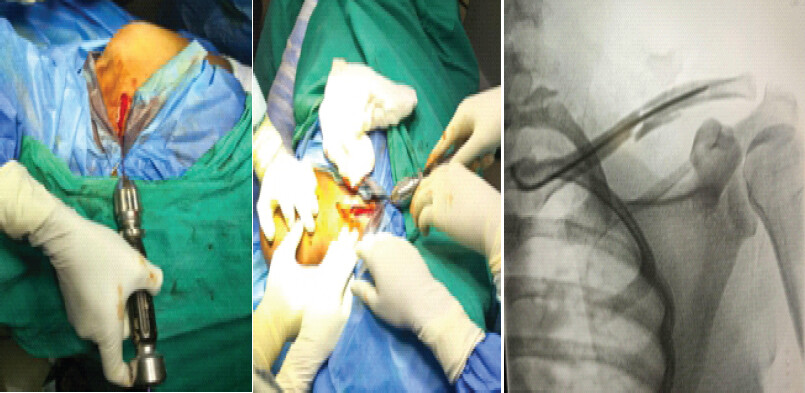
The procedure is performed under image intensifier guidance with the patient in a supine or beach chair position (Fig. 1)
-
Skin incision made 2 cm medial to the sternoclavicular joint
-
A medial entry point is created approximately 1.5–2 cm lateral to the sternoclavicular joint, and a flexible TEN (2–3.5 mm) is inserted into the intramedullary canal
-
Closed reduction is usually achieved with shoulder traction and manipulation; however, limited open reduction may be required in some cases
-
The nail is advanced across the fracture site into the lateral fragment to maintain alignment and rotational stability while preserving fracture biology.
Post-operative procedure
-
1st 2 weeks, arm immobilized with arm sling
-
2nd–6th week pendulum exercise followed by active-assisted movements
-
After 6 weeks, full range of motion exercise and strengthening exercise initiated.
Figure-of-eight bandage (Group B)
-
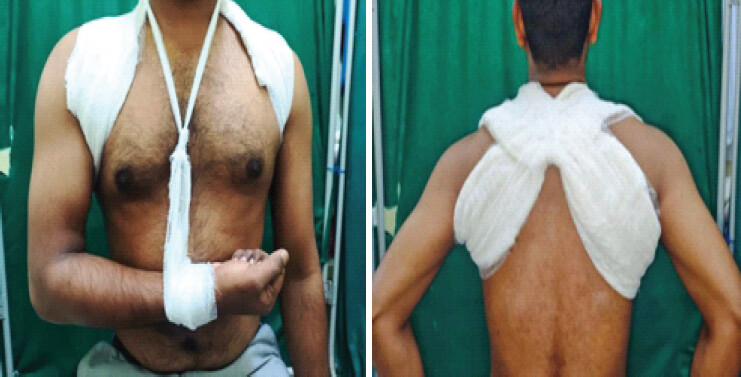
The patient is positioned in a sitting or upright position with the shoulders gently retracted
-
A soft pad is placed between the scapulae and axilla to provide comfort and support
-
A soft roll was passed over each shoulder, under the axilla, and crossed over the back to form a figure-of-eight configuration
-
The straps are tightened gradually to pull the shoulders backward into a retracted position, thereby stabilizing the fracture fragment
-
After application, neurovascular status of the upper limbs is checked to ensure that the bandage is not excessively tight (Fig. 2)
-
Patients were reviewed regularly for adjustment and compliance.
Post-operative procedure
-
1st 2 weeks, arm immobilized with arm sling
-
2nd–6th week pendulum exercise followed by active-assisted movements
-
After 6 weeks, full range of motion exercise and strengthening exercise initiated.
Statistical analysis
The data were entered into an Excel sheet and analyzed using the Statistical Package for the Social Sciences version 17.0. The continuous variables were expressed in mean and standard deviation; categorical variables were presented as frequencies and percentages. Shapiro–Wilk test was used to test the normality of distribution. Independent t-test (or Mann–Whitney U test) was used for comparison between two groups – TENS and non-operative figure-of-eight bandage in middle one-third clavicle fracture. Chi-square test was done to validate the categorical variables. P < 0.05 was considered statistical significance.
Results
A total of 60 patients with displaced middle one third clavicle fractures were enrolled in the study, and we were able to randomly allocate into two equal groups. Group A (TENS) consisted of 30 patients; all of them completed follow-up and were included in the final analysis. Group B (Figure-of-Eight Bandage) also included 30 patients initially; however, there were 2 patients who were lost to follow-up. Therefore, Group B consisted of 28 samples which were available for final analysis. Thus, out of 60 enrolled patients, 58 patients (96.7%) were analyzed for functional and radiological outcomes. The distribution of patients between the two groups was comparable (Table 1).
Socio-demographic details of participants in both groups
| Variable | TENS group (n=30) | Figure-of-eight group (n=28) |
|---|---|---|
| Age | 35.80±12.77 | 38.53±13.09 |
| Gender (%) | ||
| Male | 26 (86.66) | 20 (71.42) |
TENS: Titanium elastic nailing system
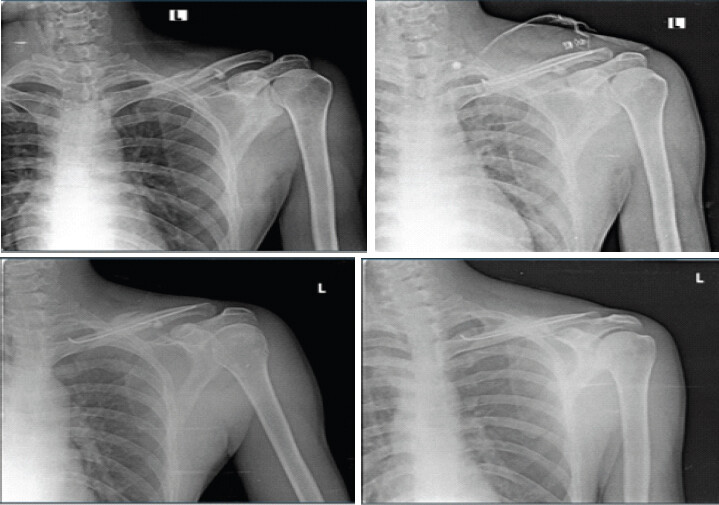
All patients had Allman Group I displaced midshaft clavicle fractures with ≥2 cm displacement (Fig. 3). Mean shortening was 0.8 cm versus 0.7 cm, and mean translation was 110% versus 103% in the TENS and figure-of-eight groups, respectively. Comminution was present in 30% versus 35% of cases. Simple/short-oblique fractures occurred in 18 patients in each group, while wedge/segmental-comminuted fractures occurred in 12 and 10 patients, respectively. Robinson classification showed 2B1 in 18 patients in each group and 2B2 in 12 versus 12 patients, indicating broadly comparable fracture characteristics (Table 2).
Comparative fracture characteristics of displaced Midshaft clavicle fractures in the TENS and figure-of-eight groups
| Fracture characteristic | TENS group (n=30) | Figure-of-eight group (n=30 initially; n=28 analyzed) |
|---|---|---|
| Allman classification | Group I | Group I |
| Displacement | ≥2 cm | ≥2 cm |
| Mean exact shortening (mm/cm) | 0.8 cm | 0.7 cm |
| Mean degree of translation (%) | 110% | 103% |
| Comminution present in | 30% of cases | 35% of cases |
| Fracture morphology/pattern | ||
| Simple/short-oblique | 18 patients | 18 patients |
| wedge-comminuted/segmental-comminuted | 12 patients | 10 patients |
| Robinson classification | ||
| 2B1 | 18 | 18 |
| 2B2 | 12 | 12 |
TENS: Titanium elastic nailing system
The mean age of patients in Group A (TENS) was 35.80 ± 12.77 years, with the youngest sample age was being 18 years and the oldest patient aged for the study is 65 years of age. Group B, the mean age was 35.53 ± 13.09 years, with an age range of 18–62 years. In the age distribution between the two groups, we found there is no statistical significance. Group A (TENS): 26 (86.7%) and 4 (13.3%) patients (30 patients) were male and female, respectively. Figure-of-eight bandage (Group B) had 28 patients who were analyzed, of which 20 (71.4%) patients were male, and 8 (28.6%) were female (Table 3).
Scoring post-intervention in both groups
| Scoring | Duration | TENS group | Figure-of-eight group | P-value |
|---|---|---|---|---|
| Constant–Murley Score | 6 weeks | 42.79±3.40 | 40.08±5.97 | 0.14 |
| 3rd Month | 68.55±6.09 | 66.19±4.68 | 0.233 | |
| 6th Month | 96.48±1.68 | 96.46±2.85 | 0.857 | |
| Disabilities of the arm, shoulder and hand score | 6 weeks | 59.55±3.55 | 65.12±4.72 | <0.001 |
| 3rd Month | 31.45±5.38 | 31.15±3.21 | 0.564 | |
| 6th Month | 1.97±1.05 | 1.50±1.14 | 0.118 |
TENS: Titanium elastic nailing system
Mean constant score at 6 weeks in Group A (TENS) was 42.79 ± 3.40. Whereas in Group B (figure-of-eight bandage) the mean constant score was 40.08 ± 5.97. The TENS group demonstrated better early functional recovery compared to the conservative group at 6 weeks. At 3 months follow-up, the mean constant score in Group A was 68.55 ± 6.09, while in Group B the mean score was 66.19 ± 4.68. Although both groups showed progressive improvement, the operative group continued to demonstrate superior functional scores during the intermediate follow-up period. At 6 months, the mean constant score was 96.48 ± 1.68 in the TENS group and 96.46 ± 2.85 in the figure-of-eight group. By the end of 6 months, both groups achieved comparable and excellent functional outcomes with no significant difference between the two groups. The results indicate that operative management with TENS provides better early functional recovery at 6 weeks and 3 months. But interestingly, both treatment groups resulted in similar excellent functional outcomes at 6th month follow-up. 6th week follow-up mean DASH score in group A (TENS) was 59.55 ± 3.55 where in group B (figure-of-eight bandage the mean score was 65.2 ± 4.72. Since lower DASH scores indicated between functional status, patients in the TENS group demonstrated significantly (P < 0.001) better early functional improvement compared to the conservative group at 6 weeks. 3rd month mean DASH score in Group A was 31.45 ± 5.38, while in Group B the mean DASH score was 31.15 ± 3.21. Both groups showed marked improvement compared to 6th week follow up and differences between groups were minimal at this stage. At 6 months follow up mean DASH score was 1.97 ± 1.05 in the TENS group and 1.50 ± 1.14 in the figure-of-eight bandage group. By the end of the 6th month, both groups achieved near-normal functional outcomes with very low DASH scores, and the difference between the two groups was not clinically significant. The findings at the 6th month clearly indicated that the TENS group showed better early functional recovery at 6 weeks, as evidenced by lower DASH scores.
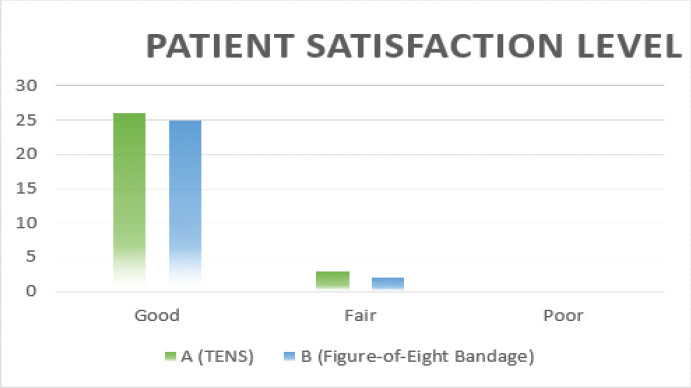
In Group A (TENS), nearly 26 patients 86.7% reported good satisfaction, while 3 patients reported fair satisfaction; no patients reported poor satisfaction.
While in Group B (Figure-of-eight bandage) nearly 25 patients 89.3% reported good satisfaction, and 2 patients 7.1% reported fair satisfaction. None of the patients reported poor satisfaction. Overall, we found that a very high level of patient satisfaction was observed in both groups, with the majority of patients in both groups expressing good satisfaction at the end of the 6th month (Fig. 4). With an increased level of satisfaction among the patients, our morale increases (Table 4).
Return of activity comparison between Group A and Group B
| Group | Mean time (Weeks) | P-value |
|---|---|---|
| A (Titanium elastic nailing system) | 9.6 weeks | 0.257 |
| B (Figure-of-eight bandage) | 10.8 weeks |
Return to activity
Mean time required returning to occupational work, heavy physical activity, and routine daily activity was reported at 9.6 weeks in Group A (TENS). Whereas Group B (Figure-of-eight bandage) mean was 10.8 weeks. The patients in the TENS group returned to their regular activity earlier compared to those managed conservatively. From the above findings, we found that both group able to recover, but the TENS group was associated with a relatively faster return to functional activity.
Discussion
The primary objective of the present study was to compare functional outcomes using the Constant–Murley Score and DASH Score between TENS fixation and conservative treatment with a figure-of-eight bandage. The demographic profile was comparable to previous studies, with a male predominance and a mean age of 35.9 ± 10.6 years, similar to Kumar et al. [5].
At 6 weeks, the TENS group demonstrated significantly better early functional recovery, with a higher Constant score (42.79 ± 3.40 vs. 40.08 ± 5.97) and a lower DASH score (59.55 ± 3.55 vs. 65.12 ± 4.72) than the conservative group, indicating better shoulder function and less disability. At 3 months, the TENS group continued to show slightly superior outcomes (Constant score 68.55 ± 6.09 vs. 66.19 ± 4.68). However, by 6 months, both groups achieved nearly identical Constant scores (96.48 ± 1.68 vs. 96.46 ± 2.85), suggesting comparable long-term functional recovery.
These findings are consistent with Kumar et al., who reported superior Constant scores following operative management (90.6 ± 6.1 vs. 82.3 ± 8.7) [5]. Hill et al. also demonstrated poorer outcomes following conservative treatment in displaced midshaft clavicle fractures with significant displacement [6]. The Canadian Orthopaedic Trauma Society reported improved early function and patient satisfaction following operative fixation [7]. Similar early functional benefits with intramedullary fixation have been reported by Smekal et al. [8] and Ganesh et al., [9] attributing improved outcomes to stable fixation and early mobilization.
The lower DASH scores observed in the TENS group during early follow-up are consistent with the findings of Rahangdale et al. [10] and Zhu et al., [11], who reported reduced disability and faster rehabilitation after TENS fixation. However, as fracture healing progressed, DASH scores between the groups became comparable, similar to the observations of Kothale et al., who reported equivalent long-term functional outcomes once union was achieved [12].
Complications
No cases of non-union were observed in either group. The TENS group experienced minor implant-related complications, including scar-related issues, implant prominence, friction bursitis, delayed wound healing, and transient numbness. The conservative group mainly experienced skin irritation and occasional need for reapplication of the figure-of-eight bandage. Defroda et al. reported that although operative treatment facilitates earlier recovery, it is associated with implant-related complications [7]. In the present study, these complications were minor, manageable, and did not adversely affect final functional outcomes.
Return to activity
Patients treated with TENS resumed normal activities significantly earlier (9.6 weeks) than those managed conservatively. Early mechanical stability following intramedullary fixation likely facilitated faster rehabilitation. Similar findings have been reported by Defroda et al., who demonstrated earlier return to sports following operative fixation [7] and by Rahangdale et al., who observed earlier fracture union and faster return to work with TENS fixation [10].
Patient satisfaction
High patient satisfaction was observed in both groups, with slightly higher satisfaction among patients treated with TENS. Kumar et al. similarly reported a greater proportion of excellent outcomes following operative management [5]. The improved early function, reduced disability, and earlier return to activity likely contributed to better patient satisfaction in the operative group.
Loss to follow-up
A small number of patients, predominantly from the conservative group, were lost to follow-up during the study. These patients were excluded from the final functional and radiological analyses to ensure the accuracy and validity of the study findings.
Fracture union
Fracture union was achieved in all patients in both treatment groups with some degrees of acceptable residual displacement or shortening, reflecting the excellent healing potential of clavicle fractures. Although complete union occurred in all cases, radiological union was observed slightly earlier in the TENS group, likely due to stable intramedullary fixation while preserving the biological environment for fracture healing. Previous studies have reported higher rates of non-union and symptomatic malunion following conservative treatment of displaced fractures [9]. Nevertheless, both groups achieved successful union in the present study.
Return to daily activities
Patients treated with TENS returned to routine daily activities earlier than those managed with a figure-of-eight bandage. Early stabilization, reduced pain, and improved shoulder biomechanics likely contributed to this advantage. Similar observations have been reported by Smekal et al., [8] who demonstrated earlier return to work after elastic intramedullary nailing, and by Jubel et al., who highlighted faster recovery and earlier restoration of pre-injury activity levels following intramedullary fixation [13]. These findings support the role of TENS in promoting early rehabilitation while maintaining comparable long-term outcomes.
Cosmetic outcome
Cosmetic outcome is an important consideration in clavicle fracture management. TENS fixation requires only a small incision with minimal soft-tissue dissection, resulting in minimal scarring and satisfactory cosmetic appearance. Jubel et al. reported superior cosmetic results with intramedullary fixation compared with plate fixation because of the smaller incision and less prominent implants [13]. In contrast, conservative treatment may result in visible deformity due to clavicular shortening or malunion, as reported by Zhu et al. [10]. Patients in the TENS group generally expressed greater satisfaction with cosmetic appearance, while the low incidence of surgical complications was comparable with the findings of Yadav et al. [14].
Limitations
Detailed randomization procedures, including sequence generation and allocation concealment, were not documented, and outcome-assessor blinding could not be confirmed, potentially introducing selection and measurement bias. The small sample size (60 enrolled; 58 analyzed) and two losses to follow-up may limit statistical power, generalizability, and introduce attrition bias; intention-to-treat analysis was not possible because outcome data were unavailable. Longitudinal outcomes were analyzed at individual time points rather than using repeated-measures or mixed-effects models, and confidence intervals and effect sizes were not reported. Complications were descriptively reported without standardized grading, limiting safety comparisons and detection of uncommon events. The conservative protocol used a figure-of-eight bandage with an arm sling for 2 weeks, but compliance and tolerance were not quantitatively assessed, limiting generalizability to other non-operative strategies. Finally, the 6-month follow-up was insufficient to assess long-term complications and functional outcomes, including symptomatic malunion, persistent dysfunction, refracture, implant-related problems, and post-traumatic degenerative changes.
Conclusion
TENS fixation provides faster early functional recovery and earlier return to routine activities compared with figure-of-eight bandage treatment for displaced midshaft clavicle fractures. However, overall functional outcomes at 6 months and fracture union were comparable between the two groups. The early functional advantage of TENS should therefore be weighed against the additional surgical risks and implant-related complications, including implant prominence, friction bursitis, scar-related problems, delayed wound healing, and transient numbness. The treatment should be individualized according to fracture characteristics, patient preferences, functional demands, and the relative benefits and risks of operative versus conservative management.
Clinical Message
TENS is a safe and effective treatment for displaced midshaft clavicle fractures, providing superior early functional recovery, earlier return to daily activities, and high patient satisfaction while achieving fracture union and long-term functional outcomes comparable to conservative figure-of-eight bandage treatment.
Conflict of Interest:
Nil
Source of Support:
Nil
Consent:
The authors confirm that informed consent was obtained from the patient for publication of this article
How to Cite this Article
Balaji S, Ravikumar N, Viswanathan V, Muralidharan R, Gunasekaran RK, Gogoularadja A. Functional Outcome of Operative Titanium Elastic Nailing System Versus Non-Operative Figure-of-Eight Bandage in Displaced Mid-Shaft Clavicle Fractures: A Randomized Controlled Study. Journal of Orthopaedic Case Reports 2026 October;16(10): 431-439.
References
- Kumar RM, Pradeep E, Sugananthan DK, Kumar KV, Mohideen S, Ashwin VY. Titanium elastic nail system for middle one-third clavicle fractures: Impact on functional recovery. J Orthop Case Rep 2025;15:275-80. [Google Scholar] | [PubMed]
- Sharma S, Kumar V, Sharma R, Aggarwal S. Burden of isolated clavicle fractures at tertiary care healthcare centre: A look into registry. Int J Res Orthop 2020;6:542. [Google Scholar] | [PubMed]
- Belapurkar K. Revisiting the epidemiology of mid shaft clavicle fracture-recent and emerging trends. Int J Res Orthop 2022;8:485-7. [Google Scholar] | [PubMed]
- Le MQ, Myers K, May T, Hosseinzadeh S. Clavicle Fracture. In: StatPearls.Treasure Island, FL: StatPearls Publishing;2026.Available from: https://www.ncbi.nlm.nih.gov/books/nbk507892. [Last accessed on 2026 Jul 1]. [Google Scholar] | [PubMed]
- Kumar R, Upadhyay V, Singh VK, Chandra I. Comparative study between operative and conservative management of clavicle fractures in adults at tertiary care hospital. Int J Med Public Health 2026;16. [Google Scholar] | [PubMed]
- Hill JM, McGuire MH, Crosby LA. Closed treatment of displaced middle-third fractures of the clavicle gives poor results. J Bone Joint Surg Br 1997;79:537-9. [Google Scholar] | [PubMed]
- DeFroda SF, Lemme N, Kleiner J, Gil J, Owens BD. Incidence and mechanism of injury of clavicle fractures in the NEISS database: Athletic and non athletic injuries. J Clin Orthop Trauma 2019;10:954-8. [Google Scholar] | [PubMed]
- Smekal V, Irenberger A, Struve P, Wambacher M, Krappinger D, Kralinger FS. Elastic stable intramedullary nailing versus nonoperative treatment of displaced midshaft clavicular fractures-a randomized, controlled, clinical trial. J Orthop Trauma 2009;23:106-12. [Google Scholar] | [PubMed]
- Ganesh MT, Pandian H, Palasseril AS. Outcome of clavicle fractures treated by various modalities. J Orthop Case Rep 2025;15:250-6. [Google Scholar] | [PubMed]
- Rahangdale A, Parteti R, Jain P, Harinkhede A. A study on results of TENS procedure in Midshaft clavicle fracture in adults through medial entry. Eur J Cardiovasc Med 2023;13:1691-6. [Google Scholar] | [PubMed]
- Zhu D, Qi H, Yao F, Feng J, Cao Y, Yang Y. Titanium elastic nail fixation versus conservative treatment for displaced mid-shaft clavicle fractures in adolescent athletes stratified according to sport function: A multicenter retrospective cohort study. J Orthop Surg Res 2026;21:184. [Google Scholar] | [PubMed]
- Kothale J, Kumar V, Azlam MP, Sharma R. Functional outcomes of minimally invasive titanium elastic nailing for displaced midshaft clavicle fractures: A prospective study. Cureus 2026;18:e111888. [Google Scholar] | [PubMed]
- Jubel A, Andermahr J, Schiffer G, Tsironis K, Rehm KE. Elastic stable intramedullary nailing of midclavicular fractures with a titanium nail. Clin Orthop 2003;408:279-85. [Google Scholar] | [PubMed]
- Yadav S, Phalak MO, Shevate I, Salunkhe R, Khandge A, Deshmukh A. Comparative study of postoperative outcomes of clavicle midshaft fracture treated by nailing vs. Plating. Cureus 2022;14:e22862. [Google Scholar] | [PubMed]
© 2026 Journal of Orthopaedic Case Reports - Published by Indian Orthopaedic Research Group
About the Authors
-

S Balaji
-

N Ravikumar
-

V Viswanathan
-

R Muralidharan
-

Rumesh Kannan Gunasekaran
-

Avinash Gogoularadja
Related Articles in Journal of Orthopaedic Case Reports
 August 1, 2026 Outcome of Retrograde Titanium Elastic Nailing System in Shaft of Humerus Fractures: A Case Series
 March 1, 2025 Titanium Elastic Nail System for Middle One-Third Clavicle Fractures: Impact on Functional Recovery
 October 1, 2026 Functional Outcome of Lucerne Cast in Patients with Metacarpal Fracture with or without Proximal Phalanx Fracture: An Observational Prospective Study
 August 1, 2026 Outcome Analysis of Loop Endobutton Repair for Acromioclavicular Joint Dislocation