


Introduction
Lipofibromatous hamartoma (LFH) is a benign, slow-growing, and very uncommon tumor of peripheral nerves, characterized by fibroadipose infiltration of the epineurium and perineurium [1]. It occurs most frequently in the upper extremity, with the median nerve being the most commonly affected site. In pediatric patients, LFH is often associated with macrodactyly [2].
Patients typically present with a long-standing soft-tissue mass associated with pain, swelling, or paresthesia, most often diagnosed in the third or fourth decade of life [1]. On magnetic resonance imaging (MRI), the lesion demonstrates the characteristic “coaxial cable” appearance on axial view and “spaghetti sign” on coronal view [3].
Treatment depends on the extent of nerve involvement. Radical tumor resection usually requires sacrificing part of the nerve, which, in adults, has been associated with poor functional recovery. Consequently, conservative management with neurolysis and decompression is generally preferred, yielding better outcomes [4]. Importantly, LFH is considered a benign lesion without malignant potential.
Combined involvement of both the median and ulnar nerves is exceedingly rare. We present the case of a young adult with long-standing LFH of the median and ulnar nerves, treated with extended neurolysis and achieving good functional recovery.
Case Report
A 28-year-old male presented with a slowly progressive mass over the volar aspect of the left hand and wrist, present for 13 years. He reported a 3-month history of persistent hypoesthesia in the thumb and intermittent paresthesia in the ring and little fingers, without motor compromise.
On examination, a palpable lobulated mass was found on the volar side at the base of the middle and ring fingers, extending proximally to the wrist at the level of the flexor retinaculum.
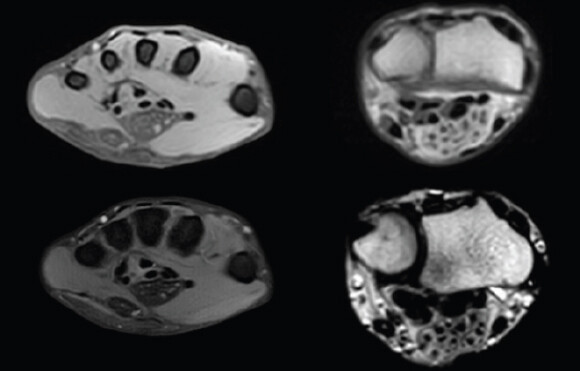
Ultrasound revealed thickening of the median and ulnar nerves from the base of the fingers to the wrist. MRI (Fig. 1) demonstrated diffuse thickening with adipose infiltration in the median nerve from the wrist to the distal metacarpus, with narrowing at the carpal tunnel and pathognomonic coaxial cable and spaghetti signs. Similar but less intense, findings were noted in the ulnar nerve.
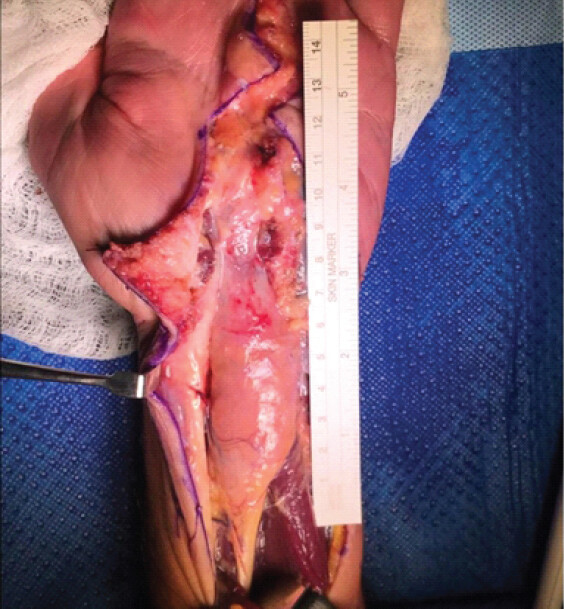
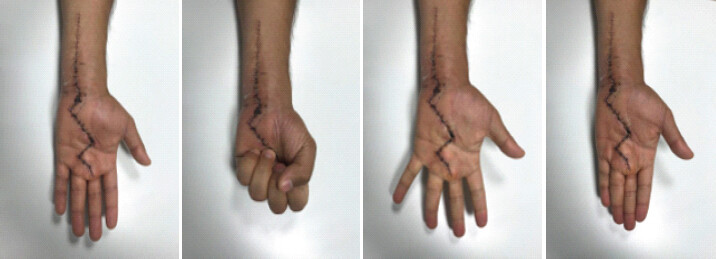
A multidisciplinary evaluation was performed by the hand surgery and musculoskeletal tumor teams. The patient underwent extended neurolysis of both the median and ulnar nerves with release of the carpal tunnel and Guyon’s canal (Fig. 2). Intraoperative biopsy revealed fibroadipose tissue without atypia, confirming LFH. Postoperatively, the patient experienced significant reduction in pain and sensory symptoms, with return to work at 2 months and sustained improvement at 12-month follow-up (Fig. 3).
Discussion
LFH is a rare peripheral nerve tumor characterized by fibroadipose infiltration of the epineurium and perineurium [1]. It most commonly involves the median nerve, though rare cases have been described in other nerves including the ulnar nerve [2,5]. Simultaneous involvement of both nerves in the same patient is extremely rare [2].
The etiology remains unclear, with theories ranging from congenital origin [6] to mechanical or inflammatory triggers [4]. Clinically, patients often present with paresthesia, dysesthesia, or soft-tissue swelling, and symptoms of carpal tunnel syndrome are frequent [7].
MRI is the gold standard for diagnosis, showing the classic coaxial cable and spaghetti appearances [3,8]. Histopathology confirms fibroadipose tissue infiltration between nerve fascicles, but biopsy is not always necessary given the characteristic imaging findings [1]. Differential diagnosis includes intraneural lipoma, traumatic neuroma, and vascular malformations [3].
Surgical strategies vary. Radical resection risks significant neurological deficits [9], while decompression with or without limited biopsy has shown good outcomes [6,9]. Recent series, such as that by Prabhu et al. [10], suggest that even excision with grafting may preserve function, but conservative management remains preferred in adults.
In our case, extended neurolysis with decompression achieved excellent pain relief and functional recovery, supporting conservative surgery as the optimal approach.
Conclusion
LFH of the median and ulnar nerves is extremely rare. MRI provides a pathognomonic diagnosis. Conservative surgery with extended neurolysis and decompression, without tumor resection, represents a safe and effective approach that preserves function.
Clinical Message
Fibrolipomatous hamartoma of the median and ulnar nerves is extremely rare. MRI provides a pathognomonic diagnosis, and conservative surgery with extended neurolysis – without tumor resection – offers a safe approach with good functional outcomes.
Conflict of Interest:
Nil
Source of Support:
Nil
Consent
The authors confirm that informed consent was obtained from the patient for publication of this article
How to Cite this Article
Alfaro PA, Silva LG, Hohf ME. Lipofibromatous Hamartoma of the Median and Ulnar Nerves: A Case Report. Journal of Orthopaedic Case Reports 2026 October;16(10): 103-105.
References
- Hoellwarth JS, Goitz RJ. Lipofibromatous hamartoma of the palmar cutaneous branch of the median nerve. J Hand Microsurg 2018;10:109-12. [Google Scholar] | [PubMed]
- Silverman TA, Enzinger FM. Fibrolipomatous hamartoma of nerve. A clinicopathologic analysis of 26 cases. Am J Surg Pathol 1985;9:7-14. [Google Scholar] | [PubMed]
- Nardella D, Sohawon S, Carlier A. Lipofibromatous hamartoma of the median nerve. Three case reports. J Plast Reconstr Aesthet Surg 2009;62:e314-7. [Google Scholar] | [PubMed]
- Guthikonda M, Rengachary S, Van Loveren H. Lipofibromatous hamartoma of the median nerve: Case report with magnetic resonance imaging correlation. Neurosurgery 1994;35:127-31. [Google Scholar] | [PubMed]
- Tahiri Y, Xu L, Kanevsky J, Luc M. Lipofibromatous hamartoma of the median nerve: A comprehensive review and systematic approach to evaluation, diagnosis, and treatment. J Hand Surg Am 2013;38:2055-67. [Google Scholar] | [PubMed]
- Warhold LG, Urban MA, Bora FWJrBrooks JS, Peters SB. Lipofibromatous hamartomas of the median nerve. J Hand Surg Am 1993;18:1032-7. [Google Scholar] | [PubMed]
- Louis DS, Hankin FM, Greene TL, Dick HM. Lipofibromas of the median nerve: Long-term follow-up of four cases. J Hand Surg Am 1985;10:403-8. [Google Scholar] | [PubMed]
- Marom EM, Helms CA. Fibrolipomatous hamartoma: Pathognomonic on MR imaging. Skeletal Radiol 1999;28:260-4. [Google Scholar] | [PubMed]
- Amadio PC, Herbert TJ, Dobyns JH. Lipofibromatous hamartoma of nerve. J Hand Surg Am 1988;13:67-75. [Google Scholar] | [PubMed]
- Prabhu A, Anil R, Kumar N. Fibrolipomatous hamartoma of the median nerve: Outcome of surgical management in six consecutive cases. Indian J Plast Surg 2017;50:345-51. [Google Scholar] | [PubMed]
© 2026 Journal of Orthopaedic Case Reports - Published by Indian Orthopaedic Research Group
About the Authors
-

Patricio A Alfaro
-

Lucas G Silva
-

Marion E. Hohf
Related Articles in Journal of Orthopaedic Case Reports
 June 10, 2023 Transscaphoid Transcapitate Perilunate Fracture-dislocation with Inferior Arc Injury and Acute Ulnar Nerve Compression: A Case Report
 December 1, 2025 Ulnar Nerve Cross-sectional Area among Ulnar Neuropathy Patients and Healthy Subjects – A Study in Hospital-based Population of Eastern India
 August 1, 2025 Hidden in Plain Palm: A Rare Case of Incidental Thenar Schwannoma
 April 1, 2025 Successful Management of a Rare Case of Arteriovenous Malformation of the Forearm in a 15-Year-Old Girl: A Case Report