


Introduction
Congenital transverse limb deficiencies are characterized by transverse arrest of limb development, resulting in absence of structures distal to the affected level. Although congenital upper-limb anomalies encompass a broad spectrum of developmental abnormalities, severe unilateral terminal transverse deficiencies are particularly uncommon [1,2]. According to the Oberg, Manske, and Tonkin (OMT) classification, transverse deficiencies are categorized within malformations resulting from abnormal axis formation and differentiation [3,4]. The presence of rudimentary distal structures, including soft-tissue nubbins and an osseous anlage, reflects incomplete limb development and may be related to disruption of apical ectodermal ridge (AER)-mediated proximodistal limb development during the early embryonic period [3,5,6].
Most available literature on congenital upper-limb deficiencies focuses on children and adolescents, particularly prosthetic use, rehabilitation, functional outcomes, and quality of life [7,8,9]. Consequently, the natural history and long-term functional adaptation of individuals who reach adulthood without surgical reconstruction, prosthetic use, or formal rehabilitation remain poorly documented. We report the clinical, radiographic, and functional characteristics of a 44-year-old treatment-naïve woman with congenital unilateral terminal transverse deficiency and a rudimentary distal osseous anlage, with particular emphasis on spontaneous long-term functional and biomechanical adaptation.
Case Report
A 44-year-old woman presented for a routine medical evaluation. She was the second of 12 children, and none of her 11 siblings had a known congenital anomaly. She was born at full term following an unmonitored pregnancy in a rural setting; her mother was 25 years old at the time of delivery. There was no reported history of consanguinity, maternal illness, radiation exposure, tobacco or alcohol use, or exposure to known teratogenic medications during pregnancy.
Clinical examination of the left upper extremity revealed a congenital terminal transverse deficiency at the distal forearm/wrist level, with absence of a normally formed hand. The terminal portion of the limb had a rounded, well-developed soft-tissue envelope with multiple rudimentary digital-like soft-tissue nubbins without recognizable nail formation (Figs. 1, 2, 3). There was no clinical evidence of previous reconstructive surgery.
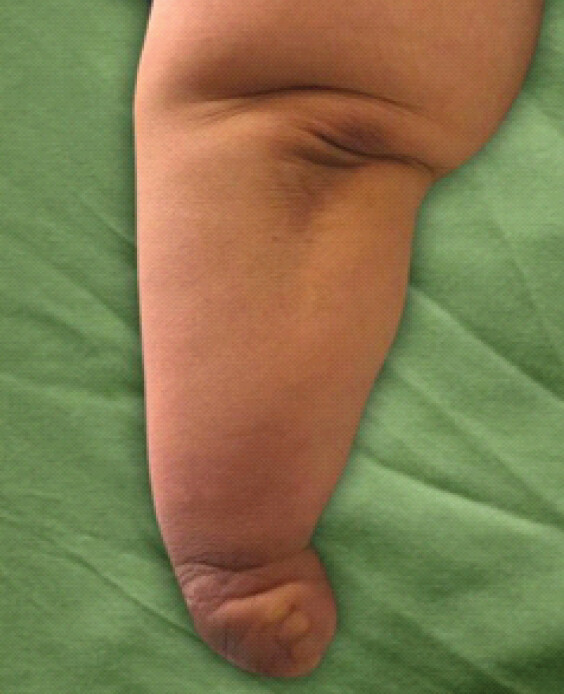
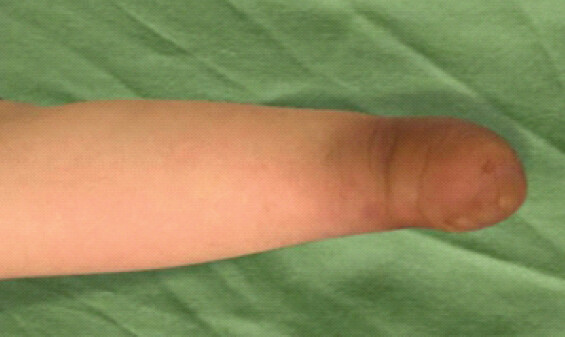
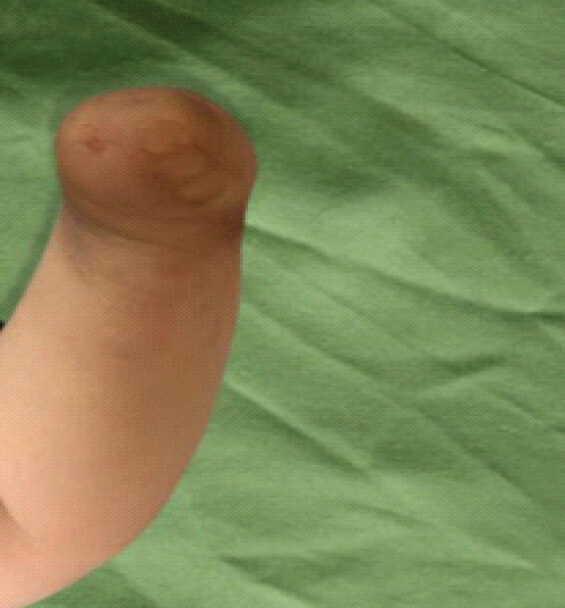
There were no constriction rings or cutaneous grooves, distal lymphedema, syndactyly, or acrosyndactyly in the affected limb, and no similar abnormalities were identified in the contralateral limbs, making amniotic band sequence clinically unlikely.
Active and passive ranges of motion of the left shoulder and elbow were preserved. Forearm rotation was restricted, with goniometric assessment demonstrating pronation from 0° to 40° and supination from 0° to 50°. Examination of the contralateral upper extremity, both lower extremities, and the spine revealed no associated clinically apparent congenital abnormalities.
Radiographic evaluation of the left forearm demonstrated a hypoplastic distal radius and ulna with absence of a normally formed wrist and hand. An irregular, dysplastic ossified structure was present distal to the radius and ulna within the terminal soft-tissue envelope, representing a rudimentary distal osseous anlage (Figs. 4 and 5). No normally formed metacarpal or phalangeal elements were identified. The overall radiographic morphology was consistent with a congenital terminal transverse deficiency with residual distal osseous development.
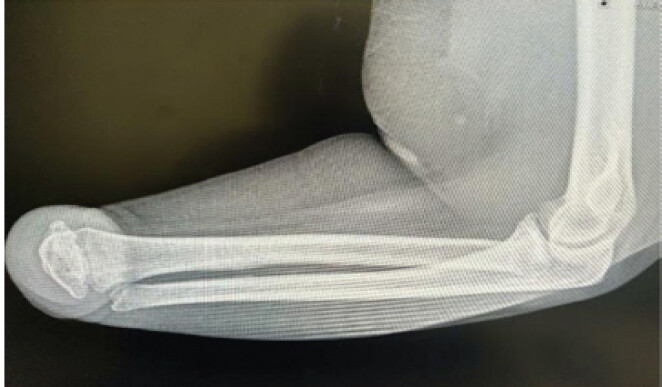
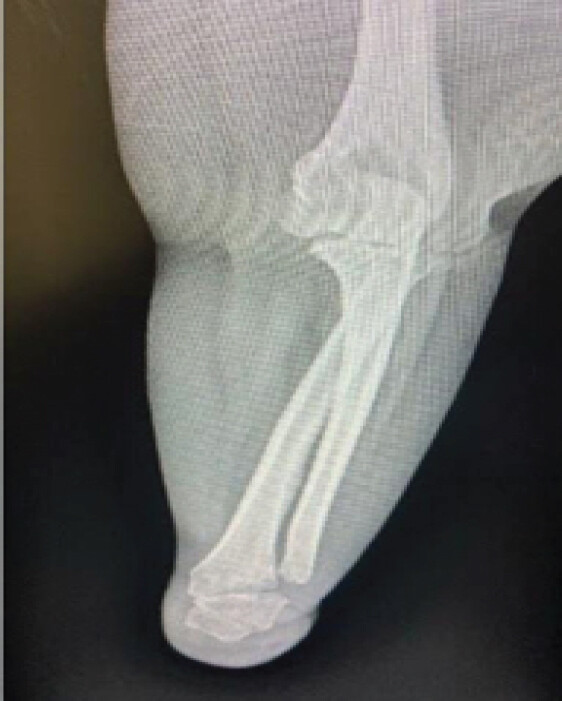
As the patient was asymptomatic with a longstanding congenital deformity and the osseous anatomy was adequately demonstrated on orthogonal plain radiographs, additional cross-sectional imaging with computed tomography or magnetic resonance imaging was not considered clinically indicated.
The patient had never undergone surgical reconstruction, prosthetic fitting, or formal physical or occupational therapy. To assess upper-extremity-related functional disability, the 11-item quick disabilities of the arm, shoulder, and hand (QuickDASH) questionnaire were administered [10]. The QuickDASH is a validated patient-reported outcome measure in which the final score ranges from 0 to 100, with higher scores representing greater disability [10].
Despite having received no surgical, prosthetic, or formal rehabilitative intervention, the patient demonstrated a high degree of functional independence. She independently managed her household and had raised two children.
The QuickDASH assessment yielded a raw score of 27 across the 11 items, corresponding to a standardized score of 36.36 out of 100. Functional limitations were most pronounced during bimanual activities requiring terminal grasp or pinch. She reported severe difficulty opening a tight or new jar (score 5) and substantial difficulty washing her back (score 4). Pain was minimal (score 2), and sleep was unaffected (score 1).
Assessment of activities of daily living demonstrated several well-established compensatory strategies. When cutting food (score 3), she stabilized the plate against the table using the distal aspect of the affected limb while manipulating the knife with her unaffected right hand. She carried shopping bags (score 2) by hooking the handles over the left elbow or by cradling objects against her torso. During heavier household activities (score 2), she used the residual limb to stabilize long-handled objects, thereby compensating for the absence of terminal grasp. These adaptations enabled her to perform most activities of daily living independently despite the absence of previous reconstructive, prosthetic, or formal rehabilitative intervention.
The remaining four QuickDASH items – recreational activities, interference with social activities, limitation in regular daily work, and tingling/paresthesia – accounted for a combined score of 8 points, completing the documented raw total of 27 across all 11 items.
Discussion
This case provides objective clinical and functional documentation of the long-term natural history of congenital unilateral terminal transverse deficiency in a treatment-naïve adult. The OMT classification provides a developmental framework for congenital anomalies of the upper limb based on disturbances in limb formation and differentiation [2,4]. In the present case, the combination of a terminal transverse deficiency, rudimentary distal soft-tissue nubbins, and a distinct distal osseous anlage represents an unusual morphological pattern within this spectrum. Although rudimentary distal structures have been described in congenital limb deficiencies such as symbrachydactyly [5], the precise developmental origin of the osseous structure in our patient cannot be determined from radiographs alone.
Normal proximodistal limb development depends on coordinated signaling involving the AER and underlying mesenchyme during embryogenesis [3,6]. Disruption of these developmental processes can result in varying degrees of transverse limb deficiency. The residual distal ossification observed in our patient may represent incomplete distal skeletal development rather than a completely arrested developmental process. However, in the absence of histological or advanced developmental evidence, the structure is most appropriately described morphologically as a rudimentary distal osseous anlage rather than assigning it a specific embryological origin.
The most clinically relevant feature of this case is the degree of functional adaptation achieved in the complete absence of surgical reconstruction, prosthetic use, or formal rehabilitation. At 44 years of age, the patient remained independent in most activities of daily living despite the absence of terminal grasp and pinch. Her QuickDASH score of 36.36 reflects persistent upper-extremity functional limitation; however, direct assessment demonstrated effective compensatory strategies for many everyday activities. She utilized the distal residual limb for stabilization, the elbow for hooking and carrying objects, and the trunk for additional support during bimanual activities. These adaptations illustrate how functional performance may evolve over decades in response to a congenital unilateral upper-limb deficiency.
Previous studies of congenital unilateral below-elbow deficiencies have primarily evaluated prosthetic use, rehabilitation, function, and quality of life in children and young individuals [7,8]. Prosthetic devices can provide important functional and cosmetic benefits for appropriately selected patients; however, their effect on overall function varies according to individual requirements and patterns of use [8]. Furthermore, upper-limb prosthesis abandonment remains an important consideration, with factors such as comfort, functional usefulness, and the development of alternative compensatory strategies influencing long-term acceptance [9].
The present case should not be interpreted as evidence against early prosthetic rehabilitation or reconstructive intervention. Rather, it emphasizes the importance of individualized assessment. Functional requirements, the degree of established compensatory adaptation, patient expectations, psychosocial factors, and the potential benefits of intervention should all be considered when planning management. In treatment-naïve adults who have developed effective compensatory strategies over many years, objective assessment of existing function is particularly important before recommending an intervention that may not necessarily improve the activities most relevant to the individual.
The principal limitation of this report is that it describes a single patient and therefore cannot be generalized to all individuals with congenital terminal transverse deficiencies. In addition, functional assessment was based primarily on the QuickDASH questionnaire and clinical observation, without formal occupational performance testing, instrumented biomechanical analysis, or longitudinal assessment. Nevertheless, this unusual treatment-naïve presentation provides an opportunity to document the natural functional adaptation that can occur over more than four decades in the absence of surgical, prosthetic, or formal rehabilitative intervention.
Conclusion
This case demonstrates the remarkable capacity for long-term functional adaptation in congenital unilateral terminal transverse deficiency. Despite the absence of surgical reconstruction, prosthetic use, or formal rehabilitation, the patient achieved substantial independence in activities of daily living through effective compensatory strategies developed over more than four decades. The presence of a rudimentary distal osseous anlage further highlights the morphological variability of congenital transverse limb deficiencies. This case emphasizes that management should be individualized, with careful consideration of existing function, patient expectations, and established compensatory mechanisms when evaluating the potential role of reconstructive or prosthetic intervention.
Clinical Message
Adults with congenital terminal transverse limb deficiency may develop substantial functional independence through long-term compensatory adaptation, even without surgical reconstruction, prosthetic use, or formal rehabilitation. Therefore, management should be individualized, with careful assessment of existing function, compensatory strategies, and patient expectations before recommending reconstructive or prosthetic intervention.
Conflict of Interest:
Nil
Source of Support:
Nil
Consent
The authors confirm that informed consent was obtained from the patient for publication of this article
How to Cite this Article
Shawer MIA, Ahmad S, Al Kindi MNS. Congenital Unilateral Terminal Transverse Deficiency with a Rudimentary Distal Osseous Anlage in a Treatment-Naïve Adult: A Case Report. J Orthop Case Rep. 2026 November;16(11):216-220. doi: 10.13107/jocr.2026.v16.i11.8446.
References
- Vij N, Goncalves LF, Llanes A, Youn S, Belthur MV. Prenatal radiographic evaluation of congenital transverse limb deficiencies: A scoping review. World J Orthop 2023;14:155-65. [Google Scholar] | [PubMed]
- Yeh JP, Kuo PJ, Lin TS, Chiang YC. Epidemiology of congenital upper-limb anomalies in Southern Taiwan based on the updated Oberg, Manske, and Tonkin classification: A series of 1,335 anomalies in 1,188 patients. J Hand Surg Am 2025;50:231.e1-10. [Google Scholar] | [PubMed]
- Oberg KC, Feenstra JM, Manske PR, Tonkin MA. Developmental biology and classification of congenital anomalies of the hand and upper extremity. J Hand Surg Am 2010;35:2066-76. [Google Scholar] | [PubMed]
- Tonkin MA, Tolerton SK, Quick TJ, Harvey I, Lawson RD, Smith NC. Classification of congenital anomalies of the hand and upper limb: Development and assessment of a new system. J Hand Surg Am 2013;38:1845-53. [Google Scholar] | [PubMed]
- Goodell PB, Bauer AS, Sierra FJ, James MA. Symbrachydactyly. Hand (N Y) 2016;11:262-70. [Google Scholar] | [PubMed]
- Zeller R, López-Ríos J, Zuniga A. Vertebrate limb bud development: Moving towards integrative analysis of organogenesis. Nat Rev Genet 2009;10:845-58. [Google Scholar] | [PubMed]
- Vasluian E, De Jong IG, Janssen WG, Poelma MJ, Van Wijk I, Reinders-Messelink HA. Opinions of youngsters with congenital below-elbow deficiency, and those of their parents and professionals concerning prosthetic use and rehabilitation treatment. PLoS One 2013;8:e67101. [Google Scholar] | [PubMed]
- James MA, Bagley AM, Brasington K, Lutz C, McConnell S, Molitor F. Impact of prostheses on function and quality of life for children with unilateral congenital below-the-elbow deficiency. J Bone Joint Surg Am 2006;88:2356-65. [Google Scholar] | [PubMed]
- Biddiss EA, Chau TT. Upper limb prosthesis use and abandonment: A survey of the last 25 years. Prosthet Orthot Int 2007;31:236-57. [Google Scholar] | [PubMed]
- Gummesson C, Ward MM, Atroshi I. The shortened disabilities of the arm, shoulder and hand questionnaire (QuickDASH): Validity and reliability based on responses within the full-length DASH. BMC Musculoskelet Disord 2006;7:44. [Google Scholar] | [PubMed]
© 2026 Journal of Orthopaedic Case Reports - Published by Indian Orthopaedic Research Group
About the Authors
-

Mohamed Ibrahim Aly Shawer
-

Shakil Ahmad
-

Mohammed Nasser Said Al Kindi
Related Articles in Journal of Orthopaedic Case Reports
 October 1, 2026 Congenital Asymmetrical Multiple Limb Deficiency in 1-Year-Old Male Child: A Case Report
 October 1, 2026 Tibial Plateau Fracture in a Patient with Fibular Hemimelia: A Case Report
 May 1, 2026 Complications of Limb Salvage in Concordant Bilateral Fibular Hemimelia and Tetramelic Ectrodactyly: A Case Report
 March 10, 2024 Isolated Bilateral Upper Limb Amelia – A Rare Case Report