


Introduction
Post-operative pain management in orthopedic surgery should be viewed as part of a recovery pathway rather than as an isolated attempt to minimize pain scores. Nearly half of adults undergoing surgery experience moderate or severe post-operative pain, and inadequate pain management may impair recovery and function [1]. Contemporary perioperative guidance emphasizes assessment of pain in relation to function, multimodal analgesia, regional anesthesia where appropriate, non-pharmacological measures and safe opioid use [1,2]. In orthopedic practice, the relevant functional endpoint varies with the procedure. After total knee arthroplasty, early knee movement and mobilization are priorities; after fracture fixation, analgesia must coexist with limb elevation, weight-bearing or range-of-motion restrictions and, where relevant, serial neurological and vascular assessment; after hip arthroplasty, early mobilization is usually central to recovery. Thus, the analgesic regimen should be judged not only by pain intensity but also by whether it enables the required rehabilitation task without introducing clinically important adverse effects.
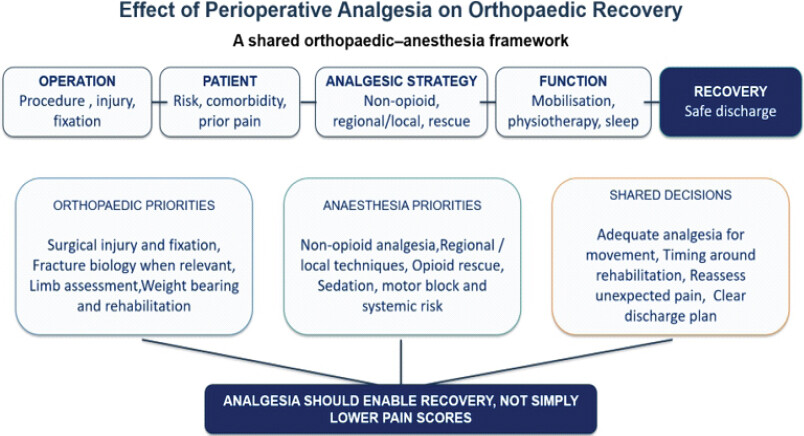
Multimodal analgesia is widely used, but its individual components do not have interchangeable evidence or identical clinical value. Recent evidence-based guidance supports combining interventions with complementary mechanisms while avoiding interventions that add little benefit or interfere with recovery [2,3,4,5,6,7]. Procedure-specific recommendations are particularly informative because the background analgesic regimen changes the incremental effect of a block, local infiltration technique, or rescue opioid. The updated PROSPECT recommendation for total hip arthroplasty retained scheduled paracetamol and an NSAID or COX-2 inhibitor plus a single perioperative dose of dexamethasone as the core regimen, while recommending selected motor-sparing regional techniques and not routinely recommending techniques with inconsistent efficacy or undesirable motor effects [7]. This review therefore takes a critical, procedure-specific approach rather than treating multimodal analgesia as a fixed bundle. The orthopedic surgeon contributes knowledge of tissue injury, fixation or reconstruction, fracture biology, limb assessment and rehabilitation, whereas the anesthesiologist contributes expertise in regional techniques, systemic analgesia and perioperative risk. Their shared objective is a strategy that provides sufficient analgesia for recovery without obscuring complications or creating avoidable treatment-related harm. The overall framework is shown in Fig. 1.
Review Methodology and Scope
This article is intended as a narrative review with a structured literature search rather than a systematic review or meta-analysis. PubMed/MEDLINE was searched using combinations of terms related to orthopedic surgery, post-operative pain, multimodal analgesia, regional anesthesia, opioids, NSAIDs, fracture healing, arthroplasty, persistent post-surgical pain and enhanced recovery. Priority was given to recent systematic reviews and meta-analyses, randomized controlled trials, consensus statements and procedure-specific guidelines; earlier high-quality studies were retained when they provided foundational evidence. Searches and reference verification were updated through September 2026. Evidence was not pooled quantitatively because the procedures, interventions, and outcomes were heterogeneous. Findings were synthesized according to procedure, functional objective, analgesic benefit, adverse effects, and limitations of the available evidence. This makes the evidentiary basis and limitations of the review explicit.
Pain management should be planned around recovery
The most useful question after orthopedic surgery is not simply whether pain is present, but whether pain is preventing an important activity or signaling an unexpected problem. Pain at rest, pain during movement and pain severe enough to disturb sleep have different clinical implications. A moderate pain score during supervised physiotherapy may be acceptable if the patient can participate, whereas a similar score at rest with inability to sleep may require a different response. Conversely, a low pain score accompanied by sedation, hypotension or weakness is not necessarily a successful outcome. The 2024 multidisciplinary consensus recommends assessing pain to facilitate function and extending the analgesic plan across the perioperative pathway [1]. The evidence therefore supports recovery-oriented analgesia, but the strength of evidence for individual interventions varies considerably. Analgesia should be linked to the rehabilitation plan from the beginning, including the expected time of mobilization, weight-bearing status, need for neurological assessment and anticipated discharge pathway.
The orthopedic–anesthesia interface
The operation is the starting point for analgesic planning because tissue injury, surgical approach, expected movement and the consequences of excessive motor block differ substantially between procedures. Patient factors then modify that baseline. Previous opioid exposure, chronic pain, renal or hepatic dysfunction, gastrointestinal or cardiovascular disease, anticoagulation, frailty, sleep-disordered breathing and previous adverse reactions may change which components of a multimodal regimen are appropriate [1,2]. A fixed “orthopedic analgesia protocol” therefore has important limitations. A regimen designed for uncomplicated elective arthroplasty should not automatically be transferred to an older patient with hip fracture, a patient undergoing complex fracture reconstruction, or a patient after ligament reconstruction.
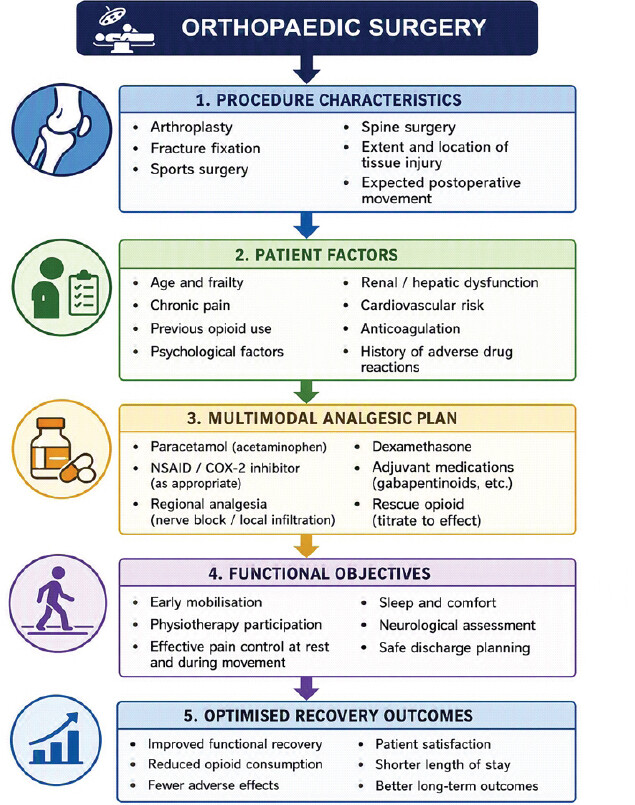
This distinction is clinically important because analgesic choices may affect not only comfort but also mobilization, fall risk, neurological examination and discharge readiness. The anesthetic consultation should identify previous analgesic use and factors associated with difficult post-operative pain, while the surgeon should define the functional and biological priorities of the operation. The resulting plan should specify the baseline non-opioid regimen, whether regional or local techniques are appropriate, how rescue opioids will be used, and what constitutes unexpected pain requiring reassessment rather than simply another dose of medication. Fig. 2 summarize these shared determinants.
The anesthetic consultation is an opportunity to identify these differences before surgery. Previous analgesic use and the likelihood of difficult post-operative pain should be recorded, while the surgeon can define the functional and biological priorities of the procedure. The resulting plan should specify the baseline non-opioid regimen, whether regional or local techniques are appropriate, how rescue opioids will be used, and what constitutes unexpected pain requiring reassessment rather than simply another dose of medication. The key determinants of perioperative analgesic planning and their relationship to post-operative recovery are summarized in Fig. 3.
Regional analgesia: Effective, but not in isolation
Regional anesthesia can provide strong early analgesia and reduce opioid exposure, but the evidence is procedure-specific and the benefit is not necessarily sustained. In distal radius fracture surgery, a meta-analysis of randomized trials found lower pain scores in the early post-operative period and lower early opioid consumption with regional compared with general anesthesia, but the early advantage diminished and opioid use increased after discharge, consistent with possible rebound pain [8]. In operative tibia and ankle fracture patients, peripheral nerve blocks improved satisfaction, time spent in severe pain, and 24-h quality of recovery, but the benefit was not maintained at 48 h in that cohort [9]. These findings illustrate two limitations: The effect of regional techniques depends on the background analgesic regimen, and early analgesic superiority does not necessarily translate into better longer-term recovery. Motor weakness, fall risk, and interference with serial neurological examination must also be considered [9,10]. Regional techniques should therefore be selected for their fit with the procedure and recovery pathway, not simply because they produce the largest reduction in pain scores.
The same principle applies to lower-limb surgery. Motor weakness may interfere with mobilization or increase fall risk, while dense analgesia can complicate the clinical assessment of a limb when neurological or vascular findings remain important. Regional techniques should therefore be selected for their fit within the recovery pathway rather than for analgesic intensity alone [9,10].
The updated 2026 PROSPECT recommendation for total hip arthroplasty illustrates this principle. It retained scheduled paracetamol and an NSAID or COX-2 inhibitor with a single intravenous dose of dexamethasone as core therapy and identified supra-inguinal fascia iliaca and pre-operative pericapsular nerve group blocks as the regional techniques with the most consistent analgesic evidence. Quadratus lumborum and lumbar erector spinae plane blocks were not recommended because efficacy was inconsistent and motor weakness was a concern; local infiltration analgesia remained an alternative when regional anesthesia was not feasible [7]. In primary total knee arthroplasty, PROSPECT similarly recommends a baseline non-opioid regimen combined with a single-shot adductor canal block and peri-articular local infiltration, while reserving opioids for rescue [11]. These recommendations demonstrate why procedure-specific pathways are preferable to a generic “multimodal bundle.” The relevant question is which component adds clinically meaningful benefit to the established regimen without compromising mobilization or safety.
Procedure-specific analgesic priorities
Procedure-specific guidance is particularly useful because analgesic priorities differ across common orthopedic operations. Elective total hip and knee arthroplasty generally emphasizes rapid mobilization within an enhanced recovery pathway, whereas fracture fixation may require preservation of neurological assessment, attention to swelling and compartment syndrome, and a more cautious approach to NSAID exposure when fracture healing is a major concern. Ligament reconstruction and other sports procedures often involve substantial early pain but rapid functional rehabilitation, making motor-sparing techniques attractive when they do not compromise examination or rehabilitation. PROSPECT provides defined pathways for total hip and knee arthroplasty [7,11], while systematic review evidence in anterior cruciate ligament reconstruction demonstrates differences among regional techniques, spinal anesthesia, and local analgesic strategies [12]. A concise procedure-based framework is provided in Table 1.
Procedure-specific priorities for perioperative analgesia in common orthopedic procedures
| Procedure | Primary functional priority | Reasonable core strategy | Important caution |
|---|---|---|---|
| Primary total hip arthroplasty | Early mobilization and safe discharge | Scheduled paracetamol+NSAID/COX-2 inhibitor, single-dose dexamethasone; selected motor-sparing regional/local techniques | Avoid unnecessary motor block; consider renal, gastrointestinal and bleeding risks [5]. |
| Primary total knee arthroplasty | Early knee movement, mobilization and physiotherapy | Paracetamol+NSAID/COX-2 inhibitor; adductor canal block+peri-articular local infiltration; dexamethasone; opioid rescue | Avoid unnecessary motor block; reassess disproportionate pain [11]. |
| Fracture fixation | Pain control compatible with limb assessment and prescribed rehabilitation | Multimodal non-opioid baseline with selective regional/local techniques and rescue opioid when required | Consider serial neurovascular examination, compartment syndrome and fracture-healing concerns; NSAID risk appears dose/duration/context dependent [7,9,10,11,12]. |
| ACLR/sports reconstruction | Early functional rehabilitation with adequate analgesia | Procedure-specific multimodal regimen; regional or local techniques selected according to motor requirements | Evidence is heterogeneous; regional techniques may differ in early pain outcomes [12]. |
NSAIDs: Non-steroidal anti-inflammatory drugs, ACLR: Anterior cruciate ligament reconstruction
Non-opioid analgesia and the NSAID–bone healing question
Paracetamol remains a practical baseline component of multimodal analgesia, although its individual analgesic effect is modest. NSAIDs and COX-2 inhibitors can provide opioid-sparing analgesia after many orthopedic procedures, but fracture surgery raises a distinct concern about bone healing. The evidence is conflicting and is substantially influenced by study design, indication, drug, dose, and duration. A 2024 systematic review and meta-analysis of 20 studies involving 523,240 patients found no statistically significant difference in delayed union or non-union between NSAID users and non-users (adjusted odds ratio [OR] 1.11, 95% confidence interval [CI] 0.99–1.23), but the evidence was largely observational and individual drug and dose effects were incompletely characterized [13]. A meta-analysis restricted to randomized trials reported an increased overall non-union signal, with risk concentrated in longer exposure, whereas short courses of <2 weeks were not associated with a statistically significant increase [14]. A 2025 critical review similarly concluded that adult clinical studies frequently identify NSAID exposure as a risk factor, but emphasized substantial heterogeneity and insufficient evidence to define a universally safe drug, dose, or duration [15]. The 2026 umbrella review and reconstructed meta-analysis found an overall association with non-union (OR 1.56, 95% CI 1.18–2.11), particularly in adults and long-bone fractures, while no increased risk was detected with exposure of 14 days or less; importantly, the authors judged much of the underlying evidence to be low or critically low [16]. Thus, the literature does not justify either blanket avoidance or unrestricted use. In a patient at high risk of non-union, prolonged or high-dose NSAID exposure should be weighed carefully against alternative analgesic strategies. Conversely, a short, clinically justified course in a lower-risk setting may be reasonable. This distinction should be discussed jointly by the surgeon and anesthesiologist.
For clinical practice, these findings argue against both blanket avoidance and indiscriminate prescribing. The decision should consider fracture type, mechanical and biological risk, patient comorbidity, NSAID choice, dose and duration, and available alternatives. This is an area where the anesthesiologist’s analgesic objective and the orthopedic surgeon’s concern about healing need to be considered together.
Opioids: Rescue treatment, not a measure of failure
Opioids remain appropriate for patients with significant post-operative pain despite an adequate multimodal regimen. Opioid-sparing care should not be confused with an opioid-free rule. A small randomized double-blind trial in opioid-naive patients undergoing total knee arthroplasty found no significant differences in pain scores or length of stay when a Schedule II opioid was omitted from an otherwise multimodal regimen, although the trial was small and four patients withdrew early because of pain [17,18]. This supports selective opioid reduction but cannot establish that opioids are unnecessary for all patients. Repeated rescue dosing should prompt review of the baseline regimen, block duration, pain trajectory, and possibility of a surgical complication. Opioid consumption is also an imperfect surrogate for recovery because a lower dose may reflect undertreatment, while a higher dose may be appropriate in an individual with severe tissue injury or opioid tolerance [19]. The clinically relevant endpoint is adequate analgesia with the lowest exposure that remains compatible with function and safety.
When severe pain should trigger a clinical review
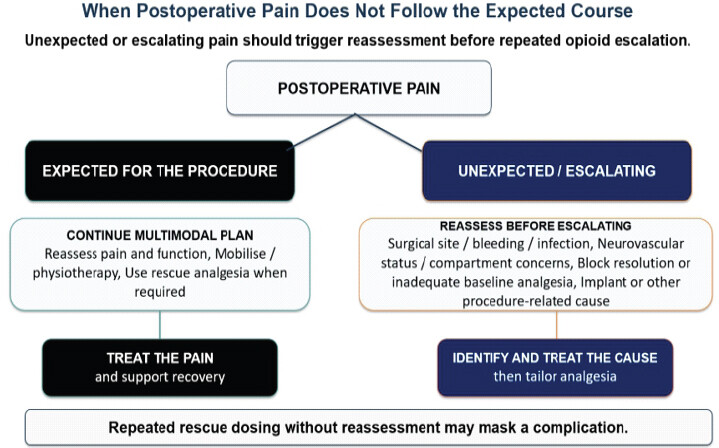
Unexpectedly severe or escalating post-operative pain should not automatically be interpreted as a requirement for stronger analgesia. Depending on the procedure, it may indicate bleeding, hematoma, infection, vascular compromise, nerve injury, compartment syndrome, implant-related problems or another surgical complication. This point is especially important in fracture surgery. Analgesia must coexist with appropriate assessment of the operated limb. Regional techniques can be valuable, but the decision to use them should take account of the clinical circumstances and the need for serial examination [9,10]. The practical rule is simple, when the severity or pattern of pain is unexpected, the first response should sometimes be “Why is this patient in so much pain?” rather than “How much more analgesia can be given?” A practical approach to unexpected or escalating post-operative pain is shown in Fig. 2.
Persistent pain after orthopedic surgery
Good acute analgesia is important, but it should not be presented as a proven method of preventing chronic pain. A 2025 systematic review and meta-analysis of 49 randomized trials found no perioperative analgesic intervention that clearly reduced pain 3–24 months after total hip or knee arthroplasty; duloxetine reduced movement pain statistically, but the difference was smaller than the pre-defined threshold for clinical importance [20]. Persistent pain is also influenced by factors that precede surgery [21]. A systematic review and meta-analysis of 81 studies involving 171,354 patients identified pre-operative pain and psychological factors among variables associated with persistent pain after hip or knee replacement, although substantial heterogeneity limited quantitative synthesis [22]. A 2026 systematic review after hip replacement similarly identified pre-operative pain, functional disability, sleep disturbance, anxiety, depressive symptoms, central sensitization, and pain catastrophizing as relevant biopsychosocial factors [23]. These findings support risk stratification and early recognition rather than assuming that more intensive perioperative analgesia will prevent persistent pain. When pain persists after arthroplasty, structural causes must also be considered. A 2025 systematic review of painful hip arthroplasty identified diagnoses, including loosening, infection, iliopsoas impingement, referred lumbar pain and greater trochanteric pain [24]. Persistent pain should therefore trigger appropriate clinical evaluation, rehabilitation and, where indicated, targeted pain management rather than automatic escalation of analgesic medication.
Where the evidence is still unsettled
Several areas remain uncertain and should temper strong clinical claims. First, the incremental benefit of an analgesic intervention depends on the background regimen and the procedure, so results from one operation cannot automatically be generalized to another. Second, regional techniques may improve early pain and opioid consumption without demonstrating durable effects on persistent pain or overall recovery [8,9,25]. Third, opioid consumption is an important stewardship outcome but is not synonymous with quality of recovery. Fourth, the NSAID-bone healing literature remains inconsistent, with recent reviews reaching different conclusions and the newest evidence suggesting that any risk is likely to be modified by drug, dose, duration, patient age, and fracture context [13,14,15,16]. Finally, persistent pain after arthroplasty is common enough to justify proactive assessment, but prevalence estimates vary because definitions, time points and assessment methods differ [26]. These uncertainties are not weaknesses of the clinical framework; rather, they define where individualized decision-making is necessary.
A Practical Shared Model
A perioperative analgesic plan is most effective when established collaboratively around the surgical procedure, patient-specific risk profiles, and post-operative functional milestones. Rather than repeating specific pharmacological dosages throughout the text, Table 2 provides an operational decision-making framework structured around five core perioperative questions, in keeping with enhanced recovery and practice-pathway approaches to multimodal analgesia and regional anesthesia after arthroplasty [27,28,29].
Shared orthopedic–anesthesia perioperative decision framework
| Clinical question | Orthopedic considerations | Anesthesia considerations | Shared decision |
|---|---|---|---|
| What operation is being performed? | Surgical approach, tissue injury, fixation or reconstruction, expected pain, and rehabilitation requirements. | Expected analgesic intensity, regional block options, and anesthetic risk. | Choose an analgesic strategy appropriate for the specific surgical procedure. |
| What is different about this patient? | Frailty, fracture characteristics, preexisting chronic pain, baseline functional status. | Prior opioid exposure, renal/hepatic function, cardiovascular/GI risk, anticoagulation, adverse drug reactions. | Modify the standard pathway according to patient-specific risk profiles. |
| What should be given before and during surgery? | Surgical requirements, need for serial post-operative neurovascular examination or early joint movement. | Baseline non-opioid analgesia, intravenous dexamethasone, motor-sparing regional/local infiltration techniques. | Select targeted interventions with demonstrated, procedure-specific efficacy. |
| What does the patient need to do after surgery? | Weight-bearing status, joint range of motion, physical therapy timing, neurovascular surveillance. | Duration of regional blocks; timing of oral analgesics; avoidance of excessive sedation or motor block. | Align analgesia timing with mobilization, physiotherapy, and functional goals. |
| When are opioids needed? | Severity and trajectory of pain; ruling out surgical complications (e.g., compartment syndrome, hematoma). | Titration protocol, monitoring, adverse-effect prevention, and multimodal opioid-sparing strategies. | Restrict opioids to rescue therapy for breakthrough pain; re-evaluate when requirements escalate unexpectedly. |
| What happens after discharge? | Expected functional recovery, rehabilitation milestones, red-flag warning signs. | Medication tapering instructions, limit on opioid prescription duration, side-effect management. | Provide a clear, written post-discharge analgesic plan with an accessible route for clinical reassessment. |
GI: Gastrointestinal
Limitations of the evidence
This review has limitations. The literature is heterogeneous, with procedure-specific guidelines, randomized trials, observational studies, and systematic reviews addressing different interventions and outcomes. The review was not designed as a formal systematic review, and no quantitative meta-analysis was undertaken. Consequently, the framework should be interpreted as an evidence-informed clinical synthesis rather than a graded guideline. Some recommendations, particularly around regional techniques and NSAID exposure after fracture surgery, remain sensitive to the quality and applicability of the underlying studies.
Conclusion
Orthopedic pain management should not be reduced to a choice between opioids, non-opioid drugs or regional anesthesia. The evidence supports a procedure-specific multimodal strategy, but the strength of evidence differs across interventions and operations. The relevant decision is whether the overall strategy provides sufficient analgesia for mobilization, sleep and rehabilitation while respecting fracture biology, neurological assessment and patient-specific safety. Regional techniques should be selected for demonstrated procedure-specific benefit and acceptable motor and examination effects; NSAIDs should be prescribed with attention to dose, duration and fracture-healing risk; and opioids should remain available as appropriately monitored rescue therapy. Unexpected or escalating pain should prompt clinical reassessment rather than reflex analgesic escalation. The most defensible model is therefore collaborative, recovery-focused and explicitly responsive to uncertainty in the evidence.
Clinical Message
Recovery-oriented analgesia is the cornerstone of modern orthopedic perioperative care. A procedure-specific multimodal plan should facilitate mobilization, physiotherapy and safe discharge while minimizing avoidable opioid exposure and treatment-related adverse effects. The choice of regional techniques, NSAIDs and opioids should be individualized according to the quality and limitations of the evidence for the procedure being performed. Severe, atypical, or escalating post-operative pain warrants timely assessment for an underlying complication rather than automatic escalation of analgesic medication.
Conflict of Interest:
Nil
Source of Support:
Nil
Consent:
Not Applicable
How to Cite this Article
Bhadani JS, Kumar I, Kumari P, Akhileshwar, Kashyap N, Kumar S. Pain Management in Orthopedic Surgery: A Procedure-Specific Orthopedic–Anesthesia Approach to Perioperative Analgesia. J Orthop Case Rep. 2026 November;16(11):585-593. doi: 10.13107/jocr.2026.v16.i11.8558.
References
- El-Boghdadly K, Levy NA, Fawcett WJ, Knaggs R, Laycock H, Baird E. Peri-operative pain management in adults: A multidisciplinary consensus statement from the association of anaesthetists and the British pain society. Anaesthesia 2024;79:1220-36. [Google Scholar] | [PubMed]
- Mojica JL, Rubin D, Mastria M, Baratta JL. Updates on multimodal analgesia for orthopedic surgery. Anesthesiol Clin 2025;43:625-43. [Google Scholar] | [PubMed]
- Van Eijk LT, Van Den Heuvel SA, Van Boekel RL, Van Der Meer R, Bruhn J, Wever KE. The effect of adding a second multimodal analgesic component to anesthesia regimens on acute postoperative pain outcomes: A systematic review and meta-analysis. BMC Anesthesiol 2026;26:225. [Google Scholar] | [PubMed]
- Kincaid S, How J, Agrawal DK. Multimodal analgesia in the perioperative period of major surgeries: An in-depth analysis. Anesth Crit Care 2025;7:68-76. [Google Scholar] | [PubMed]
- Soffin EM, Wu CL. Regional and multimodal analgesia to reduce opioid use after total joint arthroplasty: A narrative review. HSS J 2019;15:57-65. [Google Scholar] | [PubMed]
- Wainwright TW, Gill M, McDonald DA, Middleton RG, Reed M, Sahota O. Consensus statement for perioperative care in total hip replacement and total knee replacement surgery: Enhanced recovery after surgery (ERAS(®)) society recommendations. Acta Orthop 2020;91:3-19. [Google Scholar] | [PubMed]
- Carella M, Bugada D, Van De Velde M, Beloeil H, Albrecht E, Lavandhomme P. PROSPECT guideline for total hip arthroplasty: Updated systematic review and procedure-specific postoperative pain management recommendations. Anaesthesia 2026;81:312-25. [Google Scholar] | [PubMed]
- Roh YH, Park SG, Lee SH. Regional versus general anesthesia in postoperative pain management after distal radius fracture surgery: Meta-analysis of randomized controlled trials. J Pers Med 2023;13:1543. [Google Scholar] | [PubMed]
- Elkassabany N, Cai LF, Mehta S, Ahn J, Pieczynski L, Polomano RC. Does regional anesthesia improve the quality of postoperative pain management and the quality of recovery in patients undergoing operative repair of tibia and ankle fractures?. J Orthop Trauma 2015;29:404-9. [Google Scholar] | [PubMed]
- Boujeke EJ, Luginaah NA, Lin C. Advancements and controversies in regional anesthesia: A review. Asian J Anesthesiol 2024;62:179-86. [Google Scholar] | [PubMed]
- Lavand'homme PM, Kehlet H, Rawal N, Joshi GP. PROSPECT Working Group of the European Society of Regional Anaesthesia and Pain Therapy (ESRA) Pain management after total knee arthroplasty: Procedure specific postoperative pain management recommendations. Eur J Anaesthesiol 2022;39:743-57. [Google Scholar] | [PubMed]
- Maheshwer B, Knapik DM, Polce EM, Verma NN, LaPrade RF, Chahla J. Contribution of multimodal analgesia to postoperative pain outcomes immediately after primary anterior cruciate ligament reconstruction: A systematic review and meta-analysis of level 1 randomized clinical trials. Am J Sports Med 2021;49:3132-44. [Google Scholar] | [PubMed]
- Chuang PY, Yang TY, Tsai YH, Huang KC. Do NSAIDs affect bone healing rate, delay union, or cause non-union: An updated systematic review and meta-analysis. Front Endocrinol (Lausanne) 2024;15:1428240. [Google Scholar] | [PubMed]
- Al Farii H, Farahdel L, Frazer A, Salimi A, Bernstein M. The effect of NSAIDs on postfracture bone healing: A meta-analysis of randomized controlled trials. OTA Int 2021;4:e092. [Google Scholar] | [PubMed]
- Stroud SG, Passfall L, Alam JS, Segreto FA, Baum R, Shah NV. Do non-steroidal anti-inflammatory drugs (NSAIDs) adversely impact fracture healing? A critical review of the literature. Curr Rev Musculoskelet Med 2025;18:504-12. [Google Scholar] | [PubMed]
- Komargodski R, Kittany S, Abu-Kishk I, Beeri Berkovitch R, Epstein D, Matok I. NSAID use and bone healing: An umbrella review with a reconstructed meta-analysis. J Am Acad Orthop Surg 2026;34:88-98. [Google Scholar] | [PubMed]
- Young PF, Roberts C, Shi GG, Heckman MG, White L, Clendenen S. Total knee arthroplasty with and without schedule II opioids: A randomized, double-blinded, placebo-controlled trial. J Arthroplasty 2024;39:1980-6. [Google Scholar] | [PubMed]
- Shrestha S, Khatiwada AP, Sapkota B, Sapkota S, Poudel P, Kc B. What is “opioid stewardship”? An overview of current definitions and proposal for a universally acceptable definition. J Pain Res 2023;16:383-94. [Google Scholar] | [PubMed]
- Incze MA, Kelley AT, Gordon AJ. Improving opioid use disorder treatment through quality assessment. J Gen Intern Med 2021;36:2820-2. [Google Scholar] | [PubMed]
- Laigaard J, Karlsen A, Maagaard M, Haxholdt Lunn T, Mathiesen O, Overgaard S. Perioperative analgesic interventions for reduction of persistent postsurgical pain after total hip and knee arthroplasty: A systematic review and meta-analysis. Anesth Analg 2025;141:765-78. [Google Scholar] | [PubMed]
- Kashir I, Shanthanna H, Khanna V, Mbuagbaw L, Tushinski D, Busse JW. Satisfaction and persistent pain outcomes after knee arthroplasty: A prospective cohort study. J Arthroplasty 2026;41:1120-8. [Google Scholar] | [PubMed]
- Ghoshal A, Bhanvadia S, Singh S, Yaeger L, Haroutounian S. Factors associated with persistent postsurgical pain after total knee or hip joint replacement: A systematic review and meta-analysis. Pain Rep 2023;8:e1052. [Google Scholar] | [PubMed]
- Smits RJ, Poppen R, Visser J, Vissers KC, Van Der Wal SE. Biopsychosocial predictive factors for developing chronic postsurgical pain after hip replacement surgery: A systematic review. Osteoarthr Cartil Open 2026;8:100725. [Google Scholar] | [PubMed]
- Hulin K, Fearon A, Newman P. What are the diagnoses attributed to persistent hip pain after hip arthroplasty? A systematic review. J Clin Orthop Trauma 2025;67:103036. [Google Scholar] | [PubMed]
- Pepper CG, Mikhaeil JS, Khan JS. Perioperative regional anesthesia on persistent opioid use and chronic pain after noncardiac surgery: A systematic review and meta-analysis of randomized controlled trials. Anesth Analg 2024;139:711-22. [Google Scholar] | [PubMed]
- Cheng HY, Beswick AD, Bertram W, Siddiqui MA, Gooberman-Hill R, Whitehouse MR. What proportion of people have long-term pain after total hip or knee replacement? An update of a systematic review and meta-analysis. BMJ Open 2025;15:e088975. [Google Scholar] | [PubMed]
- Kandarian BS, Elkassabany NM, Tamboli M, Mariano ER. Updates on multimodal analgesia and regional anesthesia for total knee arthroplasty patients. Best Pract Res Clin Anaesthesiol 2019;33:111-23. [Google Scholar] | [PubMed]
- Kopp SL, Børglum J, Buvanendran A, Horlocker TT, Ilfeld BM, Memtsoudis SG. Anesthesia and analgesia practice pathway options for total knee arthroplasty: An evidence-based review by the American and European societies of regional anesthesia and pain medicine. Reg Anesth Pain Med 2017;42:683-97. [Google Scholar] | [PubMed]
- Soffin EM, YaDeau JT. Enhanced recovery after surgery for primary hip and knee arthroplasty: A review of the evidence. Br J Anaesth 2016;117 Suppl 3:i62-72. [Google Scholar] | [PubMed]
© 2026 Journal of Orthopaedic Case Reports - Published by Indian Orthopaedic Research Group
About the Authors
-

Janki Sharan Bhadani
-

Indrajeet Kumar
-

Priyanka Kumari
-

Akhileshwar
-

Nishant Kashyap
-

Santosh Kumar
Related Articles in Journal of Orthopaedic Case Reports
 November 1, 2026 Optimizing Post-operative Analgesia for Early Rehabilitation after Orthopedic Knee Surgery: A Randomized Comparison of Adductor Canal, Infiltration between the Popliteal Artery and Capsule of the Posterior Knee and Genicular Nerve Blocks
 August 1, 2026 The Effect of Intraarticular Platelet-Rich Plasma Injection in Knee Osteoarthritis
 May 1, 2026 Opioid-Sparing Multimodal Analgesia versus Standard Analgesia in Hip Fracture Surgery: A Prospective Study
 May 1, 2026 The Impact of Medial Cortical Reduction on the Outcomes of Fixation in Unstable Intertrochanteric Fractures