


Introduction
Injuries to the carpometacarpal joints are uncommon and account for only a small fraction of hand trauma cases. They most commonly occur following high-velocity mechanisms, such as road traffic accidents or crush injuries [1,2]. Normally, these joints are resistant to displacement because they are held by strong ligaments and supported by the interlocking configuration of the distal carpal bones and metacarpal bases [3]. The second and third carpometacarpal articulations, form the central structural pillar of the hand and play an important role in maintaining stability during grasp and load transmission. Due to this inherent rigidity, disruption of these joints requires considerable force and is therefore rarely encountered in clinical practice [4].
Such injuries can be difficult to recognize at initial presentation. Swelling can obscure the deformity and clinical signs, which may be subtle at presentation. Furthermore, overlapping bony shadows on radiographs may mask joint incongruity [5]. As a result, carpometacarpal dislocations are well known for being overlooked, especially in patients who have sustained multiple traumatic injuries, in whom attention may be directed toward more obvious or urgent conditions. Delay in diagnosis can lead to persistent pain, reduced grip strength, instability, and later degenerative joint changes. Therefore, careful examination and appropriate imaging are important.
Management strategies for these injuries remain debated. Surgical stabilization is frequently advocated, particularly when instability or associated fractures are present. There is also evidence that stable reductions can be managed successfully conservatively. Reports describing favorable outcomes following both operative and non-operative treatment emphasize that the restoration and maintenance of anatomical alignment are the most important determinants of long-term function [2,5,6,7,8].
Isolated involvement of the second and third carpometacarpal joints is extremely rare, with only a few cases reported in the contemporary literature [8]. Since these injuries are rare and there is a risk of missed diagnosis, they offer valuable clinical insight into recognition, decision-making, and outcome assessment. The present case describes an unusual central carpometacarpal dislocation managed conservatively after stable reduction. This highlights principles that may assist clinicians in evaluating and treating similar injuries.
Case Report
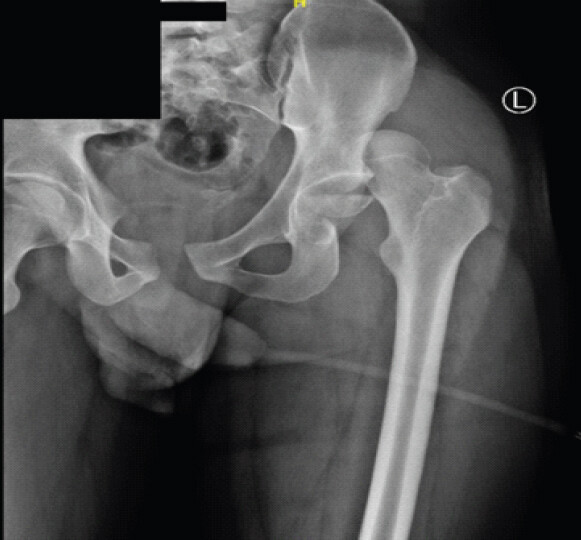
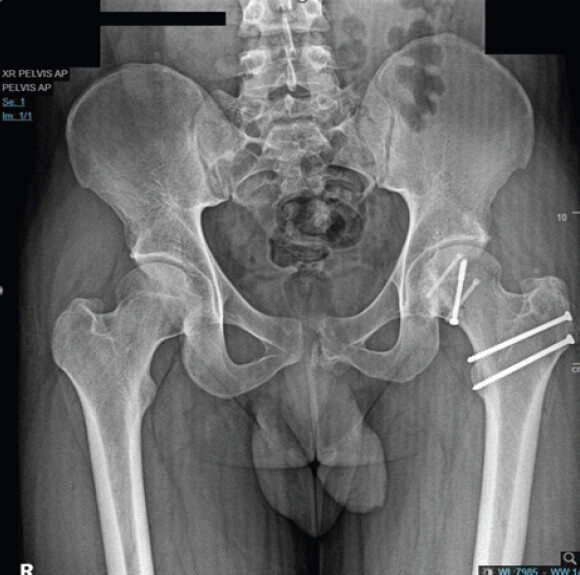
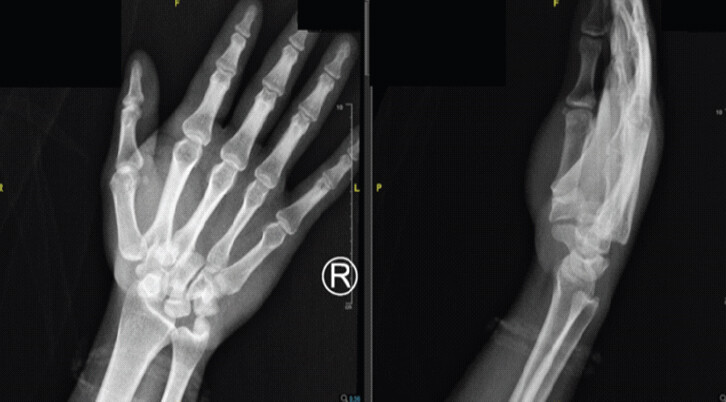
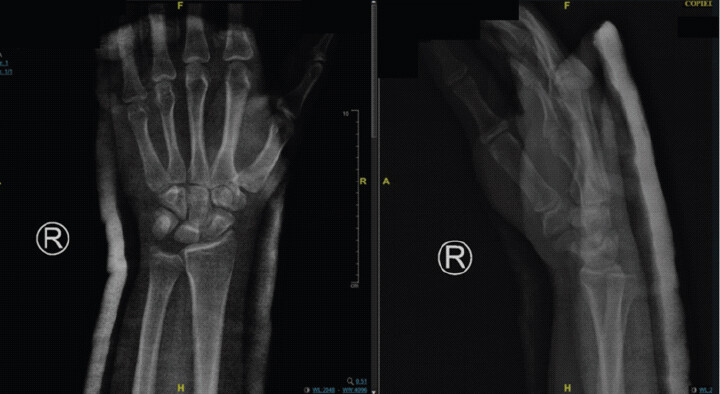
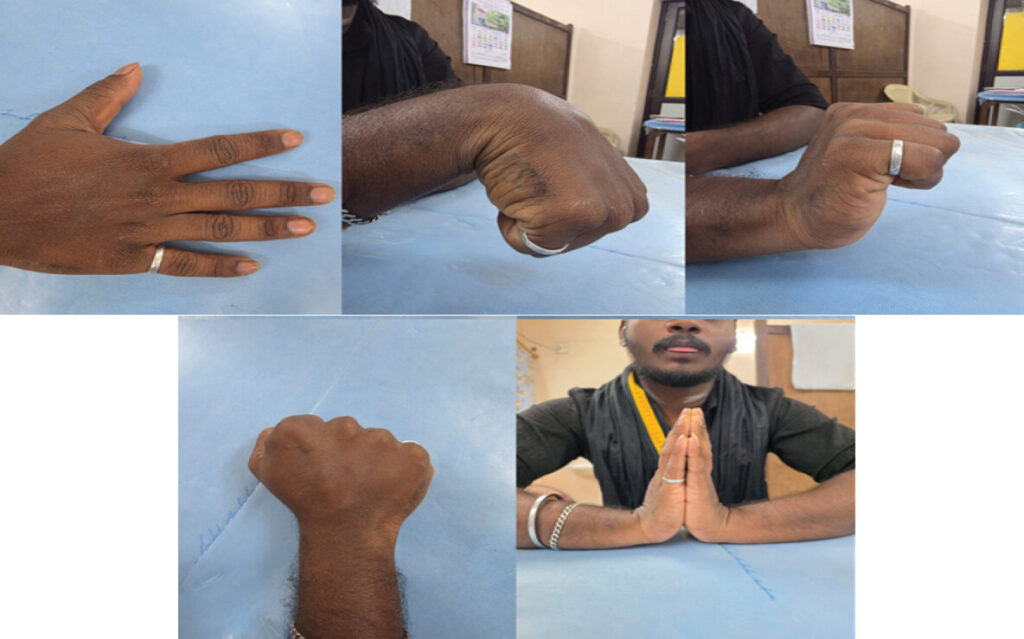
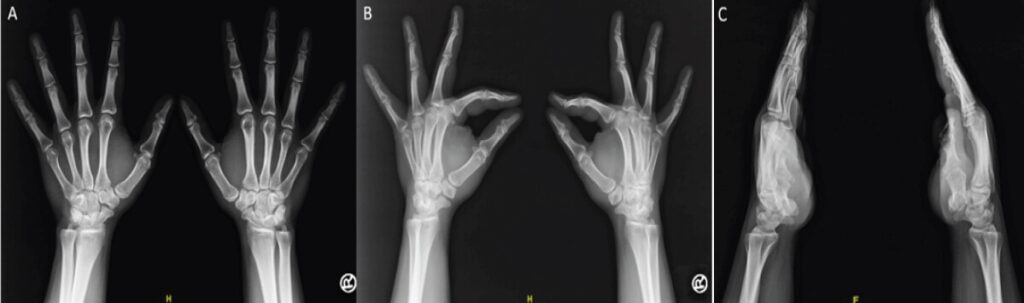
A man in his 20s presented to the emergency department following a high-energy road traffic injury involving a two-wheeler and a larger vehicle. He had no significant medical or surgical history. On arrival, he was conscious, alert, and hemodynamically stable, with severe pain and deformity of the left hip and pain and swelling over the dorsum of the right hand, associated with restricted wrist movement and difficulty gripping objects. There was no numbness, tingling, or digital weakness. Examination revealed diffuse dorsal hand swelling, a subtle contour abnormality over the bases of the index and middle metacarpals, and marked tenderness with bony prominence at this level. Wrist movements were restricted by pain, while sensory and motor functions were intact with no neurovascular deficit. During systematic trauma evaluation, imaging confirmed posterior dislocation of the left hip with an associated femoral head fracture (Fig. 1). The hip was prioritized and reduced under procedural sedation, followed by surgical dislocation and fixation of the femoral head fracture using headless compression screws and a cannulated cancellous screw (Fig. 2). Following stabilization, dedicated radiographs of the right hand demonstrated posterior dislocation of the second and third carpometacarpal joints without associated fracture (Fig. 3). Under sedation, closed reduction was performed using longitudinal traction on the affected fingers, wrist stabilization, and direct pressure over the displaced metacarpal bases. A distinct click was felt, and normal hand contour was restored (Fig. 4). Post-reduction clinical assessment and radiographs confirmed stable anatomical reduction without residual subluxation, and surgical fixation was therefore not required. The hand was immobilized in a below-elbow splint with the wrist in a neutral position, with active finger movements encouraged. After 4 weeks, the splint was removed, and structured rehabilitation was initiated. At 2-year follow-up, the patient was pain-free, had full painless wrist and finger movements, and had returned to normal occupational activities (Fig. 5). Radiographs demonstrated maintained joint congruity without late displacement or degenerative changes (Fig. 6). The associated hip injury also healed satisfactorily, with preserved alignment, painless range of motion, and no clinical or radiographic evidence of avascular necrosis or instability.
Discussion
Carpometacarpal joint dislocations are uncommon injuries that usually occur when substantial force is transmitted along the length of the hand, most often during high-energy trauma [2,3]. Their relative rarity reflects the intrinsic stability of these joints, which are reinforced by strong ligamentous structures and the interlocking configuration of the distal carpal row and metacarpal bases [3]. The second and third carpometacarpal joints, in particular, form the central structural pillar of the hand and contribute significantly to stability during grip and load transmission. Because of this biomechanical arrangement, disruption of these central joints requires considerable force and is therefore encountered much less frequently than injuries involving the more mobile ulnar carpometacarpal articulations [4].
Recognition of these injuries can be challenging at initial presentation. Clinical deformity may be subtle, swelling can mask contour abnormalities, and radiographic interpretation requires careful scrutiny of joint alignment rather than simple fracture identification. These injuries are therefore recognized as a potential source of missed diagnosis, particularly in patients with multiple traumatic injuries, in whom attention may be directed toward more obvious or urgent conditions. In the present case, the presence of a major associated injury had the potential to distract from the hand findings, illustrating the importance of systematic examination of all symptomatic areas. Suspicion should be raised whenever there is focal tenderness over the metacarpal bases or an unexplained dorsal prominence following trauma [6].
Management strategies for carpometacarpal dislocations remain largely guided by clinical judgment because high-level evidence is limited and formal treatment guidelines are lacking [7]. In practice, treatment decisions are influenced by the ability to achieve anatomical reduction, the joint’s stability after reduction, and the presence or absence of associated fractures. Surgical stabilization is frequently recommended when reduction is unstable or when fractures compromise joint congruity, as fixation may help prevent redislocation and late deformity [5,9]. Conversely, previous reports have demonstrated that stable reductions can be managed successfully without operative intervention, producing satisfactory functional outcomes when alignment is maintained [10]. These findings suggest that post-reduction stability is an important determinant of treatment rather than the injury pattern alone.
Most published cases describe dislocations of the fourth and fifth carpometacarpal joints or injuries affecting multiple rays, reflecting the greater mobility and susceptibility of these articulations [2,3,11]. Isolated central carpometacarpal dislocations, as in the present case, are distinctly uncommon and therefore provide useful clinical insight. Individual case reports have described a range of treatment strategies, from open reduction with fixation to conservative immobilization, highlighting the absence of a single universally accepted approach [1,4]. The favorable long-term outcome observed in this patient supports the existing literature indicating that when anatomical alignment is restored promptly and stability is confirmed, conservative treatment can result in excellent recovery [6,10]. Nevertheless, conclusions must be interpreted cautiously, as evidence derived from individual cases cannot be generalized. Rather than establishing a definitive treatment recommendation, this report reinforces a practical clinical principle: Carefully selected patients with stable reductions may not require operative fixation, provided that close follow-up is undertaken to ensure maintenance of joint congruity. The applicability of this single case report of a rare injury pattern is limited. The absence of computed tomography and assessment of dynamic stability prevents exclusion of subtle articular abnormalities or instability and determination of the optimal duration of immobilization. There was no assessment of patient-reported outcomes or quality of life. These limitations should be kept in mind when interpreting the favorable outcome at 2 years, and this case adds to the limited evidence supporting conservative management in carefully selected patients with stable anatomic reduction.
This case emphasizes the importance of a diagnostic suspicion for carpometacarpal injuries following high-energy trauma, and the need for a thorough clinical and radiological work-up, and individualized treatment based on an objective assessment of joint stability. These considerations are important to avoid missed injuries and obtain good long-term functional results in this rare but clinically important pattern of hand trauma.
Conclusion
Second and third carpometacarpal joint dislocations are rare injuries that may be overlooked in polytrauma. Early recognition, accurate reduction, and careful assessment of post-reduction stability are essential. In patients with stable anatomical reduction and no associated fracture, conservative management with immobilization and rehabilitation can achieve excellent long-term functional and radiographic outcomes.
Clinical Message
In carefully selected patients with stable anatomical reduction and no associated fracture, conservative treatment with immobilization and rehabilitation can provide favorable long-term outcomes.
Conflict of Interest:
Nil
Source of Support:
Nil
Consent
The authors confirm that informed consent was obtained from the patient for publication of this article
How to Cite this Article
Salam N, Kaganur R, Dwajan A, Harshith S, Arunachalam A, Bandi I. Second and Third Carpometacarpal Joint Dislocation in a Polytrauma Patient: Successful Closed Reduction and 2-Year Follow-Up. J Orthop Case Rep 2026 November;16(11):31-36. doi: 10.13107/jocr.2026.v16.i11.8378.
References
- Alagesan S, Nagasamy S, Elangovan P, Pandian H, Anantharaman G. An isolated second carpometacarpal joint dislocation treated with open reduction and transfixation with K-wire: A rare case report. Cureus 2024;16:e56338. [Google Scholar] | [PubMed]
- Żyluk A. Results of the treatment of carpo-metacarpal joints dislocations. Ortop Traumatol Rehabi 2024;26:203-11. [Google Scholar] | [PubMed]
- Bhardwaj P, Sivakumar BS, Vallurupalli A, Pai M, Sabapathy SR. Fracture dislocations of the carpometacarpal joints of the fingers. J Clin Orthop Trauma 2020;11:562-9. [Google Scholar] | [PubMed]
- Makino T, Fujioka H, Kokubu T. Neglected fracture dislocation of the second and third carpometacarpal joints: A case report. Hand Surg 2007;12:97-100. [Google Scholar] | [PubMed]
- Al-Battat MY, Al Hassan MA, Al Qahtani SM. Carpometacarpal dislocation second to fifth with associated hamate fracture: A case report of rare injury. Int J Surg Case Rep 2023;108:108417. [Google Scholar] | [PubMed]
- Telich-Tarriba JE, Guevara-Valmaña OI, Navarro-Barquín DF, Victor-Baldin A. Carpometacarpal joint dislocations: Management and long-term outcomes at a specialized hand surgery center in Latin America. Plast Surg (Oakv) 2020;28:210-4. [Google Scholar] | [PubMed]
- Kim JS, Hussain K, Higginbotham DO, Tsai AG. Management of thumb carpometacarpal joint dislocations: A systematic review. J Orthop 2021;25:59-63. [Google Scholar] | [PubMed]
- Jorgensen C, Christos SC. Carpometacarpal dislocation with third metacarpal fracture. Clin Pract Cases Emerg Med 2021;5:488-90. [Google Scholar] | [PubMed]
- Ghanem W, Saber A, Najjar J, Ezzeddine H, Badra M, Moucharafieh R. A rare case of multiple carpometacarpal joint fracture-dislocations with fractures of the hamate and capitate. Orthop Res Rev 2025;17:497-502. [Google Scholar] | [PubMed]
- Jumeau H, Lechien P, Dupriez F. Conservative treatment of carpometacarpal dislocation of the three last fingers. Case Rep Emerg Med 2016;2016:4962021. [Google Scholar] | [PubMed]
- Suwannaphisit S, Suwanno P, Fongsri W, Wongsiri S. Multiple carpometacarpal joint fracture-dislocation from the second to fifth: A case report. Ann Med Surg (Lond) 2022;76:103596. [Google Scholar] | [PubMed]
© 2026 Journal of Orthopaedic Case Reports - Published by Indian Orthopaedic Research Group
About the Authors
-

Nabiel Salam
-

Raghavendra Kaganur
-

Anirudh Dwajan
-

S Harshith
-

A Arunachalam
-

Issac Bandi
Related Articles in Journal of Orthopaedic Case Reports
 November 1, 2026 Management of Retained Epidural Catheter Fragment in a Polytrauma Patient: A Case Report
 November 1, 2026 Incidentally Detected Osseous Hemangioma of the Femoral Head: Conservative Management of a Rare Case with Review of the Literature
 November 1, 2026 Conservative Management of a Complex Schatzker Type V Bicondylar Tibial Plateau Fracture: A Case Report with 2-Year Follow-Up
 October 1, 2026 Isolated Posterior Malleolus Fracture with Early Symptom Resolution: A Case Report