


Introduction
The knee is one of the most frequently injured joints, and knee-related dysfunction is common across age groups and activity levels. Structured, patient-reported outcome measures (PROMs) are used alongside clinical examination to quantify functional limitations and monitor recovery in orthopedic research. In multilingual societies, a validated PROM translated and adapted into the patient’s primary language is a pre-requisite for accurate clinical assessment.
The Lysholm Knee Scoring Scale and Tegner Activity Scale are two complementary knee-specific instruments. The Lysholm scale evaluates symptom-based functional status [1], whereas the Tegner scale quantifies activity levels across occupational and sporting activities [2]. Both instruments have since been translated and validated in several other languages, with generally strong psychometric performance, including a Thai adaptation [3].
Despite this, no formally validated Hindi version of the Lysholm or Tegner scales has existed for use in India, even though a validated Hindi comparator instrument, the International Knee Documentation Committee Subjective Knee Form (IKDC-SKF), was already available [4]. We therefore set out to cross-culturally adapt the Lysholm and Tegner scales into Hindi and to evaluate their validity and reliability in Hindi-speaking patients with knee disorders.
Materials and Methods
This study adhered to the Consensus-based Standards for the selection of health Measurement Instruments (COSMIN) guidelines for reporting measurement properties of health-related outcome measures [5]. The study was approved by the Institutional Ethics Committee (IEC number: IEC-Ortho/DRB/2025/66; written informed consent was obtained from all participants. All procedures were performed in accordance with the ethical standards of the responsible committee on human experimentation and with the 1964 Declaration of Helsinki and its later amendments.
Study patients
A prospective cohort of 100 consecutive patients presenting with knee-related complaints (for example, ligament injuries, meniscal pathology, patellofemoral disorders, and cartilage lesions) was enrolled at a sports injury clinic of one of the largest tertiary care referral centers in North India, which receives patients from approximately nine to ten states and therefore serves a clinically and geographically diverse population.
-
Inclusion criteria: Patients aged 18–70 years, fluent and literate in Hindi, presenting with primary knee-related complaints
-
Exclusion criteria: Age <18 or >70 years; active joint infection; inflammatory or advanced post-traumatic arthritis; cognitive, neurological, or psychiatric impairment precluding completion of self-report forms; or receipt of major therapeutic interventions during the 14-day test-retest interval.
Sample size determination
Sample size requirements were estimated using the approach for reliability studies recommended by Terwee et al., which advises a minimum of 50 participants for adequate assessment of reliability and measurement error [6]. Enrolling 100 patients exceeded this threshold twofold, providing adequate precision for the primary criterion validity, reliability, and internal consistency analyses. The study was not designed to yield diagnosis-specific estimates.
Lysholm and Tegner scales
-
Lysholm scale: An eight-item questionnaire evaluating limping (5 points), support or crutches (5 points), locking (15 points), instability (25 points), pain (25 points), swelling (10 points), stair climbing (10 points), and squatting (5 points). Total scores range from 0 to 100, with higher scores reflecting superior knee function (91–100 = excellent, 84–90 = good, 65–83 = fair, <65 = poor)
-
Tegner scale: A single-item, 11-level rating scale (0–10) quantifying physical activity levels from daily living or sedentary work (level 0–1) up to elite competitive sports (level 10).
Translation and cultural adaptation procedure
Permission was obtained from the original developers before translation. Standard forward-backward translation protocols were implemented [7,8]:
-
Forward translation: Two independent translations from English into Hindi were generated by a bilingual orthopedic surgeon and a professional translator
-
Synthesis: The translations were synthesized into a single preliminary Hindi draft following consensus discussion
-
Back-translation: Blinded back-translation into English was conducted by an independent native English speaker and a professional translator
-
Expert committee review: An expert panel (orthopedic surgeons, language experts, and clinical methodologists) reviewed all versions to resolve semantic, idiomatic, and conceptual discrepancies, with disagreements resolved through open discussion until consensus was reached. Assigned point values next to response items were removed from patient-facing forms to prevent response bias
-
Cultural modification: Sports listed on Tegner activity levels 7–10 were culturally adapted. Inaccessible or uncommonly played sports (for example, bandy and ice hockey) were removed, and sports widely played in India (for example, kabaddi, kho-kho, field hockey, and cricket) were integrated at equivalent physical demand levels. The adapted scale was designated the Hindi-adjusted Tegner scale
-
Pre-testing: The draft was pretested on 30 patients. Although three participants sought clarification on the term “giving way” (instability), misinterpretation remained below the 15% threshold; minor phrasing adjustments were made to ensure maximal clarity.
Comparator instrument
The validated Hindi version of the IKDC-SKF served as the primary benchmark for criterion validity. The IKDC-SKF yields an overall transformed score ranging from 0 to 100, calculated from 18 of its 19 items; the two remaining items, present overall knee function (Item 10a) and present level of sports activity (Item 10b), both rated on a 0–10 scale, are scored separately and were used here for item-specific comparison with the Tegner scale [9].
Data collection
Patients completed the questionnaires digitally via Google Forms in waiting areas.
-
Baseline (T_{1}): Completion of the Hindi Lysholm scale (present symptoms), Hindi-adjusted Tegner scale (pre-injury, present, and expected post-treatment levels), and Hindi IKDC-SKF
-
Intraday reliability (T_{2}): Completion of a second administration on the same day after physician consultation to evaluate short-term repeatability
-
Interday test-retest reliability (T_{3}): Re-administration via digital link at 14 days post-baseline, during which no clinical interventions occurred.
The order in which the Hindi Lysholm, Hindi-adjusted Tegner, and Hindi IKDC-SKF were presented was randomized at each time point to minimize order and recall effects between instruments. Completion time was systematically tracked. Floor and ceiling effects were calculated as the proportion of participants achieving the absolute minimum (0) or maximum possible scores.
Statistical analysis
Analyses were performed using Statistical Package for the Social Sciences Version 25.0 (IBM Corp., Armonk, NY, USA).
-
Criterion validity: Evaluated using Pearson correlation coefficients (r) between present Lysholm and Tegner scores and IKDC-SKF total and item-specific scores. Values of r > 0.7 denoted strong correlation, 0.5–0.7 moderate, and <0.5 weak
-
Reliability: Intraclass correlation coefficients (ICC) ([2,1], two-way random-effects model, absolute agreement) assessed intraday and interday test-retest reliability. ICC values were classified as poor (<0.50), moderate (0.50–0.75), good (>0.75–0.90), or excellent (>0.90)
-
Measurement error: Standard error of measurement (SEM) (= standard deviation × √(1−ICC), using the intraday ICC) and minimal detectable change at 90% confidence (MDC90 = SEM × 1.645 × √2) were computed [10]
-
Internal consistency: Assessed for the multi-item Lysholm scale using Cronbach alpha (α), with values between 0.70 and 0.95 considered acceptable [6].
A two-tailed P < 0.05 was considered statistically significant for all analyses. All questionnaires were scored by an investigator blinded to the results of the comparator instrument to reduce the risk of assessment bias.
Results
Patient demographic and clinical characteristics
The baseline characteristics of the study cohort (n = 100) are summarized in Table 1. The overall mean age was 39.6 ± 13.2 years (range, 18–68 years), with a mean duration from injury to assessment of 3.5 ± 2.0 months.
Demographic and clinical baseline characteristics (n=100)
| Variable | Baseline value |
|---|---|
| Age (years), mean±SD | 39.6±13.2 |
| Body mass index (kg/m2), mean±SD | 25.2±3.5 |
| Affected knee, n (%) | |
| Right | 42 (42.0) |
| Left | 47 (47.0) |
| Bilateral | 11 (11.0) |
| Sports level, n (%) | |
| Professional or competitive | 6 (6.0) |
| Recreational | 53 (53.0) |
| Non-athlete | 41 (41.0) |
| Primary diagnosis, n (%) | |
| Isolated ACL injury | 29 (29.0) |
| Isolated meniscal injury | 36 (36.0) |
| Combined ACL and meniscal injury | 14 (14.0) |
| Patellofemoral disorder | 13 (13.0) |
| Chondral lesions or other | 8 (8.0) |
| Time from injury to evaluation | 3.5±2.0 |
| (months), mean±SD |
ACL: Anterior cruciate ligament, SD: Standard deviation
Feasibility and administration
Missing data rates were negligible (<1% across all items). Mean completion time was 4 min (range, 2–6 min) for the Hindi Lysholm scale and 3 min (range, 2–5 min) for the Hindi-adjusted Tegner scale, demonstrating excellent feasibility in outpatient settings.
Floor and ceiling effects
Neither the Lysholm total score nor the Tegner activity scores demonstrated significant overall floor or ceiling effects (>15% threshold) (Table 2). Individual Lysholm items exhibited expected ceiling effects due to discrete single-item capping (for example, support item: 72% ceiling), reinforcing that overall sum scores rather than sub-item scores should be used for functional tracking. Item-level ceiling effects may nonetheless limit sensitivity to change at the item level (Limitations).
Baseline score distributions, floor effects, and ceiling effects
| Measure | Mean±SD | Floor effect (%) | Ceiling effect (%) |
|---|---|---|---|
| Lysholm total score (0–100) | 69.8±18.9 | 0 | 6 |
| Item 1: Limp (0–5) | 3.4±1.4 | 9 | 39 |
| Item 2: Support (0–5) | 4.1±1.4 | 4 | 72 |
| Item 3: Locking (0–15) | 10.9±3.2 | 0 | 29 |
| Item 4: Instability (0–25) | 18.9±6.7 | 4 | 43 |
| Item 5: Pain (0–25) | 16.6±6.9 | 7 | 20 |
| Item 6: Swelling (0–10) | 7.1±3.2 | 12 | 51 |
| Item 7: Stair climbing (0–10) | 6.0±3.1 | 7 | 30 |
| Item 8: Squatting (0–5) | 2.5±2.0 | 28 | 20 |
| Adjusted Tegner score (0–10) | |||
| Pre-injury | 5.4±2.0 | 3 | 2 |
| Present level | 3.4±1.7 | 10 | 0 |
| Expected level | 5.9±1.8 | 0 | 9 |
SD: Standard deviation. Floor and ceiling effects denote the proportion of participants with the minimum and maximum possible scores, respectively
Validity
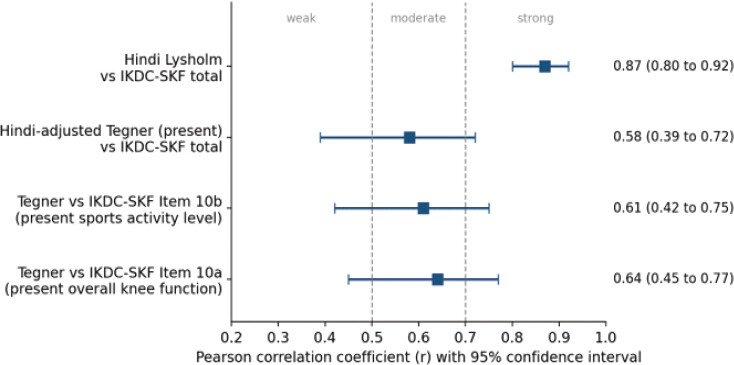
The Hindi Lysholm scale showed a strong, statistically significant correlation with the Hindi IKDC-SKF (r = 0.87, P < 0.001). The Hindi-adjusted Tegner scale demonstrated a moderate overall correlation with the Hindi IKDC-SKF (r = 0.58, P < 0.001) and higher specific correlations with IKDC-SKF activity-related items (Item 10b: r = 0.61; Item 10a: r = 0.64; both P < 0.001) (Table 3, Figure 2).
Criterion validity correlations with the Hindi IKDC-SKF
| Instrument comparison | Pearson r (95% CI) | P-value |
|---|---|---|
| Hindi Lysholm versus Hindi IKDC-SKF | 0.87 (0.80–0.92) | <0.001 |
| Hindi-adjusted Tegner (present) versus Hindi IKDC-SKF total | 0.58 (0.39–0.72) | <0.001 |
| Versus IKDC-SKF Item 10b (present sports activity level) | 0.61 (0.42–0.75) | <0.001 |
| Versus IKDC-SKF Item 10a (present overall knee function) | 0.64 (0.45–0.77) | <0.001 |
CI: Confidence interval, IKDC-SKF: International Knee Documentation Committee Subjective Knee Form
Reliability and measurement error
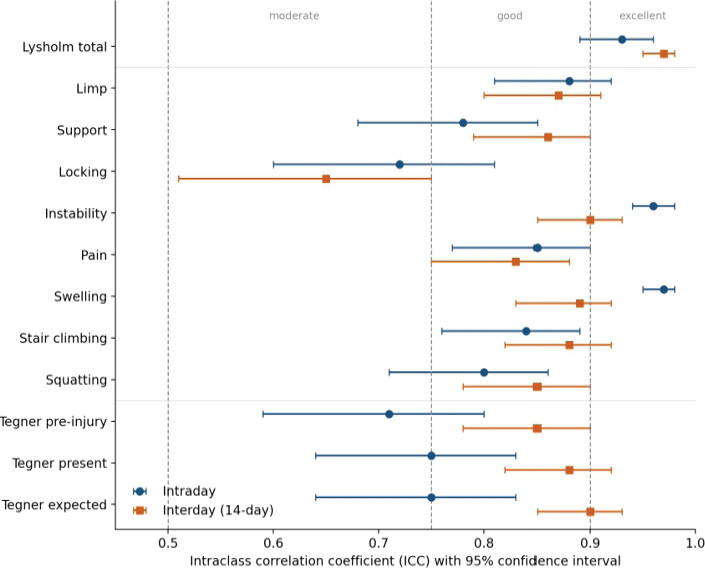
The Hindi Lysholm scale demonstrated excellent intraday (ICC = 0.93) and 14-day interday test-retest reliability (ICC = 0.97). The Hindi-adjusted Tegner scale demonstrated moderate intraday (ICC = 0.75) and interday test-retest reliability (ICC = 0.88) (Table 4, Figure 3).
Intraday and interday test-retest reliability
| Measure | Intraday ICC (95% CI) | Interday test-retest ICC (95% CI) | P-value |
|---|---|---|---|
| Lysholm total score | 0.93 (0.89–0.96) | 0.97 (0.95–0.98) | <0.001 |
| Item 1: Limp | 0.88 (0.81–0.92) | 0.87 (0.80–0.91) | <0.001 |
| Item 2: Support | 0.78 (0.68–0.85) | 0.86 (0.79–0.90) | <0.001 |
| Item 3: Locking | 0.72 (0.60–0.81) | 0.65 (0.51–0.75) | <0.001 |
| Item 4: Instability | 0.96 (0.94–0.98) | 0.90 (0.85–0.93) | <0.001 |
| Item 5: Pain | 0.85 (0.77–0.90) | 0.83 (0.75–0.88) | <0.001 |
| Item 6: Swelling | 0.97 (0.95–0.98) | 0.89 (0.83–0.92) | <0.001 |
| Item 7: Stair climbing | 0.84 (0.76–0.89) | 0.88 (0.82–0.92) | <0.001 |
| Item 8: Squatting | 0.80 (0.71-0.86) | 0.85 (0.78-0.90) | <0.001 |
| Adjusted Tegner score | |||
| Pre-injury level | 0.71 (0.59-0.80) | 0.85 (0.78-0.90) | <0.001 |
| Present level | 0.75 (0.64-0.83) | 0.88 (0.82-0.92) | <0.001 |
| Expected level | 0.75 (0.64-0.83) | 0.90 (0.85-0.93) | <0.001 |
CI: Confidence interval, ICC: Intraclass correlation coefficient
For the Lysholm total score, SEM was 5.1 points, and MDC90 was 11.9 points. For the adjusted Tegner present score, SEM was 0.81 levels, and MDC90 was 1.89 levels.
Internal consistency
Cronbach alpha for the Hindi Lysholm total score was 0.72 (95% confidence interval [CI], 0.63–0.80) at baseline, 0.74 (95% CI, 0.65–0.81) at intraday re-test, and 0.70 (95% CI, 0.60–0.78) at 14-day test-retest. All point estimates met the pre-defined threshold (0.70–0.95), indicating acceptable, although borderline, scale homogeneity; the lower confidence limits fell below 0.70.
Discussion
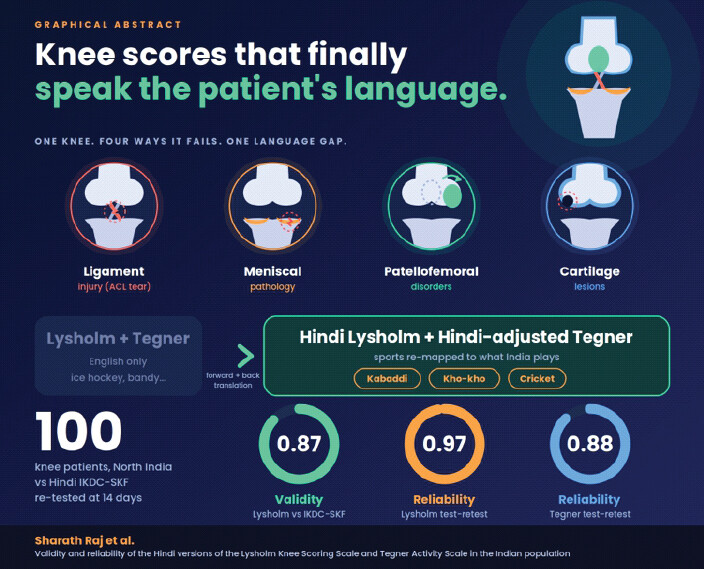
The Hindi Lysholm Knee Scoring Scale and Hindi-adjusted Tegner Activity Scale performed well psychometrically in this single-center Indian clinical cohort, with strong criterion validity for the Lysholm scale, moderate criterion validity for the Tegner scale, good test-retest reliability, and acceptable internal consistency (Figure 1).
The high correlation between the Hindi Lysholm scale and the Hindi IKDC-SKF (r = 0.87) aligns closely with the Thai translation (r = 0.89) [3], and sits within the range of reliability reported for other cross-cultural adaptations of the scale, including the Indonesian version (test-retest ICC, 0.99) [11] and a Chinese version validated for knee arthroplasty (ICC, 0.99; Cronbach alpha, 0.71) [12]. The Hindi-adjusted Tegner scale showed a moderate correlation with the IKDC-SKF total score (r = 0.58) and stronger correlations with activity-specific sub-questions, a pattern also seen with the Arabic Tegner scale, which correlated moderately with the IKDC-SKF (rho = 0.48) [13]. This fits the distinct constructs the two instruments measure: The Lysholm scale captures symptom-based joint function, while the Tegner scale captures actual participation in physical activity. The two are complementary rather than redundant. Because the Tegner scale is a single-item rating of activity participation rather than a symptom inventory, only a moderate association with a composite symptom-based score is conceptually expected, and this does not in itself indicate poor performance.
Few Indian patients would recognize ice hockey or bandy, the sports listed at Tegner levels 7–10 in the original scale. These were replaced with sports widely played across India, including kabaddi, kho-kho, field hockey, and cricket, which allowed activity levels to be captured in a culturally relevant manner while preserving the scale’s underlying grading structure. Direct comparability with the original Tegner scale and with international studies should nonetheless be interpreted with caution, as formal equivalence testing was beyond the scope of this study.
The MDC90 values calculated here give clinicians a practical benchmark: A change smaller than 11.9 points on the Hindi Lysholm scale or 1.89 levels on the Hindi-adjusted Tegner scale cannot confidently be distinguished from measurement noise; only changes above these thresholds should be interpreted as genuine clinical improvement or deterioration.
This study has several strengths. To our knowledge, it provides the first culturally adapted Hindi versions of two of the most widely used knee-specific instruments, developed through established forward and backward translation procedures, expert committee review, and pretesting, and reported in accordance with COSMIN standards. Criterion validity, intraday and interday reliability, internal consistency, floor and ceiling effects, and measurement error (SEM and MDC90) were all examined within a single cohort, giving clinicians and investigators a comprehensive psychometric profile. The order of instruments was randomized at each time point, scoring was performed by a blinded investigator, missing data were negligible, and completion required only a few minutes, which supports feasibility in busy outpatient settings. Recruitment at a large tertiary care referral centre that serves patients from approximately nine to ten states of India also yielded a clinically, socioeconomically, and geographically diverse cohort, which strengthens the relevance of the findings beyond a purely local population.
Limitations
The findings should be interpreted in light of the following limitations, which also define priorities for future work.
-
Sample size, setting, and generalizability: The sample comprised 100 consecutive patients recruited at a single sports injury clinic. Although this exceeds the minimum generally recommended for reliability analysis, it may be insufficient to establish psychometric performance across clinical subgroups. The clinic forms part of one of the largest tertiary care referral centers in North India, which receives patients from approximately nine to ten states and therefore draws a clinically and socioeconomically diverse population. This broad catchment mitigates, but does not eliminate, the risk of selection bias associated with consecutive recruitment from a specialist clinic and the limited geographical representation of a single-site sample, and patients from every Hindi-speaking region of India may still not be represented. The translated scales have not yet been validated in an independent cohort or across multiple centres, and their reproducibility and broader applicability therefore remain to be confirmed.
-
Linguistic diversity and literacy: Standard Hindi was used, and regional dialects and variations in vocabulary across northern and central India may influence comprehension and responses. The multi-state catchment of the study center is likely to have exposed the translated instruments to a range of dialects and sociocultural backgrounds, and pretesting identified few comprehension difficulties, but dialect was not recorded, and dialect-specific performance was not analyzed. Only Hindi-literate patients were included, so the findings may not extend to illiterate individuals, who may require interviewer-administered questionnaires.
-
Cultural adaptation of the Tegner scale: Although the listed sports were adapted to Indian contexts, the cultural relevance of every activity level was not independently established across different communities, although the multi-state catchment of the study centre provided some diversity of background within the sample. Replacing selected sports with Indian sports may affect direct comparability with the original scale and with previously published international studies, and measurement equivalence between the original English Tegner scale and the Hindi-adjusted version was not formally tested.
-
Criterion and construct validity: The Hindi IKDC-SKF served as the primary comparator, but it is not an independent gold standard for all aspects of knee function and activity. Correlations between the Lysholm and IKDC-SKF scores may partly reflect overlapping symptom and functional domains, and the moderate correlation of the Hindi-adjusted Tegner scale with the IKDC-SKF total score (r = 0.58) reflects, at least in part, the distinct constructs measured. Construct validity was assessed primarily through correlation with the IKDC-SKF, and a comprehensive set of pre-specified construct-validity hypotheses was not reported.
-
Responsiveness and longitudinal validation: The ability of either scale to detect clinically meaningful change after treatment or rehabilitation was not evaluated, and it remains unestablished how reliably score changes reflect recovery after procedures, such as anterior cruciate ligament (ACL) reconstruction. This initial validation was cross-sectional in design.
-
Population characteristics and eligibility criteria: Participants presented with a broad range of knee-related complaints, reflecting the case mix of a tertiary referral center. This enhances the clinical diversity of the cohort but may influence score distributions and psychometric estimates, and separate validity and reliability estimates were not reported for individual conditions, such as ligament injuries, meniscal pathology, and patellofemoral disorders. Measurement invariance across age groups, sexes, educational levels, and diagnoses was not examined. Patients younger than 18 or older than 70 years and those with cognitive, neurological, or psychiatric impairment were excluded, which limits applicability to adolescent, older, and medically complex populations.
-
Self-report and mode of administration: Self-reported scores may be affected by expectations, pain perception, social desirability, and patients’ understanding of the questions. The Tegner scale includes pre-injury activity levels, which are subject to retrospective recall bias, particularly when assessment occurs months after injury. Questionnaires were completed through Google Forms, and equivalence with paper-based or interviewer-administered formats was not established.
-
Reliability design: The intraday retest followed physician consultation on the same day, which could have influenced patients’ understanding of, or responses to, the questions. For the 14-day interval, major interventions were excluded, but the stability of symptoms and activity levels between assessments was not formally documented. The consistently high coefficients are reassuring in this regard, although these conditions should be tightly specified in future work.
-
Internal consistency, measurement error, and item-level effects: Cronbach alpha was assessed only for the multi-item Lysholm scale, as internal-consistency analysis is not ordinarily applicable to the single-item Tegner scale. Alpha values for the Lysholm scale ranged from 0.70 to 0.74, with CIs extending below 0.70, indicating acceptable but borderline internal consistency. The MDC90 values of 11.9 points for the Lysholm scale and 1.89 levels for the Tegner scale imply that smaller changes cannot be distinguished confidently from measurement error. Although overall scores showed no significant floor or ceiling effects, individual Lysholm items did show ceiling effects, which may limit their sensitivity to change.
Future multicenter studies that include patients from diverse regions, dialects, literacy levels, and diagnoses are warranted. Such studies should incorporate pre-specified construct-validity hypotheses, formal equivalence testing against the original Tegner scale, evaluation of measurement invariance, and longitudinal assessment of responsiveness after interventions, such as ACL reconstruction. Despite these limitations, the present findings provide a sound initial psychometric foundation for the use of these instruments in Hindi-speaking patients.
Conclusion
The Hindi versions of the Lysholm Knee Scoring Scale and the adjusted Tegner Activity Scale demonstrated good validity and reliability and are straightforward to administer. Both are suitable for assessing knee function and activity level in Hindi-speaking patients, whether in routine clinical practice or in orthopedic research. Further multicenter and longitudinal studies are needed to confirm their responsiveness and generalizability.
Clinical Message
The Hindi Lysholm and Hindi-adjusted Tegner scales can be applied in routine outpatient practice and in research involving Hindi-speaking patients with knee disorders. Score changes smaller than 11.9 points (Lysholm) or 1.89 levels (Tegner) fall within measurement error and should not be interpreted as true clinical change.
Conflict of Interest:
Nil
Source of Support:
Nil
Consent
The authors confirm that informed consent was obtained from the patient for publication of this article
How to Cite this Article
Raj S, Sen AK, Kumar R, Yadav A, Gopavaram UKR, Kumar SR. Validity and Reliability of the Hindi Versions of the Lysholm Knee Scoring Scale and Tegner Activity Scale. Journal of Orthopaedic Case Reports 2026 November;16(11):524-531. doi: 10.13107/jocr.2026.v16.i11.8542.
References
- Lysholm J, Gillquist J. Evaluation of knee ligament surgery results with special emphasis on use of a scoring scale. Am J Sports Med 1982;10:150-4. [Google Scholar] | [PubMed]
- Tegner Y, Lysholm J. Rating systems in the evaluation of knee ligament injuries. Clin Orthop Relat Res 1985;198:43-9. [Google Scholar] | [PubMed]
- Itthipanichpong T, Moonwong S, Thamrongskulsiri N, Prasathaporn N, Kuptniratsaikul S, Tegner Y. Validity and reliability of the Thai versions of the Lysholm knee scoring scale and Tegner activity scale. Orthop J Sports Med 2023;11 2:23259671221149785. [Google Scholar] | [PubMed]
- Irrgang JJ, Anderson AF, Boland AL, Harner CD, Kurosaka M, Neyret P. Development and validation of the international knee documentation committee subjective knee form. Am J Sports Med 2001;29:600-13. [Google Scholar] | [PubMed]
- Mokkink LB, Terwee CB, Patrick DL, Alonso J, Stratford PW, Knol DL. The COSMIN checklist for assessing the methodological quality of studies on measurement properties of health status measurement instruments: An international Delphi study. Qual Life Res 2010;19:539-49. [Google Scholar] | [PubMed]
- Terwee CB, Bot SD, De Boer MR, Van Der Windt DA, Knol DL, Dekker J. Quality criteria were proposed for measurement properties of health status questionnaires. J Clin Epidemiol 2007;60:34-42. [Google Scholar] | [PubMed]
- Beaton DE, Bombardier C, Guillemin F, Ferraz MB. Guidelines for the process of cross-cultural adaptation of self-report measures. Spine (Phila Pa 1976) 2000;25:3186-91. [Google Scholar] | [PubMed]
- Guillemin F, Bombardier C, Beaton D. Cross-cultural adaptation of health-related quality of life measures: Literature review and proposed guidelines. J Clin Epidemiol 1993;46:1417-32. [Google Scholar] | [PubMed]
- Kümmel D, Preiss S, Harder LP, Leunig M, Impellizzeri FM. Measurement properties of the German version of the IKDC subjective knee form (IKDC-SKF). J Patient Rep Outcomes 2018;2:31. [Google Scholar] | [PubMed]
- Chen S, Wolf SL, Zhang Q, Thompson PA, Winstein CJ. Minimal detectable change of the actual amount of use test and the motor activity log: The EXCITE trial. Neurorehabil Neural Repair 2012;26:507-14. [Google Scholar] | [PubMed]
- Deviandri R, Van Der Veen HC, Lubis AM, Postma MJ, Van Den Akker-Scheek I. Translation and psychometric analysis of the Indonesian versions of the Lysholm and Tegner scores for patients with anterior cruciate ligament injuries. Orthop J Sports Med 2022;10 1:23259671211066506. [Google Scholar] | [PubMed]
- Huang H, Zhang S, Wang Y, Tegner Y, Wang Y, Jiang Y. Reliability and validity of a Chinese version of the Lysholm score and Tegner activity scale for knee arthroplasty. J Rehabil Med 2022;54:jrm00317. [Google Scholar] | [PubMed]
- Alzhrani M, Alzahrani H, Alshehri YS. The Arabic version of the Tegner Activity Scale in patients with anterior cruciate ligament reconstruction: Translation, validation, and cross-cultural adaptation. Int J Environ Res Public Health 2022;19:1987. [Google Scholar] | [PubMed]
© 2026 Journal of Orthopaedic Case Reports - Published by Indian Orthopaedic Research Group
About the Authors
-

Sharath Raj
-

Aashish Kumar Sen
-

Romil Kumar
-

Aman Yadav
-

Utkarsh Kumar Reddy Gopavaram
-

Saloni Rani Kumar
Related Articles in Journal of Orthopaedic Case Reports
 November 1, 2026 Cross-Cultural Adaptation and Validation of the Hindi Version of the Fukushima Lumbar Spinal Stenosis Scale-25 in Indian Patients with Lumbar Spinal Stenosis: A Cross-Sectional Psychometric Study
 October 1, 2026 Translating and Validating a Hindi Version of the Spine Functional Index: Cross-cultural Adaptation and Psychometric Testing in an Indian Orthopedic Population
 September 1, 2026 Arthroscopic ACL Tibial Spine Avulsion Fixation Using Suture Pull-Through Double-Tunnel Technique
 August 1, 2026 The Forgotten Joint and Forgotten Spine: Recalibrating Success around the Patient’s Experience