

Simple elbow dislocations rarely cause brachial artery thrombosis; collateral circulation may mask ischemia, requiring repeated assessment, Doppler/CT angiography, and conservative management in selective cases.
Dr. Leander Paes, Department of Orthopaedics, Maulana Azad Medical College, New Delhi, India. Email: leanpaes25@gmail.com
Abstract
Introduction: Elbow dislocation, the second most common dislocation involving a large joint, typically results from a fall on an outstretched hand and most frequently presents as a posterior displacement. Neurovascular compromise may involve the ulnar, median, or radial nerves, with injury to the brachial artery being of particular clinical significance. Due to its anterior location within the cubital fossa and relative fixation, the brachial artery is especially susceptible to stretching or rupture during dislocation. In addition, a well-developed collateral vascular network may preserve distal perfusion and mask underlying ischemia, emphasizing the need for careful neurovascular assessment.
Case Report: A 55-year-old man presented to the orthopedic emergency department with severe pain, swelling, and immobility of the left elbow. Examination revealed blisters and a posteriorly displaced bony prominence, consistent with a posterior elbow dislocation. The limb appeared pale and dusky, with absent peripheral pulses. Urgent closed reduction was performed under sedation and muscle relaxation, followed by immobilization in a posterior slab. Post-reduction radiographs confirmed an acceptable reduction.
Investigations and Findings: Following the reduction, radial and ulnar pulses remained absent. Doppler ultrasonography demonstrated thrombosis of the brachial artery, which was confirmed on computed tomography (CT) angiography.
Management and Outcome: The patient was closely observed for signs of limb ischemia. Within 24 h, distal perfusion improved clinically. In view of the satisfactory perfusion, conservative management was continued with vigilant monitoring, including serial assessment of oxygen saturation, capillary refill time, and early indicators of compartment syndrome.
Conclusion: This case emphasizes meticulous neurovascular assessment following elbow dislocation reduction. Despite CT angiographic evidence of brachial artery thrombosis, preserved collateral circulation maintained adequate limb perfusion, allowing successful conservative management. Selected patients with stable perfusion and close monitoring may safely avoid surgical intervention.
Keywords: Elbow dislocation, brachial artery thrombosis, vascular injury, collateral circulation, conservative management, case report.

The elbow permits flexion–extension and forearm rotation and is stabilized by ligamentous structures [1]. Posterior elbow dislocation commonly follows a fall on an outstretched hand and may be associated with neurovascular injury because of the close relationship of the brachial artery to the joint [2]. Arterial injury occurs in 5–13% of elbow dislocations, usually in open or penetrating trauma [3,4]. In closed dislocations without fractures, vascular compromise and complete brachial artery transection are rare [3,4]. Diagnostic evaluation may include Doppler ultrasonography or computed tomography angiography (CTA), depending on availability and urgency [6]. Collateral circulation around the elbow may preserve distal perfusion despite arterial injury, producing a “pink pulseless hand” and masking ischemia [7]. We report a rare case of brachial artery thrombosis after closed posterior elbow dislocation that was successfully managed conservatively with close monitoring and anticoagulation despite radiological evidence of arterial injury.
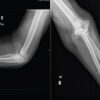
A 55-year-old man presented to the orthopedic emergency department with severe pain, swelling, and inability to move his left elbow. Clinical examination revealed multiple blisters over the cubital fossa, and the affected forearm was cold, pale, and pulseless compared to the contralateral limb, suggestive of significant vascular compromise. Antero-posterior and lateral radiographs of the affected elbow were done, which showed posterior elbow dislocation (Fig. 1).
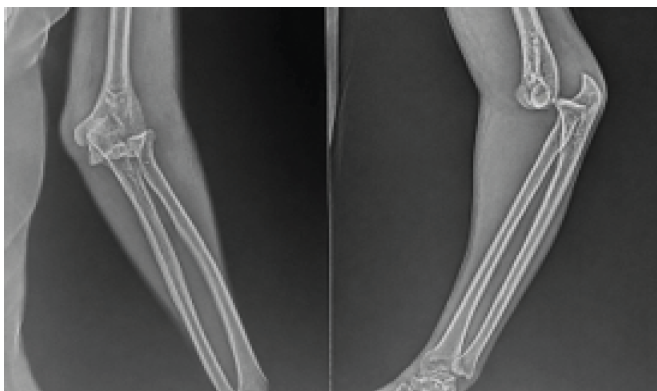
Figure 1: Pre-reduction anteroposterior and lateral view of the elbow showing posterior dislocation.
An urgent closed reduction was performed for the elbow dislocation. Post-reduction radiographs confirmed congruent joint alignment (Fig. 2), and the patient reported immediate relief of pain.
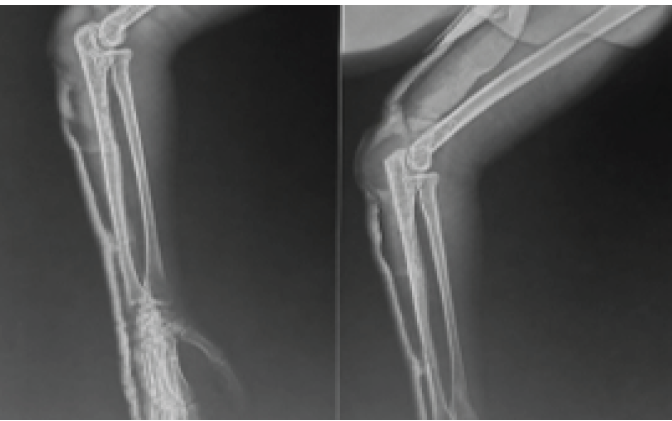
Figure 2: Post-reduction lateral views of the elbow showing congruent joint reduction.
Despite successful reduction, distal pulses were not palpable, and arterial Doppler evaluation demonstrated monophasic flow in the radial and ulnar arteries, indicating compromised arterial perfusion. In view of suspected vascular injury, the patient was urgently referred to the cardiothoracic and vascular surgery team. Emergency CTA of the left upper limb revealed a hypodense, non-enhancing intraluminal filling defect in the distal brachial artery, consistent with thrombosis (Fig. 3), confirming arterial injury as the cause of persistent ischemic features.
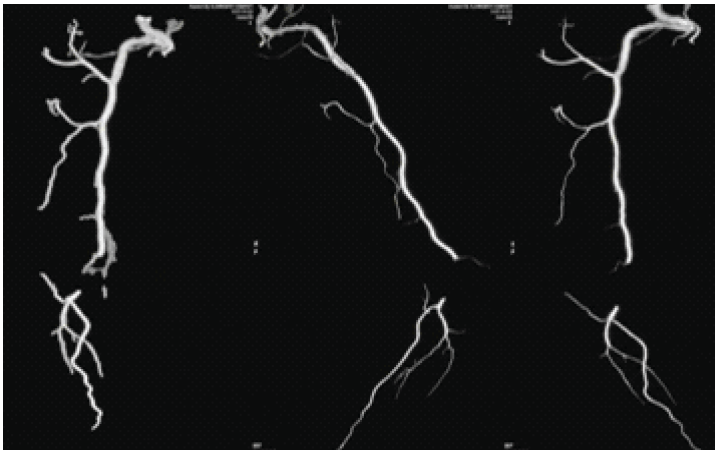
Figure 3: Computed Tomography angiography: Hypodense non-enhancing intraluminal filling defect in the distal brachial artery. Normal contrast opacification of the radial and ulnar artery.
The patient was managed conservatively with strict in-hospital observation and close monitoring of limb perfusion and injectable anticoagulation therapy [11]. Serial assessments were performed at 2-h intervals, including oxygen saturation, capillary refill time, distal pulses, limb temperature, and swelling. Continuous vigilance for compartment syndrome was maintained, with attention to worsening pain on passive stretch, increasing limb tenseness, paresthesia, and restriction of movement. Over the next 24 h, gradual clinical improvement was observed, with restoration of limb warmth and a pinkish coloration, indicating improving perfusion. Oxygen saturation remained stable and within normal limits in all digits, although distal pulses remained absent. Close monitoring was continued, and the limb was immobilized in an above-elbow slab for a further 2 days. During this period, progressive recovery was noted, with complete resolution of swelling and normalization of limb temperature and color. Oxygen saturation remained consistently normal. Following removal of immobilization, the patient demonstrated a full, pain-free range of motion at the elbow, wrist, and hand, with no residual functional deficit.
Vascular injury following closed posterior elbow dislocation is uncommon but potentially limb-threatening. The brachial artery is vulnerable because of its fixed position anterior to the elbow joint. Hyperextension during dislocation may cause stretching, intimal injury, thrombosis, or complete transection [3,4,8,9]. Clinical presentation depends on collateral circulation around the elbow. Collateral circulation may maintain distal perfusion despite major arterial compromise, producing the classic “pink pulseless hand” [7,10]. Consequently, the absence of distal pulses should not be ignored even when distal perfusion appears preserved [7,10]. Thorough neurovascular examination before and after reduction and repeated serial assessments are therefore essential [3,4,7]. Diagnosis may overlap with acute compartment syndrome. Khakbaz et al. described a case initially mistaken for compartment syndrome because of severe pain and swelling [7]. In our patient, absent pulses, delayed capillary refill, pallor, and a cold extremity suggested significant ischemia, but the absence of pain on passive stretch and progressive improvement after reduction argued against evolving compartment syndrome. Duplex Doppler ultrasonography is rapid and widely available, while CTA provides superior delineation of the level and extent of injury [3,7]. In our case, Doppler demonstrated monophasic flow in the radial and ulnar arteries, and CTA confirmed a distal brachial artery thrombosis with distal arterial reconstitution. Most reported cases have been managed surgically. Jayanth et al. treated complete brachial artery transection with thrombectomy, vein grafting, and fasciotomy [8]. Miyazaki et al. reported persistent ischemia requiring vascular reconstruction, fasciotomy, and external fixation [9]. Biswas and Healy similarly described complete vascular transection requiring urgent revascularization [8]. These reports support exploration in patients with persistent ischemia or deteriorating limb viability [8,9]. Conservative management may be appropriate in selected patients with preserved distal perfusion. Lim et al. reported successful non-operative treatment with anticoagulation and close observation in a patient with a well-perfused but pulseless hand [10]. Our patient initially appeared to have severe ischemia, with pallor, delayed capillary refill, coldness, and unrecordable oxygen saturation. However, serial examinations demonstrated progressive improvement in limb warmth, color, capillary refill time, and oxygen saturation despite the persistent absence of pulses. In view of the improving perfusion and potential morbidity of surgical exploration, conservative management with anticoagulation and vigilant monitoring was continued. The patient ultimately achieved complete functional recovery without vascular reconstruction. This case emphasizes individualized management in vascular injuries associated with elbow dislocation [7,8,9,10]. Although urgent exploration remains mandatory in patients with persistent ischemia or worsening perfusion, selected patients with stable or improving distal circulation may be safely managed non-operatively with supervision [8,9,10].
This case highlights the importance of meticulous neurovascular assessment in elbow dislocations, even after successful reduction. Brachial artery thrombosis may present without overt clinical ischemia due to the presence of robust collateral circulation around the elbow. In our patient, despite radiological evidence of distal brachial artery thrombosis on CTA, distal limb perfusion remained adequate and progressively improved with conservative management under close monitoring. This case supports non-operative management in selected patients with preserved perfusion and stable clinical parameters. Selected cases of simple elbow dislocation with vascular thrombosis and adequate collateral circulation can be safely managed conservatively with close monitoring.
Selected patients of simple elbow dislocation with brachial artery thrombosis but with adequate limb perfusion may be managed successfully with conservative treatment and close clinical monitoring.
References
- 1. Islam SU, Glover A, MacFarlane RJ, Mehta N, Waseem M. The anatomy and biomechanics of the elbow. Open Orthop J 2020;14:95-105. [Google Scholar] [PubMed]
- 2. Standring S, editor. Gray’s Anatomy: The Anatomical Basis of Clinical Practice. 42nd ed. London: Elsevier; 2020. [Google Scholar] [PubMed]
- 3. Endean ED, Veldenz HC, Schwarcz TH, Hyde GL. Recognition of arterial injury in elbow dislocation. J Vasc Surg 1992;16:402-6. [Google Scholar] [PubMed]
- 4. Sparks SR, DeLaRosa J, Bergan JJ, Hoyt DB, Owens EL. Arterial injury in uncomplicated upper extremity dislocations. Ann Vasc Surg 2000;14:110-3. [Google Scholar] [PubMed]
- 5. Hennig K, Franke D. Arterial involvement in elbow-proximal injuries. Chirurg 1978;49:580-2. [Google Scholar] [PubMed]
- 6. Marnham R. Dislocation of the elbow with rupture of the brachial artery. Br J Surg 1934;22:181-6. [Google Scholar] [PubMed]
- 7. Khakbaz E, Kantak S, Fyhring Mortensen J. Brachial artery injury as a complication of closed elbow dislocation, and disguised as compartment syndrome. JSES Rev Rep Tech 2023;3:563-6. [Google Scholar] [PubMed]
- 8. Biswas S, Healy C. Complex posterior elbow dislocation causing complete brachial artery transection: A rare complication of a common orthopedic injury. Arch Emerg Med Intensive Care 2018;1:22-6. [Google Scholar] [PubMed]
- 9. Miyazaki AN, Fregoneze M, Santos PD, Sella GD, Checchia CS, Checchia SL. Brachial artery injury due to closed posterior elbow dislocation: Case report. Rev Bras Ortop 2016;51:239-43. [Google Scholar] [PubMed]
- 10. Lim TK, Cheah AE, Yeo CJ. Conservative management of brachial artery thrombosis following closed elbow dislocation with a pink pulseless hand: A case report. Case Rep Orthop 2020;2020:1-5. [Google Scholar] [PubMed]
- 11. Alonso-Coello P, Bellmunt S, McGorrian C, Anand SS, Guzman R, Criqui MH, et al. Antithrombotic therapy in peripheral artery disease: Antithrombotic therapy and prevention of thrombosis, 9th ed: American college of chest physicians evidence-based clinical practice guidelines. Chest 2012;141 Suppl 2:e669S-90. [Google Scholar] [PubMed]



Related Articles in Journal of Orthopaedic Case Reports
 July 1, 2025 A Large-diameter Corona Mortis Artery Encountered During Surgery for Acetabular Fracture: A Case Report and Review of Anatomical Significance
 January 1, 2025 Uncommon Presentation of Hip Pain Due to Calcific Tendonitis in the Rectus Femoris
 October 1, 2026 Posterior Hip Dislocation with Ipsilateral Subtrochanteric Femur Fracture: A Rare Case Report
 October 1, 2026 Staged Bilateral Total Elbow Arthroplasty in Advanced Rheumatoid Elbow Disease: A Case Report