


Introduction
Temporary immobilization of an injured lower limb impairs venous return and has been recognized as a risk factor for venous thromboembolism (VTE) for decades [1,2]. Whether that association ought to translate into pharmacological prophylaxis for the large population managed without surgery, in casts, splints, and removable boots, has been contested since the first randomized trials of the 1990s and remains unresolved despite a substantial literature [3]. Part of the difficulty is that the decision is made in high volume, usually by clinicians who are not thrombosis specialists, often in an emergency department under time pressure, and on the basis of guidance that does not agree with itself. The American College of Chest Physicians suggested against thromboprophylaxis for isolated lower-extremity injuries requiring immobilization [4], the National Institute for Health and Care Excellence supports assessment of thrombotic and bleeding risk with prophylaxis considered on that basis [5], and emergency medicine guidance for ambulatory trauma patients has taken a position of its own again [6].
Running through much of the secondary literature is a proposition that appears to reconcile these positions: Routine prophylaxis is unnecessary, but anticoagulation is effective in patients identified as being at high risk. The claim is intuitively attractive, since absolute risk varies widely across immobilized patients and directing treatment towards those with most to gain is among the most familiar principles in clinical medicine. It is also the implicit logic of essentially every published prophylaxis algorithm in this field, each of which sorts patients into a group to be left alone and a group to be treated. What is less often examined is whether the second half of the proposition has ever actually been demonstrated.
Two developments make that examination timely. The CASTING trial showed prospectively that anticoagulation can be withheld from score-defined low-risk patients [7], and the validation and subgroup analysis of the POT-CAST trial reported that prophylaxis was not effective in any risk category examined [8]. Read together, these point in a direction that narrative syntheses of the field have not consistently followed. The aim of this review is therefore to separate two claims that are routinely conflated: First, that risk assessment identifies patients at elevated absolute risk of VTE; second, that prophylaxis benefits those patients. The first is well supported by several independent datasets, while the second, we argue, has not been established by any completed randomized comparison, and the distinction carries direct consequences for how algorithms are built, how prophylaxis is discussed with patients, and which trial the field should prioritize next.
Two features make this a question for the readership of a clinical orthopedic journal rather than for thrombosis specialists alone. The first is volume: Temporary lower-limb immobilization is among the commonest interventions in trauma and emergency practice, and the decision whether to anticoagulate is therefore taken repeatedly, usually by clinicians who are not thrombosis specialists and under time pressure. The second is that no previous synthesis in this field has explicitly separated the prognostic claim, that risk models identify patients at elevated absolute risk, from the predictive claim, that those patients benefit from prophylaxis; the two are habitually presented as one. CASTING and the validation and subgroup analysis of POT-CAST have both reported since the current recommendations were written, and neither has yet been incorporated into them. A review that distinguishes these claims is therefore both timely and consequential, since the distinction determines how prophylaxis algorithms are constructed, what patients are told when prophylaxis is offered, and which trial the field should fund next.
Aim and review questions
This review addresses three questions: (1) What is the absolute risk of symptomatic VTE after non-operative lower-limb immobilization, and how is that risk distributed across patients? (2) Does randomized evidence demonstrate that pharmacological prophylaxis prevents symptomatic VTE in patients identified as high risk? (3) What have validated risk assessment models been shown to do, and what have they not been shown to do?
Materials and Methods
Reporting standards
This narrative review was prepared in accordance with the Scale for the Assessment of Narrative Review Articles recommendations, which set out reporting standards for non-systematic syntheses [9], and with published guidance on the conduct and appraisal of narrative reviews [10]. Institutional Ethics Committee approval was not required, as the review involved no human participants, no identifiable patient data, and no animal-derived material.
Search strategy
PubMed and MEDLINE were searched from inception, with the search last run on June 30, 2026. Terms for the population were combined with terms for the intervention and for risk prediction. The full search string was:
(“venous thromboembolism” OR “deep vein thrombosis” OR “lower-limb immobilization” OR “lower limb immobilization” OR cast OR splint OR “walking boot” OR “Achilles tendon rupture” OR “non-weight bearing”) AND (thromboprophylaxis OR “low-molecular-weight heparin” OR “direct oral anticoagulant” OR “risk assessment model” OR “TRiP(cast)” OR “L-TRiP(cast)”)
No date, design, or publication-status filters were applied at the search stage. Records in languages other than English were eligible where an English-language abstract permitted assessment, and a translation of the full text could be obtained; in the event, all included sources were published in English. Reference lists of the included trials, systematic reviews, and guidelines were hand-searched, and the citing literature of the two pivotal trials was screened for subsequent analyses.
Eligibility criteria
Eligible sources addressed VTE or its prophylaxis in adults with temporary lower-limb immobilization managed without surgery. Randomized trials, systematic reviews with meta-analysis, network meta-analyses, prospective multicenter cohorts, risk model derivation and validation studies, and guidance issued by national or international bodies were eligible, and preference was given to these designs throughout. Studies confined to major orthopedic surgery, pregnancy, or pediatric practice were excluded except where cited explicitly to delimit the boundaries of the present question, as in the case of the PRONOMOS trial. Single case reports, narrative commentaries without primary data, and conference abstracts without subsequent full publication were excluded.
Study selection
Records were screened by title and abstract and then in full text against the criteria above, and the reference lists of sources meeting those criteria were hand-searched for further material. Twenty-eight sources were retained for synthesis and are cited in the text. Screening was performed by a single reviewer; duplicate independent screening was not undertaken, and this is acknowledged as a limitation.
Appraisal and synthesis
Because the argument advanced here turns on how the existing evidence has been read rather than on the discovery of new evidence, two appraisal rules were applied deliberately. The first was that every citation be verified against the stated conclusions of the paper cited rather than against the way that paper is characterized in the secondary literature, a step that proved less redundant than it sounds. The second was that a claim of treatment efficacy in a defined population be accepted only where a randomized comparison against no prophylaxis exists within that population, so that demonstration of elevated absolute risk, or of benefit in a differently constituted population, was not permitted to stand in for it. Where a study design cannot in principle answer the question being asked of it, this is stated explicitly rather than inferred from the direction of its results. Evidence was synthesized narratively under the three review questions set out above; no meta-analysis was performed, and no formal risk-of-bias instrument was applied.
Results
Absolute risk of VTE after non-operative lower-limb immobilization
The mechanism is not in dispute. Immobilization eliminates the calf muscle pump, and Doppler studies confirm that lower-limb venous flow falls measurably during ankle immobilization [11]. Population-based case–control data show correspondingly increased odds of VTE after below-knee casting [1,12], and a systematic review of individual risk factors has identified a consistent set of patient-level predictors, among them previous VTE, obesity, and active malignancy [13]. What is disputed is the size of the resulting problem, and here a pattern is evident: The more rigorous and more recent the study, the smaller the estimate tends to be.
In POT-CAST, symptomatic VTE within 3 months occurred in 1.8% of untreated patients with lower-leg casts [3]. TILLIRI, a pragmatic multicenter cohort of 1242 patients presenting to emergency departments with an immobilized injured lower limb, found symptomatic VTE at 90 days in six of 1179 patients, an incidence of 0.51% (95% confidence interval [CI] 0.1–0.92), with anticoagulant prophylaxis prescribed to only 3.6% of the cohort [14]. Risk is nonetheless heterogeneous rather than uniformly negligible, and the spread matters considerably more than the average: within POT-CAST, absolute 3-month risk reached 8.5% (95% CI 3.7–16.1) among patients with Achilles tendon rupture and 3.5% (95% CI 1.3–7.5) among those treated surgically [8]. The population confronting the clinician is therefore one in which most patients face a risk somewhere between 0.5% and 2%, while an identifiable minority faces a risk an order of magnitude higher. It is this dispersion, rather than the mean, that has motivated every attempt at risk stratification in this field.
Efficacy of prophylaxis in unselected patients
The pivotal trial remains POT-CAST, a pragmatic multicenter open-label randomized trial with blinded outcome adjudication in which 1519 patients with lower-leg cast immobilization received either prophylactic-dose low-molecular-weight heparin (LMWH) for the duration of immobilization or no anticoagulant therapy [3]. Symptomatic VTE within 3 months occurred in 1.4% of the treatment group and 1.8% of controls, a relative risk (RR) of 0.8 (95% CI 0.3–1.7) and an absolute difference of −0.4% points (95% CI −1.8–1.0), with no major bleeding in either arm. The investigators concluded that prophylaxis was not effective for the prevention of symptomatic VTE, and that conclusion has not since been overturned. One feature of the trial becomes important later and is worth flagging now: Patients with a history of VTE were not enrolled.
Meta-analytic syntheses appear at first to contradict this, and the apparent conflict has done a good deal of mischief. The older trials in this indication used mandatory venography or ultrasound screening, so their principal endpoint was asymptomatic deep vein thrombosis (DVT) rather than any event the patient would have noticed [15,16]. Meta-analysis of those trials duly demonstrated a reduction in DVT so defined [17], as did a Cochrane review [18]. Network meta-analysis (NMA) found that LMWH and fondaparinux reduce the odds of both asymptomatic and clinically detected VTE while noting that treatment effects varied by outcome and were not always conclusive [19], and a second NMA reached broadly concordant findings for major VTE [20]. Commentators have cautioned specifically against carrying screen-detected thrombosis across into patient-important outcomes in this setting [21]. The reconciliation is therefore straightforward rather than paradoxical: Prophylaxis demonstrably reduces asymptomatic and composite thrombotic endpoints, and its effect on symptomatic VTE in unselected immobilized patients has never been shown.
The high-risk group: An evidentiary gap
Three lines of evidence bear directly on whether prophylaxis benefits patients at elevated risk, and none of them supports it. The first is the validation and subgroup analysis of POT-CAST, which examined the effectiveness of prophylaxis across low- and high-risk strata defined both by the Leiden-thrombosis risk prediction for patients with cast immobilization (L-TRiP(cast)) score and by individual risk factors [8]. It confirmed that the score discriminated risk, with an area under the curve of 0.69 (95% CI 0.58–0.80), and it identified the elevated absolute risks described above. It also found no subgroup in which prophylaxis was effective for the prevention of symptomatic VTE, and concluded, in terms that admit little ambiguity, that thromboprophylaxis was not effective in any risk category.
The second is the NMA by Horner and colleagues, which went beyond pooling and undertook study-level network meta-regression to test whether population characteristics, type of injury, treatment of injury, or duration of prophylaxis modified the treatment effect [19]. No treatment effect modifier was identified other than the agent used. There is thus no signal, from the largest synthesis the field has produced, that higher-risk patients derive greater relative benefit than lower-risk ones.
The third is CASTING, which is the study most often cited in support of targeted prophylaxis and the one least able to support it. CASTING was a stepped-wedge cluster-randomized implementation trial conducted in 15 emergency departments in France and Belgium, in which the intervention was adoption of the TRiP(cast) score and the primary outcome was the 3-month rate of symptomatic VTE among patients scoring below seven, assessed against a pre-specified safety threshold [7]. Of 1505 patients analyzed at implementation sites, 1159 (77.0%) were classified as low risk; 96.9% of these received no anticoagulation, and symptomatic VTE occurred in eight of them, a rate of 0.7% (95% CI 0.3–1.4). Patients scoring seven or above were recommended anticoagulation, which means the trial contained no untreated high-risk comparator and is structurally unable to estimate efficacy in that group. It was designed and reported as a de-escalation safety study, and the question of which patients are at sufficiently high risk to warrant prophylaxis was left explicitly open.
What is at stake across all three is the distinction between prognosis and prediction of treatment response, which is easily elided and consequential when it is. A risk factor that raises the absolute event rate increases absolute benefit only if the RR reduction is preserved across strata; that assumption is plausible, it is made almost universally, and in this indication it has been tested and not confirmed [8,19]. Achilles tendon rupture illustrates the point exactly, since it carries the highest absolute risk observed anywhere within POT-CAST and prophylaxis was nonetheless not shown to be effective in that subgroup [8]. A patient at high risk is not, on present evidence, thereby a patient who can be helped (Table 1).
Key evidence on thromboprophylaxis in non-operative lower-limb immobilization
| Study (year) | Design and population | Comparison | Principal finding | What it cannot establish |
|---|---|---|---|---|
| POT-CAST (2017) [3] | Pragmatic open-label randomized trial with blinded adjudication; 1519 patients with lower-leg cast; previous VTE excluded | LMWH versus no anticoagulant | Symptomatic VTE 1.4% versus 1.8%; RR 0.8 (95% CI 0.3–1.7); no major bleeding | Efficacy in patients with previous VTE or other excluded high-risk features |
| POT-CAST validation and subgroup analysis (2019) [8] | Secondary analysis of POT-CAST across risk strata defined by L-TRiP(cast) and by individual risk factors | LMWH versus no anticoagulant, by risk category | No subgroup in which prophylaxis was effective; L-TRiP(cast) AUC 0.69 (95% CI 0.58–0.80); Achilles rupture absolute risk 8.5% (95% CI 3.7–16.1) | Not powered for stratum-specific effects; cannot exclude a modest benefit |
| CASTING (2024) [7] | Stepped-wedge cluster-randomized implementation trial in 15 emergency departments; 1505 analyzed at implementation sites | TRiP(cast)-guided care versus usual care | 1159 patients (77.0%) low risk; symptomatic VTE 0.7% (95% CI 0.3–1.4) with anticoagulation withheld | Efficacy above the threshold: All high-risk patients were treated, so no untreated comparator exists |
| TILLIRI (2025) [14] | Prospective multicenter observational cohort; 1242 patients recruited | Observational; prophylaxis at clinician discretion | Symptomatic VTE in six of 1179 patients (0.51%); 846 patients scoring below seven were untreated and none developed VTE | Any causal treatment effect; prophylaxis was not randomly allocated |
| Horner et al. network meta-analysis (2020) [19] | Systematic review and network metaanalysis of randomized trials in this indication | Multiple agents versus no pharmacological prophylaxis | LMWH and fondaparinux reduce asymptomatic and clinically detected VTE; no treatment effect modifier identified other than the agent used | Individual-level effect modification; study-level regression is prone to ecological bias |
| Ettema et al. metaanalysis (2008) [17] | Meta-analysis of randomized trials of lower-limb immobilization | LMWH versus control | Reduction in deep vein thrombosis, predominantly screen-detected | Effect on symptomatic, patient-important VTE |
| PRONOMOS (2020) [27] | Randomized trial in non-major orthopedic surgery requiring immobilization | Rivaroxaban versus enoxaparin | Rivaroxaban superior for major VTE without excess bleeding | Applicability to non-operatively managed patients; the population was surgical |
AUC: Area under the receiver operating characteristic curve, CI: Confidence interval, LMWH: Low-molecular-weight heparin, RR: Relative risk, VTE: Venous thromboembolism. Bracketed numbers refer to the reference list of the main manuscript
Risk assessment models and what they have been validated to do
Several instruments now exist for this population, and their development has been unusually collaborative. The L-TRiP(cast) score was derived and validated in three population-based case–control studies [22], the TIP score was developed separately by international expert consensus [23], and the two were subsequently combined and validated as the TRiP(cast) score, which integrates patient demographic and thrombotic risk factors with characteristics of both the injury and the immobilization device [24]. A threshold of seven separates low from higher risk, and is the threshold that was applied prospectively in CASTING [7] (Table 2).
Variable domains incorporated in the TRiP(cast) risk assessment model
| Domain | Variables considered | Comment |
|---|---|---|
| Patient demographics | Age, sex, body mass index | Obesity was an independent risk factor in POT-CAST (RR 3.8, 95% CI 1.5–9.4) [8] |
| Thrombotic predisposition | Personal and family history of VTE, active malignancy, known thrombophilia, hormonal therapy | Family history of VTE carried RR 2.4 (95% CI 1.0–5.6) in POT-CAST [8] |
| Injury characteristics | Type and severity of injury, including Achilles tendon rupture and fracture | Achilles tendon rupture is the highest absolute risk stratum identified to date [8] |
| Immobilization characteristics | Type of device, weight-bearing status, anticipated duration | These are score components and should not be used to gate entry to scoring |
Item weights and the full scoring algorithm are specified in the derivation and validation publication [24] and should be applied using the published score rather than reproduced from secondary sources. A threshold of seven was applied prospectively in CASTING to define low risk [7]. CI: Confidence interval, RR: Relative risk, VTE: Venous thromboembolism, TRiP(cast): Thrombosis risk prediction for patients with cast immobilization
Performance data across these studies are consistent, and consistent in a specific and slightly awkward way: Discrimination is modest, while negative predictive value is high. L-TRiP(cast) achieved an area under the curve of 0.69 when validated within POT-CAST, which is fair rather than impressive [8]. In CASTING, 77.0% of patients were classified as low risk and sustained a symptomatic VTE rate of 0.7% [7], and in TILLIRI, 846 patients (71.9%) scored below seven, received no prophylaxis, and sustained no symptomatic VTE at all [14]. Other instruments, including the Aberdeen VTE risk tool and the King’s K4 score, have been evaluated in ambulatory and emergency populations and point the same way [25,26]. The convergent finding is that roughly three-quarters of immobilized patients can be identified as low risk and safely left untreated, and that no study has yet established what should be done for the remaining quarter; these models, in other words, are good at the half of the problem that is easier to solve.
Choice of agent
Where prophylaxis is given, LMWH carries the largest evidence base in this indication and was the agent used in POT-CAST, in CASTING, and in the majority of trials contributing to the network meta-analyses [3,7,19], while fondaparinux has comparable supporting data for composite endpoints [19]. Direct oral anticoagulants (DOACs) have not been evaluated in any adequately powered trial confined to non-operatively managed immobilized patients. The nearest evidence is the PRONOMOS trial, which compared rivaroxaban with enoxaparin in patients undergoing non-major orthopedic surgery requiring immobilization and found rivaroxaban superior for the primary outcome of major VTE without an increase in bleeding [27]. That population was surgical, however, and extrapolating from it imports a baseline thrombotic and bleeding profile different from the one conservatively managed patients present with. DOAC use in this setting is therefore an extrapolation and should be described as one.
Guidance, practice variation, and evidence vintage
Guidance in this area predates most of the evidence that would inform it (Table 3). The recommendation against thromboprophylaxis for isolated lower-extremity injuries requiring immobilization was issued in 2012, 5 years before POT-CAST reported [4]; emergency medicine guidance for ambulatory trauma patients requiring temporary limb immobilization dates from 2013 [6]; and the relevant national guideline addressing risk assessment in this population was published in 2018 [5]. None of these incorporates CASTING, TILLIRI, or the POT-CAST subgroup analysis, which between them constitute the strongest evidence available. A clinician consulting current guidance is therefore consulting a summary of the literature as it stood before the central questions were sharpened.
Guidance on non-operative lower-limb immobilization relative to key trials
| Source (year) | Position on non-operative lower-limb immobilization | Evidence available at publication |
|---|---|---|
| American college of chest physicians (2012) [4] | Suggests against thromboprophylaxis for isolated lower-extremity injuries requiring leg immobilization | Predates POT-CAST, PRONOMOS, CASTING, and TILLIRI |
| Guidelines in emergency medicine network (2013) [6] | Guideline for thromboprophylaxis in ambulatory trauma patients requiring temporary limb immobilization | Predates POT-CAST, PRONOMOS, CASTING, and TILLIRI |
| National Institute for Health and Care Excellence (2018) [5] | Supports assessment of thrombotic and bleeding risk, with prophylaxis considered on that basis | Post-dates POT-CAST; predates PRONOMOS, CASTING, and TILLIRI |
Bracketed numbers refer to the reference list of the main manuscript. GEMNet: Guidelines in Emergency Medicine Network
Practice is correspondingly variable. A worldwide survey of foot and ankle surgeons documented substantial international heterogeneity in prophylaxis practice [28], and health technology assessment has concluded that the cost-effectiveness of competing strategies is sensitive to assumptions the underlying trials simply do not resolve [29]. Pragmatic guidance for emergency care has had to be constructed under the same uncertainty [30]. Variation of this kind is often treated as a failure of implementation; in this instance it is better understood as an accurate reflection of an unsettled evidence base.
Discussion
The central finding of this review is negative and specific. Claims that thromboprophylaxis is effective in high-risk immobilized patients trace, on inspection, to one of three things: A study measuring risk rather than treatment effect, a trial conducted in a surgical population, or a design containing no untreated high-risk arm. The single analysis that tested efficacy directly across risk strata found none [8], and the single meta-regression that looked for effect modification found none [19]. This is not a peripheral gap in the literature. It is the load-bearing assumption beneath a great deal of current practice, and it is unsupported.
Implications for practice
Risk stratification should be retained and used with confidence for the purpose for which it has actually been validated, which is identifying the majority of patients in whom anticoagulation can be withheld; three independent datasets converge on this [7, 8, 14]. For patients above the threshold, LMWH remains defensible and is permitted by contemporary guidance [5], but it should be presented to the patient and documented in the notes as a decision taken under uncertainty rather than as an established standard of care. That distinction is neither a technicality nor a piece of medicolegal hygiene. It changes what an informed conversation about daily self-injection, cost, adherence, and bleeding risk ought to contain, and a patient told that prophylaxis is unproven in their particular situation may reasonably arrive at a different decision from one told that it is indicated.
Implications for algorithm design
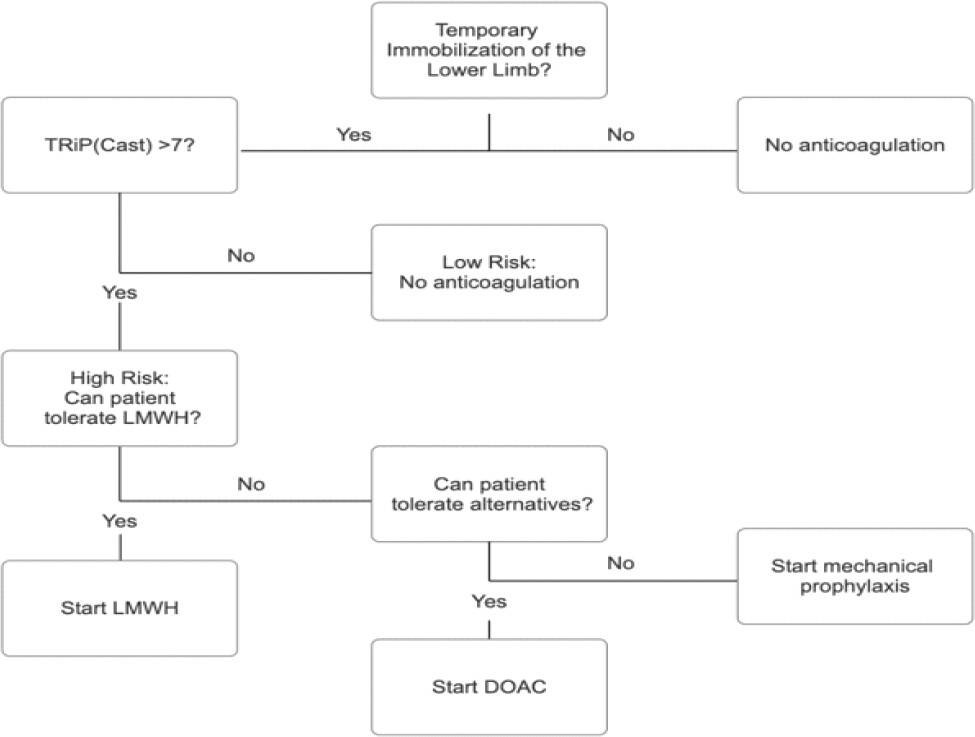
A further consequence concerns the architecture of clinical algorithms, which in this field tend to share a common and defective shape. Published algorithms commonly gate entry to risk assessment on features such as non-weight-bearing status, circumferential casting, or Achilles tendon rupture, applying a score only to patients who have already been selected on those grounds. This is circular, because several of those features are themselves scored components of the models [22, 24], and it fails in a predictable direction, since an older patient with previous VTE or active malignancy managed in a removable boot may never be assessed at all. The remedy is straightforward: Risk assessment should be applied to every patient with temporary lower-limb immobilization, with device type and weight-bearing status entering the calculation as score components rather than standing in front of it as gatekeepers (Fig. 1).
Limitations of the evidence and of this review
Absence of demonstrated benefit is not a demonstration of absent benefit, and the argument made here should not be pushed further than it will go. The POT-CAST subgroup analysis was conducted within a trial that was itself null, was not powered for stratum-specific treatment effects, and produced CIs wide enough that a clinically worthwhile reduction in the high-risk strata cannot be excluded [8]. POT-CAST also excluded patients with previous VTE, which removes an important high-risk group from precisely the analysis most often invoked in discussions of high-risk patients [3]. Study-level network meta-regression, for its part, is vulnerable to ecological bias and is no substitute for individual-participant analysis [19]. The correct conclusion is that the question is open rather than that prophylaxis is futile, and clinicians who continue to prescribe it above the threshold are not acting unreasonably.
This review carries limitations of its own. It was not designed as a systematic review and accordingly carries none of the apparatus of one: there is no registered protocol, no duplicate screening, no formal risk-of-bias appraisal, and no meta-analysis. It is narrative rather than systematic, and selection effects cannot be excluded. It is confined to adults with temporary lower-limb immobilization after injury, and does not address pregnancy, pediatric practice, thromboprophylaxis after major orthopedic surgery, or mechanical prophylaxis, for which the evidence in this population is too sparse to summarize usefully.
Future directions
The trial this field requires is a randomized comparison of prophylaxis against no prophylaxis, restricted to patients scoring at or above the TRiP(cast) threshold, with symptomatic VTE and clinically relevant bleeding as co-primary outcomes. The question is agent-agnostic and should be resolved before comparative trials between agents are prioritized, since a trial establishing that a DOAC is non-inferior to LMWH would leave the underlying uncertainty entirely untouched. In the meantime, individual-participant-data meta-analysis of the existing trials is achievable and would test effect modification with considerably more power than study-level regression allows [19]. There is also a narrower gap worth closing, in that the risk models were derived largely in cast populations and require validation in patients managed in removable boots and braces, who now make up a substantial and growing share of practice.
Conclusion
Temporary lower-limb immobilization after injury carries a real but generally low risk of symptomatic VTE, unevenly distributed across the patients who sustain it. Validated risk assessment models identify approximately three-quarters of them as low risk, and prospective data confirm that anticoagulation can be withheld from that group safely. For the remaining minority, the evidence establishes that they are at higher risk; it does not establish that prophylaxis will help them, and the two propositions have been treated as one for longer than is defensible. Risk stratification is, on current evidence, an instrument for de-escalation, and treating it as an instrument for escalation extends the evidence beyond what the underlying trials can bear. The appropriate response is not a more confident algorithm but a trial designed to answer the question directly.
Clinical Message
Apply a validated risk score, such as TRiP(cast), to every patient with temporary lower-limb immobilization rather than to a subgroup pre-selected on the basis of cast type or weight-bearing status, since those features are themselves components of the score. Below the threshold, withhold anticoagulation with confidence, as this is well supported by prospective data. Above the threshold, LMWH is reasonable but remains unproven for symptomatic VTE, and is best offered as a decision made under acknowledged uncertainty, with attention to bleeding risk, adherence, and patient preference.
Conflict of Interest:
Nil
Source of Support:
Nil
Consent
The authors confirm that informed consent was obtained from the patient for publication of this article
How to Cite this Article
Del Rio EB, Rodríguez-Reyes D, Acevedo-Soto EL, Gonzalez-Diaz G, Luigi-Martinez HE, Señeriz-Ortiz R. Thromboprophylaxis in Non-operative Lower-Limb Immobilization: Risk Stratification Identifies Whom to Spare, Not Whom to Treat – A Narrative Review. Journal of Orthopaedic Case Reports 2026 October;16(10): 320-329.
References
- Van Adrichem RA, Debeij J, Nelissen RG, Schipper IB, Rosendaal FR, Cannegieter SC. Below-knee cast immobilization and the risk of venous thrombosis: Results from a large population-based case–control study. J Thromb Haemost 2014;12:1461-9. [Google Scholar] | [PubMed]
- Nemeth B, Cannegieter SC. Venous thrombosis following lower-leg cast immobilization and knee arthroscopy: From a population-based approach to individualized therapy. Thromb Res 2019;174:62-75. [Google Scholar] | [PubMed]
- Van Adrichem RA, Nemeth B, Algra A, Le Cessie S, Rosendaal FR, Schipper IB. Thromboprophylaxis after knee arthroscopy and lower-leg casting. N Engl J Med 2017;376:515-25. [Google Scholar] | [PubMed]
- Falck-Ytter Y, Francis CW, Johanson NA, Curley C, Dahl OE, Schulman S. Prevention of VTE in orthopedic surgery patients: Antithrombotic therapy and prevention of thrombosis, 9th ed: American college of chest physicians evidence-based clinical practice guidelines. Chest 2012;141 Suppl 2:S278-325. [Google Scholar] | [PubMed]
- National Institute for Health and Care Excellence. Venous Thromboembolism in Over 16s: Reducing the Risk of Hospital-Acquired Deep Vein Thrombosis or Pulmonary Embolism. NICE Guideline NG89.. London: NICE; 2018. [Google Scholar] | [PubMed]
- Roberts C, Horner D, Coleman G, Maitland L, Curl-Roper T, Smith R. Guidelines in emergency medicine network (GEMNet): Guideline for the use of thromboprophylaxis in ambulatory trauma patients requiring temporary limb immobilisation. Emerg Med J 2013;30:968-82. [Google Scholar] | [PubMed]
- Douillet D, Penaloza A, Viglino D, Banihachemi JJ, Abboodi A, Helderlé M. Targeted prophylactic anticoagulation based on the TRiP(cast) score in patients with lower limb immobilisation: A multicentre, stepped wedge, randomised implementation trial. Lancet 2024;403:1051-60. [Google Scholar] | [PubMed]
- Nemeth B, Van Adrichem R, Nelissen R, Le Cessie S, Cannegieter SC. Individualized thromboprophylaxis in patients with lower-leg cast immobilization-a validation and subgroup analysis in the POT-CAST trial. Thromb Haemost 2019;119:1508-16. [Google Scholar] | [PubMed]
- Baethge C, Goldbeck-Wood S, Mertens S. SANRA-a scale for the quality assessment of narrative review articles. Res Integr Peer Rev 2019;4:5. [Google Scholar] | [PubMed]
- Sarkar S, Bhatia G. Writing and appraising narrative reviews. J Clin Sci Res 2021;10:169-72. [Google Scholar] | [PubMed]
- Craik JD, Clark A, Hendry J, Sott AH, Hamilton PD. The effect of ankle joint immobilization on lower limb venous flow. Foot Ankle Int 2015;36:18-23. [Google Scholar] | [PubMed]
- Braithwaite I, Healy B, Cameron L, Weatherall M, Beasley R. Lower limb immobilisation and venous thromboembolism risk: Combined case-control studies. Postgrad Med J 2017;93:354-9. [Google Scholar] | [PubMed]
- Horner D, Pandor A, Goodacre S, Clowes M, Hunt BJ. Individual risk factors predictive of venous thromboembolism in patients with temporary lower limb immobilization due to injury: A systematic review. J Thromb Haemost 2019;17:329-44. [Google Scholar] | [PubMed]
- Halloran TP, Bassa BA, Nemeth B, Cannegieter S, Breslin T, Wakai A. The (T) thrombosis (I) in patients with (L) lower (L) limb (I) injuries (R) requiring (I) immobilisation (TILLIRI) study. J Thromb Haemost 2025;23:947-56. [Google Scholar] | [PubMed]
- Kock HJ, Schmit-Neuerburg KP, Hanke J, Rudofsky G, Hirche H. Thromboprophylaxis with low-molecular-weight heparin in outpatients with plaster-cast immobilisation of the leg. Lancet 1995;346:459-61. [Google Scholar] | [PubMed]
- Jørgensen PS, Warming T, Hansen K, Paltved C, Vibeke Berg H, Jensen R. Low molecular weight heparin (Innohep) as thromboprophylaxis in outpatients with a plaster cast: A venografic controlled study. Thromb Res 2002;105:477-80. [Google Scholar] | [PubMed]
- Ettema HB, Kollen BJ, Verheyen CC, Büller HR. Prevention of venous thromboembolism in patients with immobilization of the lower extremities: A meta-analysis of randomized controlled trials. J Thromb Haemost 2008;6:1093-8. [Google Scholar] | [PubMed]
- Zee AA, Van Lieshout K, Van Der Heide M, Janssen L, Janzing HM. Low molecular weight heparin for prevention of venous thromboembolism in patients with lower-limb immobilization. Cochrane Database Syst Rev 2017;8:CD006681. [Google Scholar] | [PubMed]
- Horner D, Stevens JW, Pandor A, Nokes T, Keenan J, De Wit K. Pharmacological thromboprophylaxis to prevent venous thromboembolism in patients with temporary lower limb immobilization after injury: Systematic review and network meta-analysis. J Thromb Haemost 2020;18:422-38. [Google Scholar] | [PubMed]
- Douillet D, Chapelle C, Ollier E, Mismetti P, Roy PM, Laporte S. Prevention of venous thromboembolic events in patients with lower leg immobilization after trauma: Systematic review and network meta-analysis with meta-epsidemiological approach. PLoS Med 2022;19:e1004059. [Google Scholar] | [PubMed]
- Czuprynska J, Nemeth B, Roberts LN, Cannegieter SC, Arya R. Thromboprophylaxis in temporary lower limb immobilization: Extrapolate with care. J Thromb Haemost 2020;18:518-9. [Google Scholar] | [PubMed]
- Nemeth B, Van Adrichem RA, Van Hylckama Vlieg A, Bucciarelli P, Martinelli I, Baglin T. Venous thrombosis risk after cast immobilization of the lower extremity: Derivation and validation of a clinical prediction score, L-TRiP(cast), in three population-based case-control studies. PLoS Med 2015;12:e1001899. [Google Scholar] | [PubMed]
- Douillet D, Nemeth B, Penaloza A, Le Gal G, Moumneh T, Cannegieter SC. Venous thromboembolism risk stratification for patients with lower limb trauma and cast or brace immobilization. PLoS One 2019;14:e0217748. [Google Scholar] | [PubMed]
- Nemeth B, Douillet D, Le Cessie S, Penaloza A, Moumneh T, Roy PM. Clinical risk assessment model to predict venous thromboembolism risk after immobilization for lower-limb trauma. EClinicalMedicine 2020;20:100270. [Google Scholar] | [PubMed]
- Almoosawy SA, Ofosu-Asiedu A, Hanna J, Conlen B, Elliott H, Harrison A. Venous thromboembolism risk following temporary immobilisation after injury: Evaluation of the Aberdeen VTE risk tool. Emerg Med J 2023;40:361-8. [Google Scholar] | [PubMed]
- Marrinan E, Speed V, Giron G, Georgiou L, Harris R, Al-Agil M. King's lower limb immobilisation VTE risk assessment tool (K4 score) in conservatively treated ambulatory patients: A 2-year review. Emerg Med J 2024;41:686-7. [Google Scholar] | [PubMed]
- Samama CM, Laporte S, Rosencher N, Girard P, Llau J, Mouret P. Rivaroxaban or enoxaparin in nonmajor orthopedic surgery. N Engl J Med 2020;382:1916-25. [Google Scholar] | [PubMed]
- Zambelli R, Frölke S, Nery C, Baumfeld D, Ortiz C, Cannegieter S. Venous thromboembolism prophylaxis in foot and ankle surgery: A worldwide survey. J Foot Ankle Surg 2024;63:59-63. [Google Scholar] | [PubMed]
- Pandor A, Horner D, Davis S, Goodacre S, Stevens JW, Clowes M. Different strategies for pharmacological thromboprophylaxis for lower-limb immobilisation after injury: Systematic review and economic evaluation. Health Technol Assess 2019;23:1-190. [Google Scholar] | [PubMed]
- Horner D, Goodacre S, Pandor A, Nokes T, Keenan J, Hunt B. Thromboprophylaxis in lower limb immobilisation after injury (TiLLI). Emerg Med J 2020;37:36-41. [Google Scholar] | [PubMed]
© 2026 Journal of Orthopaedic Case Reports - Published by Indian Orthopaedic Research Group
About the Authors
-

Emmanuel Belardo Del Rio
-

Derick Rodríguez-Reyes
-

Edwin L. Acevedo-Soto
-

Gabriel Gonzalez-Diaz
-

Hiram E. Luigi-Martinez
-

Rafael Señeriz-Ortiz
Related Articles in Journal of Orthopaedic Case Reports
 July 1, 2025 Increased Anticoagulant Requirement in Total Hip Replacement Patients Post-COVID: A Comparative Study in the Indian Population
 January 1, 2026 Comparative Outcomes of Arthroscopic Versus Open Meniscus Repair: An Observational Study
 July 11, 2014 Simple Bone Cyst of Metacarpal: Rare Lesion with Unique Treatment
 June 1, 2026 Comparative Outcomes of Manipulation under General Anesthesia and Ultrasound-Guided Hydrodistension in Adhesive Capsulitis