


Introduction
Ureaplasma urealyticum is a fastidious, urease-producing bacterium typically responsible for urogenital infection [1]. In unusual circumstances, such as in an immunocompromised host, a full thickness breach in the mucosal surfaces may be complicated by hematogenous spread of the microbe, leading to septic arthritis in distant joints [2]. Septic arthritis caused by Ureaplasma species has previously been reported in patients with common variable immunodeficiency and X-linked agammaglobulinemia, as well as in patients on immunosuppressive agents with resultant hypogammaglobulinemia states [3].
U. urealyticum is difficult to isolate in culture and requires special culture media. It is not an organism that may be detected on routine microbiological cultures and requires a specific 16S RNA gene polymerase chain reaction for detection.
The authors report a case of an immunocompromised 26-year-old female with the right knee chronic U. urealyticum septic arthritis, which demonstrated poor response to multiple debridements and aggressive intravenous (IV) antibiotics over 2 years.
Case Report
A 26-year-old Chinese female with a background of neuromyelitis optica on long-term cyclosporine and Grave’s disease first presented to a tertiary hospital in Singapore for right calf pain. A magnetic resonance imaging done for her showed non-specific muscle edema in the posterior compartment of the calf with no collections. Initial knee aspiration, while turbid with a white cell count of 12,300 cell/L, did not grow any microbes on routine cultures. Despite completing 6 weeks of antibiotic therapy, she had persistent knee swelling and worsening knee pain. A right knee arthroscopic biopsy and washout was performed. Synovium samples were sent for 16 s molecular test on top of routine investigations, which finally yielded U. urealyticum. She was initially started on IV aztreonam and vancomycin, although later developed severe drug exanthem and switched to oral levofloxacin and IV azithromycin. Her ciclosporin was switched to oral prednisolone.
She later developed medial tibial plateau osteomyelitis and an intra-articular abscess with anteromedial knee subcutaneous sinus tract. Multiple right knee debridements and washouts were performed, with later insertion of cement spacer and external fixation. Intraoperative samples persistently isolated U. urealyticum isolates despite her antibiotic regime.
Seven months later, the patient underwent a right knee washout, first stage revision knee replacement with antibiotic cement spacer and reconstruction with gastrocnemius flap and split skin graft (SSG) (Fig. 1). This wound demonstrated poor healing, requiring application of negative pressure wound therapy with instillation and dwell time (NPWTi-d) (3M™ Veraflo™ Therapy, USA). Nonetheless, despite a second attempt at first stage revision total knee replacement and an interval removal of cement spacer, osteotomy of osteomyelitic bone with insertion of a new cement spacer, there was minimal improvement with persistent U. urealyticum isolates.
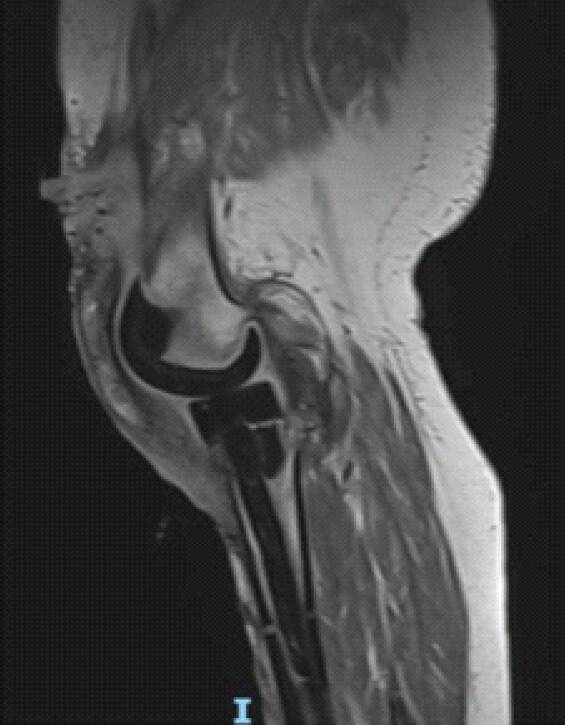
One year after the index attempt at first stage total knee revision, the patient underwent an above-knee amputation (AKA) for definitive source control. Even so, the right AKA stump wound demonstrated poor healing, which failed to improve despite aggressive debridements and NPWTi-d. She underwent a right hip disarticulation 1 month later, from which there was purulent discharge expressed from the disarticulated hip joint and a sinus tract extending to the superior aspect of the acetabulum (Fig. 2). An SSG was applied over the hip wound 1 month later, which took well after 2 months of debridements and negative pressure wound therapy (Vacuum-assisted closure therapy, KCI USA). The dressing was eventually de-escalated to silver hydrofiber foam dressing (Aquacel Ag, Convatec, USA) for 1 month, and switched over to lipodo-colloid with silver dressing (UrgoTul Ag, Urgo Medical, North America).
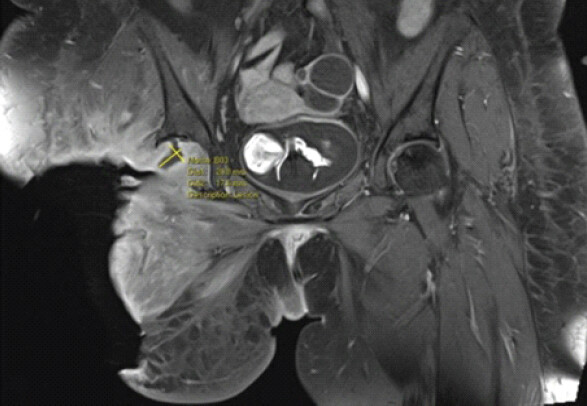
Her wound gradually granulated well with complete healing after 1 month. She was successfully discharged on 180 days after her hip disarticulation. At 2 years follow-up post-hip disarticulation, the patient was ambulant with a hip prosthesis, the SSG had healed well with no issues, was independent in her activities of daily living, and had returned to work.
Discussion
Septic arthritis caused by U. urealyticum is an rare and challenging condition to diagnose and treat. Due to its unique structure in lacking a peptidoglycan cell wall, Ureaplasma is undetectable by routine Gram staining [4], and intrinsically resistant to all beta-lactams [5]; meanwhile, as cells do not undergo de novo synthesis of folic acid, sulfonamides and diaminopyrimidines are rendered ineffective as well [6]. This limits treatment options to macrolides, tetracyclines, and fluoroquinolones, although resistance is an emerging concern necessitating susceptibility testing to guide treatment.
U. urealyticum may cause locoregional infection by attaching to mucosal surfaces through the presence of cytoadehrence proteins, with virulence through expression of surface lipoproteins, phospholipases A and C, immunoglobulin A1 proteases, and urease activity [7]. This allows it to mitigate the immune defenses and facilitates the bacterial colonization. The virulence and persistence of Ureaplasma may also be attributed to their ability to build biofilms, encouraging microbial survival and persistent inflammation. This presents a therapeutic challenge in systemic eradication of Ureaplasma, especially so in this case where antibiotic susceptibility testing for Ureaplasma was not readily available. As such, akin to previous reports, this patient received prolonged duration of non-specific broad-spectrum antimicrobial agents, which proved ineffective due to the lack of Ureaplasma-specific activity [8–10].
An additional hurdle was the patient’s allergy to multiple antibiotics, limiting her antibiotic options. As such, her prescribed antibiotic therapy was insufficient in containing the infection, which resulted in progressive joint destruction and necessitated increasingly radical surgical management.
The decision to proceed with an AKA and later a right hip disarticulation was undoubtedly a difficult one. A multidisciplinary approach involving orthopedic surgeons, infectious disease specialists, rehabilitation professionals, and psychosocial support would have been essential to weigh the risks and benefits of such extensive surgical interventions in this complex case. In addition, patient’s outcome may have been influenced by the delayed diagnosis of chronic U. urealyticum septic arthritis. This condition is often insidious and may mimic other causes of chronic joint inflammation. Increased awareness among healthcare providers, especially in the context of immunocompromised patients with atypical presentations, is crucial for early recognition and appropriate management.
Despite the extensive surgical burden, this case demonstrates the potential for meaningful functional recovery even after major limb loss. The patient was successfully fitted with a hip prosthesis post-disarticulation, allowing independent ambulation and reintegration into the workforce. Once again, the involvement of a multidisciplinary team is cardinal to coordinate long-term care of these complex patients as part of a broader strategy to restore function and quality of life.
Conclusion
The presented case emphasizes the challenges encountered in managing chronic U. urealyticum septic arthritis in an immunocompromised with multiple antibiotic allergies. The poor response to antibiotic therapy and subsequent need for extensive surgical interventions highlight the importance of early recognition, appropriate antibiotic selection, and a multidisciplinary approach to optimize patient outcomes. Further research and case reports are warranted to guide clinicians in effectively managing similar complex cases in the future.
Clinical Message
In immunocompromised patients with treatment-refractory septic arthritis, early molecular testing and a low threshold for radical surgical debridement are key to preventing progressive, limb-threatening infection.
Conflict of Interest:
Source of Support:
Nil
Consent:
The authors confirm that informed consent was obtained from the patient for publication of this article
References
- Mobarak A, Tharwat A.Ureaplasma urealyticum as a causative organism of urinary tract infection stones. J Egypt Public Health Assoc 1996;71:309-19. [Google Scholar] | [PubMed]
- Mahlouly J, Lhopitallier L, Suttels V, Mueller L, Wernly D, Borens O.Septic arthritis of the shoulder due to Ureaplasma urealyticum after emergency caesarean section: A case report. BMC Infect Dis 2020;20:767. [Google Scholar] | [PubMed]
- Gassiep I, Gore L, Dale JL, Playford EG.Ureaplasma urealyticum necrotizing soft tissue infection. J Infect Chemother 2017;23:830-2. [Google Scholar] | [PubMed]
- Walkty A, Lo E, Manickam K, Alfa M, Xiao L, Waites K.Ureaplasma parvum as a cause of sternal wound infection. J Clin Microbiol 2009;47:1976-8. [Google Scholar] | [PubMed]
- Fernández J, Karau MJ, Cunningham SA, Greenwood-Quaintance KE, Patel R.Antimicrobial susceptibility and clonality of clinical Ureaplasma isolates in the United States. Antimicrob Agents Chemother 2016;60:4793-8. [Google Scholar] | [PubMed]
- Fernández J, Karau MJ, Cunningham SA, Greenwood-Quaintance KE, Patel R.Antimicrobial Susceptibility and Clonality of Clinical Ureaplasma Isolates in the United States. Antimicrob Agents Chemother 60 2016. https://doi.org/10.1128/aac.00671-16. [Google Scholar] | [PubMed] | [CrossRef]
- Kokkayil P, Dhawan B.Ureaplasma: Current perspectives. Indian J Med Microbiol 2015;33:205-14. [Google Scholar] | [PubMed]
- Ian G, Gore , Letitia G, Joanne DL, Geoffrey PE.Ureaplasma urealyticum necrotizing soft tissue infection. J Infection Chemotherapy 2017;23(12):830-832. doi:10.1016/j.jiac.2017.07.007. [Google Scholar] | [PubMed] | [CrossRef]
- Frangogiannis NG, Cate TR.Endocarditis and Ureaplasma urealyticum osteomyelitis in a hypogammaglobulinemic patient. A case report and review of the literature 1998;37(2):181-184. doi:10.1016/s0163-4453(98)80174-6. [Google Scholar] | [PubMed] | [CrossRef]
- Deetjen P, Maurer C, Rank A, Berlis A, Schubert S, Hoffmann R.Brain abscess caused by Ureaplasma urealyticum in an adult patient. J Clin Microbiol 2014 Feb;52(2):695-8. doi: 10.1128/JCM.02990-13. Epub 2013 Dec 11 PMID: 24478517; PMCID: PMC3911303. [Google Scholar] | [PubMed] | [CrossRef]
© 2026 Journal of Orthopaedic Case Reports - Published by Indian Orthopaedic Research Group
About the Authors
-

Dr. Cassie Yang
-

Dr. Yusof Najim
-

Dr. Zainul-Abidin Suraya
Related Articles in Journal of Orthopaedic Case Reports
 December 1, 2024 Kingella kingae Induced Septic Arthritis in the Knee Revealing an Unexpected Diagnosis of Multiple Myeloma, a Case Report
 September 1, 2026 Serratia Marcescens Septic Arthritis of the Ankle in a Compromised Host: Ring Fixator Arthrodesis as Salvage, a Case Report
 July 1, 2026 Tuberculosis of the Elbow in a Chronic Kidney Disease Patient with Arteriovenous Fistula: A Case Report
 July 1, 2026 Atypical Presentation of MRSA Septic Arthritis with Concurrent Pyomyositis of the Calf Muscles in an Immunocompetent Adult