


Introduction
Factor XI Deficiency is an uncommon blood disorder, with a prevalence as low as 0–5.0/1,000,000 in non-European countries and >5.0/1,000,000 in Europe. In Colombia, a recent study by Zhang et al. [1] found a prevalence of 2.57/1,000,000. Genetic studies have shown variable clinical manifestations, with mutations located primarily on 4q35.2 [1]. These mutations result in reduced plasma FXI activity by causing quantitative defects in the FXI protein.
The most common clinical manifestation of this defect is post-traumatic bleeding; however, clinical manifestations can vary, and bleeding tendency does not always correlate with FXI plasma levels or genotype [2, 3]. Major procedures like total hip arthroplasty (THA) require careful planning in patients with FXI deficiency due to increased bleeding risk [2]. While FXI concentrates are ideal, they are often unavailable in Colombia, making fresh frozen plasma (FFP) the practical alternative. FFP has long been used but involves high volumes and risk of allergic or infectious complications [4]. Fortunately, viral inactivation methods have improved its safety. This case illustrates the use of FFP therapy for Hemophilia C in the absence of factor concentrate, along with individualized management and interdisciplinary collaboration to achieve the best possible outcomes in patients with complex bleeding disorders.
Case Report
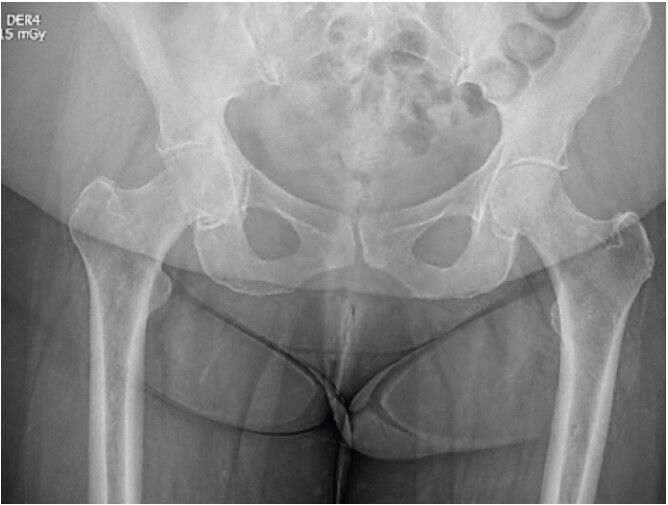
The patient is a 67-year-old female with a past medical history significant for severe right hip osteoarthritis (with chronic self-medicated non-steroidal anti-inflammatory drugs [NSAID] use for pain management), obesity, and hypertension. She presented with a 3-year history of right inguinal pain, which had worsened with prolonged standing and walking. Her functional decline increased over the past 6 months, resulting in a Single Assessment Numeric Evaluation score of 20%. A hip X-ray showed bilateral hip joint degeneration, more prominent on the right side (Fig. 1). The patient was considered a suitable candidate for THA.
The pre-operative evaluation showed mild thrombocytopenia (77,000/µL), normal hemoglobin (16 g/dL), and normal hematocrit (43.7%). She reported a family history of Hemophilia C (her son) but denied any personal bleeding history. A hematology consultation was requested. Laboratory tests showed normal levels of factors VIII, IX, and von Willebrand factor; however, FXI activity was low at 63.4%. One hour prior to the surgical procedure, the patient received five units of FFP and one gram of tranexamic acid. FFP dosage was calculated at 15–20 mL/kg to achieve a targeted rise in Factor XI levels to 94%. Antibiotic prophylaxis with two grams of cefazolin was administered 30 min before the procedure. Regional anesthesia was deemed unsuitable due to the potential bleeding risk and subsequent risk of spinal/epidural hematoma formation.
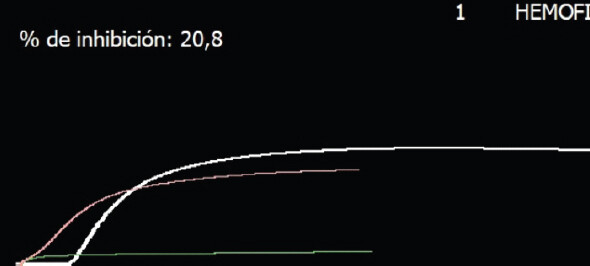
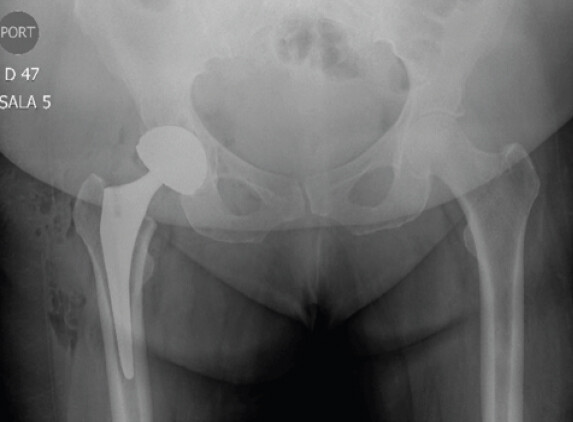
During surgery, persistent microvascular bleeding was observed despite stable blood pressure. Conventional thromboelastography (TEG) parameters demonstrated normal clot kinetics; however, automated platelet mapping revealed profound inhibition in both the adenosine diphosphate (ADP) and arachidonic acid (AA) pathways (19.4% and 20.8% response, respectively) (Fig. 2). Therefore, platelet apheresis was promptly administered intraoperatively. This targeted intervention resulted in successful surgical hemostasis, allowing for the completion of the procedure without further complications. A right THA was completed using a posterolateral approach with a press-fit acetabular prosthesis and a non-cemented stem (Fig. 3). Total operative time was 90 min, and total blood loss was 250 mL.
Post-operative hemoglobin and hematocrit decreased as expected to 11.8 g/dL and 32.8%, respectively. The post-operative platelet count rose to 133,000/µL. Twenty-four-hour post-operative laboratory assays demonstrated satisfactory coagulation profiles: Partial thromboplastin time of 25.1 s, prothrombin time of 10.9 s, fibrinogen levels of 245.6 mg/dL, and corrected Factor XI activity of 94.5%. Full weight-bearing was permitted immediately after surgery. Mechanical thromboprophylaxis alone was initiated for the first 7 days. The patient was discharged home on the 3rd post-operative day. Pharmacological thromboprophylaxis with oral rivaroxaban (10 mg daily) was initiated 1 week after discharge and continued until post-operative day 35. The remainder of her recovery was completely uneventful.
Discussion
Factor XI Deficiency impairs the intrinsic coagulation pathway, increasing surgical bleeding risks [2]. Pre-operative screening, including complete blood counts, standard coagulation studies, and specific factor assays, is recommended to optimize perioperative planning [5]. In the present case, despite the pre-operative administration of FFP to correct Factor XI levels, the patient exhibited persistent intraoperative bleeding. While standard TEG parameters were normal, platelet mapping successfully isolated a profound inhibition in both the ADP and AA pathways. In orthopedic practice, such specific pathway inhibitions are frequently secondary to the chronic consumption of NSAIDs or antiplatelet agents used for osteoarthritis joint pain management. This hidden drug-induced platelet dysfunction, compounded by the patient’s baseline thrombocytopenia (77,000 platelets), created a complex hemostatic challenge that could not be predicted by standard coagulation profiles. The utilization of real-time point-of-care platelet mapping was crucial to tailor the administration of platelet apheresis, targeting the true source of the hemorrhage and achieving successful intraoperative hemostasis.
A precise FFP dosage (15–20 mL/kg) was calculated to elevate Factor XI levels to 94%, balancing bleeding risk with the potential for volume overload, such as transfusion-associated circulatory overload or transfusion-related acute lung injury [4, 6]. No adverse transfusion reactions occurred [7]. Tranexamic acid was selected due to its well-documented efficacy in reducing perioperative blood loss in orthopedic procedures [8]. Its antifibrinolytic properties contribute to clot stability, reducing global transfusion needs [8,9]. Postoperatively, mechanical thromboprophylaxis was initiated first, safely delaying pharmacologic intervention to allow for stable tissue healing and primary hemostasis [4]. Rivaroxaban was subsequently selected due to its superior efficacy in preventing major thromboembolic events compared to enoxaparin. The choice of rivaroxaban over enoxaparin was influenced by the patient’s overall thromboembolic risk, bleeding profile, and the convenience of oral administration [10]. Randomized clinical trials have demonstrated rivaroxaban’s superior efficacy in reducing major venous thromboembolic events compared to enoxaparin, with a relative risk reduction of 70% for deep-vein thrombosis and 88% for major venous thromboembolism [10]. This robust evidence supported the decision to prioritize rivaroxaban, particularly given the patient’s history of transient platelet dysfunction.
Additional investigation into the long-term safety of FFP and tranexamic acid combinations in FXI deficiency is warranted. Future solutions may include safer, pathogen-inactivated plasma products or novel specialized agents. This case underscores the critical role of multidisciplinary collaboration, real-time diagnostics, and personalized treatment strategies in optimizing surgical outcomes for patients with rare bleeding disorders.
Conclusion
In patients with inherited coagulopathies, relying solely on standard coagulation profiles and target factor replacement can be misleading. When unexpected intraoperative microvascular bleeding occurs despite target correction, integrating real-time point-of-care viscoelastic testing and platelet mapping is crucial. This diagnostics-guided approach successfully identifies hidden, drug-induced antiplatelet effects – such as those from chronic NSAID use – enabling highly targeted interventions like platelet apheresis, preventing volume overload, and guaranteeing optimal surgical outcomes in complex orthopedic patients.
Clinical Message
Orthopedic surgeons must remain vigilant regarding the hidden hemostatic effects of self-medicated NSAIDs in osteoarthritic patients. In cases with concurrent rare bleeding disorders, standard coagulation panels may fail to predict surgical bleeding. Real-time platelet mapping and TEG are vital to differentiate and guide targeted hemostatic therapies, ensuring patient safety and preventing unnecessary transfusion complications.
Conflict of Interest:
Nil
Source of Support:
Nil
Consent
The authors confirm that informed consent was obtained from the patient for publication of this article
How to Cite this Article
Londoño L, Llinás A, Raffán-Sanabria F. Real-Time Coagulation Monitoring via Thromboelastography and Platelet Mapping in Total Hip Arthroplasty for a Patient with Factor XI Deficiency: A Case Report. Journal of Orthopaedic Case Reports 2026 October;16(10): 223-226.
References
- Zhang X, Lewandowska M, Aldridge M, Iglay K, Wolford E, Shapiro A. Global epidemiology of factor XI deficiency: A targeted review of the literature and foundation reports. Haemophilia 2022;28:912-21. [Google Scholar] | [PubMed]
- Gomez K, Bolton-Maggs P. Factor XI deficiency. Haemophilia 2008;14:1183-9. [Google Scholar] | [PubMed]
- Mannucci PM, Duga S, Peyvandi F. Recessively inherited coagulation disorders. Blood 2004;104:1243-52. [Google Scholar] | [PubMed]
- Srivastava A, Santagostino E, Dougall A, Kitchen S, Sutherland M, Pipe SW. WFH Guidelines for the Management of Hemophilia, 3rd edition. Haemophilia 2020;26 Suppl 61-158. [Google Scholar] | [PubMed]
- James PD, Connell NT, Ameer B, Di Paola J, Eikenboom J, Giraud N. ASH ISTH NHF WFH 2021 guidelines on the diagnosis of von Willebrand disease. Blood Adv 2021;5:280-300. [Google Scholar] | [PubMed]
- Bolton-Maggs PH, Colvin BT, Satchi G, Lee CA, Lucas GS. Thrombogenic potential of factor XI concentrate. Lancet 1994;344:748-9. [Google Scholar] | [PubMed]
- Richards EM, Makris MM, Cooper P, Preston FE. In vivo coagulation activation following infusion of highly purified factor XI concentrate. Br J Haematol 1997;96:293-7. [Google Scholar] | [PubMed]
- Huang ZY, Huang Q, Zeng HJ, Ma J, Shen B, Zhou ZK. Tranexamic acid may benefit patients undergoing total hip/knee arthroplasty because of haemophilia. BMC Musculoskelet Disord 2019;20:402. [Google Scholar] | [PubMed]
- Stoicea N, Moran K, Mahmoud AR, Glassman A, Ellis T, Ryan J. Tranexamic acid use during total hip arthroplasty: A single center retrospective analysis. Medicine (Baltimore) 2018;97:e10720. [Google Scholar] | [PubMed]
- Eriksson BI, Borris LC, Friedman RJ, Haas S, Huisman MV, Kakkar AK. Rivaroxaban versus enoxaparin for thromboprophylaxis after hip arthroplasty. N Engl J Med 2008;358:2765-75. [Google Scholar] | [PubMed]
© 2026 Journal of Orthopaedic Case Reports - Published by Indian Orthopaedic Research Group
About the Authors
-

Luisa Londoño
-

Adolfo Llinás
-

Fernando Raffán-Sanabria
Related Articles in Journal of Orthopaedic Case Reports
 September 1, 2026 Iliopsoas Abscess as the Initial Manifestation of Periprosthetic Hip Joint Infection after Total Hip Arthroplasty: A Case Report and Literature Review
 October 1, 2026 Staged Bilateral Total Elbow Arthroplasty in Advanced Rheumatoid Elbow Disease: A Case Report
 October 1, 2026 Posterior Hip Dislocation with Ipsilateral Subtrochanteric Femur Fracture: A Rare Case Report
 October 1, 2026 A Hand-Palm Technique for Localization of the Greater Trochanter Tip During Proximal Femoral Nailing: A Prospective Pilot Validation Study