


Introduction
Knee osteoarthritis is a common chronic musculoskeletal disorder and a leading cause of pain, physical disability, and impaired mobility, particularly among older adults [1]. Obesity is one of the most important modifiable risk factors for the development and progression of knee osteoarthritis [2]. A systematic review and meta-analysis of prospective studies found that overweight and obesity were associated with approximately 2.45-fold and 4.55-fold higher risks of knee osteoarthritis, respectively, while each 5 kg/m2 increase in body mass index (BMI) was associated with a 35% increase in the risk of knee osteoarthritis [3]. The relationship between obesity and knee osteoarthritis extends beyond the increased mechanical loading imposed on the knee. Excess adipose tissue is metabolically active and contributes to a state of chronic low-grade inflammation through the production of adipokines and other inflammatory mediators, which may influence cartilage, synovium, subchondral bone, and other components of the joint [4]. Thus, obesity may contribute not only to the structural development of knee osteoarthritis but also to greater symptom burden and functional limitation [5]. Weight management is consequently an important component of conservative knee osteoarthritis management, and present clinical guidelines recommend exercise and weight loss for patients with knee arthritis who are overweight or obese [6].
The clinical benefits of weight reduction in knee osteoarthritis are supported by evidence from dietary and lifestyle interventions. Randomized trials have demonstrated that intentional weight loss can reduce knee pain and improve physical function, mobility, and health-related quality of life, with greater weight loss generally associated with greater clinical benefit [7,8,9]. However, achieving and maintaining substantial weight loss through lifestyle intervention alone can be challenging for many individuals with obesity. The increasing availability of effective anti-obesity pharmacotherapy has therefore expanded the therapeutic approach to obesity from lifestyle modification alone to long-term, comprehensive weight management incorporating behavioral, nutritional, physical activity, and pharmacological interventions [10]. Semaglutide, a glucagon-like peptide-1 receptor agonist, has demonstrated substantial and sustained weight loss when administered at a dose of 2.4 mg once weekly in adults with overweight or obesity. Importantly, its potential relevance to knee osteoarthritis extends beyond weight reduction [11]. In the 68-week STEP 9 randomized controlled trial, which specifically enrolled individuals with obesity and moderate knee osteoarthritis, semaglutide 2.4 mg produced significantly greater reductions in body weight and knee osteoarthritis-related pain than placebo, together with greater improvement in physical function. These findings suggest that pharmacological treatment of obesity may have clinically meaningful effects on musculoskeletal symptoms and functional status in patients with obesity-associated knee osteoarthritis [12]. Against this background, the present study aimed to assess the effects of semaglutide on knee pain, physical function, and thigh skeletal muscle volume in patients with obesity-associated knee osteoarthritis. By examining these outcomes together, the study seeks to explore whether semaglutide treatment is associated with improvements in knee symptoms and physical function in addition to weight reduction.
Materials and Methods
Study design and patient population
A prospective, observational, longitudinal, investigator-initiated study was conducted at a tertiary-care center in India between July 2023 and June 2025. Obese patients with knee osteoarthritis diagnosed based on clinical and/or radiological findings who received semaglutide as part of weight-reduction management were included in this study. Obese patients were defined as those with BMIm2. Patients were excluded if they experienced major knee trauma or underwent knee surgery during the study period, had previously undergone total knee replacement or bariatric surgery, were concurrently receiving another pharmacological weight-loss treatment, or had incomplete clinical or follow-up data. The study protocol was approved by the Institutional Ethics Committee, and written informed consent was obtained from all patients before inclusion in the study.
Study procedure
Eligible patients underwent baseline clinical assessment before or at the initiation of semaglutide therapy. The baseline assessment included demographic characteristics and clinical and laboratory parameters relevant to obesity-associated knee osteoarthritis. Patients received semaglutide for weight reduction as part of their clinical management and were analyzed at the 6-month follow-up, which included reassessment of body weight, BMI, knee pain, physical function, and inflammatory/metabolic parameters. Semaglutide was initiated at 0.25 mg once weekly and gradually escalated according to the standard dose-escalation schedule to a maintenance dose of 2.4 mg once weekly. Pain was assessed using a 10-cm visual analogue scale (VAS) ranging from 0 (no pain) to 10 (worst imaginable pain). The Western Ontario and McMaster Universities Osteoarthritis Index (WOMAC) was assessed using the 24-item version, scored from 0 to 96, with higher scores indicating greater symptom severity. Laboratory assessment included C-reactive protein (CRP), erythrocyte sedimentation rate (ESR), and glycated hemoglobin (HbA1c). Thigh skeletal muscle volume was measured by magnetic resonance imaging.[13,14].
Data collection
Demographic and clinical data were recorded at baseline. The variables collected included age, sex, body weight, BMI, VAS score, WOMAC score, CRP, ESR, and HbA1c. Body weight was recorded in kilograms, and BMI was calculated as weight in kilograms divided by the square of height in meters. Knee pain was assessed using the VAS, with higher scores representing greater pain. The WOMAC score was used to assess osteoarthritis-related symptoms and physical function. Laboratory investigations included serum CRP, ESR, and HbA1c. The same outcome parameters were reassessed at the 6-month follow-up visit. Data were collected prospectively and documented for analysis. Patients who did not have adequate follow-up information were excluded from the final analysis.
Statistical analysis
Continuous variables were expressed as mean ± standard deviation, while categorical variables were expressed as numbers and percentages. Changes between baseline and 6-month follow-up were assessed using the paired Student’s t-test for normally distributed continuous variables, and the Wilcoxon signed-rank test was used for non-normally distributed continuous variables. A two-sided P < 0.05 was considered statistically significant. Statistical analysis was performed using the Statistical Package for the Social Sciences (SPSS) for Windows, version 23.0 (IBM Corp., Armonk, NY, USA).
Results
Baseline demographics of study patients
The mean age of the study patients was 56.6 ± 7.6 years. Women constituted 58 (77.3%) patients, representing the majority of the study population. The mean VAS and WOMAC scores were 6.90 ± 2.10 and 59.67 ± 6.47, respectively, indicating a considerable baseline burden of knee pain and osteoarthritis-related symptoms. Mean CRP was 6.14 ± 0.73 mg/L, ESR was 27.51 ± 3.32 mm/h, and HbA1c was 6.12 ± 0.42%. The mean body weight was 101.23 ± 15.45 kg, with a mean BMI of 34.49 ± 3.67 kg/m2. The baseline demographic characteristics of the study patients are detailed in Table 1.
Baseline demographic characteristics of study population
| Variable | Patients (n =75) |
|---|---|
| Age, years | 56.6±7.6 |
| Females | 58 (77.3%) |
| Weight, kg | 101.23±15.45 |
| Body mass index, kg/m | 34.49±3.67 |
| VAS score | 6.90±2.10 |
| WOMAC score | 59.67±6.47 |
| CRP, mg/L | 6.14±0.73 |
| ESR, mm/h | 27.51±3.32 |
| HbA1c, % | 6.12±0.42 |
CRP: C-reactive protein, ESR: Erythrocyte sedimentation rate, HbA1c: Glycated hemoglobin, VAS: Visual analogue scale, WOMAC: Western Ontario and McMaster Universities Osteoarthritis Index
6-month follow-up findings
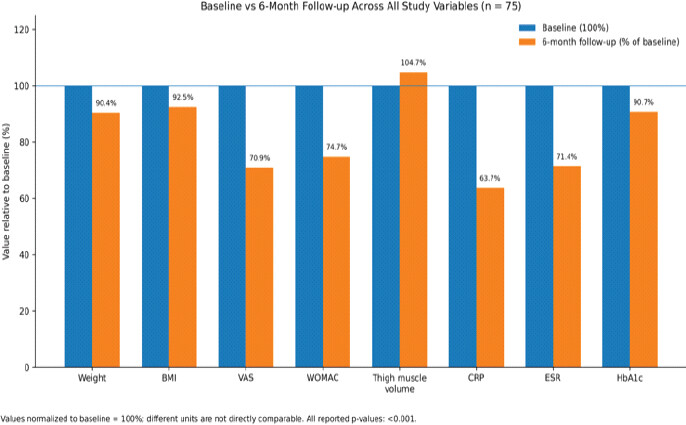
At the 6-month follow-up, mean weight decreased by 9.76 kg, BMI by 2.60 kg/m2, VAS pain score by 2.01 points, and WOMAC total score by 15.07 points. Moreover, CRP decreased by 2.23 mg/L, ESR by 7.87 mm/h, and HbA1c by 0.57%. A mean gain of 0.50 L of thigh skeletal muscle was observed. All these findings were statistically significant. The 6-month follow-up findings are presented in Table 2.
Six-month follow-up
| Variable | Baseline (n =75) | 6 Month follow-up (n =75) | Mean change | P -value |
|---|---|---|---|---|
| Weight, kg | 101.23 ± 15.45 | 91.47±9.67 | −9.76 | <0.001 |
| Body mass index, kg/m | 34.49±3.67 | 31.89±5.78 | −2.60 | <0.001 |
| VAS score | 6.90±2.10 | 4.89±0.73 | −2.01 | <0.001 |
| WOMAC score | 59.67±6.47 | 44.60±6.12 | −15.07 | <0.001 |
| Thigh skeletal muscle volume, L | 10.6±2.3 | 11.1±1.8 | 0.5 | <0.001 |
| CRP, mg/L | 6.14±0.73 | 3.91±2.08 | −2.23 | <0.001 |
| ESR, mm/h | 27.51±3.32 | 19.64±4.37 | −7.87 | <0.001 |
| HbA1c, % | 6.12±0.42 | 5.55±0.82 | −0.57 | <0.001 |
CRP: C-reactive protein, ESR: Erythrocyte sedimentation rate, HbA1c: Glycated hemoglobin, VAS: Visual analogue scale, WOMAC: Western Ontario and McMaster Universities Osteoarthritis Index
Discussion
The present prospective observational study evaluated changes following 6 months of semaglutide treatment in patients with obesity-associated knee osteoarthritis. Treatment was associated with substantial reductions in body weight and BMI, accompanied by significant improvements in knee pain, WOMAC scores, CRP, ESR, and HbA1c. The mean reduction in body weight was 9.76 kg, corresponding to approximately 9.6% of baseline body weight, while VAS and WOMAC scores decreased by 2.01 and 15.07 points, respectively. These findings suggest that pharmacological weight management may be accompanied by improvements in symptomatic and functional outcomes in patients with obesity-associated knee osteoarthritis.
The relationship between obesity and knee osteoarthritis is well established and is mediated through both mechanical and metabolic pathways. Excess body weight increases the mechanical load transmitted through the knee during weight-bearing activities, while adipose tissue acts as an endocrine organ and contributes to chronic low-grade inflammation through adipokines and other inflammatory mediators [4,5]. A systematic review and meta-analysis of prospective studies demonstrated that overweight and obesity were associated with approximately 2.45-fold and 4.55-fold higher risks of knee osteoarthritis, respectively, while each 5 kg/m2 increase in BMI was associated with a 35% increase in knee osteoarthritis risk [3]. Consequently, weight reduction may improve knee osteoarthritis symptoms through several complementary mechanisms, including reduced joint loading, improvements in metabolic health, and attenuation of systemic inflammatory activity. (Fig. 1).
The magnitude of weight reduction observed in our study is noteworthy. Patients experienced a mean reduction of 9.76 kg over 6 months, corresponding to approximately 9.6% of baseline body weight. This degree of weight loss exceeds the threshold generally associated with clinically meaningful improvements in knee osteoarthritis. In an early systematic review and meta-analysis of randomized controlled trials, Christensen et al. [15] found that weight reduction in overweight and obese patients with knee osteoarthritis improved pain and physical disability, with meta-regression suggesting that physical disability could be significantly improved when weight loss exceeded 5%. Similarly, a more recent systematic review and network meta-analysis involving 13 randomized controlled trials and 2,800 participants reported that weight-loss interventions improved clinical outcomes and suggested that clinically relevant pain relief may be anticipated when weight reduction exceeds approximately 7% [16]. The approximately 9.6% weight reduction observed in our cohort is consistent with a magnitude of weight loss associated with clinically meaningful symptomatic benefit.
The findings are also consistent with the Intensive Diet and Exercise for Arthritis (IDEA) randomized clinical trial. Messier et al. [9] evaluated 454 overweight or obese older adults with symptomatic and radiographic knee osteoarthritis over 18 months and demonstrated that intensive diet-induced weight loss, either alone or combined with exercise, produced greater reductions in body weight, knee joint compressive forces and systemic inflammation compared with exercise alone. In the diet-plus-exercise group, mean weight loss was approximately 11.4%, which is comparable to the 9.6% reduction observed in our cohort. Importantly, the diet-plus-exercise group also experienced greater improvements in pain, physical function, and health-related quality of life. These findings provide important clinical and mechanistic support for the concept that substantial weight reduction can produce benefits beyond weight itself in patients with knee osteoarthritis.
The relationship between the magnitude of weight loss and clinical benefit was further demonstrated in a secondary analysis of the IDEA trial. Messier et al. [8] demonstrated significant dose-response relationships between the amount of weight loss and pain, physical function, walking capacity, health-related quality of life, knee joint compressive force, and IL-6. Participants achieving 10–19.9% weight loss experienced substantial clinical and mechanistic benefits, while those achieving ≥20% weight losses demonstrated the greatest overall improvements. Although the mean weight reduction in our cohort was 9.6%, slightly below the 10–19.9% category associated with substantial clinical and mechanistic benefits in the IDEA secondary analysis, it approached this range and was accompanied by significant improvements in pain and physical function.
The most directly relevant comparison is the STEP 9 randomized controlled trial of semaglutide in patients with obesity and knee osteoarthritis. Bliddal et al. [12] enrolled 407 adults with obesity and clinically and radiologically diagnosed moderate knee osteoarthritis with at least moderate pain and randomized them to once-weekly semaglutide 2.4 mg or placebo for 68 weeks, alongside counseling on physical activity and a reduced-calorie diet. Semaglutide produced significantly greater reductions in body weight and knee osteoarthritis-related pain than placebo. The study therefore provides randomized evidence that semaglutide can improve both obesity and knee osteoarthritis-related symptoms in this population.
This study has several limitations. The small sample size (75 patients) and single-center design may limit statistical power and generalizability. The absence of a control group and the observational design preclude causal inference and make it difficult to distinguish the effects of semaglutide from those of weight loss, dietary and physical-activity changes, and other confounders. The six-month follow-up is insufficient to assess long-term efficacy, safety, or sustainability. Radiological progression and structural joint deterioration were not evaluated, and CRP and ESR are non-specific systemic markers that cannot establish a direct anti-inflammatory effect within the knee joint. Findings may therefore not apply to patients with different demographic characteristics, BMI categories, or comorbidities. Larger, multicenter, controlled studies with longer follow-up, standardized assessments, and imaging-based outcomes are needed to confirm these results.
Conclusion
These findings suggest that semaglutide treatment may be associated with clinical and functional benefits in patients with obesity-associated knee osteoarthritis, although the extent to which these effects are independent of weight reduction remains uncertain.
Clinical Message
In patients with obesity-associated knee osteoarthritis, semaglutide-based weight management may offer benefits beyond weight reduction, with improvements in knee pain, physical function, and inflammatory and metabolic parameters, while preserving thigh skeletal muscle volume.
Conflict of Interest:
Nil
Source of Support:
Nil
Consent
The authors confirm that informed consent was obtained from the patient for publication of this article
How to Cite this Article
Kumar BA, Sundaresan N, Syal A, AlSaifi MS, Krishnan BG, Mohanakrishnan B. Beyond Weight Loss: Effects of Semaglutide on Knee Pain, Physical Function, and Thigh Skeletal Muscle Volume in Obesity-Associated Knee Osteoarthritis. J Orthop Case Rep. 2026 November;16(11): 541-546. doi: 10.13107/jocr.2026.v16.i11.8546.
References
- Hazra S, Mondal K, Bhattacharya D, Handa G. Prevalence of Knee Osteoarthritis in India: A Systematic Review and Meta-Analysis of Population-Based Studies. Indian J Orthop. 2025 Aug 15;59 11:1785-1796. doi: 10.1007/s43465-025-01520-4.. [Google Scholar] | [PubMed] | [CrossRef]
- King LK, March L, Anandacoomarasamy A. Obesity & osteoarthritis. Indian J Med Res 2013;138 2:185-93. [Google Scholar] | [PubMed]
- Zheng H, Chen C. Body mass index and risk of knee osteoarthritis: systematic review and meta-analysis of prospective studies. BMJ Open. 2015 Dec 11;5 12:e007568. doi: 10.1136/bmjopen-2014-007568. [Google Scholar] | [PubMed] | [CrossRef]
- Sobieh BH, El-Mesallamy HO, Kassem DH. Beyond mechanical loading: The metabolic contribution of obesity in osteoarthritis unveils novel therapeutic targets. Heliyon. 2023 Apr 25;9 5:e15700. doi: 10.1016/j.heliyon.2023.e15700. [Google Scholar] | [PubMed] | [CrossRef]
- Wu J, Lei Y, Sa R, Zhong Y, Lu Y. GLP-1 receptor agonists in obesity-related knee osteoarthritis: from weight loss to therapeutic pathway reconstruction. Front Pharmacol. 2026 Jun 17;17:1856307. doi: 10.3389/fphar.2026.1856307. [Google Scholar] | [PubMed] | [CrossRef]
- Zhang W, Moskowitz RW, Nuki G, Abramson S, Altman RD, Arden N, Bierma-Zeinstra S, Brandt KD, Croft P, Doherty M, Dougados M, Hochberg M, Hunter DJ, Kwoh K, Lohmander LS, Tugwell P. OARSI recommendations for the management of hip and knee osteoarthritis, Part II: OARSI evidence-based, expert consensus guidelines. Osteoarthritis Cartilage. 2008 Feb;16 2:137-62. doi: 10.1016/j.joca.2007.12.013.. [Google Scholar] | [PubMed] | [CrossRef]
- Messier SP, Loeser RF, Miller GD, Morgan TM, Rejeski WJ, Sevick MA, Ettinger WHJr, Pahor M, Williamson JD. Exercise and dietary weight loss in overweight and obese older adults with knee osteoarthritis: the Arthritis, Diet, and Activity Promotion Trial. Arthritis Rheum. 2004 May;50 5:1501-10. doi: 10.1002/art.20256.. [Google Scholar] | [PubMed] | [CrossRef]
- Messier SP, Mihalko SL, Legault C, Miller GD, Nicklas BJ, DeVita P, Beavers DP, Hunter DJ, Lyles MF, Eckstein F, Williamson JD, Carr JJ, Guermazi A, Loeser RF. Effects of intensive diet and exercise on knee joint loads, inflammation, and clinical outcomes among overweight and obese adults with knee osteoarthritis: the IDEA randomized clinical trial. JAMA. 2013 Sep 25;310 12:1263-73. doi: 10.1001/jama.2013.277669.. [Google Scholar] | [PubMed] | [CrossRef]
- Messier SP, Resnik AE, Beavers DP, Mihalko SL, Miller GD, Nicklas BJ, deVita P, Hunter DJ, Lyles MF, Eckstein F, Guermazi A, Loeser RF. Intentional Weight Loss in Overweight and Obese Patients With Knee Osteoarthritis: Is More Better?. Arthritis Care Res (Hoboken). 2018 Nov;70 11:1569-1575. doi: 10.1002/acr.23608.. [Google Scholar] | [PubMed] | [CrossRef]
- Pedersen SD, Manjoo P, Dash S, Jain A, Pearce N, Poddar M. Pharmacotherapy for obesity management in adults: 2025 clinical practice guideline update. CMAJ. 2025 Aug 10;197 27:E797-E809. doi: 10.1503/cmaj.250502.. [Google Scholar] | [PubMed] | [CrossRef]
- Wilding JPH, Batterham RL, Calanna S, Davies M, Van Gaal LF, Lingvay I, McGowan BM, Rosenstock J, Tran MTD, Wadden TA, Wharton S, Yokote K, Zeuthen N, Kushner RF. STEP 1 Study Group Once-Weekly Semaglutide in Adults with Overweight or Obesity. N Engl J Med 2021 Mar 18;384 (11):989-1002. doi: 10.1056/NEJMoa2032183. [Google Scholar] | [PubMed] | [CrossRef]
- Bliddal H, Bays H, Czernichow S, Uddén Hemmingsson J, Hjelmesæth J, Hoffmann Morville T, Koroleva A, Skov Neergaard J, Vélez Sánchez P, Wharton S, Wizert A, Kristensen LE. STEP 9 Study Group Once-Weekly Semaglutide in Persons with Obesity and Knee Osteoarthritis. N Engl J Med 2024 Oct 31;391 (17):1573-1583. doi: 10.1056/NEJMoa2403664. [Google Scholar] | [PubMed] | [CrossRef]
- World Medical Association World Medical Association Declaration of Helsinki: ethical principles for medical research involving human subjects. JAMA. 2013 Nov 27;310 20:2191-4. doi: 10.1001/jama.2013.281053. [Google Scholar] | [PubMed] | [CrossRef]
- Dixon JRJr. The International Conference on Harmonization Good Clinical Practice guideline. Qual Assur 1998. Apr-Jun;6 2:65-74. doi: 10.1080/105294199277860.. [Google Scholar] | [PubMed] | [CrossRef]
- Christensen R, Bartels EM, Astrup A, Bliddal H. Effect of weight reduction in obese patients diagnosed with knee osteoarthritis: a systematic review and meta-analysis. Ann Rheum Dis. 2007 Apr;66 4:433-9. doi: 10.1136/ard.2006.065904. [Google Scholar] | [PubMed] | [CrossRef]
- Shahid A, Thirumaran AJ, Christensen R, Venkatesha V, Henriksen M, Bowden JL, Hunter DJ. Comparison of weight loss interventions in overweight and obese adults with knee osteoarthritis: A systematic review and network meta-analysis of randomized trials. Osteoarthritis Cartilage. 2025 Apr;33 4:518-529. doi: 10.1016/j.joca.2024.08.012. [Google Scholar] | [PubMed] | [CrossRef]
© 2026 Journal of Orthopaedic Case Reports - Published by Indian Orthopaedic Research Group
About the Authors
-

Bodla Arvind Kumar
-

Nithin Sundaresan
-

Anuragdeep Syal
-

Mohammed Saleh AlSaifi
-

B Gokula Krishnan
-

B Mohanakrishnan
Related Articles in Journal of Orthopaedic Case Reports
 March 1, 2026 Photobiomodulation Therapy Modulates Inflammatory and Cartilage Biomarkers in Patients with Knee Osteoarthritis: A Pilot Case Series
 October 1, 2026 Arthrokinematic and Magnetic Resonance Imaging-Based Outcomes of Customized Lateral Wedge Insoles in Medial Compartment Knee Osteoarthritis: Six-Month Interim Findings of a Prospective Cohort Study
 October 1, 2026 Comparative Efficacy of Leukocyte-Poor Platelet-Rich Plasma, Leukocyte-Rich Platelet-Rich Plasma, Injectable Platelet-Rich Fibrin, and Corticosteroid Injections in Kellgren–Lawrence Grade 2–3 Knee Osteoarthritis: A Prospective Comparative Study
 October 1, 2026 Efficacy of Intra-Articular Injection of Platelet-Rich Plasma and Growth Factor Concentrate in Degenerative Meniscal Lesions