


Introduction
Distal third tibial fractures are challenging injuries because the tibia is subcutaneous over much of its length and has a limited soft-tissue envelope. High-energy injuries may produce compound fractures, contamination, comminution, and disruption of the local blood supply. These features can complicate definitive fixation and increase the risk of wound problems, malalignment, and delayed healing [1,2,3,4].
Circular external fixation is one option when preservation of the soft-tissue envelope is a priority. Ilizarov described the biological response to controlled distraction and tissue tension, and the circular construct can provide stable fixation while allowing adjustment and progressive rehabilitation [5,6,7]. Comparative and cohort studies of distal tibial injuries continue to report trade-offs between fixation methods, with outcomes influenced by fracture pattern, soft-tissue injury, complications, and the selected outcome measure [8,9,10,11].
Although studies have described union, complications, and functional outcomes after distal tibial fracture fixation, prognosis after primary Ilizarov fixation remains difficult to estimate for an individual patient. Recent reviews of open tibial fracture fixation emphasize that treatment decisions are shaped by injury severity and soft-tissue considerations, whereas comparative evidence does not establish one universally superior strategy for every fracture pattern [12].
The rationale for this analysis was therefore to examine whether variables routinely available at presentation or during follow-up were associated with the final functional outcome in this cohort. Specifically, we evaluated associations between the final ASAMI outcome and compound fracture grade, the Arbeitsgemeinschaft für Osteosynthesefragen/Orthopaedic Trauma Association (AO/OTA) fracture type, and mechanism of injury, and between the final American Orthopaedic Foot and Ankle Society (AOFAS) score and age, mechanism, AO/OTA type, compound grade, frame duration, and recorded superficial pin-site complications. This manuscript is a secondary analysis of the cohort described in the author-supplied prior report [13]; the present analysis focuses on associations with outcome rather than repeating a general treatment-outcome description.
Materials and Methods
Study design and setting
This was a prospective observational secondary analysis conducted at a tertiary care center in central India from April 2024 to October 2025. The cohort comprised 30 consecutive skeletally mature patients with compound distal third tibial fractures treated with primary Ilizarov external fixation. The study protocol was approved by the Institutional Ethics Committee (IEC Protocol No. 48/IEC/2024; March 27, 2024). Written informed consent was obtained from all participants, and the study was conducted in accordance with the Declaration of Helsinki.
Sample size and selection
A formal a priori power-based sample-size calculation was not performed. As a time-bound observational cohort, the study included all consecutive eligible patients treated during the prespecified recruitment period; the final analytic sample was 30. This sample-size approach should be interpreted as a census of eligible cases accrued at the study center during the period, not as a sample demonstrated to have adequate power to detect prognostic associations.
Eligibility and fracture classification
Eligible participants were skeletally mature adults with compound distal third tibial fractures managed with primary Ilizarov external fixation. Open-fracture severity was recorded as Gustilo–Anderson Grade II, IIIA, or IIIB [2]. Fracture morphology was recorded as AO/OTA type 42 or 43 using the classification framework described by the OTA [3]. Patients with pathological fractures, severe polytrauma preventing adequate follow-up, or neurovascular compromise requiring alternate management were excluded, as stated in the source manuscript.
Operative treatment and rehabilitation
All patients underwent primary application of an Ilizarov circular external fixator under anesthesia and fluoroscopic guidance. The frame was configured according to fracture morphology and the treating surgeon’s operative protocol. Reduction and alignment were checked fluoroscopically. Postoperatively, patients received instructions on pin-site care, limb elevation, and progressive rehabilitation. Adjacent joint mobilization and weight bearing were encouraged according to fracture stability and clinical condition. Details such as wire diameter, wire tension, antibiotic regimen, and timing of definitive soft-tissue closure were not available in the supplied manuscript and are not specified here.
Outcome measures
The primary outcome was the final recorded ASAMI category (excellent, good, fair, or poor) at the 9-month assessment, using the ASAMI outcome framework associated with Ilizarov treatment [7]. The secondary functional outcome was the 9-month AOFAS score [14]. Frame duration and recorded post-operative complications were also summarized. Follow-up columns were available in the master chart at 6 weeks, 3 months, and 9 months; the final analysis presented here uses the 9-month entries.
Statistical analysis
Continuous variables were summarized as mean ± standard deviation and range; categorical variables were summarized as frequencies and percentages. Spearman correlation was used for age versus AOFAS score and frame duration versus AOFAS score. Mann–Whitney U and Kruskal–Wallis tests were used for comparisons of AOFAS score across two or more independent groups, respectively. The source manuscript reported Chi-square tests for associations between the ASAMI category and compound grade, AO/OTA type, and mechanism of injury. A two-sided P < 0.05 was considered statistically significant. The reported P-values are retained from the source analysis; because several ASAMI contingency-table cells are sparse, exact or ordinal analyses should be considered before final submission. Sex was not tested inferentially because only one participant was female.
Results
Cohort characteristics
Thirty patients were included: 29 men (96.7%) and 1 woman (3.3%). Mean age was 40.8 ± 13.6 years (range, 19–60). Falls from height were the most frequent injury mechanism (8/30, 26.7%), followed by heavy-object falls (7/30, 23.3%), assault (6/30, 20.0%), heavy blunt-object impact (5/30, 16.7%), and road traffic accidents (4/30, 13.3%). Eight fractures (26.7%) were Gustilo–Anderson Grade II, 15 (50.0%) Grade IIIA, and 7 (23.3%) Grade IIIB. AO/OTA type 42 was recorded in 20 patients (66.7%) and type 43 in 10 (33.3%) (Table 1).
Baseline characteristics, final outcome, and recorded complications
| Characteristic | Value (%) |
|---|---|
| Patients, n | 30 |
| Age, years, mean±SD (range) | 40.8±13.6 (19–60) |
| Male | 29 (96.7) |
| Female | 1 (3.3) |
| Mechanism: Fall from height | 8 (26.7) |
| Mechanism: Heavy-object fall | 7 (23.3) |
| Mechanism: Assault | 6 (20.0) |
| Mechanism: Heavy blunt-object impact | 5 (16.7) |
| Mechanism: Road traffic accident | 4 (13.3) |
| Gustilo-Anderson Grade II | 8 (26.7) |
| Gustilo-Anderson Grade IIIA | 15 (50.0) |
| Gustilo-Anderson Grade IIIB | 7 (23.3) |
| AO/OTA type 42 | 20 (66.7) |
| AO/OTA type 43 | 10 (33.3) |
| Final ASAMI: Excellent | 7 (23.3) |
| Final ASAMI: Good | 21 (70.0) |
| Final ASAMI: Fair | 2 (6.7) |
| Final ASAMI: Poor | 0 (0) |
| Final ASAMI: Good or excellent | 28 (93.3) |
| Final AOFAS score, mean±SD (range) | 84.9±9.6 (70–98) |
| AOFAS score >80 | 18 (60.0) |
| Frame duration, days, mean±SD (range) | 121.5±16.1 (91–148) |
| Recorded superficial pin-site complication | 5 (16.7) |
| Foot drop recorded | 0 (0) |
The free-text “other complication” field in the source master chart was blank. Blank cells were not interpreted as confirmed absence of other complications. SD: Standard deviation, AO/OTA: Arbeitsgemeinschaft für Osteosynthesefragen/Orthopaedic Trauma Association, AOFAS: American Orthopaedic Foot and Ankle Society
Functional outcomes and complications
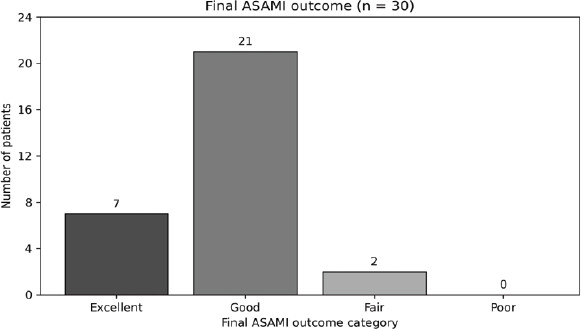
The final ASAMI category was excellent in 7 patients (23.3%), good in 21 (70.0%), and fair in 2 (6.7%); no poor category was recorded. Thus, 28 patients (93.3%) were classified as good or excellent (Fig. 1). The mean final AOFAS score was 84.9 ± 9.6 (range, 70–98); 18 patients (60.0%) had a score of 80 or higher. Mean frame duration was 121.5 ± 16.1 days (range, 91–148). Five patients (16.7%) had a superficial pin-site complication recorded in the chart; no foot drop was recorded. The source chart’s free-text “other complication” field was blank, so the absence of other complications cannot be independently established from that field alone.
Exploratory association analyses
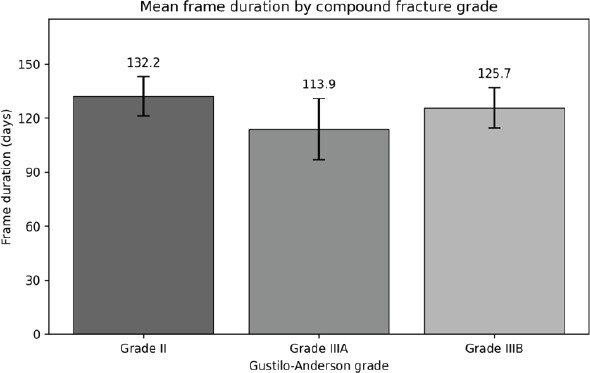
The final ASAMI category was not significantly associated with compound fracture grade (reported Chi-square P = 0.890), AO/OTA type (P = 0.526), or mechanism of injury (P = 0.821). The final AOFAS score was not significantly associated with age (Spearman rho = 0.052, P = 0.785), mechanism of injury (Kruskal–Wallis P = 0.847), AO/OTA type (Mann–Whitney U P = 0.201), compound grade (Kruskal–Wallis P = 0.379), frame duration (Spearman rho = −0.020, P = 0.918), or recorded superficial pin-site complication (Mann–Whitney U P = 0.577). Compound fracture grade was associated with frame duration (Kruskal–Wallis P = 0.030). The mean frame duration was 132.2 ± 10.8 days for Grade II, 113.9 ± 17.0 days for Grade IIIA, and 125.7 ± 11.1 days for Grade IIIB fractures (Fig. 2 and Table 2). These analyses were univariable and exploratory.
Reported univariable analyses of functional outcomes and frame duration
| Predictor | Outcome | Test | Statistic | P-value |
|---|---|---|---|---|
| Age | AOFAS score | Spearman correlation | rho=0.052 | 0.785 |
| Mechanism of injury | AOFAS score | Kruskal-Wallis | — | 0.847 |
| AO/OTA type | AOFAS score | Mann-Whitney U | — | 0.201 |
| Compound grade | AOFAS score | Kruskal-Wallis | — | 0.379 |
| Frame duration | AOFAS score | Spearman correlation | rho=–0.020 | 0.918 |
| Superficial pin-site complication | AOFAS score | Mann-Whitney U | — | 0.577 |
| Compound grade | Frame duration | Kruskal-Wallis | — | 0.03 |
| Compound grade | ASAMI category | Chi-square | — | 0.89 |
| AO/OTA type | ASAMI category | Chi-square | — | 0.526 |
| Mechanism of injury | ASAMI category | Chi-square | — | 0.821 |
AO/OTA: Arbeitsgemeinschaft für Osteosynthesefragen/Orthopaedic Trauma Association, AOFAS: American Orthopaedic Foot and Ankle Society
Discussion
This secondary analysis examined whether routinely recorded patient and fracture features were associated with outcome after primary Ilizarov external fixation for compound distal third tibial fractures. The observed final ASAMI distribution was predominantly good or excellent, and the mean final AOFAS score was 84.9. However, no statistically significant association was detected between the ASAMI category and the three categorical variables tested, and the AOFAS analyses did not identify a statistically significant association with the candidate variables assessed. The findings are best interpreted as an absence of a clear signal in a small cohort, not proof that these factors have no prognostic value.
The distal tibia remains challenging because of its limited soft-tissue envelope and the frequency of associated soft-tissue injury. Circular fixation can preserve access to soft tissues and allow adjustment of alignment, making it a useful option in selected complex injuries [5,6,7,8,11]. In a cohort of distal tibial fractures treated with circular external fixation, Giannoudis and colleagues reported high union rates but noted that functional scores varied with fracture location and joint involvement [8]. A separate comparative study of open distal tibial fractures found that both hybrid and Ilizarov fixation could provide stable treatment, whereas outcome measures differed across subgroups [9]. The current cohort’s results add a small, single-center view of associations with functional scores rather than comparative treatment effectiveness.
Our findings should also be read alongside studies comparing internal-fixation approaches. Trials and comparative cohorts have demonstrated differences between intramedullary nailing and plating in union time, alignment, wound complications, and functional outcomes, but results vary by fracture morphology and study design [10,15,16,17,18,19,20,21,22]. Recent systematic reviews continue to emphasize that the balance between soft-tissue preservation, alignment, infection risk, and reoperation depends on the individual injury rather than one method being optimal for all distal tibial fractures [11,12,22]. These studies provide context but should not be interpreted as direct comparisons with the present cohort because treatment selection and fracture populations differ.
The association between compound grade and frame duration (P = 0.030) was the only statistically significant association in the present analysis. Grade II fractures had the longest mean duration in this dataset, followed by Grade IIIB and Grade IIIA fractures. This non-monotonic pattern should be treated cautiously. Frame duration is influenced not only by biological healing but also by fracture configuration, soft-tissue condition, follow-up decisions, and the clinical threshold used for frame removal. Without patient-level radiographic union dates and a prespecified adjustment model, the analysis cannot identify a causal explanation for this finding.
The reported pin-site complication frequency was 5/30 (16.7%). This is lower than some large circular-frame series, although differences in definitions, severity, follow-up, and reporting make direct comparisons unreliable [8,23,24]. The chart records superficial pin-site problems but does not provide detailed grading, treatment, or duration for each event. It also does not independently establish the absence of deep infection, non-union, malunion, or implant failure. The final manuscript should make claims only about events that were systematically assessed and recorded.
The study has several limitations. It was conducted at a single center and included only 30 patients, with just one woman and only two patients in the fair ASAMI category. Accordingly, the analyses had limited ability to detect modest associations, and the sparse contingency-table cells make ordinary Chi-square approximations questionable for the ASAMI analyses. Only univariable comparisons were reported; confounding could not be adjusted for, and no multivariable prediction model was developed. The data supplied for revision did not permit independent verification of all radiographic complications, time-to-union variables, or operative details. The sample-size approach was based on all eligible patients accrued during the study period rather than a formal power calculation.
The cohort overlaps with the authors’ previously described series [13]. This secondary analysis should be clearly distinguished from the earlier report in its objective, outcomes, and statistical question, and the overlap should be disclosed to the editor. The bibliography and full publication details of the prior report require confirmation by the authors before submission. Recent studies of open tibial fractures and circular fixation reinforce the need for larger prospective cohorts with standardized outcome definitions and transparent reporting [23, 24, 25].
Conclusion
In this 30-patient cohort treated with primary Ilizarov external fixation for compound distal third tibial fractures, 93.3% had a recorded final ASAMI outcome of good or excellent, and the mean 9-month AOFAS score was 84.9 ± 9.6. No statistically significant association was detected between ASAMI category and compound grade, AO/OTA type, or mechanism of injury. Compound grade was associated with frame duration, but the small sample and univariable design limit interpretation. These results are exploratory and should be confirmed in larger cohorts using prespecified, appropriately powered analyses.
Clinical Message
Primary Ilizarov external fixation can be followed by favorable functional outcomes in selected compound distal third tibial fractures. In a small cohort, routine demographic and fracture variables did not show clear associations with the final ASAMI category; this should not be interpreted as evidence that they are unimportant prognostic factors.
Conflict of Interest:
Nil
Source of Support:
Nil
Consent:
The authors confirm that informed consent was obtained from the patient for publication of this article
How to Cite this Article
Rawat SS, Choudhary VK, Chauhan A. Predictors of Functional Recovery Following Primary Ilizarov External Fixation in Compound Distal Third Tibial Fractures. J Orthop Case Rep. 2026 November;16(11): 547-552. doi: 10.13107/jocr.2026.v16.i11.8548.
References
- Court-Brown CM, McBirnie J. The epidemiology of tibial fractures. J Bone Joint Surg Br 1995;77:417-21. [Google Scholar] | [PubMed]
- Gustilo RB, Anderson JT. Prevention of infection in the treatment of one thousand and twenty-five open fractures of long bones: Retrospective and prospective analyses. J Bone Joint Surg Am 1976;58:453-8. [Google Scholar] | [PubMed]
- Marsh JL, Slongo TF, Agel J, Broderick JS, Creevey W, DeCoster TA. Fracture and dislocation classification compendium - 2007: Orthopaedic trauma association classification, database and outcomes committee. J Orthop Trauma 2007;21 Suppl 10:S1-133. [Google Scholar] | [PubMed]
- Vallier HA, Le TT, Bedi A. Radiographic and clinical comparisons of distal tibia shaft fractures (4 to 11 cm proximal to the plafond): Plating versus intramedullary nailing. J Orthop Trauma 2008;22:307-11. [Google Scholar] | [PubMed]
- Ilizarov GA. The tension-stress effect on the genesis and growth of tissues. Part I. The influence of stability of fixation and soft-tissue preservation. Clin Orthop Relat Res 1989;238:249-81. [Google Scholar] | [PubMed]
- Ilizarov GA. The tension-stress effect on the genesis and growth of tissues: Part II. The influence of the rate and frequency of distraction. Clin Orthop Relat Res 1989;239:263-85. [Google Scholar] | [PubMed]
- Paley D, Catagni MA, Argnani F, Villa A, Benedetti GB, Cattaneo R. Ilizarov treatment of tibial nonunions with bone loss. Clin Orthop Relat Res 1989;241:146-65. [Google Scholar] | [PubMed]
- Giannoudis VP, Ewins E, Taylor DM, Foster P, Harwood P. Clinical and functional outcomes in patients with distal tibial fracture treated by circular external fixation: A retrospective cohort study. Strategies Trauma Limb Reconstr 2021;16:86-95. [Google Scholar] | [PubMed]
- Borah PJ, Patowary C, Das A, Shirdinayak TS, Roy JP, Kumar S. Comparative outcome of hybrid external fixator versus primary ilizarov fixator in the treatment of open distal tibia extra-articular fractures. Indian J Orthop 2022;56:2006-12. [Google Scholar] | [PubMed]
- Kc KM, Pangeni BR, Marahatta SB, Sigdel A, Kc A. Comparative study between intramedullary interlocking nailing and minimally invasive percutaneous plate osteosynthesis for distal tibia extra-articular fractures. Chin J Traumatol 2022;25:90-4. [Google Scholar] | [PubMed]
- Legg PI, Malik-Tabassum K, Ibrahim YH, Dhinsa BS. Post-operative outcomes of circular external fixation in the definitive treatment of tibial plafond fractures: A systematic review. Cureus 2022;14:e24204. [Google Scholar] | [PubMed]
- Shen M, Tejwani N. Open tibial shaft fracture fixation strategies: Intramedullary nailing, external fixation, and plating. OTA Int 2024;7 Suppl 4:e316. [Google Scholar] | [PubMed]
- Sonkar D, Rajpoot MS, Rawat S. Outcome of distal tibia fracture treated with primary Ilizarov external fixator. Int J Med 2026;8:285-90. [Google Scholar] | [PubMed]
- Kitaoka HB, Alexander IJ, Adelaar RS, Nunley JA, Myerson MS, Sanders M. Clinical rating systems for the ankle-hindfoot, midfoot, hallux, and lesser toes. Foot Ankle Int 1994;15:349-53. [Google Scholar] | [PubMed]
- Guo JJ, Tang N, Yang HL, Tang TS. A prospective, randomised trial comparing closed intramedullary nailing with percutaneous plating in the treatment of distal metaphyseal fractures of the tibia. J Bone Joint Surg Br 2010;92:984-8. [Google Scholar] | [PubMed]
- Mauffrey C, McGuinness K, Parsons N, Achten J, Costa ML. A randomised pilot trial of “locking plate” fixation versus intramedullary nailing for extra-articular fractures of the distal tibia. J Bone Joint Surg Br 2012;94:704-8. [Google Scholar] | [PubMed]
- Vallier HA, Cureton BA, Patterson BM. Factors influencing functional outcomes after distal tibia shaft fractures. J Orthop Trauma 2012;26:178-83. [Google Scholar] | [PubMed]
- Daolagupu AK, Mudgal A, Agarwala V, Dutta KK. A comparative study of intramedullary interlocking nailing and minimally invasive plate osteosynthesis in extra articular distal tibial fractures. Indian J Orthop 2017;51:292-8. [Google Scholar] | [PubMed]
- Kaya O, Tosun HB, Kürüm H, Serbest S, Uludağ A, Ayas O. Comparative study of minimally invasive plate osteosynthesis and intramedullary nailing for treating extra-articular distal tibial fractures: Clinical and radiological outcomes. Med Sci Monit 2023;29:e942154. [Google Scholar] | [PubMed]
- Wang C, Huang Q, Lu D, Wang Q, Ma T, Zhang K. A clinical comparative study of intramedullary nailing and minimally invasive plate osteosynthesis for extra-articular distal tibia fractures. Am J Transl Res 2023;15:1996-2005. [Google Scholar] | [PubMed]
- Jang Y, Wilson N, Jones J, Alcaide D, Szatkowski J, Sorkin A. Plating versus intramedullary nailing of OTA/AO 43C1 and C2 intra-articular distal tibia fractures: A propensity score and multivariate analysis. J Orthop Trauma 2024;38:e9-14. [Google Scholar] | [PubMed]
- Li X, Chen K, Xue H, Cheng J, Yu X. Efficacy comparison between intramedullary nail fixation and plate fixation in distal tibia fractures: A meta-analysis of randomized controlled trials. J Orthop Surg Res 2024;19:403. [Google Scholar] | [PubMed]
- Madhvani KR, Fong A, Clark T, Eng K, Condurache C, McGregor-Riley J. Mid to long-term outcomes of grade III-B open tibial fractures definitively managed with a circular frame: A 13-year prospective database study at a major trauma center. J Orthop Trauma 2024;38:447-51. [Google Scholar] | [PubMed]
- Romeo M, Nayak A, Kulkarni S. Study of functional outcomes of the ilizarov external fixator in the treatment of open tibial fractures (gustilo-anderson grades II, IIIA, and IIIB): A prospective clinical study. Cureus 2026;18:e107018. [Google Scholar] | [PubMed]
- Necula RD, Grigorescu S, Necula BR. Orthoplastic reconstruction of distal tibia high-energy fractures using a circular external fixator-a systematic review. J Clin Med 2024;13:5700. [Google Scholar] | [PubMed]
© 2026 Journal of Orthopaedic Case Reports - Published by Indian Orthopaedic Research Group
About the Authors
-

Shubham Singh Rawat
-

Vishal Kumar Choudhary
-

Abhishek Chauhan
Related Articles in Journal of Orthopaedic Case Reports
 October 1, 2026 Outcomes of Primary Definitive Internal Fixation of Compound Fractures within 72 h of Injury: A Prospective Cohort Study
 October 1, 2026 Clinical and Functional Outcomes of Closed Intramedullary Interlocking Nailing in Extra-articular Distal Tibial Fractures: A Prospective Observational Study
 November 1, 2026 Functional Outcome in Arthroscopic Anterior Cruciate Ligament Reconstruction Using an Autologous Quadrupled Hamstring Tendon Versus Peroneus Longus Tendon Graft: A Comparative Study
 November 1, 2026 Functional and Radiological Results of the Subvastus Versus Medial Parapatellar Method in Total Knee Arthroplasty: A Randomized Controlled Cohort