


Introduction
Common peroneal nerve palsy is one of the most common nerve palsies and can manifest due to various causes. Compression or traction of the nerve, stemming from factors such as prolonged leg crossings, poor surgical positioning, fractures of the peroneal head, inadequate cast application, and prolonged squatting positions (e.g., carpet layers, carpentry workers, and farmworkers), is a primary cause [1,2]. Only a few cases in the literature have reported the fabella sesamoid as a cause of the common fibular nerve palsy, making it an extremely rare entity [3,4]. Herein, we describe an unusual case of a common peroneal nerve palsy due to a fabella sesamoid in a carpentry worker with repetitive squatting.
Case Report
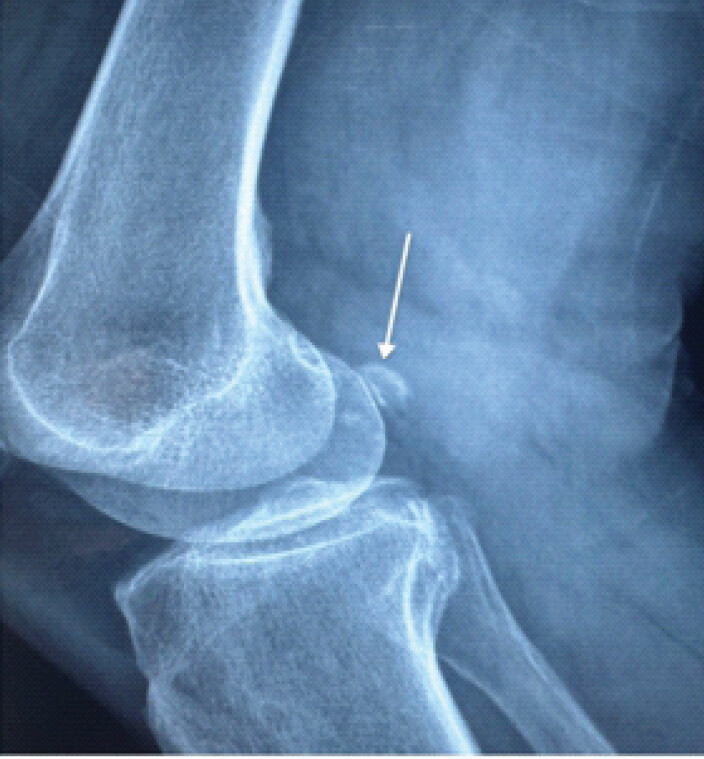
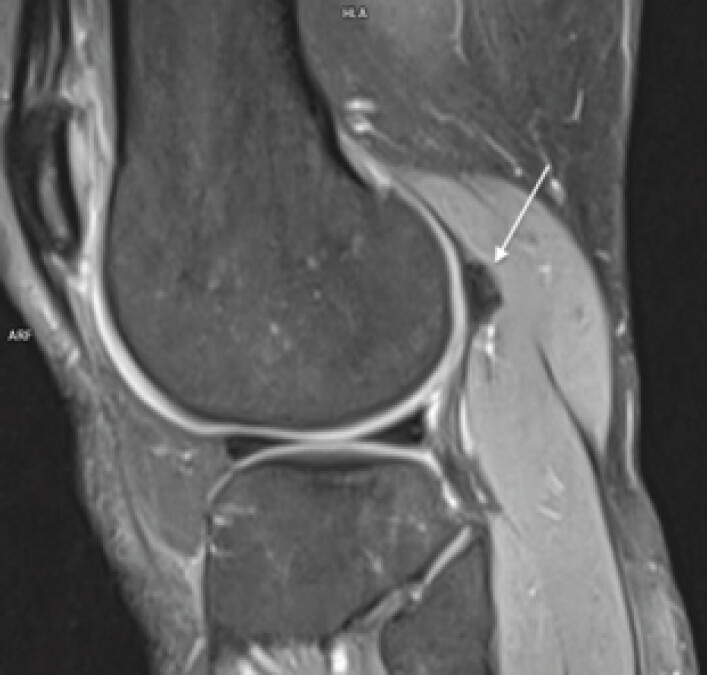
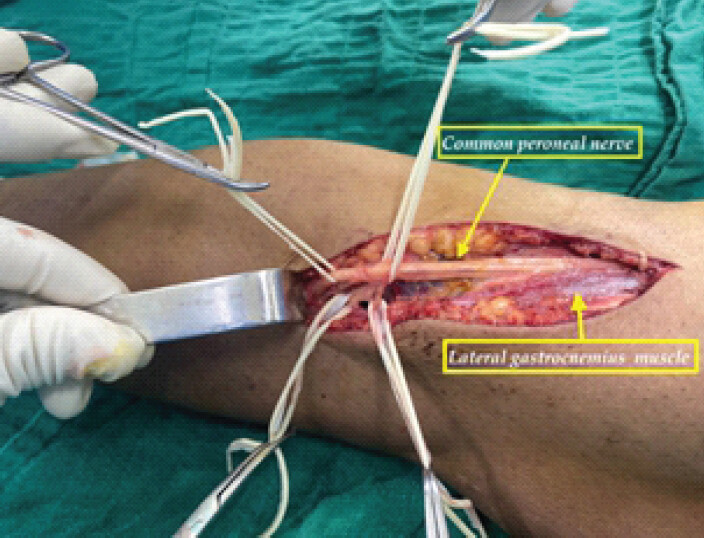
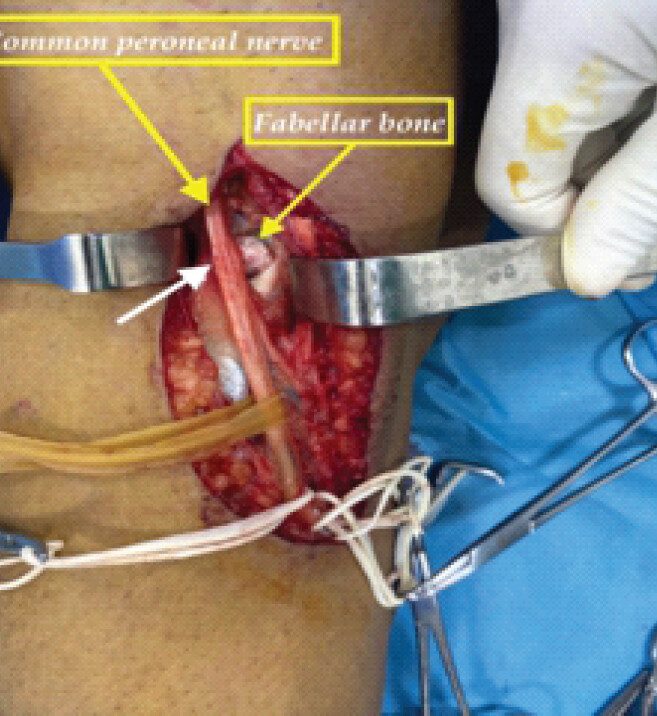
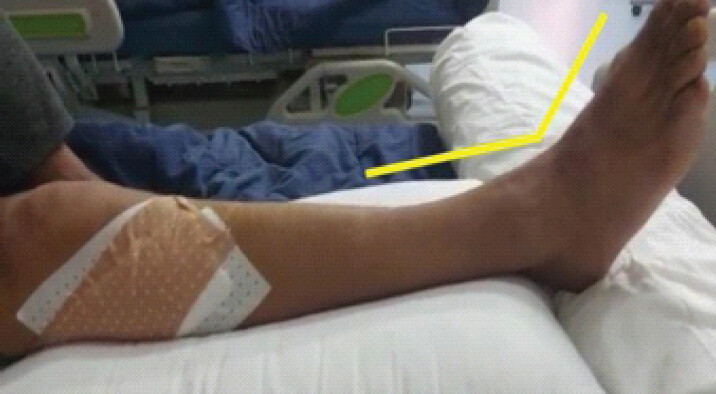
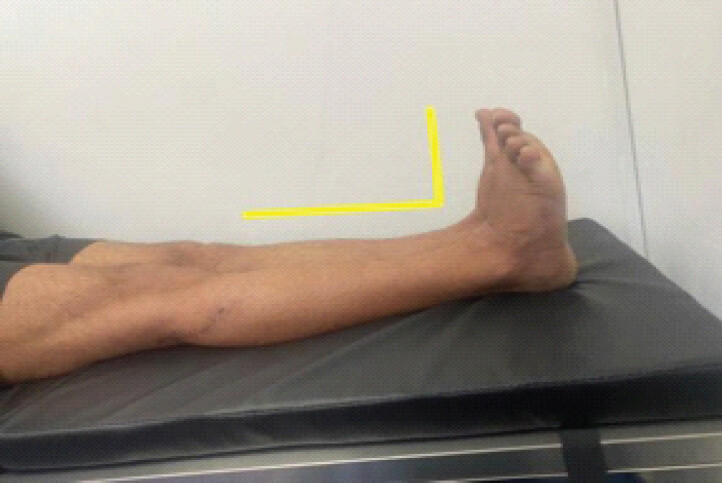
A 42-year-old sheet metal worker, who had begun a new job 6 months prior, gradually experienced a snapping sensation along the posterolateral aspect of his right knee and numbness along the dorsum of the right foot, evolving into a steppage gait due to foot drop. He consulted our orthopedic department for this issue. Physical examination revealed a decrease in sensory activity in the territory of the common peroneal nerve, as well as a motor deficit on the dorsal surfaces of the foot and toes, resulting in a foot drop. The ligaments of the knee tested were normal. The Tinel test was negative over the fibular head. There were neither palpable mass lesions nor vascular lesions around the knee joint. At this follow-up visit, the patient reported no relief from oral analgesics combined with physical therapy. However, he mentioned that his symptoms gradually worsened as he continued working in a squatting position. He denied any history of recent trauma or infection. An X-ray of the right knee revealed a fabella sesamoid with no fracture (Fig. 1). Electrodiagnostic testing revealed subacute neuropathy in the right common peroneal nerve at the fibular head level. We performed magnetic resonance imaging of the right knee, which ruled out the presence of a mass compression (Fig. 2). Given the clinical, neurodiagnostic, and radiological findings, as well as the history, we elected to proceed with surgical treatment. Under spinal anesthesia, we used a posterolateral approach in the operating room, allowing neurolysis of the common peroneal nerve until it reached the fibular neck (Fig. 3) and excision of the fabella sesamoid (Fig. 4). Post-operative care revealed a significant improvement (Fig. 5). After 3 days, the patient was discharged with a prescription for an ankle-foot orthosis and a gradual full range of motion exercise for his right foot. At 6-month follow-up, the patient had regained full range of motion in the foot (Fig. 6) with no deficit and had returned to his daily activities. We recommended that he avoid prolonged squatting and, if necessary, use a stool while squatting.
Discussion
The common fibular nerve receives innervation from the L4-S1 nerve roots with a minor contribution from the L2 nerve root. It originates from the lateral border of the sciatic nerve in the distal posterior thigh, proximal to the popliteal fossa, and is known to be vulnerable to knee compression. After bifurcation, the common peroneal nerve runs laterally across the lateral head of the gastrocnemius muscle through the posterior intermuscular septum, where injuries often occur [5,6]. Less than 30% of the population has the fabella, which is a sesamoid bone located in the proximal belly of the lateral gastrocnemius [3,4,5,6,7]. Routine knee X-rays typically reveal it as a normal anatomical variant. Due to the fabella’s bone localization in the posterolateral corner of the knee, the common peroneal nerve is exposed to potential injuries [5]. Nerve compression can occur through various mechanisms, such as direct impingement, vascular compromise, or inflammation, all of which can lead to nerve dysfunction and palsy symptoms. The clinical history aims to obtain a comprehensive record of precipitating circumstances, including the timing of symptom onset, duration of symptoms, and any recent illness, physical trauma, or prolonged periods of sitting or squatting [2,3,4,5,6,7,8]. The main clinical symptoms of common nerve injuries are foot drop (either the ankle joint or toe is unable to extend back), walking in a steppage gait, loss of sensation along the dorsum of the foot, and impaired reflexes. Neurodiagnostic studies may be helpful for identifying the site of a lesion. If treatment is not timely, severe cases may result in atrophy of the anterior tibialis and lateral calf muscles. Foot drop has a negative impact on quality of life, with significantly lower scores in the physical and psychosocial domains [9,10]. Given the infrequency and likely lack of accurate identification of fabella syndrome, there is a scarcity of literature regarding its treatment. However, the treatment of choice for compressive neuropathy caused by a fabella is to undergo surgery, which includes excision of the fabella bone and subsequent neurolysis of the nerve. Almost all cases resolve after surgery, except for those with delayed diagnoses [11]. In our case, the repetitive prolonged squatting position led to a closed contact between the common peroneal nerve and the fabella bone at the posterolateral corner of the knee, which was the primary cause of common peroneal nerve palsy. This condition resulted in a foot drop that induced a steppage gait while walking. Therefore, we elected to proceed with surgical treatment involving neurolysis of the nerve and excision of the fabella with a satisfactory outcome. Furthermore, we advised the patient to avoid the squatting position and use a stool if squatting is mandatory for his work.
Conclusion
We have documented a rare instance of peroneal nerve compression neuropathy caused by a fabella, which responded quite well after operative excision of the fabella.
Clinical Message
The squatting position is a predisposing factor for injury to the common peroneal nerve at the level of the knee. Always look for the fabellar sesamoid, which is not always anodyne. When the MRI is normal, the combination of foot drop, sesamoid bone, and squatting position is sufficient conditions to neurolyze the common peroneal nerve and excise the sesamoid bone for a better result.
Conflict of Interest:
Nil
Source of Support:
Nil
Consent
The authors confirm that informed consent was obtained from the patient for publication of this article
How to Cite this Article
Elghoul N , Sallahi H, Margad O, Chagar B. Unusual Presentation: Foot Drop, Fabella Bone, Squatting Position – What Relationship? J Orthop Case Rep. 2026 November;16(11): 79-82. doi: 10.13107/jocr.2026.v16.i11.8394.
References
- Fridman V, David WS. Electrodiagnostic evaluation of lower extremity mononeuropathies. Neurol Clin 2012;30:505-28. [Google Scholar] | [PubMed]
- Hanewinckel R, Ikram MA, Van Doorn PA. Peripheral neuropathies. Handb Clin Neurol 2016;138:263-82. [Google Scholar] | [PubMed]
- Lin JC, Tsai MH, Lin WP, Kuan TS, Lien WC. Entrapment neuropathy of common peroneal nerve by fabella: A case report. World J Clin Cases 2023;11:6857-63. [Google Scholar] | [PubMed]
- Yilmaz E, Karakurt L, Serin E, Güzel H. Peroneal nerve palsy due to rare reasons: A report of three cases. Acta Orthop Traumatol Turc 2004;38:75-8. [Google Scholar] | [PubMed]
- Marciniak C. Fibular (peroneal) neuropathy electrodiagnostic features and clinical correlates. Phys Med Rehabil Clin N Am 2013;24:121-37. [Google Scholar] | [PubMed]
- Craig A. Entrapment neuropathies of the lower extremity. PM R 2013;5(Suppl 5)S31-40. [Google Scholar] | [PubMed]
- Takebe K, Hirohata K. Peroneal nerve palsy due to fabella. Arch Orthop Trauma Surg 1981;99:91-5. [Google Scholar] | [PubMed]
- Woliński F, Bryliński Ł, Kostelecka K, Teresiński G, Buszewicz G, Baj J. Common fibular nerve palsy due to the fabella: A review. Clin Anat 2024;37:73-80. [Google Scholar] | [PubMed]
- Lien WC, Ching CT, Lai ZW, Wang HD, Lin JS, Huang YC. Intelligent fall-risk assessment based on gait stability and symmetry among older adults using tri-axial accelerometry. Front Bioeng Biotechnol 2022;10:887269. [Google Scholar] | [PubMed]
- Lien WC, Wang WM, Wang F, Wang JD. Savings of loss-of-life expectancy and lifetime medical costs from prevention of spinal cord injuries: Analysis of nationwide data followed for 17 years. Inj Prev 2021;27:567-73. [Google Scholar] | [PubMed]
© 2026 Journal of Orthopaedic Case Reports - Published by Indian Orthopaedic Research Group
About the Authors
-

Elghoul Naoufal
-

Sallahi Hicham
-

Margad Omar
-

Chagar BelKacem
Related Articles in Journal of Orthopaedic Case Reports
 August 1, 2026 50 Years Later: Delayed Presentation of Foot Drop Due to Sciatic Nerve Neuropathy on a Background of Ipsilateral Femur Intramedullary Nailing – A Case Report
 July 1, 2025 Acute Onset Common Peroneal Nerve Palsy Secondary to Fibular Head Osteochondroma in an Adolescent: A Case Report
 June 10, 2022 Resolution of Deep Peroneal Nerve Palsy after Seroma Evacuation in a Primary Total Hip Arthroplasty: A Case Report
 July 1, 2026 Role of Surgical Stabilization in the Management of Post-discectomy Septic Spondylodiscitis: Two Successful Case Reports