

Artificial intelligence is transforming pre-operative planning and implant design in hip and knee arthroplasty by enhancing precision and decision-making. Still, its true clinical value depends on high-quality data, rigorous validation, ethical integration, and responsible regulatory oversight.
Dr. Kunal Aneja, Department of Orthopaedics, Max Super Speciality Hospital, Shalimar Bagh, New Delhi, India, and Naveda Healthcare Centres, New Delhi, India. E-mail: drkunalaneja@gmail.com
Abstract
Abstract: Artificial intelligence (AI) is rapidly transforming hip and knee arthroplasty, particularly in the areas of pre-operative planning and implant design. By integrating advanced imaging analysis, machine learning algorithms, and data-driven analytics, AI-enabled technologies have the potential to enhance surgical precision, improve implant selection, and facilitate consistent restoration of joint biomechanics. AI-based planning systems can automate the analysis of radiographic and three-dimensional imaging data, enabling more accurate prediction of implant size, alignment, and anatomical landmarks compared with conventional templating. Robotic and navigation-assisted platforms further extend these capabilities by providing real-time intraoperative guidance, improving the accuracy and reproducibility of implant positioning while maintaining surgeon control. In addition, advances in generative design and computational modeling are enabling the development of patient-specific implants and biomechanically optimized implant geometries. Despite these advances, challenges related to data quality, algorithmic bias, interpretability, cost, ethical concerns, and regulatory oversight remain. This editorial discusses the current applications, benefits, and limitations of AI in arthroplasty and highlights the need for rigorous validation and responsible integration, emphasizing that AI should complement rather than replace surgical expertise.
Keywords: Artificial intelligence, hip arthroplasty, knee arthroplasty, pre-operative planning, machine learning algorithms, robotic-assisted surgery, navigation systems.

Total hip arthroplasty (THA) and total knee arthroplasty (TKA) have long been regarded as among the most successful procedures in modern medicine, restoring mobility and quality of life for millions of patients worldwide [1]. However, despite remarkable advances in implant design, surgical techniques, and perioperative care, challenges such as variability in surgical decision-making, implant positioning, patient-specific biomechanics, and prediction of post-operative outcomes persist [1]. In recent years, artificial intelligence (AI) has emerged as a transformative technological force with the potential to address many of these limitations. By leveraging large clinical datasets and advanced machine learning (ML) algorithms, AI can assist surgeons across the entire arthroplasty pathway – from diagnostic imaging and pre-operative planning to intraoperative guidance and post-operative monitoring – thereby enabling more data-driven and personalized surgical care [2]. Early applications have demonstrated promising capabilities in improving surgical planning, implant positioning, and outcome prediction; however, the integration of AI into routine clinical practice remains complex and raises important questions regarding reliability, interpretability, ethical considerations, and clinical validation.
Pre-operative planning plays a pivotal role in achieving optimal outcomes in THA and TKA procedures. Traditional planning methods based on two-dimensional (2D) radiographs are subject to inter-observer variability and limited accuracy [3]. AI-based planning systems have addressed these limitations by enabling automated analysis of radiographic and three-dimensional (3D) imaging data. In one study involving TKA surgery, an AI-based 3D planning system (AI-knee) predicted femoral and tibial implant sizes correctly in ~90% of cases, compared to ~60–67% accuracy with conventional X-ray templating [3]. ML algorithms can accurately identify anatomical landmarks, calculate limb alignment, and predict appropriate implant sizes [1]. Several studies have demonstrated that AI-assisted planning improves the accuracy of component sizing and alignment in both TKA and THA [1,3,4]. During TKA, AI-driven 3D planning has been shown to reduce mechanical axis outliers and improve restoration of coronal alignment when compared with conventional templating [4]. Similarly, AI-based hip templating systems have demonstrated high accuracy in predicting femoral stem and acetabular cup sizes, even when using standard radiographs [5]. Beyond templating, AI enables virtual surgical simulation, allowing surgeons to anticipate technical challenges and plan corrective strategies in complex cases such as deformities or post-traumatic arthritis. Predictive analytics using clinical and demographic data may further assist in risk stratification, patient counselling, and perioperative decision-making [6]. These findings suggest AI can substantially improve planning accuracy over human-only templating.
Robotic-assisted and navigation-based systems represent the most visible and clinically established applications of AI in THA and TKA. These technologies integrate algorithm-driven pre-operative planning with real-time intraoperative feedback to enhance precision, reproducibility, and consistency of surgical execution [6]. Navigation platforms such as Knee+ augmented reality navigation system (Knee+,Pixee Medical Company, Besancon, France) and Intellijoint (Intellijoint Surgical Inc., Ontario, Canada) employ computer vision and data-driven analytics to assist surgeons during implant positioning. Pixee assists surgeons during TKA by providing real-time guidance using smart glasses and computer vision algorithms [7]. At the same time, Intellijoint (Intellijoint Surgical Inc., Ontario, Canada) offers accurate intraoperative assessment of leg length, offset, and component positioning in hip arthroplasty, thereby reducing alignment-related complications [8]. Joint surgical robots, including MAKO, ROSA, VELYS, and CUVIS joint, further extend these capabilities by combining 3D imaging–based planning with controlled robotic execution, enabling reproducible bone preparation and objective assessment of soft-tissue balance in both hip and knee replacement (Table 1) [9]. In parallel, AI-assisted, indigenous robotic platforms such as MISSO (Meril Healthcare Pvt. Ltd., Vapi, India) have emerged with an emphasis on affordability and adaptability to varied clinical environments, aiming to broaden access to precision arthroplasty while maintaining surgeon control [10]. Collectively, these systems function as surgeon-assistive technologies designed to augment accuracy and decision-making rather than replace clinical judgment.
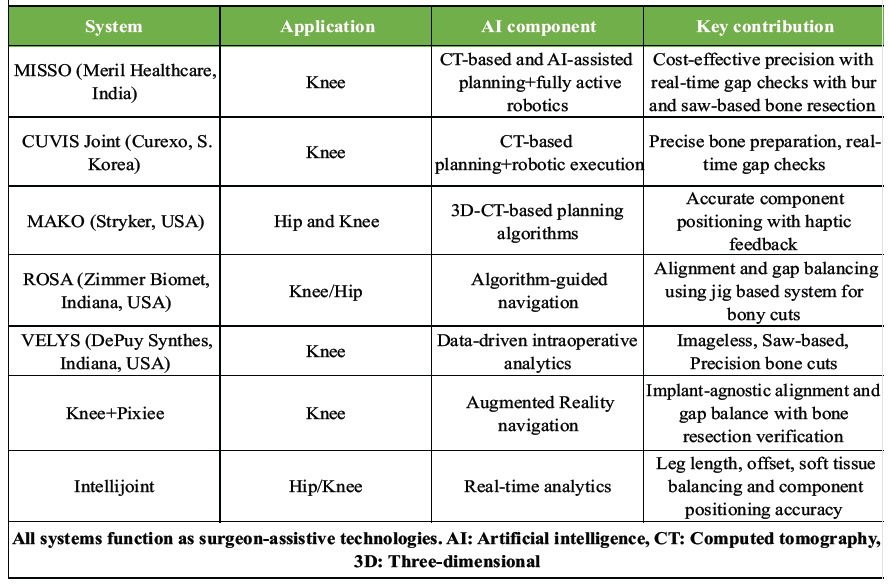
Table 1: AI-assisted robotic and navigation systems used in hip and knee arthroplasty
Importantly, robotic and navigation technologies function as surgeon-assistive tools rather than autonomous systems. Surgical expertise, judgement, and intraoperative decision-making remain central to successful outcomes [1].
AI is increasingly being applied to implant design through generative modelling and computational optimisation. By analysing large datasets of anatomical and biomechanical parameters, AI-driven design tools can generate implant geometries optimised for strength, durability, and anatomical fit [11]. These advances are particularly relevant in TKA, where component sizing and alignment significantly influence functional outcomes and implant longevity. AI-supported implant design also offers opportunities to address anatomical variations seen in Indian and Asian populations, which may not be adequately represented in Western design datasets [12]. When combined with additive manufacturing, AI-designed implants may incorporate optimised surface features to promote bone ingrowth and implant stability. AI-driven approaches are facilitating the development of biocompatible materials and drug-eluting coatings aimed at improving healing and reducing infection risk [12]. However, such designs require thorough biomechanical testing and clinical validation before they can be widely adopted.
The integration of AI into pre-operative planning, robotics, and implant design offers several potential clinical advantages. These include improved accuracy of implant positioning, reduced variability between surgeons, and more consistent restoration of joint biomechanics in hip and knee arthroplasty [3,13]. AI-assisted workflows may also improve operating room efficiency by reducing instrument inventory and streamlining procedural steps. Early clinical studies suggest that AI-supported planning and robotic execution are associated with improved short-term functional outcomes and patient satisfaction [13]. Over time, these benefits may translate into reduced complication rates and enhanced implant survivorship.
Limitations, ethical concerns, and regulatory challenges:
Despite its promise, AI in arthroplasty is associated with important limitations. AI systems are highly dependent on the quality and diversity of training data. Algorithms trained on non-representative datasets may produce biased recommendations when applied to broader populations [14]. The limited interpretability of many AI models raises concerns about transparency and explainability, both of which are essential for informed consent and shared decision-making. Ethical considerations related to data privacy, algorithmic bias, and accountability must be addressed [1]. Cost remains a major barrier, particularly in low and middle-income settings. Robotic platforms, navigation systems, and advanced imaging infrastructure increase procedural expenses and may widen disparities in access to care [14]. Regulatory frameworks for AI-based surgical tools are still evolving, with uncertainties surrounding validation standards and medico-legal responsibility. In addition, excessive reliance on AI without adequate training and oversight may risk erosion of surgical skills [1,6].
India represents a unique environment for the adoption of AI in orthopaedic surgery, characterised by high procedural volumes and resource constraints. Indigenous innovations such as the MISSO robotic platform highlight the potential of AI-driven solutions tailored to local needs [10]. However, successful integration of AI in Indian arthroplasty practice requires robust clinical evidence, development of Indian-specific datasets, structured surgeon training, and clear regulatory guidance. Establishing national joint registries and encouraging collaborative research will be critical to ensuring safe and effective implementation [1,2].
AI is redefining pre-operative planning, robotic assistance, and implant design in THA and TKA. Technologies such as Knee+, Intellijoint, and MISSO robotic systems offer meaningful improvements in precision and consistency, while AI-driven implant design opens new avenues for personalisation. Nevertheless, challenges related to data quality, cost, ethics, and regulation must be carefully addressed. AI should be viewed as a supportive adjunct that enhances surgical decision-making rather than replacing clinical expertise. With responsible adoption, rigorous validation, and strong indigenous innovation, AI has the potential to significantly improve outcomes in hip and knee arthroplasty, particularly within the Indian healthcare landscape.
AI is reshaping pre-operative planning and implant design in hip and knee arthroplasty by enhancing precision, consistency, and decision support. When integrated responsibly, AI-assisted planning, navigation, and robotic technologies can complement surgical expertise and improve early clinical outcomes. However, their benefits depend on robust validation, appropriate training, and ethical implementation. Artificial intelligence should support, not supplant, clinical expertise in arthroplasty practice.
References
- 1. Mickley JP, Kaji ES, Khosravi B, Mulford KL, Taunton MJ, Wyles CC. Overview of artificial intelligence research within hip and knee arthroplasty. Arthroplasty Today 2024;27:101396. [Google Scholar] [PubMed]
- 2. Andriollo L, Picchi A, Iademarco G, Fidanza A, Perticarini L, Rossi SM, et al. The role of artificial intelligence and emerging technologies in advancing total hip arthroplasty. J Pers Med 2025;15:21. [Google Scholar] [PubMed]
- 3. Mozafari JK, Moshtaghioon SA, Mahdavi SM, Ghaznavi A, Behjat M, Yeganeh A. The role of artificial intelligence in preoperative planning for total hip arthroplasty: A systematic review. Front Artif Intell 2024;7:1417729. [Google Scholar] [PubMed]
- 4. Lan Q, Li S, Zhang J, Guo H, Yan L, Tang F. Reliable prediction of implant size and axial alignment in AI-based 3D preoperative planning for total knee arthroplasty. Sci Rep 2024;14:16971. [Google Scholar] [PubMed]
- 5. Singh VK, Bajpai H, Sharma PK, Gupta G. Machine learning assisted pre-operative planning for total hip arthroplasty: Accuracy validation and post operative critical analysis- a retrospective study. J Orthop Ccase Rep 2025;15:329-35. [Google Scholar] [PubMed]
- 6. Elkohail A, Soffar A, Khalifa AM, Omar I, Mosaad M, Abdulaziz M, et al. AI-enhanced surgical decision-making in orthopedics: From preoperative planning to intraoperative guidance and real-time adaptation. Cureus 2025;17:e92762. [Google Scholar] [PubMed]
- 7. Sakellariou E, Alevrogiannis P, Alevrogianni F, Galanis A, Vavourakis M, Karampinas P, et al. Single-center experience with Knee+TM augmented reality navigation system in primary total knee arthroplasty. World J Orthop 2024;15:247-56. [Google Scholar] [PubMed]
- 8. Paprosky W, Muir J. Intellijoint HIP®: A 3D mini-optical navigation tool for improving intraoperative accuracy during total hip arthroplasty. Med Devices (Auckl) 2016;9:401-8. [Google Scholar] [PubMed]
- 9. Airapetov GA, Zagorodniy NV, Daniliyants AA, Bezverkhiy SV, Naidanov VF, Dmitrov IA, et al. Review of contemporary robotic systems used in total knee arthroplasty. NN Priorov J Traumatol Orthop 2025;32:676-84. [Google Scholar] [PubMed]
- 10. Aneja K Rudraraju RT, Shyam A. Personalized alignment strategies and the need for customization in total knee arthroplasty: The role of MISSO joint robotic system. J Orthop Case Rep 2025;15:1-5. [Google Scholar] [PubMed]
- 11. Oettl FC, Pruneski JA, Zsidai B, Yu Y, Cong T, Tischer T, et al. Is orthopaedics entering the age of generative AI?-A narrative review of current applications challenges and future directions. Knee Surg Sports Traumatol Arthrosc 2026;34:370-7. [Google Scholar] [PubMed]
- 12. Batailler C, Shatrov J, Sappey-Marinier E, Servien E, Parratte S, Lustig S. Artificial intelligence in knee arthroplasty: Current concept of the available clinical applications. Arthroplasty 2022;4:17. [Google Scholar] [PubMed]
- 13. Velasquez Garcia A, Bukowiec LG, Yang L, Nishikawa H, Fitzsimmons JS, Larson AN, et al. Artificial intelligence-based three-dimensional templating for total joint arthroplasty planning: A scoping review. Int Orthop 2024;48:997-1010. [Google Scholar] [PubMed]
- 14. Polisetty TS, Jain S, Pang M, Karnuta JM, Vigdorchik JM, Nawabi DH, et al. Concerns surrounding application of artificial intelligence in hip and knee arthroplasty: A review of literature and recommendations for meaningful adoption. Bone Joint J 2022;104-B:1292-303. [Google Scholar] [PubMed]



Related Articles in Journal of Orthopaedic Case Reports
 December 1, 2025 Machine Learning Assisted Pre-operative planning for Total Hip Arthroplasty: Accuracy Validation and Post Operative Critical Analysis- A Retrospective Study
 October 1, 2026 Digital Transformation in Orthopedics: Can India Leapfrog with Artificial Intelligence, Augmented Reality, and Robotics?
 September 1, 2026 The Evolution of CT-Based Robotic Systems in Total Knee Arthroplasty: From Precision Tools to Intelligent Surgical Partners
 September 1, 2026 Iliopsoas Abscess as the Initial Manifestation of Periprosthetic Hip Joint Infection after Total Hip Arthroplasty: A Case Report and Literature Review