


Introduction
Medial malleolar fractures are common lower extremity injuries that can result in a variety of complications, especially if not managed appropriately [1,2,3,4]. Among these complications, checkrein deformity is a rare yet functionally significant condition that may develop following trauma or surgery around the ankle region [4,5]. This deformity is characterized by abnormal motion of the hallux, typically manifesting as dynamic flexion of the great toe during ankle dorsiflexion and resolution during plantar flexion [6].
Checkrein deformity most often results from adhesions or entrapment of the flexor hallucis longus (FHL) tendon, secondary to scar formation, callus entrapment, or fibrosis after trauma [7,8,9,10]. Cases have been reported following fractures of the tibia, talus, and calcaneus, and after internal fixation procedures [7,11,12,13]. However, the development of checkrein deformity due to mechanical impingement of the FHL tendon beneath fixation hardware has been only rarely discussed in the literature [5,7,11,12].
Dynamic ultrasonography provides valuable diagnostic information in such cases, enabling real-time visualization of FHL motion and distinguishing mechanical impingement from adhesive tethering [7,13].
To the best of our knowledge, no previous report has described checkrein deformity caused by direct mechanical compression of the FHL tendon beneath medial malleolar screws. The present case highlights this rare mechanism, discusses its pathophysiology, and emphasizes the importance of dynamic imaging and early hardware removal in achieving a full functional recovery.
Case Report
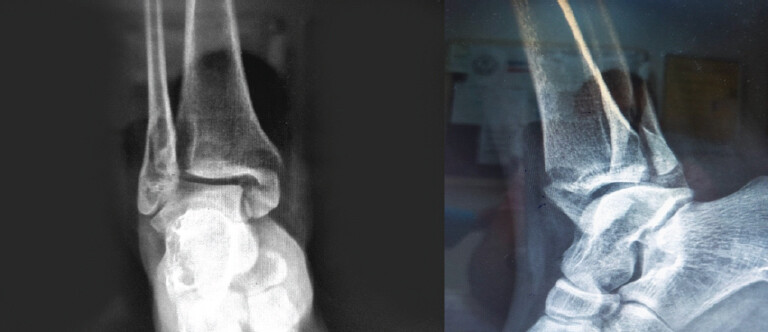
A 42-year-old male presented to the emergency department following a fall from height, sustaining a trimalleolar ankle fracture (Fig. 1). Initial anteroposterior and lateral radiographs revealed displaced fractures of the posterior, lateral, and medial malleoli. The ankle was temporarily immobilized in a below-knee splint until definitive fixation.
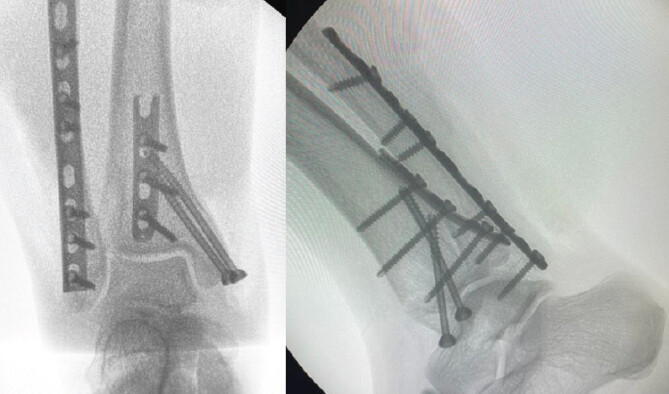
Open reduction and internal fixation were performed through standard approaches. For the medial malleolus, two cancellous screws were inserted after anatomical reduction (Fig. 2). The posterior and lateral malleoli were fixed with plate-and-screw constructs. After wound closure, a short-leg cast was applied, and the patient was instructed to remain non-weight-bearing for 4 weeks.
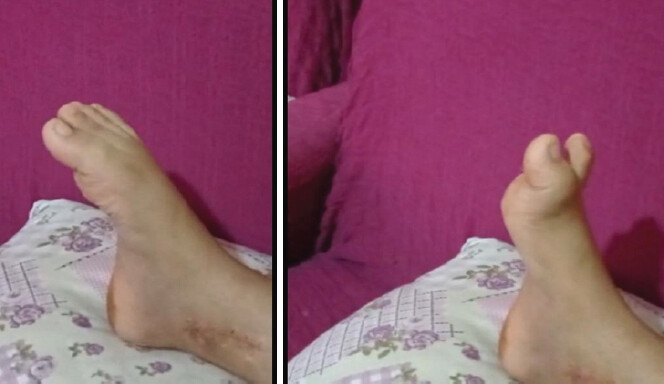
At the 1-month follow-up, after cast removal, the patient reported an abnormal motion of the great toe. During ankle dorsiflexion, the hallux developed a flexion deformity and could not return to neutral; this deformity resolved completely during plantar flexion (Fig. 3).
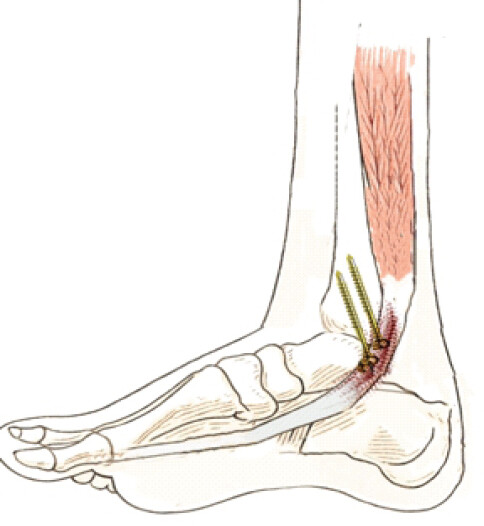
The patient experienced discomfort while walking, though ankle and lesser toe motion remained normal in the neutral position. Dynamic ultrasonography was performed to identify the cause of this phenomenon. The examination revealed impingement of the FHL tendon beneath the medial malleolar screws, producing mechanical compression during ankle motion. No peritendinous adhesions, fibrosis, or tendon rupture were observed. These findings confirmed a diagnosis of FHL impingement-induced checkrein deformity (Fig. 4).
Based on the imaging findings, hardware removal was planned to relieve the mechanical restriction. Under spinal anesthesia, both medial malleolar screws were removed through the previous incision. Intraoperative assessment showed immediate correction of the deformity when the ankle was dorsiflexed, confirming the mechanical nature of the impingement. No additional soft-tissue release was required. Postoperatively, the patient began early range-of-motion and strengthening exercises for the ankle and great toe. At 6 weeks after screw removal, full, pain-free movement of the hallux and ankle had been restored, with no recurrence of deformity. At the 6-month follow-up, the patient had returned to all daily activities without any functional limitations or discomfort.
Discussion
Trimalleolar fractures are complex injuries that often require precise surgical intervention to restore joint congruity and prevent long-term dysfunction [8,9,10]. Although complications related to hardware or soft-tissue structures are not uncommon, impingement of the FHL tendon following internal fixation is exceedingly rare [5].
Checkrein deformity is typically caused by adhesions or tethering of the FHL tendon following trauma, fracture fixation, or soft-tissue injury [7,11,12,13]. The deformity manifests as flexion of the hallux during ankle dorsiflexion and resolution during plantar flexion, resulting from a dynamic restriction in tendon gliding rather than fixed contracture. Previous reports have described this condition secondary to entrapment of the FHL after talar or calcaneal fractures, or due to fibrotic adhesions around the tendon sheath [11,12,13].
In contrast, the present case demonstrates a purely mechanical cause of checkrein deformity, where the FHL tendon was directly compressed by the medial malleolar screws used for fixation. Dynamic ultrasonography allowed real-time visualization of the tendon impingement, confirming the diagnosis and differentiating it from adhesion-related pathology. This emphasizes the diagnostic advantage of dynamic imaging over static modalities in detecting subtle mechanical obstructions.
Immediate resolution of the deformity following screw removal further supports the mechanical nature of the problem and highlights the importance of understanding tendon anatomy and movement during surgical planning. Even minimal prominence or malposition of medial malleolar screws can result in tendon irritation or compression.
While tendon-related complications after ankle fracture surgery have been previously documented [8,14], this case represents a unique example of FHL mechanical impingement successfully treated by simple hardware removal. Awareness of this potential complication and early use of dynamic imaging can facilitate timely diagnosis, preventing chronic deformity and functional impairment.
Conclusion
This case demonstrates a rare instance of FHL tendon impingement following medial malleolar screw fixation, resulting in checkrein deformity. Dynamic ultrasonography allowed accurate differentiation between mechanical impingement and adhesive restriction, enabling prompt diagnosis and targeted treatment. Hardware removal alone resulted in immediate and complete resolution of the deformity, confirming the mechanical etiology. Surgeons should consider the proximity of fixation screws to the FHL tendon during medial malleolar fracture fixation and remain vigilant for postoperative dynamic toe deformities.
Clinical Message
In patients who develop a dynamic hallux deformity after medial malleolar fixation, mechanical impingement of the FHL by the fixation screws should be considered. Dynamic ultrasonography can identify this mechanical cause and may allow successful treatment with hardware removal alone, avoiding unnecessary tendon release.
Conflict of Interest:
Nil
Source of Support:
Nil
Consent:
The authors confirm that informed consent was obtained from the patient for publication of this article
References
- Court-Brown CM, McBirnie J, Wilson G. Adult ankle fractures--an increasing problem? Acta Orthop Scand 1998;69:43-7. [Google Scholar] | [PubMed]
- Aitken SA, Johnston I, Jennings AC, Chua IT, Buckley RE. An evaluation of the Herscovici classification for fractures of the medial malleolus. Foot Ankle Surg 2017;23:317-20. [Google Scholar] | [PubMed]
- Carter TH, Duckworth AD, White TO. Medial malleolar fractures: Current treatment concepts. Bone Joint J 2019;101-B:512-21. [Google Scholar] | [PubMed]
- Toth MJ, Yoon RS, Liporace FA, Koval KJ. What's new in ankle fractures. Injury 2017;48:2035-41. [Google Scholar] | [PubMed]
- Chen WT, Liu ZY, Wang BJ. Posttraumatic checkrein deformity following isolated Lauge-Hansen pronation external rotation stage IV malleolar fracture-a case report and literature review. Front Surg 2023;10:887611. [Google Scholar] | [PubMed]
- Clawson DK. Claw toes following tibial fracture. Clin Orthop 1974;103:47-8. [Google Scholar] | [PubMed]
- Mudarra García J, Saus Milán N, Blasco Mollá MC, Forriol Brocal F, Martin-Gorgojo V. Arthroscopic tenotomy of the flexor hallucis longus to treat checkrein deformity. Foot Ankle Spec 2025;18:541-7. [Google Scholar] | [PubMed]
- Beckenkamp PR, Lin CW, Chagpar S, Herbert RD, Van Der Ploeg HP, Moseley AM. Prognosis of physical function following ankle fracture: A systematic review with meta-analysis. J Orthop Sports Phys Ther 2014;44:841-51, B2. [Google Scholar] | [PubMed]
- Fong DT, Hong Y, Chan LK, Yung PS, Chan KM. A Systematic review on ankle injury and ankle sprain in sports. Sports Med 2007;37:73-94. [Google Scholar] | [PubMed]
- Koval KJ, Zhou W, Sparks MJ, Cantu RV, Hecht P, Lurie J. Complications after ankle fracture in elderly patients. Foot Ankle Int 2007;28:1249-55. [Google Scholar] | [PubMed]
- Kim SH, Lee KT, Smith RW, Park YU. Checkrein deformity secondary to entrapment of FHL after talus fracture: A case report. Foot Ankle Int 2010;31:336-8. [Google Scholar] | [PubMed]
- Abolfotouh SM, Mahmoud KM, Mekhaimar MM, Said N, Al Dosari MA. Checkrein deformity associated with intra-articular talar fracture: A report of three cases. JBJS Case Connect 2015;5:e21. [Google Scholar] | [PubMed]
- Polichetti C, Greco T, Inverso M, Maccauro G, Forconi F, Perisano C. Retro-malleolar Z-plasty of flexor hallucis longus tendon in post-traumatic checkrein deformity: A case series and literature review. Medicina (Kaunas) 2022;58:1072. [Google Scholar] | [PubMed]
- Monestier L, Riva G, Coda Zabetta L, Surace MF. Outcomes after unstable fractures of the ankle: What's new?A systematıc revıew. Orthop Rev (Pavia) 2022;14:35688. [Google Scholar] | [PubMed]
© 2026 Journal of Orthopaedic Case Reports - Published by Indian Orthopaedic Research Group
About the Authors
-

Mustafa Ali Kahreman
-

Ali Can Koluman
Related Articles in Journal of Orthopaedic Case Reports
 August 1, 2026 Thoracolumbar Fascial Defect in Persistent Low Back Pain After Lumbar Surgery: Ultrasound Findings and Response to Fascial Plane Injection
 June 1, 2026 Clinical and Ultrasonographic Outcomes of Percutaneous Achilles Tenotomy Using an 18-Gauge Needle in Idiopathic Clubfoot: A Prospective Study
 February 1, 2026 Endoscopic Flexor Hallucis Longus Tenotomy for Post-traumatic Checkrein Deformity: A Case Report
 October 1, 2025 Management of Ipsilateral Tibia and Fibula Shaft Fracture with Trimalleolar Fracture: A Rare Case Report