


Introduction
Low back pain is one of the most prevalent musculoskeletal disorders worldwide and a leading cause of disability and socioeconomic burden, affecting nearly 60–80% of individuals during their lifetime [1]. Lumbar disc herniation (LDH) is a common cause of lumbosacral radiculopathy, with an estimated annual incidence of 5–20 cases/1,000 adults, most frequently affecting individuals between the third and fifth decades of life [2]. Herniation of the nucleus pulposus through defects in the annulus fibrosus results in mechanical compression and inflammatory irritation of adjacent nerve roots, producing radicular pain, sensory disturbances, and functional disability [3].
Although most of the patients improve with conservative management, including analgesics, physiotherapy, and activity modification, approximately 10–20% develop persistent symptoms requiring interventional or surgical treatment [4]. Surgical discectomy remains the standard intervention for refractory cases or progressive neurological deficits; however, it is associated with potential complications such as infection, dural tears, nerve injury, and recurrent disc herniation [5]. Therefore, minimally invasive procedures have gained increasing attention as alternatives that may provide effective symptom relief while reducing surgical morbidity.
Intradiscal oxygen-ozone therapy has emerged as a promising minimally invasive modality for the management of LDH. The technique involves injection of a regulated oxygen-ozone mixture into the affected intervertebral disc under imaging guidance, leading to oxidative degradation of proteoglycans within the nucleus pulposus, disc dehydration, and reduction in herniated disc volume [6]. In addition to mechanical decompression, ozone demonstrates anti-inflammatory, analgesic, and immunomodulatory effects that contribute to symptomatic improvement [7]. Previous studies have reported significant reductions in pain and disability following intradiscal ozone therapy, with low complication rates, supporting its use as an alternative to surgery in selected patients [8]. The procedure can be performed under local anesthesia using fluoroscopic or computed tomography guidance, allowing outpatient management with reduced procedural morbidity [9].
Radicular symptoms in LDH are mediated not only by mechanical compression but also by inflammatory cytokines released from degenerated disc material. Periforaminal steroid injections are therefore widely used to reduce perineural inflammation and nerve root edema. Combining intradiscal ozone therapy with periforaminal steroid injection may provide synergistic therapeutic benefits by addressing both mechanical and inflammatory mechanisms [8,9]. Despite increasing evidence supporting its safety and effectiveness, intradiscal ozone therapy remains underutilized in routine clinical practice in many regions. Therefore, the present study aimed to evaluate the clinical effectiveness of intradiscal ozone therapy, with or without periforaminal steroid injection, in patients with symptomatic LDH refractory to conservative treatment.
Materials and Methods
Study design and setting
This retrospective cohort, hospital-based observational study was conducted in patients who underwent percutaneous fluoroscopy-guided intradiscal ozone therapy, with or without adjunctive periforaminal steroid injection, for the management of symptomatic LDH. Patient data were obtained from the electronic medical records of the Department of Orthopaedics and Spine Surgery at Shree Narayana Hospital, Raipur, Chhattisgarh. Data collection and analysis were performed following approval from the Institutional Ethics Committee of Shree Narayana Hospital with Approval No. (SNH/IEC/Cert./SPINE1.1/2026). All study procedures adhered to the ethical principles outlined in the Declaration of Helsinki and its subsequent amendments. A total of 100 consecutive patients presenting with lumbar radiculopathy secondary to magnetic resonance imaging (MRI)-confirmed LDH, treated between January 2022 and December 2024, were included in the analysis. A consecutive sampling strategy was employed, wherein all eligible patients treated during the study who satisfied the predefined inclusion and exclusion criteria were included. Consequently, the final study cohort comprised 100 patients. Owing to the retrospective observational design of the study, no formal a priori sample size calculation was performed. Patients were retrospectively categorized according to the treatment they had received. The decision to administer intradiscal ozone therapy alone or in combination with a periforaminal corticosteroid and local anesthetic injection was made by the treating spine surgeon based on the patient’s clinical presentation, severity of radicular symptoms, neurological findings, and MRI characteristics. Accordingly, Group 1 comprised patients treated with intradiscal ozone therapy alone, whereas Group 2 included patients who received intradiscal ozone therapy combined with a periforaminal corticosteroid and local anesthetic injection.
Patient selection
Patients presenting with low back pain accompanied by unilateral or bilateral radiculopathy suggestive of LDH were screened for eligibility. The diagnosis was established based on detailed clinical assessment and MRI findings demonstrating disc herniation corresponding to the patient’s clinical symptoms and neurological findings. Eligible participants included patients aged 18–70 years with MRI-confirmed single-level LDH, particularly at the L4-L5 or L5-S1 level, presenting with low back pain with or without radiculopathy, as supported by clinical examination and imaging findings. Patients were required to have persistent symptoms for at least 6 weeks–3 months despite adequate conservative management, including pharmacological therapy, physiotherapy, and activity modification. Additional inclusion criteria included a Visual Analog Scale (VAS) pain score greater than 4, absence of previous lumbar spine surgery, and no history of interventional pain procedures within the preceding 6 months. Patients were excluded if they had progressive neurological deficits, cauda equina syndrome, sequestered or significantly migrated disc fragments requiring surgical intervention, or multilevel symptomatic disc disease. Additional exclusion criteria included previous lumbar spine surgery at the affected level, systemic infection, uncontrolled systemic illness, spinal malignancy, vertebral fracture, calcified disc herniation, coagulation disorders or ongoing anticoagulant therapy, hemorrhagic diathesis, glucose-6-phosphate dehydrogenase deficiency, pregnancy, or refusal to participate in the study.
Procedure technique
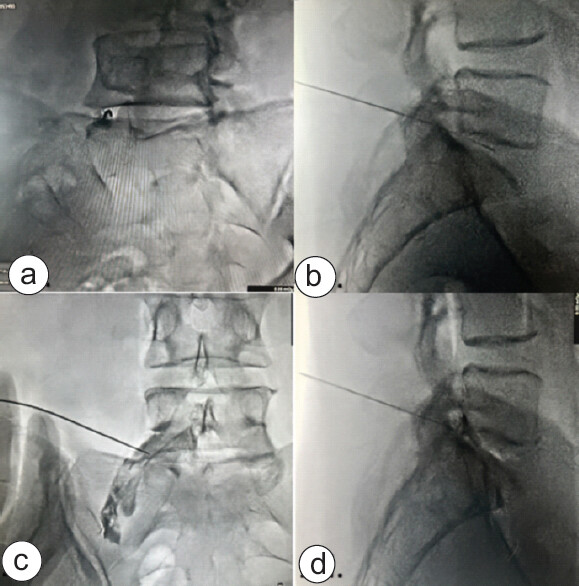
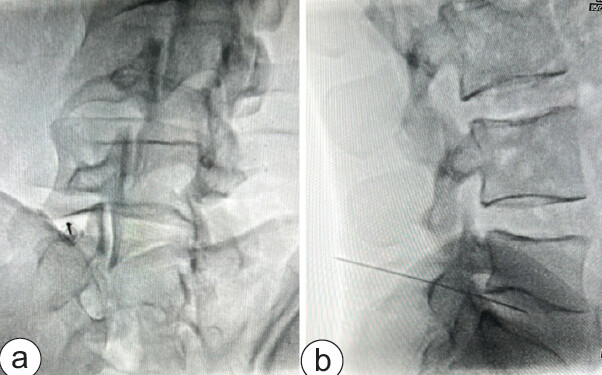
All procedures were performed under strict aseptic conditions and fluoroscopic guidance using a C-arm fluoroscopy system (Siemens Healthineers, Erlangen, Germany). The skin was prepared with povidone–iodine solution, and vital parameters were continuously monitored. Patients were placed in the prone position on a radiolucent operating table, with a pillow under the abdomen to reduce lumbar lordosis. After identifying the target level using anteroposterior, lateral, and oblique fluoroscopic views, the skin and subcutaneous tissues were infiltrated with 1% lidocaine. A 22-gauge, 15-cm spinal needle was advanced into the affected intervertebral disc through a posterolateral approach under fluoroscopic guidance. Proper needle placement in the center of the nucleus pulposus was confirmed using oblique, lateral, and post-contrast fluoroscopic views as shown in Fig. 1. Subsequently, 3–5 mL of an oxygen-ozone (O2-O3) mixture (ozone concentration 25–30 µg/mL) was generated using a medical ozone generator (Ozonosan Alpha Plus, Dr. Hänsler GmbH, Iffezheim, Germany). In patients with more severe or persistent radicular pain, as determined by the treating spine surgeon based on clinical examination and MRI findings, an additional periforaminal injection of dexamethasone (8 mg) combined with 1 mL of 0.05% bupivacaine was administered adjacent to the affected nerve root (Group 2). Needle placement within the neural foramen was confirmed fluoroscopically using oblique and lateral views before drug administration, as shown in Fig. 2. All procedures were performed by an experienced spine surgeon. Patients were observed for about 1 h after the procedure and discharged the same day, with advice on short-term rest, gradual mobilization, and physiotherapy.
Outcome measures
Clinical outcomes were assessed using the VAS and the Oswestry Disability Index (ODI). Pain intensity was evaluated using the 10-cm VAS, where 0 represents no pain, and 10 represents the worst imaginable pain, as originally described by Huskisson [10]. Functional disability was assessed using the ODI, a validated questionnaire consisting of 10 sections, with scores expressed as percentages ranging from 0% (no disability) to 100% (maximum disability), as described by Fairbank and Pynsent [11]. Baseline assessments were performed before the procedure, and follow-up evaluations were conducted at 1-, 3-, and 6-months post-procedure. Clinical improvement was defined as a ≥50% reduction in the VAS score accompanied by a corresponding reduction in the ODI score. Procedure-related complications, including infection, discitis, neurological deterioration, allergic reactions, and other adverse events, were also systematically documented.
Statistical analysis
The data collection was conducted using electronic medical records, which contain socio-demographic and clinical history as well as outcome details of the patients. Statistical analysis was performed using Statistical Package for the Social Sciences software. Continuous variables, such as VAS and ODI scores, were reported as mean ± standard deviation. Changes in clinical scores between baseline and follow-up visits were analyzed using paired t-tests or repeated-measures analysis of variance as appropriate. Categorical variables were expressed as frequencies and percentages. A P < 0.05 was considered statistically significant.
Results
Baseline demographic
A total of 100 patients completed the study, with 50 patients in Group 1 (intradiscal ozone therapy alone) and 50 patients in Group 2 (intradiscal ozone therapy combined with periforaminal steroid injection). The mean age of the cohort was 45.6 ± 11.2 years (range 18–70 years), with 56% males and 44% females. The most commonly affected disc levels were L4-L5 (58%) and L5-S1 (42%). Baseline demographic and clinical characteristics, including VAS and ODI scores, were comparable between groups (P > 0.05), confirming successful randomization as shown in Table 1.
Baseline demographic and clinical characteristics of patients
| Parameter | Group 1: Ozone only (n=50) | Group 2: Ozone+Steroid (n=50) | P-value |
|---|---|---|---|
| Age (years, mean±SD) | 46.1±10.9 | 45.2±11.6 | 0.62 |
| Sex (M/F) | 28/22 | 28/22 | 1 |
| Disc level L4–L5/L5–S1 | 30/20 | 28/22 | 0.68 |
| Baseline VAS (mean±SD) | 7.8±1.1 | 7.7±1.2 | 0.72 |
| Baseline ODI (mean±SD) | 56.3±9.5 | 55.8±10.2 | 0.78 |
Visual Analog Scale, ODI: Oswestry disability index
Pain and functional outcomes
Both groups (Group 1, n = 50; Group 2, n = 50) demonstrated statistically significant reductions in VAS and ODI scores over follow-up. In Group 1, mean VAS decreased from 7.8 ± 1.1 at baseline to 4.2 ± 1.0 at 1 month, 2.9 ± 0.9 at 3 months, and 2.5 ± 0.8 at 6 months, representing a 68% reduction at 6 months. In Group 1, ODI improved from 56.3 ± 9.5 at baseline to 38.6 ± 7.8 at 1 month, 29.4 ± 6.5 at 3 months, and 27.1 ± 6.0 at 6 months. In Group 2, patients receiving combined therapy showed a faster and more pronounced improvement. VAS decreased from 7.7 ± 1.2 at baseline to 3.5 ± 0.9 at 1 month, 2.2 ± 0.7 at 3 months, and 1.9 ± 0.6 at 6 months (75% reduction at 6 months). In Group 2, ODI improved from 55.8 ± 10.2 at baseline to 34.2 ± 6.9 at 1 month, 25.1 ± 5.8 at 3 months, and 23.5 ± 5.3 at 6 months. Between-group comparisons at 6 months revealed a mean difference in VAS scores of 0.6 (95% confidence interval [CI]: 0.2–1.0, P < 0.05), and a mean difference in ODI scores of 3.6 (95% CI: 1.5–5.7, P < 0.05), indicating that the addition of periforaminal steroid injection produces a clinically meaningful and statistically robust enhancement in both early and sustained outcomes, as described in Tables 2 and 3.
VAS scores during follow-up
| Time point | Group 1: Ozone only | Group 2: Ozone + steroid | P-value |
|---|---|---|---|
| Baseline | 7.8±1.1 | 7.7±1.2 | 0.72 |
| 1 Month | 4.2±1.0 | 3.5±0.9 | 0.01 |
| 3 Months | 2.9±0.9 | 2.2±0.7 | 0.003 |
| 6 Months | 2.5±0.8 | 1.9±0.6 | 0.002 |
Oswestry Disability Index (ODI) scores during follow-up
| Time point | Group 1: Ozone only | Group 2: Ozone + steroid | P-value |
|---|---|---|---|
| Baseline | 56.3±9.5 | 55.8±10.2 | 0.78 |
| 1 Month | 38.6±7.8 | 34.2±6.9 | 0.01 |
| 3 Months | 29.4±6.5 | 25.1±5.8 | 0.004 |
| 6 Months | 27.1±6.0 | 23.5±5.3 | 0.002 |
Time-dependent improvement
The rate of improvement was faster in Group 2, with a 55% reduction in VAS by 1 month compared to 46% in Group 1. Similarly, ODI improvement at 1 month was 39% in Group 2 versus 31% in Group 1, indicating accelerated early functional recovery with adjunctive periforaminal steroid injection as shown in Table 4.
Procedure-related complications
| Complication | Group 1 (n=50) | Group 2 (n=50) | Total (n=100) |
|---|---|---|---|
| Transient local pain | 3 (6%) | 3 (6%) | 6 (6%) |
| Mild post-procedural spasm | 2 (4%) | 2 (4%) | 4 (4%) |
| Infection | 0 | 0 | 0 |
| Neurological deficit | 0 | 0 | 0 |
| Systemic complications | 0 | 0 | 0 |
Frequency of minor and major complications in both groups. No serious adverse events were observed. Data are presented as number of patients (%)
Receiver operating characteristic (ROC) curve analysis
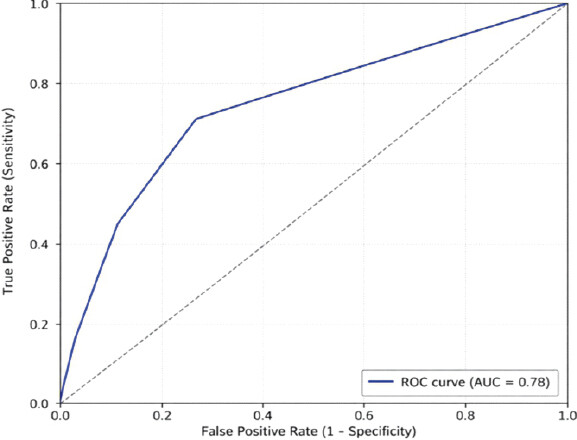
To evaluate the predictive value of combined therapy for achieving clinically meaningful pain relief, an ROC curve was constructed using ≥50% VAS reduction at 6 months as the outcome. In our cohort, ROC analysis yielded an area under the curve (AUC) of 0.78, indicating moderate discriminative ability for identifying patients achieving clinically meaningful pain reduction (≥50% VAS improvement) and supporting its potential usefulness in guiding patient selection, as shown in Fig. 3. This analysis shows that patients receiving combined therapy are more likely to achieve substantial VAS reduction than those receiving ozone therapy alone.
Complications
No major procedure-related complications occurred. Minor adverse events included transient local pain at the injection site in 6 patients (6%) and mild post-procedural muscle spasm in 4 patients (4%), both of which resolved spontaneously within 24–48 h. No patient experienced infection, neurological deficit, or systemic complications, and no additional interventions were required, as shown in Table 5.
Comparative analysis of previous studies on intradiscal ozone therapy for lumbar disc herniation
| Study | Intervention | Sample size | Follow-up | Outcomes (VAS/ODI) (%) | Key findings | Complications |
|---|---|---|---|---|---|---|
| Paoloni et al., 2009 [8] | Intramuscular O₂–O₃ | 60 | 6 months | Pain and disability improved | Significant reduction in pain and disability compared with simulated treatment | No adverse events reported |
| Muto et al., 2004 [12] | Intradiscal and intraforaminal O₂–O₃ | 2,200 | 6–18 months | Clinical success: 80% at 6 months; 75% at 18 months | Sustained clinical improvement in lumbar disc herniation | No significant complications reported |
| Steppan et al., 2010 [9] | O₂–O₃ therapy | Meta-analysis | Various | Significant improvement in pain and function | Overall favorable efficacy and safety | Low complication rate |
| Andreula et al., 2003 [14] | Intradiscal and periganglionic O₂–O₃ ± corticosteroid/local anesthetic | 600 | 6 months | Pain and functional improvement | Effective minimally invasive treatment for lumbar disc herniation | No major complications reported |
| Gallucci et al., 2007 [16] | Intradiscal/intraforaminal O₂–O₃ + corticosteroid | 159 | 6 months | Significant improvement in pain and disability | Favorable outcomes compared with steroid treatment alone | No major complications reported |
| Magalhaes et al., 2012 [17] | Percutaneous O₂–O₃ therapy | Systematic review/meta-analysis | Various | Improvement in pain and disability | Favorable clinical outcomes with low morbidity | Low morbidity |
| Liguori et al., 2018 [18] | Fluoroscopy-guided intradiscal O₂–O₃ (5 mL; 27–30 μg/mL) + periradicular O₂–O₃, steroid and local anesthetic | 52 | 2 and 6 months | ODI improvement: 76%; pain improvement: 78% at 6 months | Significant reduction in pain and disability; ozone nucleolysis was considered a safe, minimally invasive treatment | No complications recorded |
| Bhatia et al., 2019 [19] | Percutaneous O₂–O₃ | 39 | 1, 6 and 12 months | At 12 months: ODI 68%; leg-pain VAS 64%; back-pain VAS 61% improvement | Significant improvement in pain and function | No adverse events/device-related complications |
| Zhang et al., 2016 [22] | O₂–O₃ + corticosteroid | 85 | 6 months | VAS improvement | Combined therapy provided favorable pain relief | Transient muscle spasm |
| Rahimzadeh et al., 2018 [23] | Percutaneous intradiscal O₂–O₃ | 60 | 6 months | Improvement in pain and disability | Significant improvement in pain and functional outcomes compared with baseline | No major complications reported |
| Present study | O₂–O₃ ± corticosteroid | 100 | 6 months | VAS ↓68/75%; ODI ↓52/58% | Combined therapy demonstrated greater early improvement in pain and disability | Transient local pain (6%); muscle spasm (4%) |
Discussion
LDH represents a significant cause of chronic low back pain and radiculopathy, affecting a substantial portion of the adult population and imposing a high burden on quality of life and functional capacity [1]. The pathological process involves herniation or extrusion of the nucleus pulposus, which not only mechanically compresses the adjacent nerve roots but also triggers a cascade of inflammatory mediators, including interleukins (IL) and tumour necrosis factor-alpha (TNF-α), that amplify pain perception and contribute to nerve root irritation [2,3]. While initial management relies on conservative approaches such as analgesics, structured physiotherapy, and activity modification, a subset of patients with persistent radicular pain or functional limitation necessitates minimally invasive interventions or surgical therapy [4,5].
In the present study, both groups exhibited significant improvement in pain and disability scores over 6 months. Group 1, which received ozone therapy alone, demonstrated a mean VAS reduction of 68% and an ODI improvement of 52%, whereas Group 2, receiving ozone therapy with adjunctive periforaminal steroid injection, achieved a VAS reduction of 75% and an ODI improvement of 58%. Early improvement at 1 month was more pronounced in Group 2 (VAS reduction 55% vs. 46%), highlighting the benefit of combined therapy in rapidly reducing radicular pain. These findings are in concordance with previous studies, including Paoloni et al. [8] and Muto et al. [12], which demonstrated superior early pain control and functional improvement when peri radicular steroid therapy was combined with intradiscal ozone therapy.
Comparative analysis of prior literature further supports our results. Summarizes key studies evaluating intradiscal ozone therapy for LDH, highlighting consistent efficacy in pain reduction (60–75%) and functional improvement (ODI 50–55%), with a low rate of adverse events [9,13,14]. Several studies, including meta-analyses by Steppan et al. [9], have confirmed the safety and effectiveness of this minimally invasive approach, while studies assessing combined ozone and steroid therapy demonstrate that adjunctive steroid administration enhances early pain relief and accelerates functional recovery. ROC analysis yielded an AUC of 0.78, indicating that combined therapy demonstrates moderate discriminative ability for identifying patients achieving clinically meaningful pain reduction (≥50% VAS improvement) [9].
Intradiscal ozone therapy has emerged as a safe and effective minimally invasive treatment for symptomatic LDH, combining mechanical decompression with biochemical anti-inflammatory effects. Adjunctive periforaminal steroid injection suppresses perineural inflammation and reduces nerve root edema, thereby facilitating early pain relief and functional recovery [15,16]. Mechanically, ozone oxidizes the proteoglycan matrix within the nucleus pulposus, leading to disc volume reduction and alleviation of nerve root compression. Biochemically, ozone decreases pro-inflammatory cytokines such as IL-1β, IL-6, and TNF-α, thereby modulating local inflammation and nociception [6,7,17].
Safety outcomes in this study were favourable, with only minor transient complications reported, including local injection site pain (6%) and post-procedural muscle spasm (4%), both resolving spontaneously without sequelae. No serious complications, neurological deficits, or infections occurred. These observations are consistent with prior studies and support the favourable safety profile of intradiscal ozone therapy [6,9,17]. These findings have important clinical implications. Fluoroscopy-guided intradiscal ozone therapy, particularly when combined with periforaminal steroid injection, may serve as a minimally invasive therapeutic option in appropriately selected patients with symptomatic LDH who fail conservative management. The rapid pain relief, sustained functional improvement, and low complication rate suggest that this approach may reduce the need for surgical intervention in appropriately selected patients [18,19,20,21]. As a result, conclusions regarding the relative effectiveness of ozone-based interventions versus surgery cannot be definitively drawn from these results. This limitation should be considered when interpreting the potential role of intradiscal ozone therapy as an alternative to surgical management.
However, several limitations should be acknowledged. This study was conducted at a single center, which may limit generalizability, and the follow-up duration was 6 months, preventing assessment of long-term efficacy and recurrence rates. Ongoing follow-up of this patient cohort is planned and will specifically monitor for sustained clinical improvement, late adverse events, and recurrence, to address the durability of treatment outcomes. In addition, the study design was non-blinded, introducing potential bias in outcome assessment, and a direct comparison with surgical interventions was not performed, limiting conclusions regarding relative effectiveness. Future multicenter randomized controlled trials with longer follow-up are warranted to confirm these findings, determine the durability of outcomes, and refine patient selection criteria.
Conclusion
Fluoroscopy-guided intradiscal oxygen-ozone therapy is an effective minimally invasive treatment for symptomatic LDH refractory to conservative management. Although both treatment strategies significantly improved pain and functional outcomes, the addition of a periforaminal steroid injection provided superior early pain relief and functional recovery, supporting its use in appropriately selected patients with significant radicular symptoms.
Clinical Message
Intradiscal oxygen-ozone therapy provides significant pain relief and functional improvement in lumbar disc herniation. Adjunctive periforaminal steroid injection may accelerate recovery and should be considered as part of a minimally invasive treatment strategy before surgery.
Conflict of Interest:
Nil
Source of Support:
Nil
Consent:
The authors confirm that informed consent was obtained from the patient for publication of this article
References
- Andersson GB. Epidemiological features of chronic low-back pain. Lancet 1999;354:581-585. doi:10.1016/S0140-6736(99)01312-4. Google Scholar | PubMed | CrossRef
- Deyo RA, Mirza SK. Clinical practice: herniated lumbar intervertebral disk. N Engl J Med. 2016;374:1763-1772. doi:10.1056/NEJMcp1512658. Google Scholar | PubMed | CrossRef
- Fardon DF, Williams AL, Dohring EJ. Lumbar disc nomenclature: version 2.0: recommendations of the combined task forces of the North American Spine Society, the American Society of Spine Radiology and the American Society of Neuroradiology. Spine J 2014;14:2525-2545. doi:10.1016/j.spinee.2014.04.022. Google Scholar | PubMed | CrossRef
- Kreiner DS, Hwang SW, Easa JE. An evidence-based clinical guideline for the diagnosis and treatment of lumbar disc herniation with radiculopathy. Spine J 2014;14:180-191. 10.1016/j.spinee.2013.08.003. Google Scholar | PubMed | CrossRef
- Atlas SJ, Keller RB, Wu YA. Long-term outcomes of surgical and nonsurgical management of sciatica secondary to a lumbar disc herniation: 10-year results from the Maine Lumbar Spine Study. Spine (Phila Pa 1976) 2005;30:927-935. doi:10.1097/01.brs.0000158954.68522.2a. Google Scholar | PubMed | CrossRef
- Clavo B, Borrelli E. Editorial: ozone in medicine: biochemical background, physiological modulation and clinical applications. Front Physiol 2023;14:1112860. doi:10.3389/fphys.2023.1112860. Google Scholar | PubMed | CrossRef
- Iliakis E, Valadakis V, Vynios DH, Tsiganos CP, Agapitos E. Rationalization of the activity of medical ozone on intervertebral disc: a histological and biochemical study. Rivista di Neuroradiologia 2001;14:23-30. doi:10.1177/19714009010140S105. Google Scholar | PubMed | CrossRef
- Paoloni M, Di Sante L, Cacchio A. Intramuscular oxygen-ozone therapy in the treatment of acute back pain with lumbar disc herniation: a multicenter, randomized, double-blind, clinical trial of active and simulated lumbar paravertebral injection. Spine (Phila Pa 1976) 2009;34:1337-1344. doi:10.1097/BRS.0b013e3181a3c18d. Google Scholar | PubMed | CrossRef
- Steppan J, Meaders T, Muto M, Murphy KJ. A metanalysis of the effectiveness and safety of ozone treatments for herniated lumbar discs. J Vasc Interv Radiol 2010;21:534-548. doi:10.1016/j.jvir.2009.12.393. Google Scholar | PubMed | CrossRef
- Huskisson EC. Measurement of pain. Lancet 1974;2:1127-1131. doi:10.1016/S0140-6736(74)90884-8. Google Scholar | PubMed | CrossRef
- Fairbank JC, Pynsent PB. The Oswestry Disability Index. Spine (Phila Pa 1976) 2000;25:2940-2952. doi:10.1097/00007632-200011150-00017. Google Scholar | PubMed | CrossRef
- Muto M, Andreula C, Leonardi M. Treatment of herniated lumbar disc by intradiscal and intraforaminal oxygen-ozone (O2-O3) injection. J Neuroradiol 2004;31:183-189. Google Scholar | PubMed
- Ezeldin M, Leonardi M, Princiotta C. Percutaneous ozone nucleolysis for lumbar disc herniation. Neuroradiology 2018;60:1231-1241. doi:10.1007/s00234-019-02261-6. Google Scholar | PubMed | CrossRef
- Andreula CF, Simonetti L, De Santis F, Agati R, Ricci R, Leonardi M. Minimally invasive oxygen-ozone therapy for lumbar disk herniation. AJNR Am J Neuroradiol 2003;24:996-1000. Google Scholar | PubMed
- Ercalik T, Kilic M. Efficacy of intradiscal ozone therapy with or without periforaminal steroid injection on lumbar disc herniation: A double-blinded controlled study. Pain Physician 2020;23:477-84. Google Scholar | PubMed
- Ozcan S, Muz A, Yildiz Altun A, Onal SA. Intradiscal ozone therapy for lumbar disc herniation. Cell Mol Biol (Noisy-le- grand) 2018;30:52-5. Google Scholar | PubMed
- Magalhães FN, Dotta L, Sasse A, Teixeira MJ, Fonoff ET. Ozone therapy as a treatment for low back pain secondary to herniated disc: a systematic review and meta-analysis of randomized controlled trials. Pain Physician 2012;15(2):E115-E129. doi:10.36076/ppj.2012/15/E115. Google Scholar | PubMed | CrossRef
- Liguori A, Galli F, Gurgitano M. Clinical and instrumental assessment of herniated discs after nucleoplasty: a preliminary study. Acta Biomed 2018;89(1-S):220-229. doi:10.23750/abm.v89i1-S.7025. Google Scholar | PubMed | CrossRef
- Bhatia A, Munk P, Lee D, Elias G, Murphy K. Percutaneous ozone treatment for herniated lumbar discs: 1-year follow-up of a multicenter pilot study of a handheld disposable ozone-generating device. J Vasc Interv Radiol 2019;30:752-760. Google Scholar | PubMed
- Burke JG, Watson RW, McCormack D, Dowling FE, Walsh MG, Fitzpatrick JM. Intervertebral discs which cause low back pain secrete high levels of proinflammatory mediators. J Bone Joint Surg Br 2002;84:196-201. Google Scholar | PubMed
- Benyamin RM, Manchikanti L, Parr AT, Diwan S, Singh V, Falco FJ. The effectiveness of lumbar interlaminar epidural injections in managing chronic low back and lower extremity pain. Pain Physician 2012;15:E363-E404. Google Scholar | PubMed
- Zhang Y, Ma Y, Jiang J, Ding T, Wang J. Treatment of lumbar disc herniation with intradiscal and intraforaminal injection of oxygen-ozone. J Back Musculoskelet Rehabil 2013;26:317-322. Google Scholar | PubMed
- Rahimzadeh P, Imani F, Ghahremani M, Faiz SH. Comparison of percutaneous intradiscal ozone injection with laser disc decompression in discogenic low back pain. J Pain Res. 2018;11:1405-1410. Google Scholar | PubMed
© 2026 Journal of Orthopaedic Case Reports - Published by Indian Orthopaedic Research Group
About the Authors
-

Dr. Sunil Khemka
-

Dr. Sandesh Subhash Agrawal
-

Dr. Manindra Bhushan
-

Dr. Pritam Agrawal
-

Dr. Ambrish Verma
-

Dr. Ram Khemka
Related Articles in Journal of Orthopaedic Case Reports
 September 1, 2026 Direct Endoscopic Visualization of Gas Release in a Lumbar Disc Herniation: A Case Report
 August 1, 2026 Adolescent Cauda Equina Secondary to Traumatic Lumbar Disc Herniation: A Rare Case Report with Review of Literature
 October 1, 2025 Epidural Steroid Injections for Lumbar Disc Herniation and Lumbar Degenerative Disc Disease
 June 20, 2021 Eosinophilic Granulomatosis with Polyangiitis that was Difficult to Distinguish from Peroneal Nerve Palsy and Lumbar Disc Herniation: A Case Report