


Introduction
Anterior cruciate ligament (ACL) injury is a common knee ligament injury, especially among athletes and active individuals. Due to its limited natural healing capacity, a torn ACL often leads to instability, reduced knee function, and difficulty returning to previous activity levels [1]. Long-term ACL deficiency can also make the knee more vulnerable to further meniscal and cartilage injuries and raise the risk of degenerative changes [2]. As a result, arthroscopic ACL reconstruction is now the standard surgical approach to restore stability and function in symptomatic patients [3].
Although improvements in surgical methods have enhanced ACL reconstruction outcomes, post-operative rehabilitation is still key to functional recovery [4]. It focuses on restoring knee motion, muscle strength, neuromuscular control, and overall performance, while ensuring the graft heals properly [5]. Usually, rehab follows a structured, time-based plan that gradually increases weight-bearing, strengthening, and proprioception, and allows return to activity only once specific functional milestones are met [6].
In recent years, accelerated rehabilitation protocols have become more widely accepted. These protocols promote earlier mobilization, gradual weight-bearing, and progression based on the patient’s clinical recovery instead of fixed timelines [7]. Their goal is to restore function sooner without harming graft healing or knee stability. Nonetheless, there are concerns about the safety of accelerated methods, particularly their potential effects on graft laxity, tunnel widening, and long-term clinical outcomes [8, 9].
Previous studies have reported mixed results regarding accelerated rehabilitation after ACL reconstruction. Some researchers found faster recovery of knee motion and performance early on, while others observed increased knee laxity or tunnel widening, even though long-term outcomes were similar [10, 11]. Systematic reviews indicate that although accelerated rehab might speed up initial recovery, long-term clinical results are usually comparable to traditional rehab [9]. As a result, the best rehabilitation approach after ACL reconstruction is still under debate.
Given the current evidence and ongoing uncertainties regarding the optimal rehabilitation approach, this prospective randomized study was conducted to compare functional outcomes of accelerated versus conventional rehabilitation after primary ACL reconstruction. The study assessed recovery using validated patient-reported outcomes, clinical stability tests, knee range of motion (ROM), and thigh circumference changes to determine whether accelerated rehabilitation provides clinical benefits without compromising knee stability or overall function.
Materials and Methods
This prospective randomized controlled study was conducted in the department of orthopedics at a tertiary-care postgraduate teaching institute. Ethical approval was obtained, and all participants gave written consent. A total of 44 patients with clinically and magnetic resonance imaging (MRI)-confirmed isolated ACL tears who were undergoing primary arthroscopic ACL reconstruction were enrolled. Patients were randomly assigned using the chit method into two groups: Conventional rehabilitation (n = 22) and accelerated rehabilitation (n = 22). Patients aged 18–50 years with an isolated ACL rupture confirmed through clinical examination and MRI, who provided consent, were included in the study. Those with multiligament knee injuries, associated meniscal or chondral damage, previous ACL revision surgeries, or neurological, inflammatory, or musculoskeletal conditions affecting knee function, as well as any pathology involving either lower limb that might impact functional outcome, were excluded from the study.
The conventional rehabilitation group adhered to a structured, time-based program focusing on graft protection, gradual weight-bearing, restoring knee motion, progressive strengthening, proprioceptive training, and functional rehab. In contrast, the accelerated group followed a criterion-based approach that included earlier mobilization, prompt quadriceps activation, progressive weight-bearing as tolerated, neuromuscular training, and functional exercises. Progression was driven by clinical recovery markers rather than time alone [5].
In this prospective study, the patients with clinicoradiological diagnosis of ACL rupture were divided into two groups by randomization process of chit method. Patients underwent evaluations before surgery and again at 6 weeks, 3 months, and 9 months post-operation.
-
Group A: Where conventional rehabilitation program was used
-
Group B: Where accelerated rehabilitation program was used.
The accelerated rehabilitation program was implemented using a five-phase, criterion-based progression following ACL reconstruction. Phase I (0–2 weeks) focused on pain and swelling control, early weight-bearing as tolerated, restoration of knee extension and flexion up to 90°, and quadriceps activation. Phase II (2–6 weeks) emphasized full weight-bearing, progressive ROM up to 120°, closed kinetic-chain strengthening, cycling, and proprioceptive exercises. Phase III (6–12 weeks) aimed to restore full ROM, achieve at least 70% strength of the contralateral limb, and improve dynamic balance through progressive resistance and neuromuscular training. Phase IV (12–20 weeks) incorporated advanced strengthening, jogging, agility, proprioception, and plyometric exercises, with progression after achieving ≥80% contralateral limb strength and satisfactory functional testing. Phase V (20–24 weeks onward) focused on return to sport through sport-specific drills, agility, plyometrics, and supervised training.
The conventional rehabilitation program was implemented using a five-phase, criterion-based progression following ACL reconstruction. Phase I (0–2 weeks) focused on graft protection, control of pain and swelling, prevention of stiffness, and early quadriceps activation, with partial weight-bearing using crutches, a brace locked in extension during ambulation, cryotherapy, and limited ROM exercises. Phase II (2–6 weeks) emphasized gradual progression of weight-bearing and knee ROM up to 90°, along with quadriceps strengthening and active-assisted mobilization. Phase III (6–12 weeks) aimed at restoring ROM up to 120°, normalizing gait, and progressively improving strength and proprioception through cycling, closed kinetic-chain exercises, and balance training. Phase IV (12–20 weeks) incorporated advanced quadriceps and hamstring strengthening, dynamic balance, neuromuscular training, and gradual initiation of light agility and jogging, generally after 16–18 weeks. Phase V (20–36 weeks) focused on gradual return to activity and sports through progressive running, hopping, agility, pivoting, and sport-specific drills.
Patients underwent evaluations before surgery and again at 6 weeks, 3 months, and 9 months post-operation. Functional outcomes were measured through the Lysholm knee score, International Knee Documentation Committee (IKDC) score, visual analog scale (VAS) for pain, knee ROM, thigh circumference difference [12], and clinical stability tests such as Lachman, Anterior Drawer, and Pivot Shift [13]. The main focus was on comparing functional results between the two rehabilitation protocols. Secondary measures included pain levels, graft laxity, and instances of graft failure.
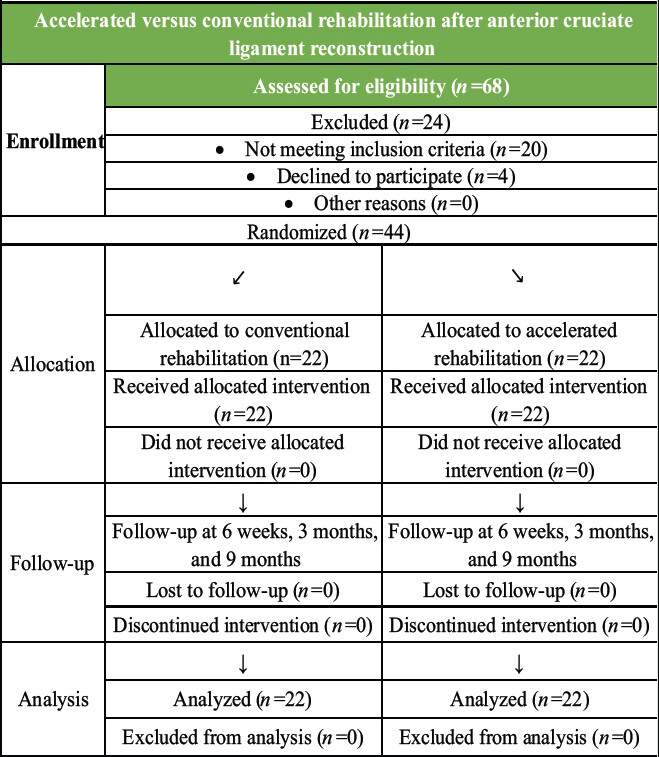
Data were analyzed using the Statistical Package for the Social Sciences version 20.0. Continuous variables were reported as mean ± standard deviation or median with interquartile range, depending on the data distribution. Categorical variables were shown as frequencies and percentages. Between-group differences were evaluated using either the independent samples t-test or the Mann–Whitney U-test, while categorical comparisons employed the Chi-square or Fisher’s exact test. Changes over time were examined through repeated-measures analysis of variance. Effect sizes were determined using Cohen’s d with 95% confidence intervals. Pearson correlation and multivariable linear regression analyses identified factors linked to final functional outcomes. P < 0.05 indicated statistical significance. CONSORT Participant Flow Chart 1.
Results
The study involved 44 patients with isolated ACL tears who all underwent primary arthroscopic ACL reconstruction. They were randomly divided into two equal groups: one undergoing traditional rehabilitation (n=22) and the other receiving accelerated rehabilitation (n=22). Follow-up assessments were conducted at 6 weeks, 3 months, and 9 months, and every participant was included in the final analysis.
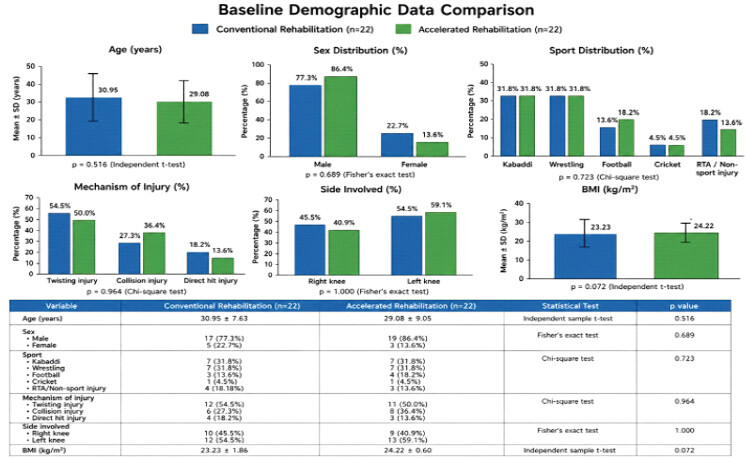
The two groups were similar at baseline, with no significant differences in age, sex, body mass index, injury side, injury mechanism, or pre-operative functional status, demonstrating that they were well matched before intervention (Fig. 1).
Lysholm Knee Scores showed significant improvement over time in both groups (P < 0.001). The pre-operative scores were similar (61.68 ± 7.52 vs. 61.73 ± 7.36; P = 0.984). During early follow-up, the accelerated rehabilitation group tended to have slightly higher scores, while at 9 months, the conventional group had marginally higher scores (Fig. 2). However, none of these differences between groups were statistically significant (Fig. 2).
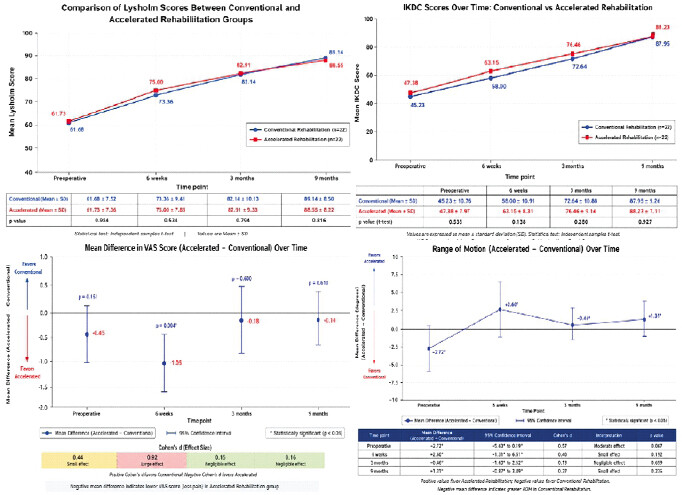
Likewise, the IKDC scores showed significant improvement in both groups throughout the follow-up period (P < 0.001). Patients undergoing accelerated rehabilitation tended to have higher scores during the first 3 months after surgery. However, by the final assessment, the IKDC scores were similar in both groups (Fig. 2).
VAS pain scores gradually declined in both groups throughout the follow-up period. Although the accelerated rehabilitation group had consistently lower pain scores early on, these differences were not statistically significant (Fig. [1.1]2). Knee ROM improved considerably over time in both cohorts. Patients in the accelerated rehabilitation group exhibited slightly better post-operative ROM at follow-up visits, but these differences did not reach statistical significance. By 9 months, both groups achieved comparable knee mobility (Fig. 2).
Thigh circumference difference increased initially after surgery in both groups, indicating post-operative quadriceps atrophy, but then gradually improved. The accelerated rehabilitation group tended to experience less quadriceps wasting early on, but the difference was not statistically significant. By the final assessment, muscle recovery was similar across both groups (Fig. 2).
Clinical stability gradually improved after ACL reconstruction in both groups. The results of Lachman, Anterior Drawer, and Pivot Shift tests were similar at all follow-up points, showing no significant differences between groups. This suggests that both rehabilitation protocols achieved comparable knee stability recovery.
Correlation analysis showed that faster recovery of knee ROM was linked to better final functional results. Conversely, larger differences in thigh circumference and higher early post-operative pain scores were associated with poorer functional recovery.
Both rehabilitation protocols led to notable improvements in patient-reported outcomes, pain levels, knee ROM, quadriceps muscle recovery, and clinical stability. While accelerated rehabilitation indicated a tendency for earlier functional recovery post-surgery, by 9 months, both approaches resulted in similar clinical and functional results (Table 1).
Summary of outcomes comparing conventional and accelerated rehabilitation following ACL reconstruction
| Outcome variable | Findings | Favored group | Statistical significance | Clinical interpretation |
|---|---|---|---|---|
| Lysholm score | Improved significantly in both groups with similar final scores | Neither | No | Functional recovery was comparable with both protocols. |
| IKDC score | Significant improvement in both groups; no difference at final follow-up | Neither | No | Subjective knee function was equivalent between groups. |
| VAS score | Accelerated group showed lower pain scores at 6 weeks | Accelerated | Yes (early only) | Accelerated rehabilitation resulted in earlier pain relief. |
| Range of motion | Accelerated group demonstrated numerically greater early ROM recovery | Accelerated (trend) | No | Accelerated rehabilitation may facilitate earlier restoration of ROM without affecting final outcomes. |
| Thigh circumference difference | Lower muscle wasting observed in accelerated group during early follow-up | Accelerated (trend) | No | Accelerated rehabilitation may promote earlier quadriceps recovery. |
| Lachman test | Significant improvement in both groups with comparable final stability | Neither | No | Anterior knee stability was restored equally with both protocols. |
| Anterior drawer test | Similar improvement in both groups | Neither | No | Rehabilitation protocol did not influence final anterior stability. |
| Pivot shift test | Comparable restoration of rotational stability in both groups | Neither | No | Accelerated rehabilitation did not compromise graft integrity or rotational stability. |
ACL: Anterior cruciate ligament, IKDC: International Knee Documentation Committee, VAS: visual analog scale, ROM: Range of motion
Discussion
This prospective randomized controlled study evaluated the functional results of accelerated versus conventional rehab after primary arthroscopic ACL reconstruction. Both protocols led to notable improvements in knee function, pain, motion, quadriceps recovery, and stability over 9 months. While the accelerated group showed quicker recovery on several measures, the long-term outcomes were similar for both rehabilitation methods.
The study groups were similar at the start, reducing the impact of demographic and clinical differences on post-operative results. This enhances the validity of the comparison and indicates that the observed differences during follow-up were mainly due to the rehabilitation protocols. Functional recovery, evaluated with the Lysholm knee score and IKDC score, improved markedly in both groups. Patients in the accelerated rehabilitation group tended to experience better early functional recovery, but these differences were not statistically significant. Ultimately, both groups achieved similar results at the final follow-up. These findings align with the studies cited in the thesis, which suggest that while accelerated rehabilitation may enhance early recovery, it does not lead to superior long-term functional outcomes [14, 15].
Pain gradually decreased, and knee ROM improved notably in both groups. While the accelerated rehabilitation protocol showed a tendency for lower early pain scores and increased post-operative knee movement, these differences were not statistically significant. Overall, the results indicate that earlier mobilization can be safely carried out with proper supervision, achieving similar medium-term outcomes. The recovery of the quadriceps muscle followed the typical pattern of initial atrophy after surgery, then gradually improved. The group undergoing accelerated rehabilitation showed a tendency for less early muscle wasting, although both groups reached similar levels of muscle recovery by the end of the follow-up period. This indicates that accelerated rehabilitation might help promote earlier muscle activation without affecting long-term recovery outcomes.
The restoration of knee stability was similar across both rehabilitation protocols. Clinical stability assessments, such as the Lachman, Anterior Drawer, and Pivot Shift tests, showed consistent improvement over time, with no notable differences between the groups. This suggests that accelerated rehabilitation does not compromise graft stability and aligns with other studies mentioned in the thesis that report comparable clinical stability after accelerated rehabilitation [16, 17]. Correlation analysis showed that restoring knee ROM earlier leads to improved final functional outcomes. Conversely, greater quadriceps wasting and higher early post-operative pain scores are linked to poorer recovery. These findings emphasize the need for the early knee motion, effective pain management, and quadriceps preservation during rehabilitation.
This study’s strengths lie in its prospective randomized design, similar baseline characteristics, and thorough evaluation using validated patient-reported outcome measures alongside objective clinical assessments. However, its limitations include a small sample size, a follow-up period of only 9 months, and the lack of radiological assessments for graft maturation or tunnel widening. Future research should involve larger samples and longer follow-up to better understand long-term functional results and graft-related changes.
Overall, the results suggest that accelerated rehabilitation enables earlier functional recovery without sacrificing knee stability. Nonetheless, since these early benefits did not lead to statistically significant differences in long-term clinical outcomes, both accelerated and traditional rehabilitation protocols remain effective options after ACL reconstruction, which provided that they are properly supervised. Additional prospective research with larger samples and extended follow-up periods is needed to assess long-term functional results, sports return rates, graft longevity, and the emergence of degenerative changes after various rehabilitation approaches.
Conclusion
Both accelerated and traditional rehab protocols substantially improved outcomes after ACL reconstruction, as evidenced by improvements in knee function, pain, ROM, quadriceps recovery, and stability. The accelerated rehab group tended toward earlier pain relief and functional recovery, though these differences were not statistically significant. At final follow-up, both protocols yielded similar Lysholm and IKDC scores, knee stability, and functional outcomes. The findings indicate that accelerated rehab is a safe and effective option after ACL surgery, offering a practical alternative when tailored to individual clinical recovery.
Clinical Message
Clinicians may safely implement a criterion-based accelerated rehabilitation protocol following primary ACL reconstruction in appropriately selected patients, as it facilitates earlier pain relief, restoration of knee ROM, quadriceps muscle recovery, and functional improvement without compromising graft stability. When performed under appropriate supervision, accelerated rehabilitation provides clinical and functional outcomes comparable to those achieved with conventional rehabilitation.
Conflict of Interest:
Nil
Source of Support:
Nil
Consent:
The authors confirm that informed consent was obtained from the patient for publication of this article
References
- Mall NA, Chalmers PN, Moric M, Tanaka MJ, Cole BJ, Bach BR Jr. Incidence and trends of anterior cruciate ligament reconstruction in the United States Am J Sports Med 2014;42:2363-70. Google Scholar | PubMed
- Lohmander LS, Ostenberg A, Englund M, Roos H. High prevalence of knee osteoarthritis, pain, and functional limitations in female soccer players twelve years after anterior cruciate ligament injury Arthritis Rheum 2004;50:3145-52. Google Scholar | PubMed
- Davarinos N, O'Neill BJ, Curtin W. A brief history of anterior cruciate ligament reconstruction Adv Orthop Surg 2014;2014:706042. Google Scholar | PubMed
- Elabd OM, Alghadir AH, Ibrahim AR, Hasan S, Rizvi MR, Sharma A, et al. Functional outcomes of accelerated rehabilitation protocol for anterior cruciate ligament reconstruction in amateur athletes: A randomized clinical trial J Rehabil Med 2024;56:jrm12296. Google Scholar | PubMed
- Van Der Graaff F. Updated rehabilitation guidelines after ACL reconstruction Br J Sports Med 2023;56:brj12296. Google Scholar | PubMed
- Grindem H. Criteria-based return to sport after ACL reconstruction Am J Sports Med 2022;56:rm12296. Google Scholar | PubMed
- Joreitz R, Lynch A, Popchak A, Irrgang J. Criterion-based rehabilitation program with return to sport testing following ACL reconstruction: A case series Int J Sports Phys Ther 2020;15:1151-73. Google Scholar | PubMed
- Deichsel A, Oeckenpöhler S, Raschke MJ, Grunenberg O, Peez C, Briese T, et al. Recurrent instability rate and subjective knee function following accelerated rehabilitation after ACL reconstruction in comparison to a conservative rehabilitation protocol J Clin Med 2023;12:4567. Google Scholar | PubMed
- Fan Z, Yan J, Zhou Z, Gao Y, Tang J, Li Y, et al. Delayed versus accelerated weight-bearing rehabilitation protocol following anterior cruciate ligament reconstruction: A systematic review and meta-analysis J Rehabil Med 2022;54:jrm00260. Google Scholar | PubMed
- Patra SK, Nanda SN, Patro BP, Sahu NK, Mohnaty CR, Jain M. Early accelerated versus delayed conservative rehabilitation protocol after anterior cruciate ligament reconstruction: A prospective randomized trial Rev Bras Ortop (Sao Paulo) 2022;57:429-36. Google Scholar | PubMed
- Yu JK, Paessler HH. Relationship between tunnel widening and different rehabilitation procedures after anterior cruciate ligament reconstruction with quadrupled hamstring tendons Chin Med J (Engl) 2005;118:320-6. Google Scholar | PubMed
- Collins NJ, Misra D, Felson DT, Crossley KM, Roos EM. Measures of knee function: International knee documentation committee (IKDC) subjective knee evaluation form, Knee injury and osteoarthritis outcome score (KOOS), Knee injury and osteoarthritis outcome score physical function short form (KOOS-PS), Knee outcome survey activities of daily living scale (KOS-ADL), Lysholm knee scoring scale, Oxford knee score (OKS), Western ontario and mcmaster universities osteoarthritis index (WOMAC), Activity rating scale (ARS), and Tegner activity score (TAS) Arthritis Care Res (Hoboken) 2011;63 Suppl 11 S208-28. Google Scholar | PubMed
- Ostrowski JA. Accuracy of 3 diagnostic tests for anterior cruciate ligament tears J Athl Train 2006;41:120-1. Google Scholar | PubMed
- Heinz M, Lettner J, Patt T, Hakam HT, Ramadanov N, Prill R. Accelerated versus standard rehabilitation after anterior cruciate ligament reconstruction: A systematic review and meta-analysis of randomized controlled trials J Arthrosc Surg Sports Med 2026;7:S42-53. Google Scholar | PubMed
- Alqahtani TA, Kardm SM, Alnakhli HH, Alyazedi FM, Kandakurti PK, Reddy RS. Impact of early vs. Delayed physical therapy on functional recovery, proprioception, and return to sport after anterior cruciate ligament (ACL) reconstruction: A cross-sectional study J Orthop Surg Res 2025;20:644. Google Scholar | PubMed
- Jin T, Li Y, Yang G, Liao X, Wang G, Wang F. Comparison of rapid rehabilitation after anterior cruciate ligament reconstruction with tensioning technique and traditional rehabilitation Dis Markers 2022;2022:6779207. Google Scholar | PubMed
- Kim JG, Kim WS, Kim SG, Lee DH. Accelerated versus non-accelerated rehabilitation after primary anterior cruciate ligament reconstruction using hamstring autografts: A systematic review and meta-analysis of comparative studies Indian J Orthop 2021;55:405-15. Google Scholar | PubMed
© 2026 Journal of Orthopaedic Case Reports - Published by Indian Orthopaedic Research Group
About the Authors
-

Dr. Ajay Sheoran
-

Dr. Amitoj Singh
-

Dr. Radhika Devgan
-

Dr. Virender Kumar
-

Dr. Ashish Devgan
-

Dr. Sarita Dhankhar
Related Articles in Journal of Orthopaedic Case Reports
 September 1, 2026 Serial Magnetic Resonance Imaging Graft Signal Intensity and its Correlation with Functional Recovery Following Primary Anterior Cruciate Ligament Reconstruction
 August 1, 2026 Comparative Outcomes of Hamstring Tendon versus Peroneus Longus Tendon Autograft in Arthroscopic Single-Bundle Anterior Cruciate Ligament Reconstruction: A Prospective Comparative Study
 July 1, 2026 Clinical and Donor-site Outcomes of Full-thickness Peroneus Longus Autograft in Arthroscopic Anterior Cruciate Ligament Reconstruction: A Prospective Indian Cohort Study
 July 1, 2026 Role of Meniscal Ramp Lesion Repair in Preventing Residual Instability after Anterior Cruciate Ligament Reconstruction