


Introduction
Total knee arthroplasty (TKA) is one of the most frequently performed and successful orthopedic procedures for the management of advanced degenerative knee diseases, particularly end-stage osteoarthritis [1]. The procedure involves replacement of the damaged femoral condyles and tibial articular surfaces using metallic and polyethylene prosthetic implants to relieve pain, improve mobility, restore joint function, and enhance quality of life. Since the development of the first hinge knee prosthesis by Walldius in the 1950s and the subsequent evolution of condylar prosthetic systems in the 1970s, substantial advancements have occurred in implant design, surgical techniques, perioperative care, and rehabilitation protocols [2,3]. Despite these developments, post-operative pain following TKA continues to remain a major clinical challenge and significantly influences early mobilization, functional recovery, patient satisfaction, and duration of hospital stay [4].
Post-operative pain after TKA is often severe due to extensive soft-tissue handling, periosteal trauma, and inflammatory mediator release during surgery. Inadequate pain management may result in delayed ambulation, prolonged immobilization, increased opioid consumption, joint stiffness, thromboembolic complications, and delayed rehabilitation [5,6]. Therefore, optimization of post-operative analgesia has become an essential component of enhanced recovery protocols in TKA patients. Multimodal analgesic strategies are currently preferred because they provide effective pain relief while reducing opioid-related adverse effects [7].
Among various analgesic techniques, periarticular infiltration analgesia has gained considerable popularity as an adjunctive modality for post-operative pain control in TKA [8,9]. Periarticular injection involves administration of analgesic agents around highly nociceptive structures of the knee joint during surgery, including the infrapatellar fat pad, periosteum, collateral ligament insertions, retinacula, and pes anserine region [10]. This targeted local analgesic approach provides effective pain relief, improves post-operative range of motion, facilitates early ambulation, and reduces systemic analgesic requirements [11].
Several pharmacological agents such as local anesthetics, opioids, corticosteroids, epinephrine, ketorolac, and α2-adrenergic receptor agonists have been used in periarticular analgesic cocktails with encouraging results [12]. Dexmedetomidine, a highly selective α2-adrenergic agonist, possesses analgesic, sedative, sympatholytic, and anti-inflammatory properties and has shown promising efficacy in prolonging post-operative analgesia and reducing analgesic consumption after TKA [13,14]. Fentanyl, a potent synthetic opioid with rapid onset and strong analgesic potency, is also widely used for perioperative pain management. Although both agents have demonstrated beneficial analgesic effects, comparative evidence regarding their periarticular administration in TKA remains limited [15,16].
Therefore, the present randomized controlled trial was undertaken to compare the effects of periarticular fentanyl and dexmedetomidine injection for post-operative pain management in patients undergoing TKA, with particular emphasis on analgesic duration; post-operative pain relief, cumulative analgesic requirement, ambulation, and duration of hospital stay [17].
Materials and Methods
The present study was a prospective, hospital-based randomized controlled trial conducted in the Department of Orthopaedics at Teerthanker Mahaveer Medical College and Research Centre after obtaining approval from the Institutional Ethics Committee (IEC Approval No. TMU/IEC/PG 2034-25/120, dated June 10, 2024). The study was carried out over a period of 18 months, and all procedures adhered to ethical guidelines for biomedical research involving human participants.
The study population comprised patients undergoing TKA during the study period. Eligible participants fulfilling predefined inclusion and exclusion criteria were enrolled after obtaining written informed consent. Patients of either gender aged between 18 and 80 years undergoing TKA for primary osteoarthritis, secondary osteoarthritis due to septic arthritis or tuberculosis, or post-traumatic arthritis were included in the study. Patients undergoing revision surgery or second-stage TKA, fresh peri-knee trauma, neurological disorders affecting mobility, major psychiatric illness, or those unwilling to participate were excluded.
Participants were randomly allocated into study groups using a computer-generated randomization method with adequate allocation concealment to minimize selection bias. Each participant received the assigned periarticular analgesic intervention according to the study protocol.
Detailed demographic, clinical, and pre-operative functional data were recorded using a predesigned pro forma. All patients underwent TKA under standard aseptic precautions and institutional operative protocols. Intraoperative and post-operative parameters were documented systematically.
Post-operative evaluation included assessment of duration of analgesia, pain relief, cumulative analgesic requirement, duration to ambulation, and length of hospital stay. Outcome measures were assessed using standardized clinical assessment tools at predefined follow-up intervals. Collected data were analyzed using appropriate statistical methods to evaluate treatment efficacy and post-operative outcomes.
Sample size estimation
The sample size was calculated using the standard formula for comparison of means between two independent groups, considering mean values of 1.758 and 2.546 with standard deviations of 0.435 and 0.506, respectively. A confidence interval of 99% ((Z_{1-alpha/2}=2.58)) and study power of 80% ((Z_{1-beta}=0.84)) were considered for estimation. The calculated minimum sample size was 27 participants in each group. After accounting for an anticipated attrition rate of 15%, the final sample size was increased to 30 participants per group, resulting in a total study population of 90 patients.
Statistical analysis
Quantitative variables were expressed as mean ± standard deviation, whereas qualitative variables were presented as frequency and percentage. Appropriate inferential statistical tests were applied according to the nature and distribution of variables. Comparative analysis between study groups was performed using suitable statistical methods, and a P < 0.05 was considered statistically significant.
Results
A total of 90 patients undergoing TKA were enrolled and randomly allocated into three equal groups comprising 30 patients each: Group A (Bupivacaine + Fentanyl), Group B (Bupivacaine + Dexmedetomidine), and Group C (Bupivacaine + Saline). Baseline demographic characteristics were comparable among the three study groups. The majority of participants in Group A belonged to the 51–60 years age group, whereas most patients in Groups B and C were aged above 50 years. The mean age of patients in Groups A, B, and C was 57.17 ± 5.89 years, 58.97 ± 5.92 years, and 60.33 ± 6.33 years, respectively, without statistically significant intergroup variation (P > 0.05). Baseline demographic characteristics are summarized in Table 1.
Baseline demographic characteristics of study participants
| Variable | Group A (Bupivacaine+ Fentanyl) | Group B (Bupivacaine+De xmedetomidine) | Group C (Bupivacaine+ Saline) | Statistical test | P-value |
|---|---|---|---|---|---|
| n (%) | n (%) | n (%) | |||
| Age group (Years) | |||||
| 41–50 | 5 (16.67) | 4 (13.33) | 4 (13.33) | Analysis of variance=2.819 | 0.067 |
| 51–60 | 17 (56.67) | 13 (43.33) | 9 (30.00) | ||
| >60 | 8 (26.67) | 13 (43.33) | 17 (56.67) | ||
| Total | 30 (100) | 30 (100) | 30 (100) | ||
| Mean±standard deviation | 57.17±5.89 | 58.97±5.92 | 60.33±6.33 | ||
| Gender | |||||
| Female | 9 (30.0) | 16 (53.3) | 18 (60.0) | Chi-square=1.189 | 0.044* |
| Male | 21 (70.0) | 14 (46.7) | 12 (40.0) | ||
| Total | 30 (100) | 30 (100) | 30 (100) | ||
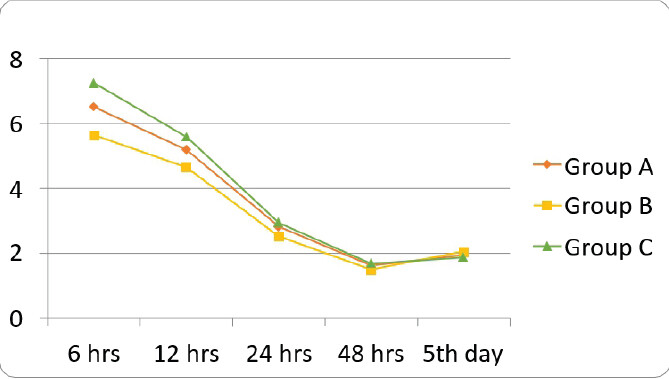
Post-operative pain assessment using the Visual Analog Scale (VAS) demonstrated progressive reduction in pain scores from 6 h to the 5th post-operative day across all study groups. Patients receiving periarticular dexmedetomidine (Group B) consistently demonstrated the lowest VAS scores at all post-operative intervals, followed by Group A and Group C. At 6 h postoperatively, the mean VAS score was significantly lower in Group B (5.63 ± 1.06) compared with Group A (6.50 ± 1.10) and Group C (7.23 ± 1.22) (P = 0.021). Post hoc Tukey analysis demonstrated a significant difference between Group B and Group C at 6 h (P = 0.045), indicating superior early post-operative analgesia with dexmedetomidine infiltration. Subsequent post-operative intervals showed comparable pain scores among study groups (P > 0.05). Detailed comparison of post-operative VAS scores is presented in Table 2 and illustrated in Fig. 1.
Mean VAS score at different post-operative time intervals
| Time interval | Group A Mean±SD | Group B Mean±SD | Group C Mean±SD | P-value |
|---|---|---|---|---|
| 6 h | 6.50±1.10 | 5.63±1.06 | 7.23±1.22 | 0.021* |
| 12 h | 5.17±0.74 | 4.63±0.85 | 5.57±0.89 | 0.06 |
| 24 h | 2.80±0.61 | 2.50±0.57 | 2.93±0.82 | 0.077 |
| 48 h | 1.60±0.56 | 1.47±0.50 | 1.67±0.54 | 0.091 |
| 5th Postoperative day | 1.93±0.73 | 2.03±0.71 | 1.87±0.77 | 0.082 |
SD: Standard deviation, VAS: Visual Analog Scale
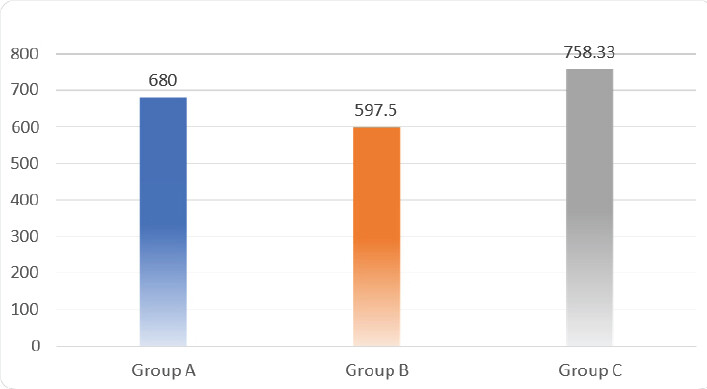
Assessment of cumulative post-operative analgesic requirement demonstrated significantly lower diclofenac consumption among patients receiving periarticular dexmedetomidine. Group B required the least cumulative post-operative diclofenac dose (597.5 ± 153.17 mg), followed by Group A (680 ± 132.02 mg) and Group C (758.33 ± 109.13 mg), showing statistically significant intergroup variation (P = 0.001). Post hoc analysis further demonstrated significant differences between all study groups, confirming superior analgesic efficacy of dexmedetomidine compared with fentanyl and saline infiltration. These observations are summarized in Table 3 and represented in Fig. 2.
Mean post-operative analgesic requirement among study groups
| Study group | Mean diclofenac dose (mg)±SD |
|---|---|
| Group A (Bupivacaine+Fentanyl) | 680.00±132.02 |
| Group B (Bupivacaine+Dexmedetomidine) | 597.50±153.17 |
| Group C (Bupivacaine+Saline) | 758.33±109.13 |
| ANOVA | 23.665 |
| P-value | 0.001* |
SD: Standard deviation, ANOVA: Analysis of variance
Evaluation of post-operative recovery parameters demonstrated that patients in Groups A and B achieved ambulation earlier (2.43 ± 0.50 days) compared with Group C (2.50 ± 0.50 days), although the difference was not statistically significant (P > 0.05). Similarly, the shortest mean duration of hospital stay was observed in Group B (6.30 ± 1.23 days), followed by Group C (6.53 ± 1.22 days) and Group A (6.60 ± 1.32 days), without statistically significant intergroup variation (P = 0.220). These findings suggest relatively faster post-operative recovery among patients receiving dexmedetomidine-based periarticular infiltration. Recovery-related outcomes are summarized in Table 4. (Fig. 3).
Post-operative recovery parameters among study groups
| Parameter | Group A | Group B | Group C | P-value |
|---|---|---|---|---|
| Days to ambulation | 2.43±0.50 | 2.43±0.50 | 2.50±0.50 | 0.088 |
| Length of hospital stay (days) | 6.60±1.32 | 6.30±1.23 | 6.53±1.22 | 0.22 |
Morbidity score analysis demonstrated a progressive increase in post-operative morbidity scores from day 1 to day 3 across all study groups. Although all patients demonstrated excellent morbidity scores on day 1 and good scores on day 2, Group A showed the highest mean morbidity score on post-operative day 3 (25.20 ± 0.66), followed by Group B (24.93 ± 0.78) and Group C (24.57 ± 0.72). However, intergroup comparison revealed no statistically significant variation in morbidity scores at any post-operative interval (P > 0.05). Morbidity score analysis is summarized in Table 5.
Mean morbidity score at different post-operative intervals
| Time interval | Group A Mean±SD | Group B Mean±SD | Group C Mean±SD | P-value |
|---|---|---|---|---|
| Day 1 | 4.80±0.71 | 4.83±0.79 | 5.10±0.75 | 0.133 |
| Day 2 | 14.76±0.72 | 14.96±0.80 | 14.76±0.89 | 0.066 |
| Day 3 | 25.20±0.66 | 24.93±0.78 | 24.57±0.72 | 0.2 |
SD: Standard deviation
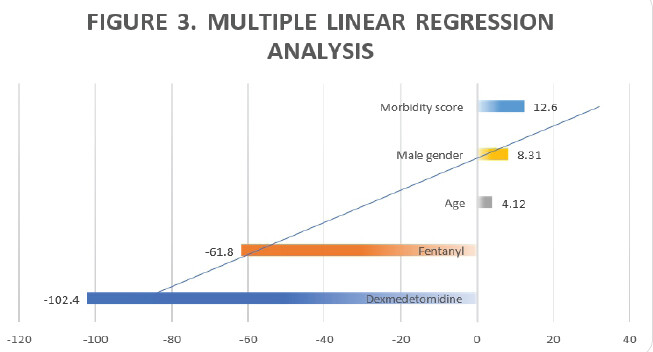
Advanced statistical analysis using multiple linear regression demonstrated that periarticular dexmedetomidine infiltration independently reduced post-operative analgesic requirement compared with fentanyl and saline groups. Dexmedetomidine showed the strongest negative association with cumulative post-operative diclofenac consumption (β = −102.4, P = 0.001), whereas increasing morbidity scores were significantly associated with greater post-operative analgesic requirement (β = 12.6, P = 0.003). Age and gender did not demonstrate a statistically significant association with post-operative analgesic consumption. These findings indicate that periarticular dexmedetomidine provides superior analgesic efficacy and improved post-operative pain control following TKA. Regression analysis findings are summarized in Table 6.
Multiple linear regression analysis for predictors of post-operative analgesic requirement
| Variable | Beta coefficient (P) | 95% Confidence interval | P-value |
|---|---|---|---|
| Dexmedetomidine group | –102.4 | –158.6– –46.2 | 0.001* |
| Fentanyl group | –61.8 | –118.5– –15.7 | 0.018* |
| Age | 4.12 | –1.62–9.85 | 0.142 |
| Male gender | 8.31 | –16.2–32.8 | 0.491 |
| Morbidity score | 12.6 | 4.8–20.3 | 0.003* |
Discussion
Post-operative pain management following TKA remains a major concern because inadequate analgesia may delay mobilization, impair rehabilitation, prolong hospital stay, and increase post-operative analgesic consumption. The present randomized controlled trial compared periarticular fentanyl and dexmedetomidine infiltration for post-operative analgesia in TKA patients and demonstrated superior analgesic efficacy with dexmedetomidine-based periarticular infiltration. In the present study, patients receiving dexmedetomidine showed significantly lower post-operative pain scores, reduced cumulative analgesic requirement, relatively earlier ambulation, and shorter duration of hospital stay compared with fentanyl and saline groups.
Post-operative pain assessment using the VAS demonstrated significantly lower pain scores in the dexmedetomidine group during the early post-operative period. At 6 h post-operatively, the mean VAS score in Group B was 5.63 ± 1.06 compared with 6.50 ± 1.10 in the fentanyl group and 7.23 ± 1.22 in the saline group (P = 0.021). These findings are comparable with those of Jia D et al. [18], who demonstrated prolonged post-operative analgesia and delayed first rescue analgesic requirement following intra-articular dexmedetomidine administration after knee arthroscopy. Similarly, Chan et al. [19] reported significantly reduced post-operative morphine consumption with dexmedetomidine during TKA, with cumulative morphine requirement reduced to 29.2 mg compared with 61.2 mg in controls during the first 24 post-operative h. The opioid-sparing effect observed in their study closely correlates with the present findings, where cumulative post-operative diclofenac consumption was lowest in the dexmedetomidine group (597.50 ± 153.17 mg) compared with the fentanyl group (680.00 ± 132.02 mg) and saline group (758.33 ± 109.13 mg) (P = 0.001).
The superior analgesic efficacy of dexmedetomidine observed in the present study is further supported by Manuar et al. [20], who demonstrated significantly prolonged duration of analgesia and lower rescue analgesic requirement with dexmedetomidine-based analgesic protocols. Their study reported the first rescue analgesic requirement at 380.61 min in the dexmedetomidine group compared with 244.09 min in controls. Salem et al. [21] also compared dexmedetomidine and fentanyl as adjuvants to intra-articular bupivacaine and reported significantly improved post-operative analgesia with both agents. Although their study demonstrated slightly longer analgesia duration with fentanyl, the present study showed comparatively lower post-operative pain scores and reduced cumulative analgesic requirement with dexmedetomidine infiltration following TKA. This variation may be attributed to differences in surgical procedure, periarticular infiltration technique, and post-operative rehabilitation protocols.
The present study also demonstrated relatively earlier ambulation (2.43 ± 0.50 days) and shorter hospital stay (6.30 ± 1.23 days) in the dexmedetomidine group compared with saline controls, although these differences did not achieve statistical significance. Improved post-operative analgesia likely facilitated better patient mobilization and functional recovery. Similar observations were reported by Zhao et al. [22], who demonstrated reduced post-operative opioid requirement and delayed rescue analgesia with dexmedetomidine-based periarticular infiltration following TKA. Furthermore, regression analysis in the present study demonstrated that dexmedetomidine independently reduced post-operative analgesic requirement (β = −102.4, P = 0.001), confirming its strong analgesic efficacy even after adjustment for confounding variables.
Lu et al. [23] reported that intra-articular fentanyl effectively reduced post-operative pain following knee arthroscopy, which is comparable to the improved analgesic outcomes observed in the fentanyl group of the present study when compared with saline controls. However, dexmedetomidine demonstrated comparatively greater analgesic efficacy, likely due to its combined anti-nociceptive, anti-inflammatory, and sympatholytic effects mediated through α2-adrenergic receptor agonism. No significant adverse effects were observed in the present study, indicating that periarticular dexmedetomidine infiltration appears to be a safe and effective adjunct for post-operative pain management following TKA.
Conclusion
Periarticular dexmedetomidine infiltration provided superior post-operative analgesia following TKA compared with fentanyl and saline infiltration. It significantly reduced post-operative pain scores and cumulative analgesic requirement while facilitating earlier ambulation and shorter hospital stay. The findings of the present study support dexmedetomidine as a safe and effective adjunct in multimodal periarticular analgesic protocols for improving post-operative pain control and functional recovery after TKA.
Clinical Message
Periarticular dexmedetomidine appears to be a safe and effective adjunct for post-operative analgesia following total knee arthroplasty. It provides superior early pain relief, significantly reduces cumulative analgesic requirements, and may facilitate earlier ambulation and shorter hospital stay. These findings support its use as part of a multimodal periarticular analgesic protocol for improved post-operative pain control and functional recovery.
Conflict of Interest:
Nil
Source of Support:
Nil
Consent:
The authors confirm that informed consent was obtained from the patient for publication of this article
How to Cite this Article
Sharma A, Saraf A, Prasad MK, Phogaat M, Shah S, Jain S. Comparative Study of Effect of Periarticular Fentanyl and Dexmedetomidine Injection for Pain Management in Total Knee Arthroplasty a Randomized Control Trial. Journal of Orthopaedic Case Reports 2026 October;16(10): 535-541.
References
- Varacallo MA, Luo TD, Mabrouk A, Johanson NA. Total knee arthroplasty techniques. In: StatPearls. Treasure Island, FL: StatPearls Publishing; 2026. [Google Scholar] | [PubMed]
- Causero A, Di Benedetto P, Beltrame A, Gisonni R, Cainero V, Pagano M. Design evolution in total knee replacement: Which is the future? Acta Biomed 2014;85 Suppl 2:5-19. [Google Scholar] | [PubMed]
- Dall'Oca C, Ricci M, Vecchini E, Giannini N, Lamberti D, Tromponi C. Evolution of TKA design. Acta Biomed 2017;88:17-31. [Google Scholar] | [PubMed]
- Zhao C, Liao Q, Yang D, Yang M, Xu P. Advances in perioperative pain management for total knee arthroplasty: A review of multimodal analgesic approaches. J Orthop Surg Res 2024;19:843. [Google Scholar] | [PubMed]
- Pirmohamadi H, Rahmati Roodsari S, Arab-Mazar Z, Rahimi M. Pain management after total knee arthroplasty. Interv Pain Med Neuromodulation 2022;1:e119944. [Google Scholar] | [PubMed]
- Lavand'homme PM, Kehlet H, Rawal N, Joshi GP. PROSPECT Working Group of the European Society of Regional Anaesthesia and Pain Therapy (ESRA). Pain management after total knee arthroplasty. Eur J Anaesthesiol 2022;39:743-57. [Google Scholar] | [PubMed]
- Yang L, Lou W, Jiang Y, Yang L, Wang D, Wang J. The clinical application progress of multimodal analgesia strategy in enhanced recovery after surgery: A narrative review. Front Pain Res (Lausanne) 2025;6:1680157. [Google Scholar] | [PubMed]
- King GA, Le A, Nickol M, Sarkis B, Van Der Merwe JM. Periarticular infiltration used in total joint replacements: An update and review article. J Orthop Surg Res 2023;18:859. [Google Scholar] | [PubMed]
- Nikhar S, Yadav M, Damera S, Mohan L, Ch VJ, Ramachandran G. A comparative study of periarticular infiltration with dexmedetomidine versus ketorolac as an additive to ropivacaine after total knee arthroplasty: A prospective, randomized double-blind study. Anesth Essays Res 2020;14:550-4. [Google Scholar] | [PubMed]
- Ross JA, Greenwood AC, Sasser P 3rd, Jiranek WA. Periarticular injections in knee and hip arthroplasty: Where and what to inject. J Arthroplasty 2017;32:S77-80. [Google Scholar] | [PubMed]
- Getachew M, Tesfaye H, Yihunie W, Ayenew T, Alemu S, Dagnew EM. Sustained release local anesthetics for pain management: Relevance and formulation approaches. Front Pain Res (Lausanne) 2024;5:1383461. [Google Scholar] | [PubMed]
- Martin NJ, Padmanabhan V, Pindis JJ. Efficacy of periarticular cocktail injection in rheumatoid patients undergoing total knee replacement. Indian J Orthop 2020;54:811-22. [Google Scholar] | [PubMed]
- Liu X, Li Y, Kang L, Wang Q. Recent advances in the clinical value and potential of dexmedetomidine. J Inflamm Res 2021;14:7507-27. [Google Scholar] | [PubMed]
- Lee S. Dexmedetomidine: Present and future directions. Korean J Anesthesiol 2019;72:323-30. [Google Scholar] | [PubMed]
- Sandhu KS, Kumar S, Garg K, Aggarwal K, Tiwwary M, Perry G. The xylazine-fentanyl nexus: A public health emergency. SAGE Open Med 2025;13:20503121251348068. [Google Scholar] | [PubMed]
- Naji A, Ramsingh D. Oral transmucosal fentanyl. In: StatPearls. Treasure Island, FL: StatPearls Publishing; 2026. [Google Scholar] | [PubMed]
- Shanwal PK, Saraf A, Pathak PK, Chincholi S, Sinha PR, Prasad MK. Comparative efficacy of periarticular fentanyl versus ketorolac for post-operative pain in total hip arthroplasty: A randomized controlled trial. J Orthop Case Rep 2025;15:268-74. [Google Scholar] | [PubMed]
- Jia D, Yuan X, He C, Tu F. Intravenous lidocaine decreased the median effective concentration of sufentanil for tracheal intubation in obese patients. Drug Des Devel Ther 2023;17:2431-9. [Google Scholar] | [PubMed]
- Chan IA, Maslany JG, Gorman KJ, O'Brien JM, McKay WP. Dexmedetomidine during total knee arthroplasty performed under spinal anesthesia decreases opioid use: A randomized-controlled trial. Can J Anesth 2016;63:569-76. [Google Scholar] | [PubMed]
- Manuar MB, Majumdar S, Das A, Hajra BK, Dutta S, Mukherjee D. Pain relief after arthroscopic knee surgery: A comparison of intra-articular ropivacaine, fentanyl, and dexmedetomidine: A prospective, double-blinded, randomized controlled study. Saudi J Anaesth 2014;8:233-7. [Google Scholar] | [PubMed]
- Salem DA, Nabi SM, Alagamy SA, Kamel AA. Comparative study between dexmedetomidine and fentanyl as an adjuvant to intraarticular bupivacaine for postoperative analgesia after knee arthroscopy. Pain Physician 2021;24:E989-96. [Google Scholar] | [PubMed]
- Zhao E, Zhou K, Liu Z, Ding Z, Lu H, Chen J. Dexmedetomidine prolongs the analgesic effects of periarticular infiltration analgesia following total knee arthroplasty: A prospective, double-blind, randomized controlled trial. J Arthroplasty 2023;38:1273-80. [Google Scholar] | [PubMed]
- Lu JZ, Fu JX, Wang DF, Su ZL, Zheng YB. The efficacy of intra-articular fentanyl supplementation for knee arthroscopy: A meta-analysis of randomized controlled studies. J Orthop Surg (Hong Kong) 2020;28:2309499019900274[T. [Google Scholar] | [PubMed]
© 2026 Journal of Orthopaedic Case Reports - Published by Indian Orthopaedic Research Group
About the Authors
-

Ayush Sharma
-

Amit Saraf
-

Mukesh Kumar Prasad
-

Mayank Phogaat
-

Sahil Shah
-

Shubham Jain
Related Articles in Journal of Orthopaedic Case Reports
 October 1, 2026 Dynamic Computed Tomography Evaluation of Patellar Tracking Following Unrestricted Kinematic Versus Mechanical Alignment in Primary Total Knee Arthroplasty: A Prospective Comparative Study
 October 1, 2026 Intraoperative Discovery of Incorrect Femoral Component Packaging during Bilateral Total Knee Arthroplasty: A Near-Miss Case Report
 October 1, 2026 Prevalence and Clinical Impact of Lumbosacral Transitional Vertebrae in Chronic Low Back Pain: A Cross-Sectional Study from Central India
 October 1, 2026 Association between Coronal Mechanical Axis Correction and Early Functional Outcomes after Primary Total Knee Arthroplasty: A Retrospective Observational Study