


Introduction
Total knee arthroplasty (TKA) is a highly standardized and widely performed procedure with generally predictable outcomes. Its success depends not only on surgical technique and pre-operative planning but also on accurate delivery of appropriate implant components. Errors related to implant selection or delivery, including incorrect size, laterality, fixation type, or incompatible components, are recognized as uncommon but potentially serious patient-safety events in joint replacement surgery [1, 2].
Implant-related errors may reflect system-level failures in verification and device-management processes rather than isolated surgical mistakes. Implant-selection errors have been documented even in high-volume arthroplasty practice, and wrong-side implantation has been reported during bilateral TKA [2, 3]. When the external package label itself is correct, but the enclosed implant is incorrect, conventional pre-operative verification cannot identify the discrepancy before the package is opened.
Near-miss events are incidents that could have resulted in patient harm but are intercepted before injury occurs. Analysis of such events is central to a systems approach to patient safety because it can reveal latent vulnerabilities in safeguards and workflows [4].
We report a near-miss case in which a correctly labeled femoral component package contained an implant that differed in fixation type, size, and laterality and was discovered intraoperatively during bilateral TKA. This case highlights the limitations of label-based verification and the importance of backup implants and system-level approaches to implant safety.
Case Report
A 76-year-old woman with bilateral varus knee osteoarthritis underwent simultaneous bilateral TKA. Pre-operative planning was performed using computed tomography (CT)-based patient-specific instrumentation (PSI), and a medial pivot-type knee system was selected. Cementless fixation was planned for both femoral and tibial components.
Surgery was performed under general anesthesia with pneumatic tourniquet control using a parapatellar approach. The left knee was addressed first. Bone resections were completed according to the PSI guides, and cementless femoral and tibial components were implanted without any intraoperative issues.
The right knee was then prepared using the same PSI protocol. After completion of bone cuts, implantation was initiated. The cementless tibial baseplate was inserted as planned. However, on opening the femoral component package, despite correct labeling indicating the intended side, size, and cementless fixation (Fig. 1), the actual implant inside was inconsistent with the label. The femoral component was a cemented type rather than cementless, one size larger than planned, and intended for the contralateral (left) knee (Fig. 2).

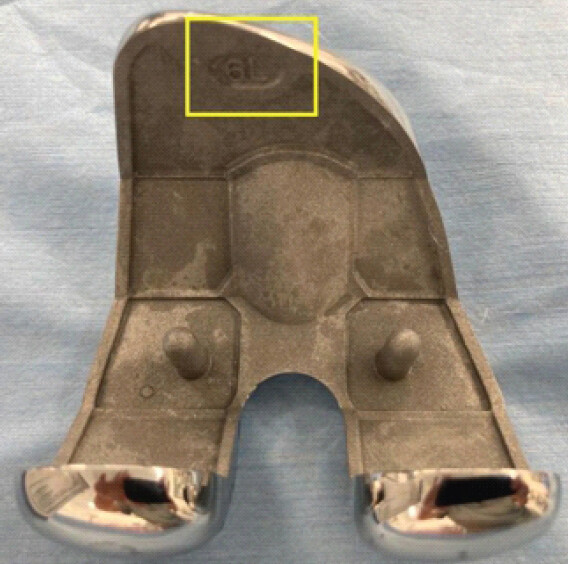
Fortunately, a backup femoral component of the appropriate size designed for cemented fixation was available. Given the intraoperative situation, the surgical plan was modified, and a cemented femoral component was implanted on the right side. The procedure was completed without further complications. Total operative time for bilateral TKA was 2 h and 9 min. Pre-operative range of motion was −5°–110° in the left knee and −10°–114° in the right knee. Pre-operative pain severity assessed using a visual analog scale (VAS) was 67, and the pre-operative Western Ontario and McMaster Universities Osteoarthritis Index (WOMAC) score was 56.1.
At the 1-year follow-up, post-operative range of motion improved to 0°–120° in the left knee and 0°–125° in the right knee. The patient reported complete pain relief with a VAS score of 0. The WOMAC score improved to 90.6. No implant loosening, infection, or revision surgery was observed during follow-up. Written informed consent was obtained from the patient for publication.
Discussion
This case represents an implant-related near-miss event identified intraoperatively during bilateral TKA. Despite correct external labeling, the femoral component inside the package was inconsistent with the intended implant in fixation method, size, and laterality. Such discrepancies pose a patient-safety threat and illustrate vulnerabilities that may exist beyond the control of the operating surgeon. To the best of our knowledge, intraoperative discovery of a correctly labeled but internally mismatched femoral component during bilateral TKA has rarely been reported.
Implant mismatch events, including wrong size, wrong side, and incompatible components, have been documented in total joint arthroplasty [2]. Ast et al. identified implant-selection errors before implantation in 169 of 22,847 total hip and knee arthroplasties despite existing safeguards, demonstrating that verification systems remain important even in high-volume practice [2]. Alanazi et al. also reported wrong-side femoral component implantation during bilateral TKA [3]. In contrast, the present event differed because the external label indicated the intended implant, while the enclosed component was simultaneously incorrect in fixation type, size, and laterality.
Standardized surgical safety protocols and verification systems reduce preventable surgical errors, yet rare device-related discrepancies may still bypass routine safeguards [5]. In the present case, CT-based PSI planning and routine verification were performed, but the discrepancy could not be detected before intraoperative opening because the external label itself was correct. Our group has previously reported the use of PSI in technically complex TKA and has also investigated computer-assisted techniques for optimizing intraoperative execution [6,7]. We have further reported clinical outcomes of medial-pivot TKA [8] and associations between intraoperative findings and post-operative knee range of motion [9]. These studies emphasize the value of meticulous planning and intraoperative assessment; however, the present case demonstrates that such measures cannot eliminate errors originating from an incorrectly packaged implant. Despite the unexpected mismatch, prompt recognition and contingency management allowed the patient to achieve excellent 1-year pain, functional, and range-of-motion outcomes.
Importantly, the event was recognized before implantation and therefore constituted a near miss rather than an adverse event. A systems approach to human error emphasizes identifying latent weaknesses in defenses rather than attributing every event solely to individual performance [4]. In this case, the availability of an appropriate backup femoral component enabled immediate intraoperative adaptation and prevented cancellation, prolonged interruption, or implantation of the incorrect component. This highlights the importance of contingency planning, particularly in bilateral TKA, where an unexpected implant problem arises after substantial operative preparation has already been completed.
Beyond intraoperative management, implant-related near-miss events underscore the need for effective reporting, feedback, and system-level prevention. Comprehensive surgical safety systems have been associated with reductions in surgical complications and mortality, supporting the principle that safety depends on multiple coordinated safeguards rather than a single verification step [10]. For implant-related discrepancies, these safeguards should include accurate packaging and traceability, pre-operative verification, intraoperative confirmation after package opening, ready access to appropriate backup components, and timely reporting of discrepancies so that recurrent hazards can be identified.
Although the clinical outcome in this case was favorable, the event demonstrates that implant packaging errors can occur even in a well-controlled surgical environment and may be impossible for the surgical team to detect while the package remains sealed. Surgeons should therefore remain vigilant when the implant is opened and should verify visible implant characteristics whenever feasible. At the same time, quality assurance throughout manufacturing, packaging, distribution, and hospital inventory processes is critical to minimizing similar events. Reporting near misses of this type may provide useful information for improving implant verification and patient-safety systems.
Conclusion
This case highlights a rare but clinically meaningful implant-related near-miss event in TKA. Despite correct external labeling, discrepancies in fixation type, size, and laterality remained undetected until the package was opened intraoperatively. Prompt recognition and the availability of an appropriate backup implant prevented patient harm. Systematic verification, reporting, and analysis of such events are important for improving implant safety in joint arthroplasty.
Clinical Message
Surgeons should not rely solely on external package labeling during TKA. Implant characteristics should be verified immediately after opening, and appropriate backup components should be readily available to allow safe management of unexpected implant discrepancies.
Conflict of Interest:
Tsuneari Takahashi has served as a consultant for MicroPort Orthopedics. Takumi Matsumoto declares no conflict of interest
Source of Support:
Nil
Consent
The authors confirm that informed consent was obtained from the patient for publication of this article
How to Cite this Article
Takahashi T, Matsumoto T. Intraoperative Discovery of Incorrect Femoral Component Packaging during Bilateral Total Knee Arthroplasty: A Near-Miss Case Report. Journal of Orthopaedic Case Reports 2026 October;16(10): 215-218.
References
- National Guideline Centre (UK) Evidence Review for Wrong Implant Selection:. Joint Replacement (Primary): Hip, Knee and Shoulder London National Institute for Health and Care Excellence (NICE) 2020. [Google Scholar] | [PubMed]
- Ast MP, Mayman DJ, Bostrom MP, Gonzalez Della Valle A, Haas SB. Can we avoid implant-selection errors in total joint arthroplasty? Clin Orthop Relat Res 2019;477:130-3. [Google Scholar] | [PubMed]
- Alanazi H, Alahmari M, Hashem MA, Alqahtani M, Alanazi A, Alenazi B. Total knee arthroplasty wrong side implant. Surg J (N Y) 2018;4:e167-9. [Google Scholar] | [PubMed]
- Reason J. Human error: Models and management. BMJ 2000;320:768-70. [Google Scholar] | [PubMed]
- Haynes AB, Weiser TG, Berry WR, Lipsitz SR, Breizat AH, Dellinger EP. A surgical safety checklist to reduce morbidity and mortality in a global population. N Engl J Med 2009;360:491-9. [Google Scholar] | [PubMed]
- Takahashi T, Matsumura T, Takeshita K. Total knee arthroplasty, following application of Taylor Spatial Frames to treat knee osteoarthritis with severe tibia extraarticular deformity due to fracture malunion: A case report. Trauma Case Rep 2022;39:100640. [Google Scholar] | [PubMed]
- Takahashi T, Sugimoto K, Ae R, Saito T, Kimura Y, Kubo T. Can tibia-first total knee arthroplasty using computer-assisted system improve anterior and posterior knee stability?. Technol Health Care 2022;30:1147-54. [Google Scholar] | [PubMed]
- Takahashi T, Hatayama K, Nishino M, Hai H, Yamada Y, Suzuki K. Comparison of postoperative clinical outcome in medial-pivotal and gradually reducing radius design cruciate-retaining total knee arthroplasty-a multicenter analysis of propensity-matched cohorts. J Exp Orthop 2024;11:e12002. [Google Scholar] | [PubMed]
- Takahashi T, Hatayama K, Ae R, Saito T, Handa M, Kimura Y. Association between intraoperative findings and postoperative knee range motion after cruciate-retaining total knee arthroplasty. Technol Health Care 2024;32:1313-22. [Google Scholar] | [PubMed]
- De Vries EN, Prins HA, Crolla RM, Den Outer AJ, Van Andel G, Van Helden SH. Effect of a comprehensive surgical safety system on patient outcomes. N Engl J Med 2010;363:1928-37. [Google Scholar] | [PubMed]
© 2026 Journal of Orthopaedic Case Reports - Published by Indian Orthopaedic Research Group
About the Authors
-

Tsuneari Takahashi
-

Takumi Matsumoto
Related Articles in Journal of Orthopaedic Case Reports
 October 1, 2026 Superficial Femoral Artery Pseudoaneurysm after Total Knee Arthroplasty: An Uncommon Vascular Complication
 October 1, 2026 Comparative Study of Effect of Periarticular Fentanyl and Dexmedetomidine Injection for Pain Management in Total Knee Arthroplasty a Randomized Control Trial
 October 1, 2026 Association between Coronal Mechanical Axis Correction and Early Functional Outcomes after Primary Total Knee Arthroplasty: A Retrospective Observational Study
 October 1, 2026 Dynamic Computed Tomography Evaluation of Patellar Tracking Following Unrestricted Kinematic Versus Mechanical Alignment in Primary Total Knee Arthroplasty: A Prospective Comparative Study