


Introduction
Elbow dislocations represent the second most common major joint dislocation in adults, with an estimated incidence of 5.21/100,000 person-years in the United States [1]. Posterolateral dislocations account for the majority of cases and typically occur through a combination of axial loading, valgus stress, and forearm supination applied to an outstretched hand [2]. Although most elbow dislocations result from low-energy mechanisms such as falls, high-energy trauma is more frequently associated with complex patterns involving fractures of the radial head, coronoid process, or olecranon [3]. In contrast, simple dislocations, those without associated fractures, are generally managed with closed reduction and early mobilization, provided joint stability is maintained [4, 5].
Open elbow dislocations are exceedingly rare, comprising <2% of adult elbow dislocations [1]. These injuries carry a substantially higher risk of complications, including deep infection, instability, and soft-tissue compromise, necessitating urgent recognition and operative management [6, 7]. The presence of a periarticular wound near the medial or lateral elbow should raise suspicion for joint violation, particularly when accompanied by significant soft-tissue disruption or persistent instability after reduction. Computed tomography (CT) plays a critical role in identifying intra-articular air, subtle fractures, or capsuloligamentous injury that may not be apparent on initial radiographs [7, 8].
Management of open elbow dislocations requires prompt irrigation and debridement, assessment of ligamentous integrity, and layered soft-tissue repair to restore stability and minimize the risk of infection [6,9]. While complex dislocations with osseous injury often require fixation, isolated soft-tissue disruptions, such as avulsion of the flexor pronator mass, may be successfully treated with anatomic reattachment and early supervised rehabilitation [10,11]. Early mobilization is essential to prevent stiffness, a common sequela of elbow trauma, and has been shown to improve long-term functional outcomes [12,13].
This case describes an uncommon open posterolateral elbow dislocation in a middle-aged adult following a low-energy fall, highlighting the diagnostic challenges, operative considerations, and favorable recovery associated with timely recognition and appropriate surgical management.
Case Report
A man in his mid-forties went outside to take out his garbage and slipped, landing on an outstretched right arm. He noticed a deformity of his right elbow and presented to the emergency department (ED) for evaluation. Initial vital signs showed a heart rate of 80 beats/min, respiratory rate of 17 breaths/min, temperature of 98°F, oxygen saturation of 100% on room air, and blood pressure of 191/118 mmHg. Physical examination revealed a laceration and deformity of the right elbow, with full range of motion, strength, and sensation distal to the injury.
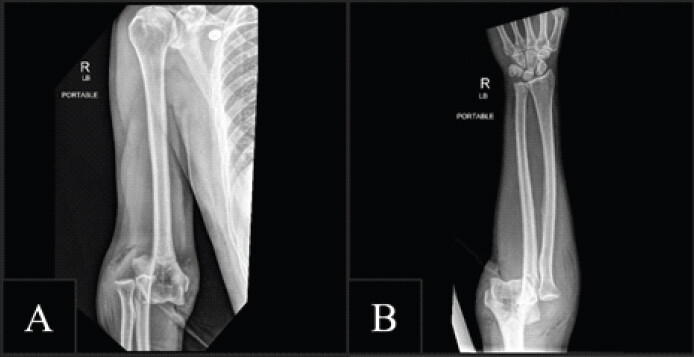
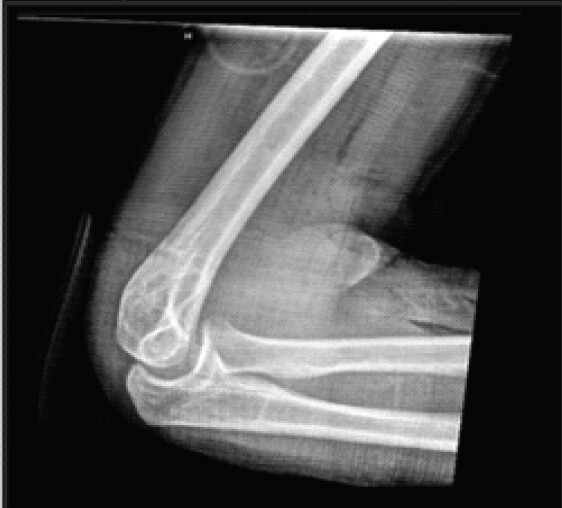
A forearm radiograph demonstrated foreshortening and radial displacement of the proximal radius and ulna, concerning for a posterolateral elbow dislocation (Fig. 1). The patient received intravenous fentanyl and propofol for procedural sedation. The joint was reduced, and the laceration was irrigated with saline and repaired with sutures. A posterior mold splint was applied. Post-reduction radiographs confirmed successful reduction of the elbow joint (Fig. 2). The patient reported improvement in symptoms and was discharged home.
Orthopedic surgery later reviewed the radiographs and recommended a CT scan. The patient was contacted and returned to the ED for further evaluation. CT imaging demonstrated a reduced joint but revealed intra-articular air, raising concern for an open elbow dislocation. He was given 2 g of intravenous cefazolin and admitted to the hospital. The patient was taken to the operating room for a washout.
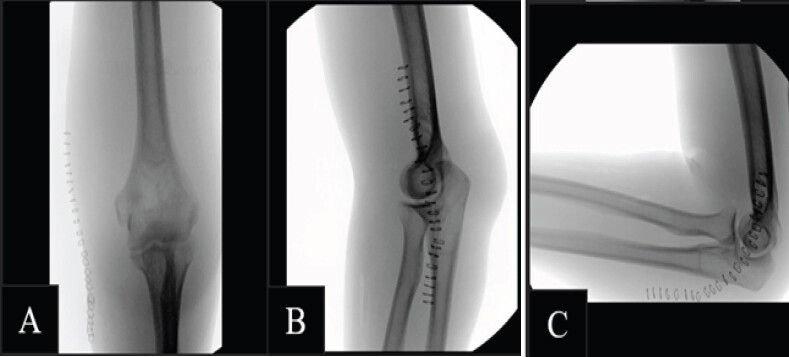
The prior sutures were removed, and the two open wounds were elliptically excised using a standard medial approach. There was avulsion of all flexor tendons from the medial epicondyle. The joint was entered, and irrigation and debridement were performed through the arthrotomy. Throughout the procedure and during prepping and draping, the elbow remained stable. After irrigation and debridement, layered closure was performed, including reapproximation of the capsule and flexor musculature. Sterile dressings were applied. Intraoperative imaging confirmed that the elbow remained reduced (Fig. 3). A hanging arm test demonstrated no subluxation, suggesting a stable injury following reduction. The arm was placed in a long arm splint. The procedure was completed without complications. The post-operative plan included non-weight-bearing, pain management, intravenous antibiotics, and overnight admission for monitoring.
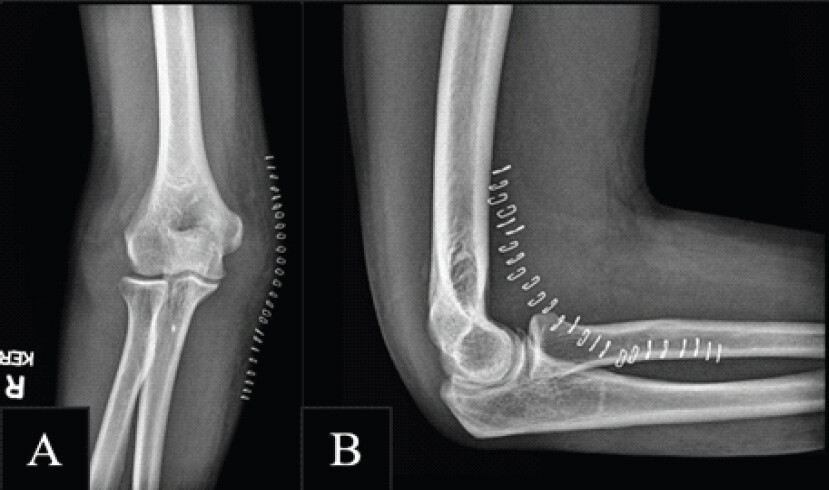
The patient received 24 h of intravenous antibiotics and was discharged home. At his 2-week follow-up visit, he was removed from the splint and began a range of motion exercises. At the 1-month post-operative visit, he demonstrated excellent range of motion and a stable elbow joint, consistent with the post-operative radiographs obtained at that time (Fig. 4). He continued non-surgical management of the elbow dislocation.
Discussion
The case presented here highlights an uncommon open elbow dislocation in a middle-aged adult following a low-energy fall during a routine activity. Although elbow dislocations are the second most common major joint dislocation in adults, open dislocations account for <2% of cases and are therefore rarely encountered in clinical practice [1]. Pediatric open dislocations are comparatively more frequent, comprising 3–6% of elbow injuries due to the vulnerability of developing capsuloligamentous structures and the higher prevalence of high-energy falls during play [2,3]. The posterolateral dislocation pattern observed in this patient typically results from axial loading through an outstretched arm with the elbow in slight flexion and valgus stress [4]. Even minor trauma can produce significant soft-tissue injury when valgus forces act on compromised or degenerative ligamentous structures [5, 6].
Initial imaging demonstrated marked displacement of the proximal radius and ulna, prompting urgent reduction under procedural sedation. Although the medial elbow laceration was irrigated and repaired, subsequent CT imaging revealed intra-articular air, raising concern for an open dislocation. The presence of gas within the joint is a critical diagnostic indicator of capsular violation and necessitates operative washout to reduce the risk of deep infection and joint compromise [7, 8].
Open elbow dislocations require prompt surgical irrigation, debridement, and layered soft-tissue repair [1,9]. In this case, operative findings revealed complete avulsion of the flexor pronator mass from the medial epicondyle, underscoring the severity of soft-tissue disruption [10,11]. Reapproximation of the joint capsule and flexor musculature restored stability, and the elbow remained reduced throughout the procedure. The patient received intravenous cefazolin and was monitored postoperatively before discharge.
Unlike complex elbow dislocations involving fractures of the radial head or coronoid process, this patient sustained an isolated soft-tissue injury. Such cases generally carry a more favorable prognosis when treated with early surgical repair and timely rehabilitation [8,12]. At 2 weeks post-injury, the patient began an active range of motion exercises to minimize stiffness, consistent with evidence supporting early mobilization to prevent post-traumatic contracture [12,13]. By 4 weeks, he demonstrated stable alignment and excellent range of motion, supporting continued non-surgical management.
Even in low-energy trauma, clinicians should maintain a high index of suspicion for open elbow dislocations when periarticular wounds are present. Subtle radiographic findings and variable clinical presentations may delay diagnosis, increasing the risk of septic arthritis, instability, or prolonged immobilization [7,8,10]. Early CT imaging, timely operative intervention, and appropriate antibiotic therapy remain essential to minimizing morbidity and optimizing functional outcomes [4,7,8].
Conclusion
Open elbow dislocations in adults are rare injuries that may occur even after low-energy mechanisms and can be easily overlooked when periarticular wounds appear benign. This case highlights the importance of maintaining a high index of suspicion for joint violation, particularly when initial imaging or wound characteristics raise concern for capsular disruption. Early CT evaluation, timely operative irrigation and debridement, and layered soft-tissue repair are essential to minimize the risks of infection, instability, and long-term stiffness. With prompt recognition and appropriate management, patients with isolated soft-tissue open dislocations can achieve excellent functional outcomes, as demonstrated in this case.
Clinical Message
Open elbow dislocations are uncommon in adults, especially after low-energy falls, and any periarticular wound should prompt evaluation for joint violation and early operative management.
Conflict of Interest:
Nil
Source of Support:
Nil
Consent:
The authors confirm that informed consent was obtained from the patient for publication of this article
How to Cite this Article
Wahhab J, Scofield SM, Turinske T. Open Posterolateral Elbow Dislocation in an Adult after Low-Energy Trauma: A Case Report Highlighting Diagnostic and Operative Considerations. Journal of Orthopaedic Case Reports 2026 October;16(10): 137-141.
References
- Singh J, Elvey MH, Hamoodi Z, Watts AC. Current perspectives on elbow dislocation and instability. Ann Joint 2021;6:10. [Google Scholar] | [PubMed]
- Hyvönen H, Korhonen L, Hannonen J, Serlo W, Sinikumpu JJ. Recent trends in children's elbow dislocation with or without a concomitant fracture. BMC Musculoskelet Disord 2019;20:294. [Google Scholar] | [PubMed]
- Lewallen L, Elliott ME, McIntosh A, Ho CA. Pediatric elbow dislocations and associated fractures. Children (Basel) 2023;10:993. [Google Scholar] | [PubMed]
- Grazette AJ, Aquilina A. The assessment and management of simple elbow dislocations. Open Orthop J 2017;11:1373-9. [Google Scholar] | [PubMed]
- Breulmann FL, Lappen S, Ehmann Y, Bischofreiter M, Lacheta L, Siebenlist S. Treatment strategies for simple elbow dislocation-a systematic review. BMC Musculoskelet Disord 2024;25:148. [Google Scholar] | [PubMed]
- Schnetzke M, Porschke F, Kneser U, Studier-Fischer S, Grützner PA, Guehring T. Functional outcomes and complications of open elbow dislocations. Obere Extrem 2018;13(3):204-210. doi:10.1007/s11678-018-0466-0. [Google Scholar] | [PubMed] | [CrossRef]
- Windt AE, Colaris JW, Den Hartog D, The B, Eygendaal D. Persistent elbow dislocation. JSES Int 2023;7:2605-11. [Google Scholar] | [PubMed]
- Lu S, Shen Y, Wang Y, Yu S, Zhong B, Wang W. Conservative and surgical management of simple elbow dislocations: SMDA-SEC consensus and guidelines. Orthop Rev 2025;17:133988. [Google Scholar] | [PubMed]
- Anderson DR, Haller JM, Anderson LA, Hailu S, Chala A, O'Driscoll SW. Surgical treatment of chronic elbow dislocation allowing for early range of motion: Operative technique and clinical results. J Orthop Trauma 2018;32:196-203. [Google Scholar] | [PubMed]
- Feger J. Flexor-Pronator Mass Injury. Australia: Radiopaedia; 2021. [Google Scholar] | [PubMed]
- Wright-Chisem J, Dines JS. Flexor pronator repairDines JS, Dines DM. Tips and Techniques in Elbow Surgery. Berlin: Springer; 2022. 343-8. [Google Scholar] | [PubMed]
- Reiter AJ, Schott HR, Castile RM, Cannon PC, Havlioglu N, Chamberlain AM. Early joint use following elbow dislocation limits range-of-motion loss and tissue pathology in posttraumatic joint contracture. J Bone Joint Surg Am 2023;105:223-30. [Google Scholar] | [PubMed]
- Catapano M, Pupic N, Multani I, Wasserstein D, Henry P. Early functional mobilization for non-operative treatment of simple elbow dislocations: A systematic review. Shoulder Elbow 2020;12:1-11. [Google Scholar] | [PubMed]
© 2026 Journal of Orthopaedic Case Reports - Published by Indian Orthopaedic Research Group
About the Authors
-

John Wahhab
-

Sebastian M. Scofield
-

Thomas Turinske
Related Articles in Journal of Orthopaedic Case Reports
 January 10, 2021 Acute Kidney Injury Secondary to Rhabdomyolysis: A Rare Complication of Low-Energy Trauma
 January 10, 2017 Teriparatide Treatment Improved Loosening of Cementless Total Knee Arthroplasty: A Case Report
 January 1, 2026 Retrograde Intramedullary Nailing Versus Locked Plating for Periprosthetic Distal Femur Fractures: A Propensity-matched Cohort from TriNetX
 November 10, 2023 Uncemented Total Hip Arthroplasty in an Adult without Osteotomy for Neglected Developmental Dysplasia of Hip