

Trust in surgeon expertise and structured counseling are stronger determinants of TKA adherence than robotic technology.
Dr. Mithin Aachi, Department of Orthopaedics, Apollo Hospitals, Secunderabad, Telangana, India. E-mail: mithin78@yahoo.com
Abstract
Introduction: Robotic-assisted total knee arthroplasty (rTKA) is increasingly promoted as a precision-enhancing advancement, although clinical studies consistently demonstrate comparable outcomes between rTKA and conventional TKA (cTKA). With rising patient interest in robotics, it remains unclear whether lack of robotic availability affects day-of-surgery cancellations (DOSCs). This study addresses an important knowledge gap by specifically evaluating perception-driven cancellations attributable to the absence of robotics, an area that has not been previously quantified in the arthroplasty literature.
Materials and Methods: A retrospective review of all scheduled primary TKAs from January 2023 to May 2025 at two tertiary centres was conducted. Reasons for DOSCs were categorised. Only same-day cancellations (occurring on the scheduled operative day after admission or final listing) were included. Complications and Knee Society Scores (KSS) were evaluated for completed cases.
Results: Of 276 scheduled TKAs (Center A = 142; Center B = 134), the overall DOSC rate was 7.6% (21/276). Only 2 cancellations (0.7%) were due to absence of robotics, both from a single centre. Other cancellations involved medical instability (3.26%), financial issues (1.08%), and patient withdrawal or no-show (2.2%). Outcomes of completed cTK As we were favourable: Persistent pain >6 months occurred in 2.0%, surgical-site infection in 1.6%, and mean KSS improved from 82 ± 7 at 6 weeks to 88 ± 6 at 6 months, with no major reoperations.
Conclusion: Perception-driven cancellations due to lack of robotic systems were rare (0.7%) in this two-centre audit but identifiable as a distinct behavioural pattern. Importantly, these cancellations were restricted to a single centre, highlighting that counselling strategies and surgeon–patient trust – not robotic availability – shape patient adherence. Overall DOSC rates and post-operative results reaffirm the strength and resilience of cTKA, which continues to deliver reliable outcomes despite increasing marketing-driven enthusiasm for robotic surgery. These findings should be interpreted in the context of the study’s limitations and do not preclude potential benefits of robotics in specific settings.
Keywords: Robotic-assisted total knee arthroplasty, conventional total knee arthroplasty, day of surgery cancellations.

The adoption of robotic-assisted total knee arthroplasty (rTKA) has expanded rapidly, fuelled by claims of enhanced surgical precision, improved alignment, and theoretically superior outcomes. Robotic platforms are increasingly featured in hospital marketing and digital health communication, shaping public perception and reinforcing the belief that robotic surgery offers inherently better results. However, multiple systematic reviews and meta-analyses consistently demonstrate that while robotic systems offer marginal radiographic advantages, they do not translate into clinically meaningful improvements in functional outcomes, patient satisfaction, complications, or implant survivorship compared with conventional TKA (cTKA) [1,2,3,4]. Furthermore, rTKA introduces logistical complexity and substantially higher costs, raising concern regarding value in routine arthroplasty practice [5,6,7]. Patient expectations have nevertheless shifted. Several studies show that many patients equate robotics with greater safety, accuracy, or longevity – even when clinical evidence does not support these assumptions [8,9,10,11]. With increasing access to online information and hospital advertisements, technology-driven decision-making is becoming more common. Day-of-surgery cancellations (DOSCs) represent a significant source of inefficiency, resource loss, and disruption of operative workflow. In orthopaedic surgery, DOSC rates of 4–10% have been reported, most often due to medical instability, administrative delays, or patient non-attendance [12,13,14,15]. However, the contribution of technology-driven expectations – particularly regarding robotic availability – to these cancellations remains poorly understood and underexplored in existing literature. In addition, variability in patient expectation profiles across institutions – potentially influenced by demographic factors, socioeconomic status, referral patterns, and urban versus semi-urban catchment populations, – may further affect cancellation behaviour, although these factors have not been systematically studied [16,17,18]. This two-centre retrospective audit was conducted to identify whether lack of robotic availability influenced DOSCs in primary TKA and to evaluate differences between centres with similar surgical expertise but variable patient expectation profiles. Based on the robust evidence supporting the reliability of cTKA and the mitigating role of surgeon experience in shaping patient confidence, we hypothesised that the absence of robotics would contribute minimally to DOSCs.
Knowledge gap:
Although rTKA has been extensively investigated with respect to implant alignment, precision and clinical outcomes, little attention has been directed toward its influence on patient behaviour and healthcare delivery. In particular, the contribution of robotic technology to DOSCs and operating room efficiency remains largely unexplored. To our knowledge, this is among the first studies to quantify robotics-driven DOSCs and evaluate their implications for elective arthroplasty workflow.
Study design:
A retrospective review of prospectively maintained arthroplasty databases from two tertiary centres was performed for surgeries scheduled between January 2023 and May 2025. Ethics approval was obtained at both institutions, with waiver of informed consent due to the retrospective design.
Inclusion criteria:
- All consecutive scheduled primary unilateral TKAs
- Surgeries performed by three senior surgeons (one at Center A, two at Center B), each with >20 years of experience in cTKA and >1000 independent procedures.
Exclusion criteria:
- Revision TKA
- Bilateral or staged procedures
- Outpatient consultations where surgery was pre-scheduled due to preference for robotics (not captured in scheduling logs).
Data collection:
For each scheduled surgery, the following variables were collected:
- Occurrence of day-of-surgery cancellation
- Reason for cancellation:
- Absence of robotics
- Medical/safety-related
- Insurance/financial issues
- Patient refusal/no-show
- Scheduling or administrative error
- Only DOSCs (defined as cancellations occurring on the scheduled operative day after admission or final surgical listing) were included in the analysis. Cancellations occurring before the day of surgery were excluded.
- The exclusion of outpatient refusals represents a potential source of selection bias, as patients declining surgery due to preference for robotic systems before scheduling were not captured.
Preoperative counselling:
Both centres followed structured preoperative counselling protocols; however, formal standardisation of counselling content and delivery was not enforced. Variability in communication style and emphasis on robotic versus conventional techniques may have influenced patient expectations and decision-making.
Statistical analysis:
The study is primarily descriptive in nature. Given the very small number of robotics-related cancellations (n = 2), statistical comparison between centres was considered underpowered and potentially misleading; therefore, no inferential statistical testing was performed for this subgroup.
- For completed cases:
- Post-operative complications (infection, persistent pain)
- Major reoperations
- Knee Society Score (KSS) at 6 weeks and 6 months.
Scheduled surgeries and cancellation rates:
A total of 276 primary TK As were scheduled: 142 at Center A and 134 at Center B. The overall DOSC rate was 7.6% (21/276).
Robotics-related cancellations:
Only 2 cancellations (0.7%) were due to refusal to proceed without robotic assistance. Both occurred at Centre A. Centre B recorded zero robotics-driven cancellations. Reasons for cancellations (Table 1) Post-operative outcomes (Completed TKAs, n = 255)
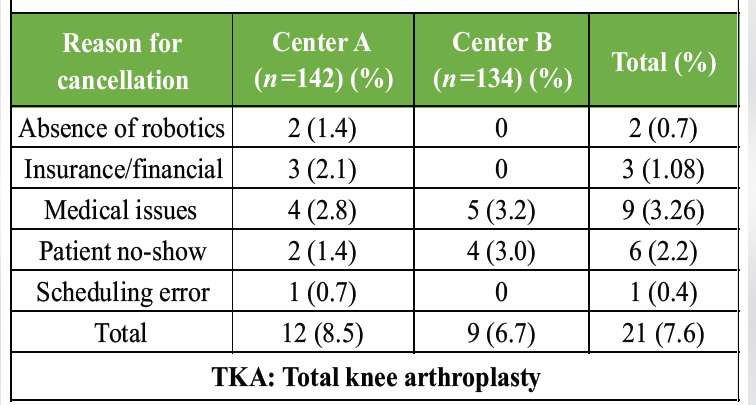
Table 1: Reason for cancellation of TKA surgery
- Persistent pain >6 months: 2.0%
- Surgical-site infection: 1.6%
- Major reoperations: 0
- Mean KSS:
-
- 6 weeks: 82 ± 7
-
- 6 months: 88 ± 6.
These outcomes are consistent with contemporary benchmarks for cTKA.
This two-centre retrospective analysis demonstrates that lack of robotic availability rarely influenced DOSCs in primary TKA. Only 0.7% of cancellations were attributable to the absence of robotics, and both occurred in a single centre. This finding suggests that institutional differences in counselling, expectation-setting, or referral patterns – not technological access – dominate patient behaviour.
Surgeon experience and trust buffer technology pressure:
The rare absence of robotics-driven cancellations underscores the importance of surgeon–patient rapport. When patients perceive the surgeon as highly competent and outcomes-focused, reliance on technology becomes secondary. This aligns with research showing that patients often defer to surgeons’ recommendations despite preconceived notions about robotics [8,9,10].
Reality versus perception: The robotics evidence gap:
Despite broad promotional claims, evidence shows that robotic assistance:
- Improves radiographic alignment but does not improve functional outcomes (1–4)
- Does not reduce complications (1–3)
- Offers uncertain cost-effectiveness due to high capital and maintenance costs (5–7).
The disconnect between marketing and clinical reality reinforces why robust counselling remains essential.
Operational and economic implications:
Even a small number of DOSCs can disrupt surgical workflow, operating room efficiency, and hospital finances. However, this audit shows that non-robotic centres are not disadvantaged by lacking robotic systems. Institutions should therefore:
- Base robotics investment decisions on clinical value, not fear of patient attrition
- Strengthen early expectation management to reduce perception-driven disruptions.
Center differences:
The presence of robotics-related cancellations in only one centre suggests that institutional factors – such as counselling approach, patient population characteristics, and referral pathways – may play a more significant role than technological availability itself.
Institutional differences highlight communication strategies:
The contrast between centres likely reflects differences in:
- How expectations are framed during initial consultations
- How marketing and local patient populations perceive robotics
- The degree to which surgeons emphasise evidence-based reassurance.
Such variation suggests that cancellation patterns may serve as indirect indicators of communication effectiveness rather than technological value.
Performance of cTKA remains strong:
The excellent clinical outcomes observed – low infection rates, minimal chronic pain, and solid KSS improvements – are consistent with literature affirming the durability and reliability of cTKA. These results highlight that robotics is not necessary to achieve high-quality outcomes.
Comparison with other specialities:
Similar patterns have been observed in other surgical specialities, such as urology and general surgery, where robotic platforms are widely adopted. In these fields, patient perception and institutional branding often drive adoption, despite variable evidence demonstrating clear clinical superiority. This parallel reinforces the notion that perception-driven expectations may not necessarily translate into measurable improvements in outcomes or workflow efficiency [19,20].
Limitations:
The study has several limitations:
- Retrospective design
- Small absolute number of robotics-related cancellations
- Exclusion of outpatient refusals before surgery scheduling may underestimate robotics preference
- Regional variability may limit generalizability
- Psychological drivers of cancellation were not formally assessed.
Future multicenter prospective studies incorporating patient questionnaires may clarify the behavioural and expectation-based factors influencing TKA acceptance.
Perception-driven cancellations due to lack of robotic systems were rare (0.7%) in this two-centre audit but identifiable as a distinct behavioural pattern. Importantly, these cancellations were restricted to a single centre, highlighting that counselling strategies and surgeon–patient trust – not robotic availability – shape patient adherence. Overall DOSC rates and post-operative results reaffirm the strength and resilience of cTKA, which continues to deliver reliable outcomes despite increasing marketing-driven enthusiasm for robotic surgery. These findings should be interpreted in the context of the study’s limitations and do not preclude potential benefits of robotics in specific settings.
Effective preoperative counselling and strong surgeon–patient trust are critical determinants of surgical adherence, and absence of robotic systems alone should not be considered a major driver of day-of-surgery cancellations in TKA.
References
- 1. Kayani B, Konan S, Huq SS, Tahmassebi J, Haddad FS. Robotic-arm assisted total knee arthroplasty: A systematic review and meta-analysis. Bone Joint J 2021;103-B:438-47. [Google Scholar] [PubMed]
- 2. Marchand RC, Sodhi N, Anis HK, Ehiorobo J, Newman JM, Taylor K, et al. One-year patient outcomes for robotic-arm-assisted versus manual total knee arthroplasty. J Knee Surg 2019;32:1063-8. [Google Scholar] [PubMed]
- 3. Han Q, Li X, Li J, Zhang G, Chen J, Lu B, et al. Robotic-assisted versus conventional total knee arthroplasty: A meta-analysis of randomized controlled trials. J Orthop Surg Res 2023;18:53. [Google Scholar] [PubMed]
- 4. Clement ND, Macpherson GJ, Burnett R. Robotic-assisted versus conventional total knee arthroplasty: A systematic review and meta-analysis of functional outcomes. EFORT Open Rev 2022;7:287-99. [Google Scholar] [PubMed]
- 5. Cool CL, Jacofsky DJ, Seeger KA, Sodhi N, Mont MA. A cost analysis of robotic-arm assisted total knee arthroplasty. J Knee Surg 2019;32:1020-7. [Google Scholar] [PubMed]
- 6. Goh GS, Liow MH, Lim WS, Tay DK, Lo NN, Yeo SJ. Robotic-assisted versus conventional total knee arthroplasty: Two-year outcomes and cost analysis. Bone Joint J 2018;100-B:495-502. [Google Scholar] [PubMed]
- 7. Moschetti WE, Konopka JF, Rubash HE, Genuario JW. Can robot-assisted total knee arthroplasty be cost-effective? A Markov decision analysis. J Arthroplasty 2016;31:759-65. [Google Scholar] [PubMed]
- 8. Clemens J, Patel NK, Bancroft LW, Mont MA, Domb BG. Patient perception and interest in robotic-assisted joint arthroplasty. J Arthroplasty 2022;37:256-62. [Google Scholar] [PubMed]
- 9. Sodhi N, Khlopas A, Piuzzi NS, Sultan AA, Chughtai M, Mont MA. Patient perceptions of robotic technology in joint arthroplasty. J Knee Surg 2019;32:1037-42. [Google Scholar] [PubMed]
- 10. Davies BM, Toms AP. Robotic total knee arthroplasty: Patient expectations and attitudes. EFORT Open Rev 2021;6:174-80. [Google Scholar] [PubMed]
- 11. Ho C, Tsakonas E, Tran K, Cimon K, Severn M, Mierzwinski-Urban M, et al. Public perceptions on robotic surgery, hospitals with robots, and surgeons that use them. J Robot Surg. 2015;9:1–7. [Google Scholar] [PubMed]
- 12. Li C, Zhang T, Wang H, Hou Z, Zhang Y, Chen W. Advanced surgical tool: Progress in clinical application of intelligent surgical robot. Smart Med. 2022;1(1). [Google Scholar] [PubMed]
- 13. Abate A, Salerno M, Schiavone C, Di Carlo L, Bove T, Marotta M, et al. Day-of-surgery cancellations in elective orthopaedic surgery: Incidence, causes, and strategies for reduction. J Orthop Surg Res 2021;16:67. [Google Scholar] [PubMed]
- 14. Kumar N, Agarwal V, Sharma A, Pandey R. Reasons for cancellation of elective orthopaedic surgery on the day of surgery: A tertiary care experience. Indian J Orthop 2019;53:491-6. [Google Scholar] [PubMed]
- 15. Al-Tarawneh M, Khreisat W, Alkhatib R, Al-Sabah A. Day-of-surgery cancellations in total joint arthroplasty: A retrospective analysis. BMC Musculoskelet Disord 2020;21:738. [Google Scholar] [PubMed]
- 16. Cloney MB, Hopkins BS, Shlobin NA, Dahdaleh NS. Disparities and patient selection bias in robotic surgery: A systematic review. Ann Transl Med 2020;8:493. [Google Scholar] [PubMed]
- 17. Goytia RN, Berend KR, Hozack WJ. Robotics and navigation in knee arthroplasty: An overview and current clinical relevance. J Bone Joint Surg Am 2022;104 Suppl 1:72-80. [Google Scholar] [PubMed]
- 18. Ponzio DY, Lonner JH. The economic and clinical implications of robotic technology in total knee arthroplasty. Orthop Clin North Am 2019;50:381-7. [Google Scholar] [PubMed]
- 19. Barbash GI, Glied SA. New technology and health care costs–the case of robot-assisted surgery. N Engl J Med 2010;363:701-4. [Google Scholar] [PubMed]
- 20. Yaxley JW, Coughlin GD, Chambers SK, Occhipinti S, Samaratunga H, Zajdlewicz L, et al. Robot-assisted laparoscopic prostatectomy versus open radical prostatectomy: Early outcomes from a randomised controlled phase 3 study. Lancet 2016;388:1057-66. [Google Scholar] [PubMed]




Related Articles in Journal of Orthopaedic Case Reports
 June 1, 2026 Comparative Analysis of Functional Outcomes in Robotic-assisted versus Conventional Total Knee Arthroplasty
 November 28, 2019 Medial Dislocation of the Long Head of the Biceps without Concomitant Subscapularis Tear: A Case Report
 July 1, 2026 Post-operative Desaturation in Prone Spine Surgery; Diagnostic Dilemma in Pneumothorax Due to Barotrauma: A Case Report
 September 1, 2026 Multifactorial Non-union After First Metatarsophalangeal Arthrodesis Revised With Structural Iliac Crest Autograft: A Case Report and Comprehensive Literature Review