


Introduction
Rheumatoid arthritis is a chronic systemic inflammatory disease that may produce progressive synovitis, cartilage loss, bone erosion, instability and deformity of the elbow. Although contemporary disease-modifying therapy has reduced the frequency of severely destructive rheumatoid elbow disease, end-stage joint destruction can still occur and may be profoundly disabling, especially when multiple upper- and lower-limb joints are affected [1,2].
Total elbow arthroplasty (TEA) was initially developed mainly for advanced inflammatory arthritis and remains one of the most effective surgical options for pain relief and restoration of a functional arc of motion in elderly or low-demand patients [3,4]. However, TEA is performed less frequently than hip or knee arthroplasty and is associated with a relatively high complication profile, including aseptic loosening, infection, instability, periprosthetic fracture, polyethylene wear, and ulnar neuropathy [5,6,7,8].
Bilateral TEA in rheumatoid arthritis is less commonly reported than unilateral replacement and raises specific issues: The patient may depend on both upper limbs for transfers and daily living activities, implant protection must be applied bilaterally, and staged surgery should be timed according to symptoms, contralateral function, and general medical condition. We present a case of staged bilateral TEA in an elderly woman with advanced rheumatoid elbow destruction and multiple previous orthopedic procedures.
Case Report
A 79-year-old female with long-standing rheumatoid arthritis was referred to the orthopedic clinic in May 2018 because of severe bilateral elbow pain, more marked on the right side. Her medical history included arterial hypertension and glaucoma. Her previous surgical history reflected widespread musculoskeletal disease and included right total hip arthroplasty in 2016, bilateral total knee arthroplasty, bilateral hallux valgus correction, cataract surgery and bilateral carpal tunnel release.
At presentation, she described progressive loss of elbow function and a gradual decline in autonomy. Her regular medications included sulfasalazine, losartan, pregabalin, prednisolone, tramadol/paracetamol, and ocular drops. Clinical examination showed painful limitation of elbow motion bilaterally, worse on the right. There were no symptoms in the ulnar nerve territory, and no distal neurovascular deficit was identified. Plain radiographs demonstrated advanced rheumatoid destruction of the elbow joint. On the right side, there was severe joint destruction with a reducible dislocation (Fig. 1).
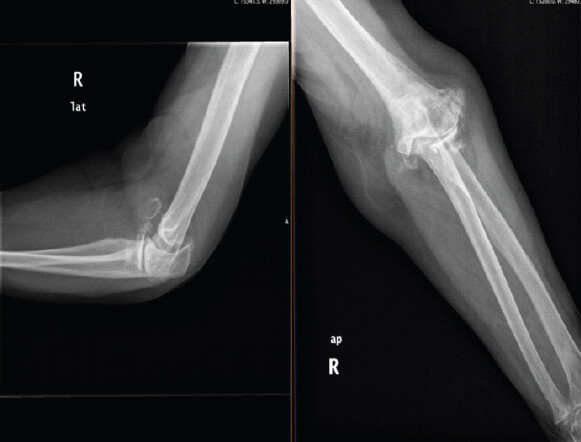
Validated functional scores were not available for inclusion in this retrospective case report. Clinically, the right elbow was the most symptomatic joint, with painful restriction of flexion-extension and forearm rotation, impairment of self-care activities, and radiographic end-stage rheumatoid destruction with reducible instability.
After an exhaustive clinical and imaging assessment, the case was discussed in a departmental meeting. Because of severe pain, structural destruction, reducible instability, and progressive functional loss, right TEA was proposed. The procedure was performed in December 2019 using a Latitude EV total elbow prosthesis (Stryker, Kalamazoo, MI, USA). The patient had an excellent clinical response, with substantial pain relief and improvement in right upper-limb function (Fig. 2).
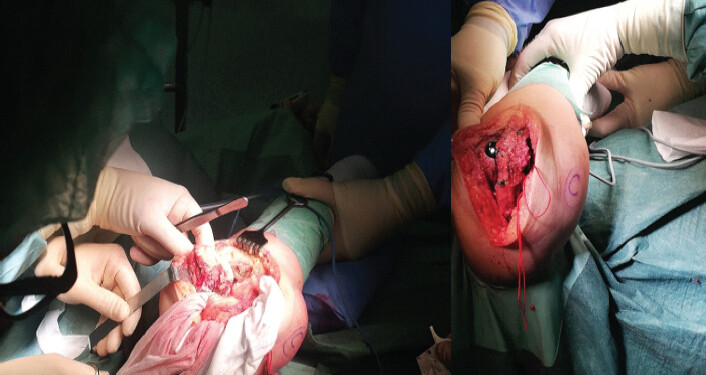
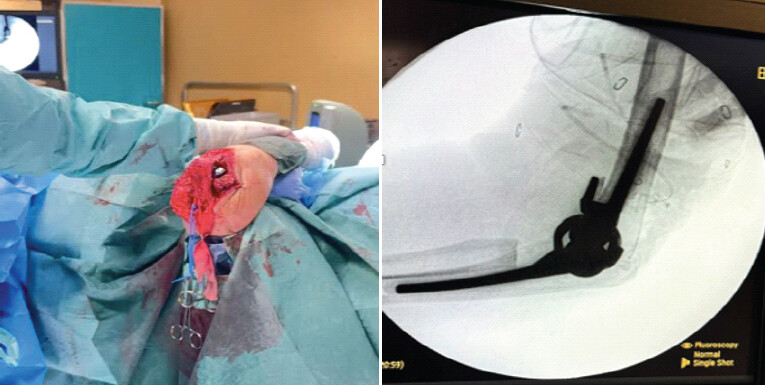
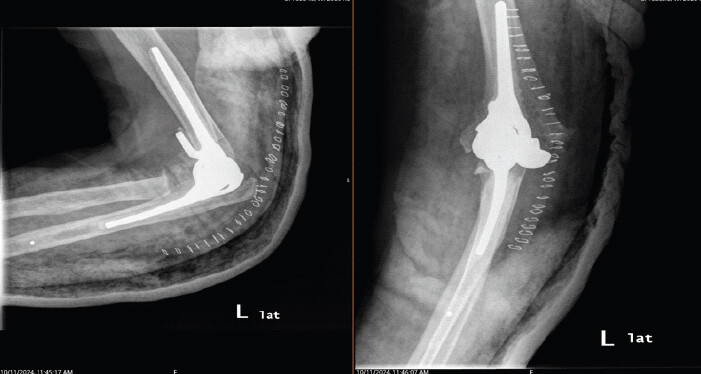
During follow-up, progressive symptomatic involvement of the contralateral elbow became the main functional limitation (Fig. 3). Given the favorable result after the right TEA and the bilateral nature of the rheumatoid disease, staged left TEA was performed in October 2024 with the same implant (Fig. 4). The immediate post-operative course and hospital stay were uneventful. Rehabilitation was followed by progressive symptomatic relief and functional improvement.
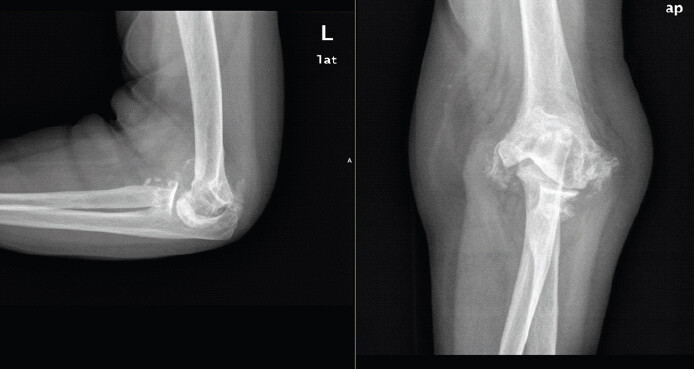
At the most recent review, the patient had a high degree of satisfaction with the treatment, good function of both upper limbs, and absence of elbow pain. The right elbow improved from a pre-operative flexion–extension range of 45°–95° to 15°–130°, with pronation/supination improving from 45°/35° to 75°/70°. The left elbow improved from 35°–100° to 20°–130°, with pronation/supination improving from 50°/45° to 75°/70°. She was able to use both upper limbs for routine activities of daily living with improved comfort compared with the pre-operative state.
Post-operative radiographs after the second-stage procedure show the implant construct in extension and flexion (Fig. 5). Formal radiographic measurements and validated functional outcome scores were not available for inclusion; therefore, outcome reporting was based on the documented clinical recovery and patient satisfaction. The patient was advised regarding standard lifelong precautions after TEA, including avoidance of heavy lifting, repetitive impact loading, and forceful weight-bearing through either upper limb.
The clinical timeline of this case, from the initial referral to the latest follow-up after staged bilateral TEA, is summarized in Table 1.
Clinical timeline
| Date/period | Clinical event |
|---|---|
| 2016 | Right total hip arthroplasty. |
| Before 2018 | Known rheumatoid arthritis; previous bilateral total knee arthroplasty, bilateral hallux valgus correction, cataract surgery, and bilateral carpal tunnel release. |
| May-18 | Orthopedic referral for severe bilateral elbow pain, worse on the right, with progressive functional loss and declining autonomy. Imaging showed advanced joint destruction and a reducible right elbow dislocation. |
| Dec-19 | Right total elbow arthroplasty performed after clinical and imaging assessment and departmental discussion. |
| Post-right TEA | Marked pain relief and functional improvement. |
| Oct-24 | Left total elbow arthroplasty performed because of progression of contralateral disease. |
| Latest follow-up | Latest documented follow-up after staged bilateral TEA: no elbow pain, good bilateral upper-limb function for routine activities of daily living and high satisfaction with the staged treatment. |
TEA: Total elbow arthroplasty
Discussion
This case illustrates the role of staged bilateral TEA in an elderly patient with advanced rheumatoid elbow destruction, major functional limitation and multiple comorbidities. In rheumatoid elbow disease, the combination of pain, instability, deformity and loss of motion may severely compromise feeding, hygiene, dressing and transfers. In such patients, the indication for surgery is not based on radiographic destruction alone but on the interaction between pain, functional autonomy, contralateral limb status, lower-limb capacity and general health.
The literature supports TEA as a reliable option for end-stage rheumatoid elbow disease. Systematic reviews have shown that inflammatory arthritis remains one of the major historical indications for TEA and that substantial improvements in pain and elbow function can be expected [4, 5, 6]. In large rheumatoid cohorts, linked semiconstrained designs have produced satisfactory long-term outcomes, with Sanchez-Sotelo et al. reporting survivorship free of revision or removal of 92% at 10 years, 83% at 15 years, and 68% at 20 years in a series of 461 primary TEAs performed for rheumatoid arthritis [9].
Nevertheless, TEA should not be presented as a low-risk procedure. Compared with hip or knee arthroplasty, TEA tolerates less mechanical loading, leaving a narrow margin between functional benefit and implant overload. Reported complications include aseptic loosening, infection, instability, polyethylene or bushing wear, periprosthetic fracture, and ulnar neuropathy [6,7,8,10]. Clinical series and reviews of semiconstrained TEA in rheumatoid arthritis have reported reliable pain relief, together with clinically relevant rates of these complications and of revision surgery [11,12,13,14]. These risks are particularly relevant in bilateral procedures because both upper limbs are involved in daily loading and because patients with rheumatoid arthritis often have concomitant shoulder, wrist, hand, hip, or knee disease.
The staged strategy used in this case was appropriate for several reasons. First, the right elbow was more symptomatic and functionally limiting at initial presentation. Second, a staged procedure allowed the patient to recover from the first operation and confirmed that elbow replacement produced meaningful clinical benefit before addressing the contralateral side. Third, staging avoided the temporary dependency that may follow simultaneous bilateral upper-limb surgery, an important consideration in elderly patients with previous hip and knee arthroplasties.
The main educational point is that bilateral rheumatoid elbow disease should be evaluated as a whole-person functional problem rather than as two isolated joints. In this patient, the first TEA restored useful function and pain control on the most symptomatic side, whereas the second TEA was justified only after progression of the contralateral disease and after the benefit of the first operation had been established. This staged, patient-centered approach is consistent with the current understanding that TEA provides substantial pain relief but requires careful counseling about activity modification and implant protection [3,7,8].
This report has limitations. Validated outcome scores, and full radiographic follow-up data were not available. However, the case remains clinically relevant because it documents successful staged bilateral TEA in a complex rheumatoid patient with multiple previous arthroplasties, high treatment satisfaction, and restoration of painless bilateral upper-limb function..
Conclusion
Staged bilateral TEA can be an effective strategy for selected elderly patients with advanced rheumatoid elbow destruction, severe pain and progressive loss of autonomy. Careful patient selection, staged decision-making, multidisciplinary assessment, realistic counseling and long-term implant-protection advice are essential, especially in patients with multiple comorbidities and bilateral upper-limb involvement.
Clinical Message
In advanced rheumatoid elbow disease, bilateral TEA may restore painless function and autonomy when performed in a staged and carefully planned manner. The decision should be driven by the patient’s global functional needs, comorbidities, contralateral limb status, and ability to comply with lifelong implant-protection measures.
Conflict of Interest:
Nil
Source of Support:
Nil
Consent
The authors confirm that informed consent was obtained from the patient for publication of this article
How to Cite this Article
Chaves RN, Neves SM, Teles A, Pinto HL, Lopes RC, Lopes AL. Staged Bilateral Total Elbow Arthroplasty in Advanced Rheumatoid Elbow Disease: A Case Report. Journal of Orthopaedic Case Reports 2026 October;16(10): 168-172.
References
- Studer A, Athwal GS. Rheumatoid arthritis of the elbow. Hand Clin 2011;27:139-50. [Google Scholar] | [PubMed]
- Sanchez-Sotelo J. Total elbow arthroplasty. Open Orthop J 2011;5:115-23. [Google Scholar] | [PubMed]
- Sanchez-Sotelo J, Ramsey ML, King GJ, Morrey BF. Elbow arthroplasty: Lessons learned from the past and directions for the future. Instr Course Lect 2011;60:157-69. [Google Scholar] | [PubMed]
- Samdanis V, Manoharan G, Jordan RW, Watts AC, Jenkins P, Kulkarni R. Indications and outcome in total elbow arthroplasty: A systematic review. Shoulder Elbow 2020;12:353-61. [Google Scholar] | [PubMed]
- Welsink CL, Lambers KT, Van Deurzen DF, Eygendaal D, Van Den Bekerom MP. Total elbow arthroplasty: A systematic review. JBJS Rev 2017;5:e4. [Google Scholar] | [PubMed]
- Chou TF, Ma HH, Wang JH, Tsai SW, Chen CF, Wu PK. Total elbow arthroplasty in patients with rheumatoid arthritis. Bone Joint J 2020;102-B:967-80. [Google Scholar] | [PubMed]
- Wang JH, Ma HH, Chou TF, Tsai SW, Chen CF, Wu PK. Outcomes following total elbow arthroplasty for rheumatoid arthritis versus post-traumatic conditions: A systematic review and meta-analysis. Bone Joint J 2019;101-B:1489-97. [Google Scholar] | [PubMed]
- Davey MS, Hurley ET, Gaafar M, Molony D, Mullett H, Pauzenberger L. Long-term outcomes of total elbow arthroplasty: A systematic review of studies at 10-year follow-up. J Shoulder Elbow Surg 2021;30:1423-30. [Google Scholar] | [PubMed]
- Sanchez-Sotelo J, Baghdadi YM, Morrey BF. Primary linked semiconstrained total elbow arthroplasty for rheumatoid arthritis: A single-institution experience with 461 elbows over three decades. J Bone Joint Surg Am 2016;98:1741-8. [Google Scholar] | [PubMed]
- Prasad N, Dent C. Outcome of total elbow replacement for rheumatoid arthritis: Single surgeon's series with Souter-Strathclyde and Coonrad-Morrey prosthesis. J Shoulder Elbow Surg 2010;19:376-83. [Google Scholar] | [PubMed]
- Gill DR, Morrey BF. The Coonrad-Morrey total elbow arthroplasty in patients who have rheumatoid arthritis. A ten to fifteen-year follow-up study. J Bone Joint Surg Am 1998;80:1327-35. [Google Scholar] | [PubMed]
- Little CP, Graham AJ, Karatzas G, Woods DA, Carr AJ. Outcomes of total elbow arthroplasty for rheumatoid arthritis: Comparative study of three implants. J Bone Joint Surg Am 2005;87:2439-48. [Google Scholar] | [PubMed]
- Lee KT, Singh S, Lai CH. Semi-constrained total elbow arthroplasty for the treatment of rheumatoid arthritis of the elbow. Singapore Med J 2005;46:718-22. [Google Scholar] | [PubMed]
- Kwak JM, Koh KH, Jeon IH. Total elbow arthroplasty: Clinical outcomes, complications, and revision surgery. Clin Orthop Surg 2019;11:369-79. [Google Scholar] | [PubMed]
© 2026 Journal of Orthopaedic Case Reports - Published by Indian Orthopaedic Research Group
About the Authors
-

Rui Nobre Chaves
-

Sara Machado Neves
-

Afonso Teles
-

Henrique Lascasas Pinto
-

Rita Coelho Lopes
-

António Lemos Lopes
Related Articles in Journal of Orthopaedic Case Reports
 December 10, 2023 Total Elbow Arthroplasty in Young Patients – An 8-Year Follow-up Case Series
 October 1, 2026 Posterior Hip Dislocation with Ipsilateral Subtrochanteric Femur Fracture: A Rare Case Report
 September 1, 2026 Iliopsoas Abscess as the Initial Manifestation of Periprosthetic Hip Joint Infection after Total Hip Arthroplasty: A Case Report and Literature Review
 September 1, 2026 Angular Improvement with Bracing Over 7 Years in Anterolateral Tibial Bowing without Neurofibromatosis Type 1: A Case Report