


Introduction
Hand injuries are among the most common musculoskeletal traumas worldwide and contribute substantially to disability, particularly among economically productive young adults. Globally, the age-standardized incidence of hand and wrist fractures was estimated at 178.9/100,000 population in 2017, with digit amputations further increasing the burden of disability. Although incidence rates have declined modestly over recent decades, the absolute number of injuries remains high, especially in developing countries [1]. Young adult males are disproportionately affected because of occupational exposure and manual labor. Common mechanisms include falls, road traffic accidents, machinery-related trauma, and domestic injuries. These injuries often result in significant impairment of grip strength, dexterity, and daily activities, leading to considerable socioeconomic consequences through loss of productivity and prolonged disability[2].
Phalangeal fractures constitute one of the most frequent upper-extremity fractures encountered in emergency practice. Large epidemiological studies have demonstrated a predominance in males with a median age of 40–45 years. Border digits, particularly the ring and little fingers, are most commonly affected because of their exposed anatomical position. Fractures involve the proximal, middle, or distal phalanges, with injury patterns varying according to the mechanism of trauma. Crush injuries, blunt trauma, and falls are the predominant causes, while intra-articular involvement occurs in nearly half of all cases, emphasizing the importance of accurate anatomical reduction. Open fractures are also common, particularly following high-energy industrial injuries [3,4].
The proximal interphalangeal (PIP) joint is one of the most functionally important joints of the hand, providing the majority of flexion required for power grip and fine motor activities. It is a hinge joint stabilized by the volar plate, collateral ligaments, and extensor mechanism. Injury to these stabilizing structures may result in chronic instability, stiffness, extensor lag, boutonniere deformity, or swan-neck deformity, all of which significantly impair hand function. Restoration of articular congruity is therefore essential to preserve long-term joint motion and prevent post-traumatic arthritis. Despite advances in surgical approaches, complete visualization of the articular surface remains challenging while preserving surrounding soft tissues, contributing to post-operative stiffness and functional limitations [5,6,7,8].
Intra-articular PIP joint fractures result from complex biomechanical forces including axial loading, hyperextension, hyperflexion, and rotational stress. Axial loading, commonly encountered during sports injuries, falls, and industrial accidents, may produce pilon fractures with comminution and central articular depression. Hyperextension injuries typically cause volar lip avulsion fractures through disruption of the volar plate and may progress to unstable fracture-dislocations when more than half of the articular surface is involved. Hyperflexion injuries generally produce dorsal lip fractures or central slip avulsions, whereas rotational forces lead to unicondylar or bicondylar fractures often associated with collateral ligament injuries. Joint stability is significantly compromised when multiple stabilizing structures are disrupted [9,10].
The study was undertaken to evaluate the functional outcomes, range of motion (ROM), and complications of Suzuki dynamic external fixation in closed intra-articular PIP joint fractures, where instability and post-operative stiffness are major concerns.
Materials and Methods
Study design
The study was designed as a prospective observational study conducted to evaluate the functional outcome of closed intra-articular fracture of PIP joint management with Suzuki frame fixation.
Study setting
The study was conducted in the department of orthopedics at a tertiary care teaching hospital.
Study duration
The study was carried out over a period of 2 years.
Study population
All patients presenting to the orthopedic outpatient department and casualty with closed intra-articular fracture of PIP joint of the hand and who met the inclusion criteria of the present study.
Sample size
The sample size was calculated using:
Where:
-
n = required sample size
-
Zα/2 = 1.96 for 95% confidence level
-
p = expected proportion
-
q = 1 – p
-
d = allowable absolute precision
-
P = 50% (0.50)
-
q = 50% (0.50)
-
d = 17.3% (0.173).
Thus, the calculated sample size was 32 patients.
Inclusion criteria
Patients with closed intra-articular fracture at PIP joint of finger presenting both in outpatient department and casualty who were managed with Suzuki frame device willing to participate in present study.
-
Age = 18–65 years
-
Both male and female
-
Both right and left
-
Acute fractures >1 week
-
Closed fractures
-
Patient with comorbidities (Controlled).
Exclusion criteria
-
Open fracture of proximal interphalangeal joint
-
Extra-articular fracture
-
Associated tendon injuries
-
Pathological fracture
-
Old fracture >3 weeks
-
Patient with prior deformity
-
Stiffness of the affected finger.
Pre-operative assessment
-
Detailed history taking including mechanism of injury
-
Clinical examination assessing swelling, deformity, stability, and neurovascular status
-
Radiographic evaluation with anteroposterior and lateral views of the affected finger.
Surgical technique
All procedures were performed under local anesthesia under strict aseptic conditions. After achieving adequate reduction under fluoroscopy guidance, the Suzuki frame was applied.
-
Two Kirchner wires were inserted transversely
-
One through the head of the proximal phalanx
-
One through the base of the middle phalanx.
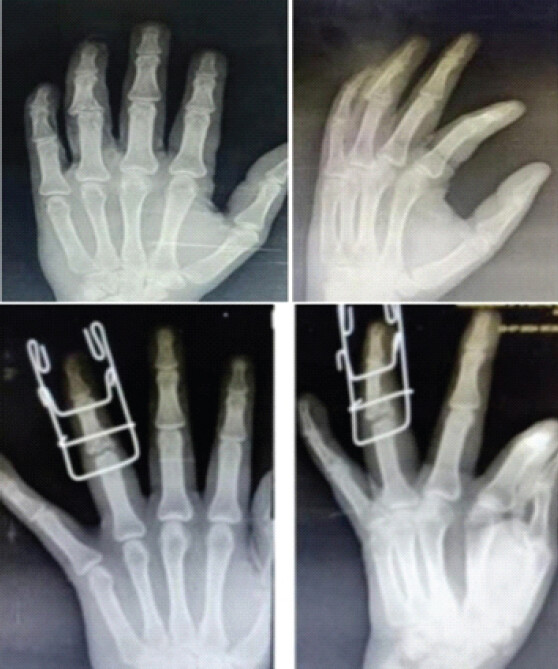
Wires were bent externally, and elastic rubber bands were applied between wires to provide dynamic traction across the PIP joint based on the principle of ligamentotaxis. Adequate distraction and concentric reduction were confirmed under fluoroscopy. Day-1 Post-operative X-rays were taken (Fig. 1).
Post-operative protocol
Active finger mobilization was limited within 24–48 h postoperatively
-
Patients were encouraged to perform supervised physiotherapy
-
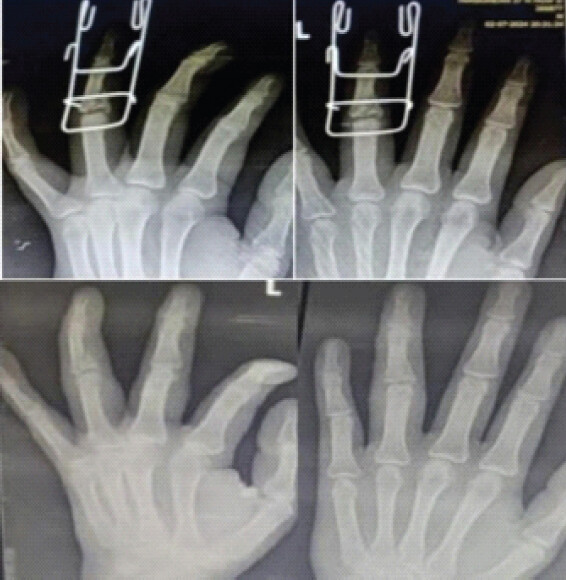
Suzuki frame maintained for approximately 4–6 weeks depending on radiological evidence of healing. Following radiological union, implants removed and patients were followed-up and serial X-rays taken (Fig. 2).
Ethical statement
Institute Ethics Committee (Human Studies), Indira Gandhi Medical College and Research Institute, Puducherry, approved the study proposal No. 626/IEC–40/IGMC and RI/PP-70/2024, entitled “Study of Functional Outcome of PIP Joint of Hand Managed by Suzuki Frame – A Longitudinal Study.” The study was submitted by Dr. C. Gokul Raj, 1st-Year Postgraduate, Department of Orthopaedics, IGMC and RI, Puducherry, and was approved at the Institute Ethics Committee meeting held on February 1st and 5th, 2024.
Statistical analysis
-
All the data were collected and entered into MS Office Excel sheet, and the data were analysed using the Statistical Package for the Social Sciences software version 18
-
Descriptive statistics were used for the following parameters such as demography, clinical variables. Categorical parameters such as age, sex, type of injure fracture, side of fracture involvement, and post-operative complications are expressed as frequency and percentage
-
Continuous variables such as mean ROM, quick disabilities of the arm, shoulder, and hand (QuickDASH) scores at 6th week, 9th week, and 12th week were performed between follow-up intervals. P < 0.05 was considered statistically significant
-
One patient was lost to follow-up was excluded from the functional outcome analysis. Therefore, statistical comparison of ROM and QuickDASH was performed on 31 patients.
Results
A total of 32 patients were included in the study. The majority belonged to the 18–30 years of age group (18 patients, 56.3%), followed by 31–40 years (7 patients, 21.9%), 41–50 years (3 patients, 9.4%), and >50 years (4 patients, 12.5%).
There was a clear male predominance, with 25 males (78.1%) and 7 females (21.9%).
The most common mechanism of injury was slip and fall, including falls from two-wheelers and stairs (14 patients, 43.8%), followed by sports-related injuries (predominantly cricket) (9 patients, 28.1%), road traffic accidents (4 patients, 12.5%), and other blunt trauma (5 patients, 15.6%). Thus, accidental falls and sports injuries were the leading causes of PIP joint fractures.
The right hand was more frequently involved (19 patients, 59.4%) than the left hand (13 patients, 40.6%), indicating a predominance of injuries affecting the dominant side.
Regarding fracture pattern, simple intra-articular fractures were observed in 21 patients (65.6%), whereas fracture-subluxations occurred in 11 patients (34.4%), making simple fractures the more common injury pattern.
All 32 patients (100%) underwent Suzuki frame fixation under local anesthesia. No patient required regional anesthesia, and no anesthesia-related complications were encountered, highlighting the minimally invasive nature and feasibility of the Suzuki frame technique as a day-care procedure.
At 6th post-operative week, the mean ROM of PIP joint was 42.5° with standard deviation of 8.3°. The minimal recorded ROM was 30°, while the maximum achieved was 50°. Most patients demonstrated moderate improvement in joint mobility at this stage. Thus reflecting early functional recovery following Suzuki frame fixation.
At the 6th post-operative week, 15 patients 48% achieved ROM of 50°. Whereas 8 patients (25%) demonstrated 40° of motion. The remaining 8 patients (25%) had a ROM of 30°. Thus, half of the study population achieved 50° of movement at 6th week. This indicated satisfactory early post-operative improvement in joint mobility.
Among the 31 patients available for follow-up, there was progressive improvement in functional outcome over time. The mean ROM was improved from42.5° ± 8.3° at the 6th week to 67.7° ± 10.4° at the 9th week, and this further increased to 110.6° ± 9.2° at the 12th week postoperatively. Similarly, the mean QuickDASH score demonstrated significant improvement, decreasing from 99 ± 0.0 at the 6th week to 39.7 ± 4.2 at the 9th week and further reducing to 14.9 ± 4.5 at the 12th week. These findings indicate substantial functional recovery and progressive restoration of joint mobility following Suzuki frame fixation.
Statistical analysis demonstrated a significant improvement in ROM over successive follow-up periods. The mean difference is ROM between 6th and 9th week was 25.2° between 9th and 12th week was 42.9° and between 6th and 12th week was 68.1°. The improvements were found to be statistically highly significant. Similarly, the QuickDASH score showed a statistically significant reduction over time. The mean decrease in QuickDASH score between 6th and 9th week was 59.3 points; between the 9th and 12th week was 24.8 points between 6th and 12th week was 84.1 points. All these comparisons demonstrated high statistical significance (P < 0.002 and <0.001). These findings confirm that Suzuki frame fixation resulted in significant and progressive functional improvement during post-operative follow-up period (Table 1 and 2).
Comparison of functional improvement over follow-up
| Comparison | Mean difference(°) | P-value |
|---|---|---|
| 6th versus 9th week | 25.2° | <0.002* |
| 9th versus 12th week | 42.9° | <0.001* |
| 6th versus 12th week | 68.1° | <0.002* |
QuickDASH score comparison
| Comparison | Mean difference | P-value |
|---|---|---|
| 6th versus 9th week | 59.3 | <0.002* |
| 9th versus 12th week | 24.8 | <0.001* |
| 6th versus 12th week | 84.1 | <0.002* |
Out of the total 32 patients included in the study, 28 patients (81.3% did not develop any post-operative complications. One patient 3.1% developed a 10° extensor lag, and one patient 3.1% developed nonunion during the follow-up period. One patient 3.1% was lost to follow-up after surgery. No other complications such as pin tract infection, overdistraction, or joint instability were observed.
Discussion
Closed intra articular fractures of PIP joint are complex injuries due to the small articular surface and delicate soft-tissue envelope. If it is not managed appropriately they can result in stiffness of joint, deformity, and long-term functional impairment. Liodaki et al. emphasized that suboptimal treatment of intra-articular PIP fracture frequently leads to persistent stiffness and reduced hand function.
In the present study, the total sample size of 32; however, only 31 completed follow-up. The majority of patients were young, and they were mostly male, with 56.1% in 17–30 years age group and 78.1% male in total predominance. This pattern is consistent with trauma-related epidemiology described by Harmon et al. who have reported that PIP injuries commonly occur following axial loading mechanisms, especially in young, active individuals.
The mean ROM of the PIP joint improved from 42.5° ± 8.3° at 6 weeks to 110.6° ± 9.2° at 12 weeks postoperatively. This improvement was statistically significant (P < 0.001), indicating progressive restoration of joint mobility following Suzuki frame fixation. Dynamic external fixation works on the principle of capsuloligamentotaxis and allows early mobilizations. Liodaki et al.,[11] described that dynamic fixation, such as the Suzuki frame, provides simultaneous traction and mobilization. Preventing peri-articular adhesions and stiffness. Similarly Suzuki et al. originally reported excellent outcomes with early motion using pins and a rubber traction system. Furthermore, long-term PIP flexion averaged nearly 85° with joint remodeling observed over time. In comparison, our study demonstrated a mean ROM of 110.6° ± 9.2°, which indicated excellent early functional recovery. This may be due to early initiation of mobilization, proper frame construction, strict follow-up protocol.
Functional outcome assessment using QuickDASH score formed a key component of the present study. The mean QuickDASH score demonstrated significant statistical significance, with a reduction from 99 ± 0.0 at 6 weeks to 39.7 ± 4.2 at 9 weeks and further 14.9 ± 4.5 at 12 weeks (P < 0.001). The progressive decline reflects substantial improvement in upper limb function, reduction in pain and restoration of hand utility over the follow-up period.
Early high QuickDASH score at 6 weeks can be attributed to post-operative stiffness soft-tissue edema, and protective splinting during the initial healing phase. However, as early mobilization was initiated and distraction maintained articular congruity, there was rapid functional improvement. Dynamic traction systems such as the Suzuki frame permit controlled early joint motion while maintaining reduction through the capsule-ligament axis. Suzuki et al. mobilization demonstrated that early mobilization under traction enhances joint modeling and functional recovery. Similarly, Harmon et al. [12] emphasized that early referral to therapy and initiation of motion are critical determinants of final functional outcome in PIP joint fractures. Delayed mobilization has been associated with persistent stiffness and poor functional scores. therefore significant reduction in QuickDASH score observed in our study supports the principle that stable dynamic fixation combined with early rehabilitation leads to superior patient-reported outcomes. Although many previous studies have primarily reported ROM as principal outcome measures, patient-reported outcome measures such as QuickDASH provide a more comprehensive evaluation of real-life functional recovery. The normal QuickDASH score at 12 week in our study indicated that most patients were able to resume daily activities with minimal difficulty [13].
According to Lee et al., Ikeda et al., Jain et al. open reduction and internal fixation (ORIF) is traditionally employed in unstable intra-articular PIP joint fractures to achieve anatomical reduction. While ORIF provides rigid fixation, it requires surgical exposure and soft tissue dissection, which may compromise blood supply and predispose post-operative stiffness [14,15,16].
According to Stern et al. reported that ORIF can achieve anatomical articular reconstruction, but extensive soft-tissue dissection around the PIP joint may lead to adhesion and limited post-operative motion. Furthermore, Liodaki et al. [11] noted that open techniques may result in residual flexion contracture and impaired function despite radiological alignment. In contrast, the Suzuki frame technique is a minimally invasive technique soft tissue sparing, and avoid direct manipulation of small intra-articular fragments. It works on the principle of ligamentotaxis, allowing indirect fracture reduction while preserving periarticular soft tissue.
Our study mean ROM was 110.6° ± 9.2° which compares favorably with outcomes reported in ORIF series, where post-operative stiffness is a recognized complication. Additionally, significant improvement in QuickDASH score supports better functional restoration without morbidity associated with open procedures. All in all, our findings suggest that closed intra-articular PIP fracture amenable to ligamenttotaxis the Suzuki frame offers comparable, if not superior, functional outcomes with reduced soft tissue morbidity compared to ORIF.
Post-operative complications remain one of the major concerns in management of PIP joint fracture due to the high risk of stiffness and deformity. In the present study, 81.3% of patients had no complications, 3.1% developed mild extensor lag (10°), 3.1% developed non-union, 3.1% were lost to follow-up, and no cases of pin tract infection or joint instability were observed.
The low complication rate in our study is encouraging; pin tract infection is a commonly reported complication in dynamic external fixation. Liodaki et al.[11] reported instances of Pin tract infection and secondary surgical procedure in some cases treated with dynamic traction devices. However, meticulous pin care and proper technique can significantly reduce this risk. Flexion contracture and extensor lag are frequently reported sequelae following PIP joint injuries; authors like Chatterjee et al.[17] reported good to excellent outcomes in 91% of cases treated with the Suzuki frame with minimal complications. Our present study is consistent with these results, as only one patient developed mild extensor lag, which did not significantly impair function. Non-union in intra-articular phalangeal fracture is uncommon but may occur due to comminution or inadequate stability. A single case of non-union in our study represents a small proportion 3.1% and did not significantly affect overall functional analysis. Importantly, no cases of overdistraction, joint subluxation, or post-traumatic instability were noted. Dynamic traction when properly balanced maintains joint congruity and prevents collapse while permitting early motion. This complication profile observed in our study reinforces the safety and reliability of the Suzuki frame technique.
The strengths of the study include its prospective longitudinal design, standardized Suzuki frame fixation technique, serial assessment at 6, 9, and 12 weeks, and evaluation of both PIP joint ROM and QuickDASH scores, along with post-operative complications. However, the study is limited by its small sample size of 32 patients, with one patient lost to follow-up, a short 12-week follow-up, absence of a control or comparison group, and single-center design, which may limit the statistical power and generalizability of the findings.
Conclusion
The present prospective longitudinal study evaluated the functional outcomes of closed intra-articular PIP joint fractures managed using Suzuki frame fixation. A total of 32 patients were enrolled, with 31 completing the 12-week follow-up. Functional outcomes were assessed using PIP joint ROM and QuickDASH scores.
Patients demonstrated significant functional improvement throughout the follow-up period. Mean PIP joint ROM increased progressively from the 6th to the 12th post-operative week, indicating effective restoration of joint mobility with Suzuki frame fixation. This improvement was statistically significant, reflecting the benefits of dynamic external fixation and early mobilization.
No major complications were encountered, likely owing to careful patient selection, meticulous surgical technique, appropriate frame construction, and adherence to post-operative rehabilitation. Overall, Suzuki frame fixation provided excellent functional recovery, significant improvement in joint mobility, and minimal complication rates. Its minimally invasive nature and ability to facilitate early motion make it an effective treatment option for unstable intra-articular PIP joint fractures.
Clinical Message
Suzuki dynamic external fixation is a safe, minimally invasive, and effective treatment for closed intra-articular PIP joint fractures. By facilitating early mobilization through ligamentotaxis, it restores joint congruity, improves ROM and functional outcomes, and minimizes post-operative stiffness and complications when combined with appropriate rehabilitation.
Conflict of Interest:
Nil
Source of Support:
Nil
Consent:
The authors confirm that informed consent was obtained from the patient for publication of this article
How to Cite this Article
Balaji S, Kaliaperumal A, Gokulraj C, Gunasekaran RK, Muralidharan R, Gogoularadja A. A Functional Outcome of Closed Intra-articular Fracture of Proximal Interphalangeal Joint of Hand Managed By Suzuki Frame – A Longitudinal Study. Journal of Orthopaedic Case Reports 2026 October;16(10): 423-430.
References
- Crowe CS, Massenburg BB, Morrison SD, Chang J, Friedrich JB, Abady GG. Global trends of hand and wrist trauma: A systematic analysis of fracture and digit amputation using the global burden of disease 2017 study. Inj Prev 2020;26:i115-24. [Google Scholar] | [PubMed]
- Trybus M, Lorkowski J, Brongel L, Hładki W. Causes and consequences of hand injuries. Am J Surg 2006;192:52-7. [Google Scholar] | [PubMed]
- Moura SP, Meulendijks MZ, Veeramani A, Szapary H, Gomez-Eslava B, Hoftiezer YA. Epidemiology and fracture patterns of traumatic phalangeal fractures. Plast Reconstr Surg Glob Open 2022;10:e4455. [Google Scholar] | [PubMed]
- Kremer L, Frank J, Lustenberger T, Marzi I, Sander AL. Epidemiology and treatment of phalangeal fractures: Conservative treatment is the predominant therapeutic concept. Eur J Trauma Emerg Surg 2022;48:567-71. [Google Scholar] | [PubMed]
- Cheah AE, Yao J. Surgical approaches to the proximal interphalangeal joint. J Hand Surg Am 2016;41:294-305. [Google Scholar] | [PubMed]
- Wei DH, Strauch RJ. Dorsal surgical approaches to the proximal interphalangeal joint: A comparative anatomic study. J Hand Surg Am 2014;39:1082-7. [Google Scholar] | [PubMed]
- Kumar R, Kumar A, Shanker A, Kumar R. Suzuki frame results in the treatment of comminuted phalanx fractures. J Orthop Dis Traumatol 2023;6:209-12. [Google Scholar] | [PubMed]
- Özdemir E, Altay N, Topsakal FE, Koçaslan M, Karabak B, Demirel E. Functional outcomes of miniplate/screw versus Suzuki frame fixation in Eaton type III middle phalanx base fractures: A case series. J Hand Surg Glob Online 2026;8:100866. [Google Scholar] | [PubMed]
- Körting O, Facca S, Diaconu M, Liverneaux P. Treatment of complex proximal interphalangeal joint fractures using a new dynamic external fixator: 15 cases. Chir Main 2009;28:153-7. [Google Scholar] | [PubMed]
- Haase SC, Chung KC. Current concepts in treatment of fracture-dislocations of the proximal interphalangeal joint. Plast Reconstr Surg 2014;134:1246-57. [Google Scholar] | [PubMed]
- Liodaki E, Xing SG, Mailaender P, Stang F. Management of difficult intra-articular fractures or fracture dislocations of the proximal interphalangeal joint. J Hand Surg Eur Vol 2015;40:16-23. [Google Scholar] | [PubMed]
- Harmon D, Spirtos M. An investigation of the acute management of closed intra-articular fractures of the proximal interphalangeal joint in Ireland. Ir J Occup Ther 2020;48:55-68. [Google Scholar] | [PubMed]
- Keramidas E, Solomos M, Page RE, Miller G. The Suzuki frame for complex intra-articular fractures of the proximal interphalangeal joint of the fingers. Ann Plast Surg 2007;58:484-8. [Google Scholar] | [PubMed]
- Lee JK, Kim YS, Lee JH, Jang GC, Han SH. Open reduction and internal fixation for dorsal fracture-dislocation of the proximal interphalangeal joint. Handchir Mikrochir Plast Chir 2020;52:18-24. [Google Scholar] | [PubMed]
- Ikeda M, Serigano K, Kobayashi Y, Saito I, Ishii T, Nakajima D. Open reduction and internal fixation of dorsal fracture-dislocation of the proximal interphalangeal joint using a plate: A series of 37 patients. J Hand Surg Asian Pac Vol 2023;28:34-44. [Google Scholar] | [PubMed]
- Jain DK, Shetty HB, Bhat RG. Outcomes of open reduction and internal fixation for dorsal fracture dislocations of the proximal interphalangeal joint presenting late. J Hand Surg Asian Pac Vol 2025;30:617-25. [Google Scholar] | [PubMed]
- Chatterjee B, Kumar D. Suzuki frame as a treatment modality for PIP joint fractures. J Evid Based Med Healthc 2020;7:87-91. [Google Scholar] | [PubMed]
© 2026 Journal of Orthopaedic Case Reports - Published by Indian Orthopaedic Research Group
About the Authors
-

S Balaji
-

Arun Kaliaperumal
-

C Gokulraj
-

Rumesh Kannan Gunasekaran
-

R Muralidharan
-

Avinash Gogoularadja
Related Articles in Journal of Orthopaedic Case Reports
 September 1, 2025 Dynamic External Fixation Using Suzuki Frame for Intra-articular Middle Phalanx Base Fracture with Dorsal Subluxation: A Case Report
 October 1, 2026 Association between Coronal Mechanical Axis Correction and Early Functional Outcomes after Primary Total Knee Arthroplasty: A Retrospective Observational Study
 October 1, 2026 Minimally Invasive J-Nail Fixation for Neer Type 2, 3, and 4 Proximal Humerus Fractures in Elderly Patients: A Prospective Clinical and Radiological Outcome Study
 October 1, 2026 A Study of Spinopelvic Relationship and its Impact on Functional Outcome of Total Hip Arthroplasty